


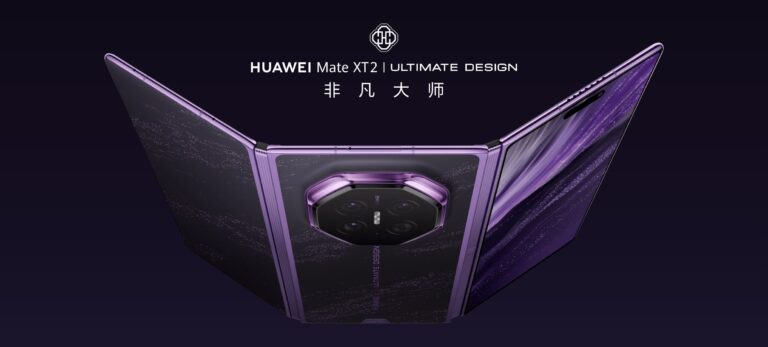
Huawei’s tri-fold Mate XT was a revelation last year; with an outward-facing hinge and a 10.2-inch panel that folds into a phone-sized 6.4 inches, it was a phenomenal showcase of foldable tech. Samsung’s Galaxy Z TriFold didn’t feel quite that special, but I’ll admit that the inward-folding hinge came with inherent benefits.
It looks like Huawei took notes, because the manufacturer switched to a similar inward-facing hinge with the Mate XT 2 Ultimate Design, which just debuted in China. As you’d imagine, this is a costly phone; the base model with 16GB of RAM and 256GB storage costs the equivalent of $2,945, and the high-end 16GB/2TB variant comes out closer to $4,500. You can buy the Pixel 11, 11 Pro XL, 11 Pro Fold, and the Pixel Watch 5 with that cash.

The Mate XT 2 has similar dimensions as its predecessor, and it retains the same 5,600mAh silicon battery. That means an ultra-thin 4.0mm silhouette when unfolded, going up to 12.3mm while folded. At 299g, it is still an absolute unit, but it gets IP58 and IP59 dust and water resistance this time. Oh, and the purple color looks absolutely gorgeous.
Latest Videos FromAndroid Central
The biggest difference is the inward-folding G hinge, which should do a better job protecting the inner panels. Interestingly, Huawei is using a privacy screen that’s similar to what Samsung did with the Galaxy S26 Ultra, where the contents on the screen will be hidden if you’re viewing it at an off-axis.

Another upgrade is the Kirin 9050 Pro, which brings a slew of tweaks to the hardware. I’ll have to get my hands on the Mate XT 2 to see what’s changed this year, but I like that it has the latest connectivity. The outer 120Hz panel now goes up to 6.5 inches, with the inner panel the same 10.2-inch 90Hz OLED as last generation.
Cameras have also received a boost, with the Mate XT 2 touting a new 50MP LOFIC main camera, 50MP tele lens with 3.5x optical zoom, and a 40MP wide-angle lens. The tri-fold runs HarmonyOS 7.0 out of the box, with Huawei modernizing the UI.
At this point, Huawei hasn’t detailed whether the Mate XT 2 Ultimate Design will launch globally, like its predecessor. With Samsung shelving the Z TriFold, it would be a win for Huawei to bring the foldable outside China, but we’ll have to wait and see if that turns out to be the case.