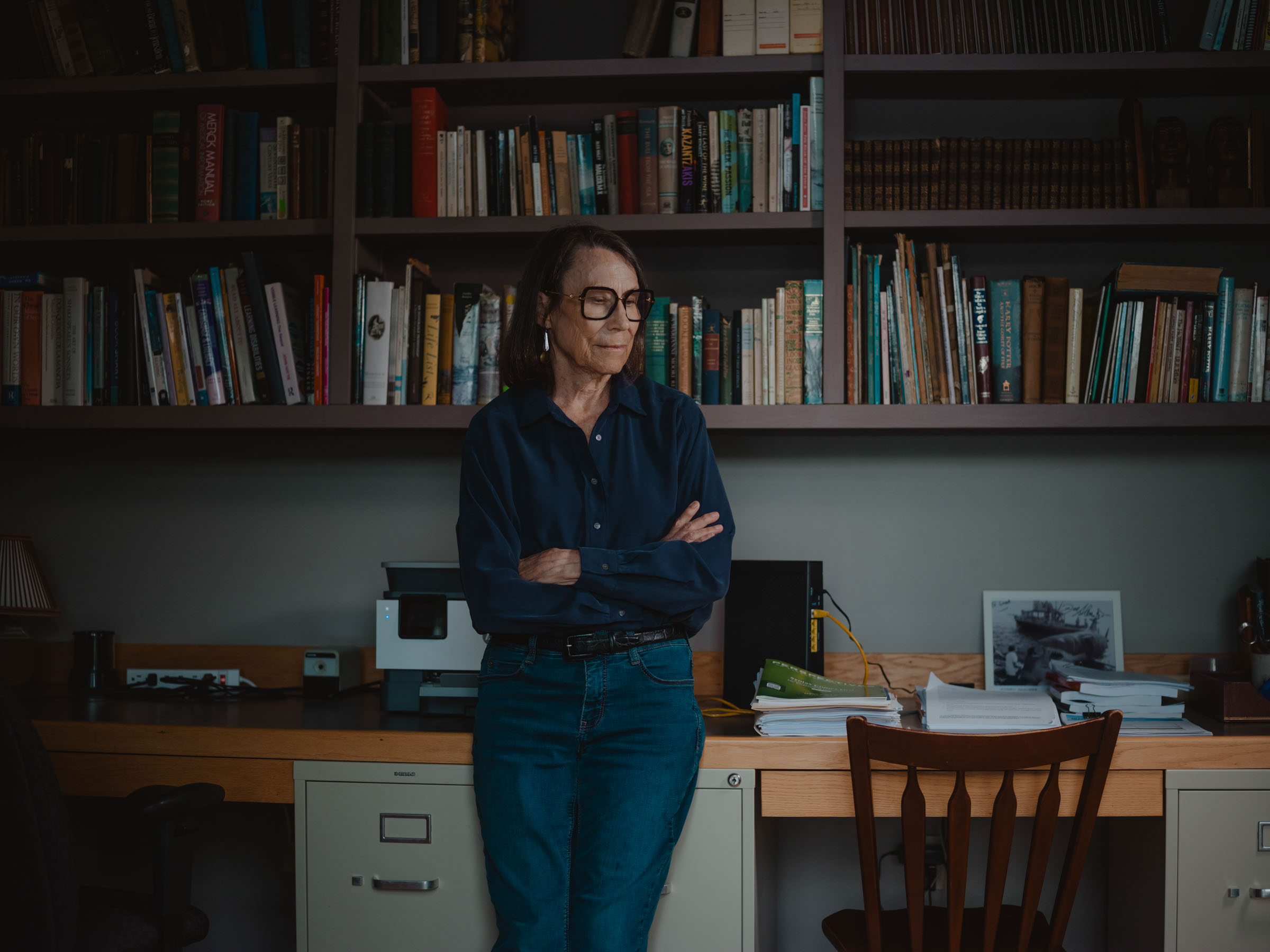
About 700,000 teachers have enrolled in the intensive reading course written by Moats, pictured outside her home in rural Vermont —John Tully for TIME
Louisa Moats was at a conference in Daphne, Ala., earlier this year when she was approached by a group of teachers. For the 81-year-old, this was a relatively new occurrence. “They’re poorly paid, they don’t look very healthy, they certainly didn’t have an elite education and I feel this concern and admiration for them as they do this job,” she says, with her characteristic frankness. “They come up to me, with this glazed, starry-eyed look, and thank me as if I, personally, was the conduit to their renewed sense of purpose and competence. I get that a lot now.”
Moats has become a late-in-life heroine, at least in some circles, because of a teacher-training program she wrote decades ago that has become a buzzy property. She is not exactly basking in the attention. “I take it with a grain of salt,” she says, sitting in her remote Vermont lake house. “Behind that is my sense that what I would want them to do is probably not exactly what’s going on in their classroom, but it’s a reasonable enough approximation that it’s making a difference for kids.”
Her skepticism can be forgiven. For a long time, Moats found herself on the losing side of America’s so-called reading wars, the back-and-forth over the best way to teach kids to read. She and her cohort of researchers promote the idea that reading is a skill that must be painstakingly taught, first through an understanding of the way sounds make up speech and get represented as letters, then through explicit instruction on how language works. But the prevailing view, until a few years ago, was that most children would figure out how to decode the letters if given enough encouragement, stimulating material, and context clues, just as they do with speech.
“This is still something I ponder all the time,” Moats says, about why schools chose to teach the way they did. One explanation she has landed on: people did not keep up with the research. “Usually they have not sat down and looked at the evidence—the nature of the evidence, the scope of the evidence, the durability of the evidence—and so they don’t understand what the science is about.”
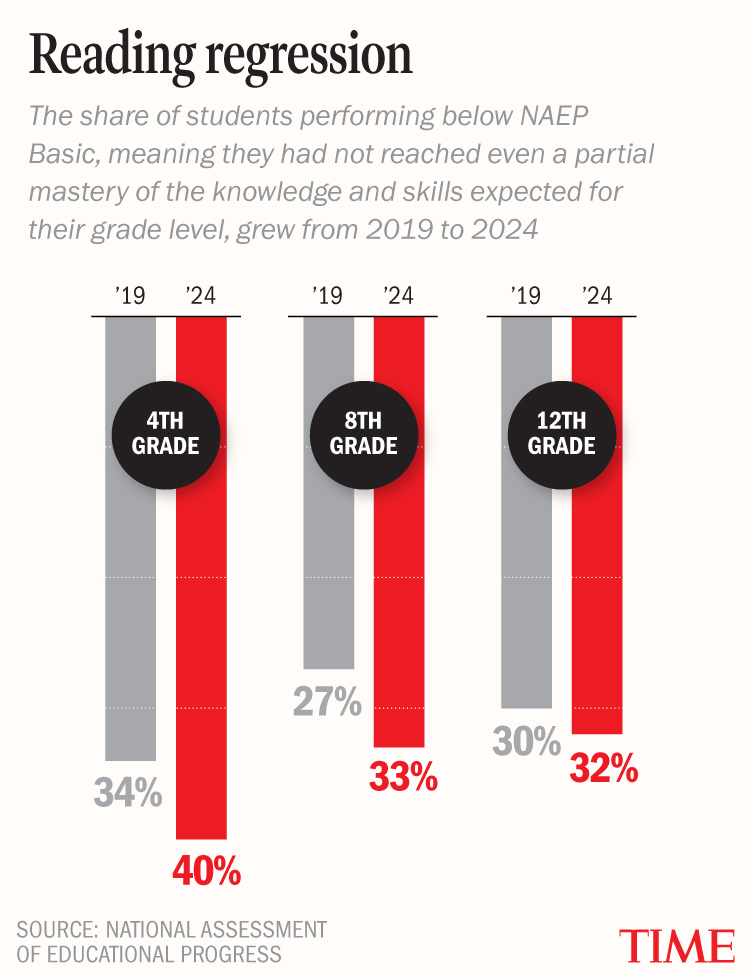
Interest in “the science” has recently increased dramatically, alongside the level of panic about literacy rates in the U.S. About 4 in 10 American children have not mastered basic reading-comprehension skills by fourth grade, the worst result in 20 years, according to the 2024 National Assessment of Educational Progress (NAEP). A third of eighth-graders also fall below the reading level expected for their age. The average 12th-grader scores three points lower on a reading test than his or her peers did in 2019, and 10 points lower than those from 1992.
Some of that can be laid at the door of school closures during the pandemic. But it’s a problem with deeper roots: roughly a quarter of young adults (16 to 24) are functionally illiterate, according to the National Center for Education Statistics. Professors bemoan having to assign ever-shorter reading assignments. Time-use surveys report that people from 20 to 34 spend no more than 10 minutes a day reading for pleasure. Grave declarations have proclaimed the “end of reading.”
To combat the decline, states have looked to the few education districts where students are showing improvement and followed their example by enacting what are known as science-of-reading laws. The laws, which have been passed in 42 states and D.C., mostly in the past seven years, mandate that schools use very structured techniques—including foundational instruction on phonics. Many teachers did not learn this approach in college and have to be retrained.
Moats’ program, Language Essentials for Teachers of Reading and Spelling (LETRS), has become the preferred way for schools to meet the requirements. The course is famously long and rigorous. Teachers must delve into language theory and cognitive science before any advice on instruction is given. It isolates 19 vowel sounds and 29 consonant sounds in U.S. English. Moats’ ideas are generally associated with phonology (how words sound), but the program goes deeply into morphology (how words are built of parts) and orthography (how words are written). It’s also relatively pricey. Public contracts and appropriations suggest statewide LETRS rollouts cost up to $1,700 per educator, before factoring in substitute teachers, planning time, coaching, and administration. And it’s not clear that all the knowledge translates into better teaching methods.
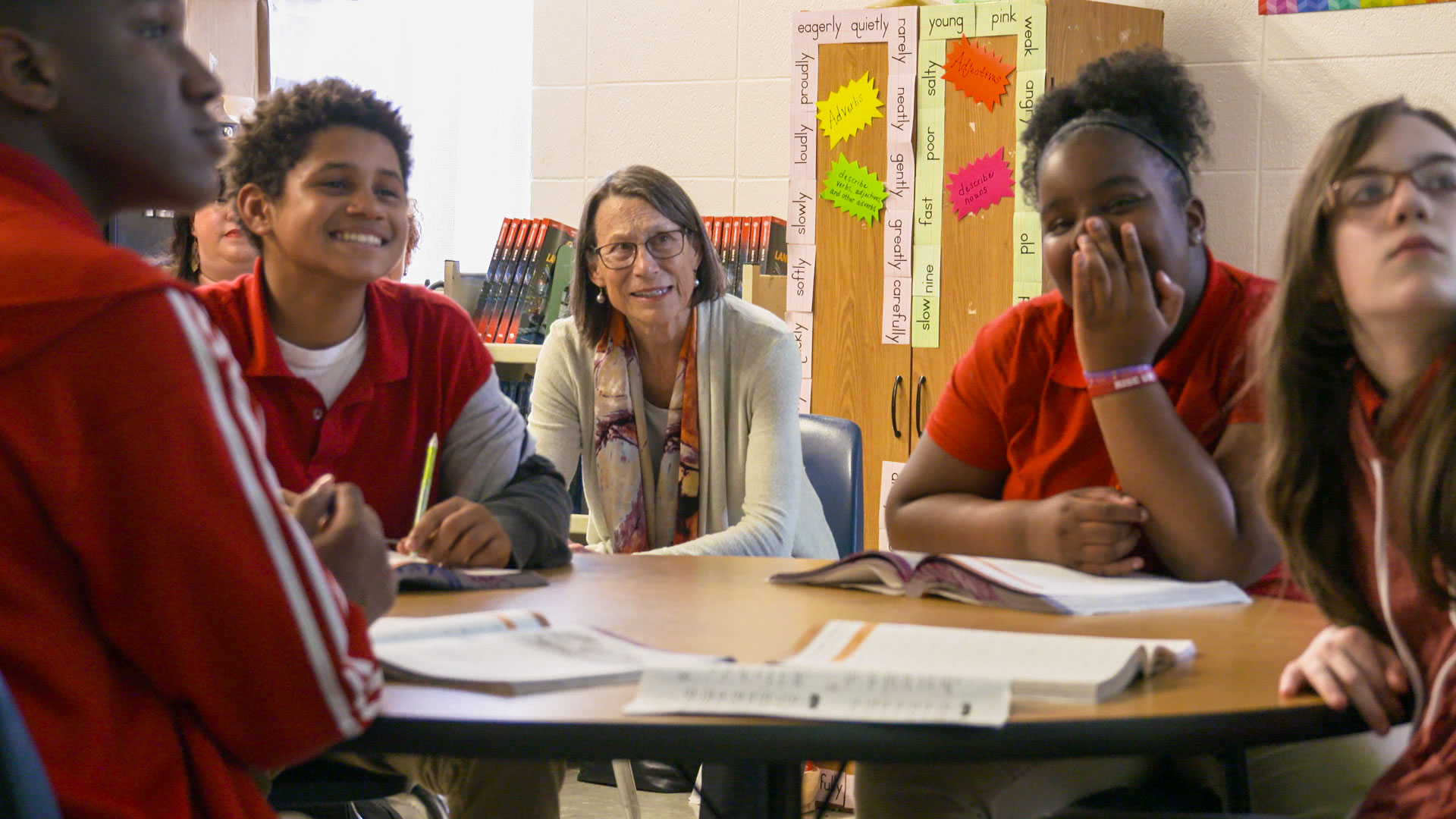
Moats in a class of middle-school students in Clayton County, Georgia, in 2018 —Courtesy Voyager Sopris Learning/Lexia Learning
But that hasn’t stopped 23 states from purchasing the program, and at least one, Alabama, from paying teachers $1,000 if they did all of it. In 2020, fewer than 25,000 teachers had enrolled in the 155-hour course, according to Lexia, the company that now owns it. In 2025, that number reached 700,000, mostly lower elementary. (There are approximately 1.5 million K-5 educators in the U.S., according to the Bureau of Labor Statistics.) Michigan, whose recent standardized test results showed 38.2% of third-graders were proficient in reading, announced this summer it was spending $75 million so that every reading teacher could do the course. (It has already spent $44 million on teachers who did it voluntarily.) “The last three years, I have seen more money from this than I ever expected to see from it,” says Moats, who earns what she calls “a small royalty” on each sale.
Still, whether out of native New England reticence or because she’s almost sure she’s seen this movie before, Moats, now allegedly retired, regards this turn of events with mild suspicion. “It’s humbling, it’s a bit bewildering, it’s a bit surrealistic,” she says. Finally, when asked directly, she adds, “and yes, it’s very gratifying.” Educators may dismiss the idea of the reading wars, claiming teaching is not an us-vs.-them endeavor, but if they are real—and it looks like they are—it sure seems that Moats has emerged as a victor.
She intended to be a folk singer. But having graduated from Wellesley College with a degree in music, Moats needed a job, and her sister got her one in Boston, with a researcher in the emerging field of neuropsychology, who needed people to type up reports. He also needed a lab technician, so he gave Moats a white coat and trained her to administer tests. “That’s how I learned to think about the kids with learning disabilities who were sent to our clinic,” she says. “I learned how to think of them through this neurological lens.”
When Vanderbilt University’s Peabody College offered one of the first fellowships for a master’s in learning disabilities, Moats jumped at the chance to move to Nashville. “I tromped up and down Music Row and got a contract as a songwriter and got a master’s degree in learning disabilities,” she says. “It was fun, and it was completely worthless as far as learning how to teach.” Armed with a balance beam, a chalkboard, and some visual aids, she was hired to “cure” learning disabilities in local schools. “The experience of the total disconnect between what I learned in a master’s program and the realities of the kids and their needs,” she says, has given her sympathy for teachers now realizing that the reading-instruction methods they learned in college might be flawed.
Even though her music career was progressing (she had a songwriting contract with Screen Gems) and her career in special education was opening doors (she had a parent-teacher meeting with Johnny Cash), Moats was not a Nashville type. She found the music industry predatory and missed the snow. (Her daughter Charlotte would later become a Junior Olympics ski champion.) She moved back to her old job at Tufts–New England Medical Center and claims she more or less fell into a doctorate at Harvard, where she encountered the terrifying but brilliant linguist Carol Chomsky, wife of Noam, and Jeanne Chall, after whom Harvard’s reading lab is named. “Chall was the one who got me into understanding how to look at spelling errors in a very detailed and informed way,” says Moats.
She began to observe that children who couldn’t read or spell just did not register the relationship between the sounds in a word and the letters. They struggled especially when the words sounded a little alike but were spelled very differently, as in juice and choose, or spelled alike but pronounced differently as in the s sound in was and saw. Moats came to believe teaching kids to read entails understanding a lot more about the brain and language processing than the average teacher knows.
In the mid-1980s, after a few years of helping struggling readers, from impoverished children to Dartmouth academics, in her private practice in East Thetford, Vt., Moats realized that earlier intervention was needed. So she began to teach teachers, at Harvard and at smaller Vermont colleges. She gave her incoming postgraduates surveys. “The results were appalling,” she says. “They didn’t know anything.” Many had been taught the whole-language theory of reading, which suggested that teaching students to decode words distracted them from understanding their meaning, and therefore students should learn the words as a unit, not by blending graphemes. She wrote an academic paper about it, which was republished by the American Federation of Teachers in 1995.
A few years earlier, another literacy researcher, G. Reid Lyon, had been put in charge of creating and overseeing a federally funded reading-research network, a large multisite program that investigated how children learn to read and why some don’t. He asked Moats to help. “What I needed was a leader and a teacher and a teacher of teachers, which she was extraordinary at,” says Lyon, also now retired in Vermont. “A lot of professors can get up there and quack away, but they don’t really have the wherewithal to demonstrate it. She did.” Moats was assigned to the Washington, D.C., site.
“Boy, did I have impostor syndrome,” she says. “Here I was in this room full of eminences, and I had been reading their work, I’d been citing them, I’d been learning from them.” She also had some hard lessons to learn as a northeastern hippie in a majority-Black school district. “I just couldn’t believe the state of affairs in these schools,” says Moats. “Libraries with no books, no doors on the lavatory, no running water in the sinks.” She labored to get the teachers to trust her. Eventually, one of her assistants took her aside. “She said, ‘You’re the director, you’ve got to look like the director,’” recalls Moats, who favors denim and heavy glasses. “I said, ‘You have any advice?’ She said, ‘Go to Ann Taylor.’” The project was a success, her nine schools’ reading rates soared, and local politicians started to drop by for photo opportunities.
Then national politicians took notice too. The No Child Left Behind Act that President George W. Bush signed in 2002 enshrined the work of Lyon’s team and the National Reading Panel. Moats was tapped to write the teacher-training component of the act’s Reading First initiative, which became LETRS.
—Lon Tweeten for TIME
Reading First was expensive—about a billion dollars was spent on a few million children—and the law mandated that a report be made of how effective it was by 2008. The news was not great. While students had been taught in a way that research had said was most effective, and first-graders did decode words better, elementary students as a whole were not better at understanding what they read than the students who were not part of the initiative. An Institute of Education Sciences (IES) report on LETRS in particular found that while the training improved teachers’ understanding of language, it did not improve outcomes for students.
Moats is still steaming about that analysis. “You don’t get an impact on student achievement after one year,” she says. “You’ve barely gotten through the professional-development material.” She also notes that after four years of Reading First, many state-level reading analyses showed improvement, especially in high-poverty regions. Nevertheless, Reading First’s funding was not renewed, and states were allowed to go their own way with reading instruction.
It is perhaps reductive to boil this history down to a battle between two women. But it is also true that around the time Moats and her colleagues were doing their work, another approach was ascendant, championed largely by a figure with a lot of the kind of main-character energy that Moats lacks. The founder of the Teachers College Reading and Writing Project (TCRWP) at Columbia University, Lucy Calkins, promulgated the idea of balanced literacy, which purported to be a détente between the phonics camp and the whole-language advocates. Calkins, whose background was in writing instruction, believed that children first of all needed enticing books at a level they could manage and a ton of cheerleading. “I always knew phonics mattered,” Calkins says now. “When kids write, every single minute of what they’re doing shows their phonics.” Nevertheless, the curriculum materials she authored had little phonics, and suggested that teachers use a separate phonics course.
“A lot of people who have a casual acquaintance with the research have persuaded themselves that balanced reading instruction means a little of this, a little of that,” Moats wrote in a seminal essay about balanced literacy in 2000. “Take a cup of phonics from one cupboard, add a half-pint of whole language from the fridge, and the resulting blend will succeed with children while avoiding the battles and conflicts of the ‘reading wars.’ Everyone will be happy, and all will be well. The problem is that it doesn’t work that way.”
This was the world that Margaret Goldberg was introduced to after she completed her master’s degree at UC Berkeley. In 2015, she arrived at a Title I Oakland school and quickly found that the methods she used in higher-performing schools just down the road did not work. After discovering Moats’ essay via Google, she started using more structured literacy methods with some of her classes and took a balanced-literacy approach with others. “I didn’t realize that I was teaching on both sides of the reading wars,” says Goldberg, who co-founded the Right to Read Project in 2019. The results were stark. “All of the ideals of balanced literacy were happening with the kids who were being taught systematically and explicitly how to decode. The students I was teaching balanced literacy to—I was just trying to sell them on reading.”
Eventually, parents, especially those with dyslexic children, who tend to need more explicit phonics instruction, began to protest. Mississippi, which gave all its K-3 teachers LETRS training starting in 2014, was the first state to improve its numbers. By 2019, its fourth-grade NAEP reading score had risen 10 points from 2013—the largest gain of any state during that period. LETRS wasn’t the sole reason for Mississippi’s success. The state also added new practices around teacher coaching and accountability, more student screening and intervention, and held back a bunch of third-graders. But the teacher training was key.
Meanwhile, public-radio journalist Emily Hanford amassed enough evidence against the balanced-literacy methodology to publish a 2018 audio documentary that would become her influential Sold a Story podcast. Politicians, administrators, and even teachers’ colleges took heed. But change, especially to higher education, came slowly. Carol Tolman, one of the co-authors of later versions of LETRS, was an early trainer in the program. At one college, she says, “there was a letter on my podium, just saying, ‘We don’t need the likes of you here. As soon as you leave, this is all going to change and go back.’ I mean, it got really heated.”
“The evidence for what works with kids has been there for more than 30 years,” says Moats —John Tully for TIME
Alabama piloted the use of LETRS in 2018, and expanded it to the whole state in 2021, by which time South Carolina and North Carolina were also jumping on board. In 2022 they were joined by Kentucky and Arkansas. In 2021 North Carolina approved almost $50 million to train its K-5 educators using LETRS. Not all of them appreciated it. “I’m all for the science of reading. I’m all for providing structured sequence materials to teachers,” says John Davis, who did the training as a third-grade teacher. But he knew a lot of the material already. And the main curriculum used in his school was not aligned with LETRS methodology. “You spent all this money and time on this training, and it’s not showing up in our reading curriculum?” says Davis. “It just seems like a waste.”
Even Calkins came around—a bit. She rereleased her curriculum materials a few times, adding more phonics emphasis, but criticism of some of the methods she recommended mounted, and after Columbia University detached itself from TCRWP in 2023, she founded her own institute. “I am all for what I’ve learned from the science of reading, and also the new relationships I’ve developed and the new organizations I belong to now,” she says. “All that’s been helpful, but it’s awful to have teachers teaching in ways they don’t believe in.”
Indeed, the prospect of yet more mandatory training brought many teachers zero joy. Lisa Anderson was one of them. She had been an elementary teacher in Minnesota for more than 20 years when she was required in 2022 to undertake LETRS. “Another hurdle, something more to jump through,” she says. “The pendulum’s swinging, we jump on, and let’s see where this one lands.”
That feeling lasted until about halfway into Volume 2. Before she’d even completed the program, she began to implement some of its methods—the school was also using a different curriculum that was more aligned with LETRS ideas—and saw surprising results. Students were starting to read, even many who were floundering. A new emotion emerged: anger. Why had she never been shown this information before? She was moved to write to her alma mater, Bemidji State, and demand a refund of the fees associated with the courses she had taken on teaching children to read. “You didn’t do your job,” she says she told them. (A spokesperson told TIME that the college continually updates its curriculum in accordance with state standards.)
While LETRS’ success has assured Moats a comfortable retirement, she is still hoping that it will pay other dividends. “I hope that maybe we’re getting beyond the reading wars,” she says, meaning that the correct way to teach reading has been established. “But I don’t feel that secure about what it is I’m trying to teach actually taking hold. I think people do the course, but they don’t realize the power of the information.”
Sitting on a chair in her dining room, not far from the guitar on another one, is a spelling sheet from a second-grade child in California that a teacher has sent through asking for help. Moats sighs deeply as she reads it. (“She sighs a lot,” says Lyon.) The child has written all the -igh words (thigh, high, fight) like -ing words (thing, hing, fing). “He’s trying to memorize letters by their appearance. He has no idea about the correspondence between speech and print,” she says. Even today, five or more years after the science-of-reading revolution began and decades after the Reading Panel, “this teacher cannot look at these writing samples and recognize poor phoneme awareness.” (Surveys suggest that even with all the legislation and training, no more than half of K-3 teachers are using science-of-reading techniques.)
LETRS is also hitting critical mass just as Moats cedes control over the quality of the training, to the consternation of some of the earlier employees. “The mission became the money,” says Leta Palmiter, a former LETRS trainer who joined the company shortly after Lexia was bought by the private-equity firm Veritas Capital in 2020. “Not the people who received the training.” A Lexia spokesperson says improving literacy “remains at the heart of everything we do.”
It’s too soon to tell—especially with the interruptions caused by the pandemic clouding the data—whether any of the states that have newly adopted LETRS have managed to improve the reading skills of their students. And even if they do, it will be difficult to tell how much LETRS is responsible. A $4 million five-year randomized study of its effect is under way, but the results will not be available until 2029. A recent analysis by the Kentucky Department of Education found that schools with higher rates of LETRS-trained teachers posted larger gains in reading proficiency than schools with lower rates, but it was an internal study. Meanwhile, NAEP reading scores ticked up a few points for 9-year-olds in 2025 (although not for 13-year-olds), and another national report showed improvement in K-8 reading skills from 2025 to 2026. “I think all this work can only help,” says David Liben, a literacy consultant and one of the authors of the 2010 Common Core standards. “I just don’t think that at this point we have the evidence that we can make a claim that we’re turning a corner now.”
Experts agree that teacher training alone is not a solution for America’s reading ills. “This idea that nobody was teaching phonics, it just is absurd,” says former director of reading for Chicago Public Schools Timothy Shanahan, whose recent book Leveled Reading, Leveled Lives takes aim at balanced literacy, but who is also not sold on its replacement. For every Mississippi, he says, there’s a state like Arkansas, where LETRS hasn’t seemed to make any difference. And the tight focus on teacher training has come at a cost to other urgent problems in education, like truancy. “Is it that the kids are getting poor instruction, or that our attendance levels are so low right now that kids just aren’t learning?” he asks.
Mistakes in education take a long time to show up, and so do fixes. By the time the students who learned how to read from LETRS-trained teachers are in the workforce, the landscape for communication may be unrecognizable. Even now, reading is not as vital to thriving as it was a mere five years ago. There are remarkable new ways to glean information and disperse it. Generative AI can write for us, and books can be read aloud by machines, so some of the disadvantages of being illiterate may be overcome by technology.
But the ability to recognize and manipulate written words will still be a critical skill, say most educators, because it is inextricably linked to thinking. Decades of research in psychology, neuroscience, linguistics, and education suggest that becoming literate changes how people reason, solve problems, organize knowledge, and deliberate on their own thinking. “The mental work that is reading,” says Moats, “is the essence of learning.”