The U.S. Men Are Beginning to Look Like the Team We Were Promised

June 20, 2026:

The U.S. Men Are Beginning to Look Like the Team We Were Promised

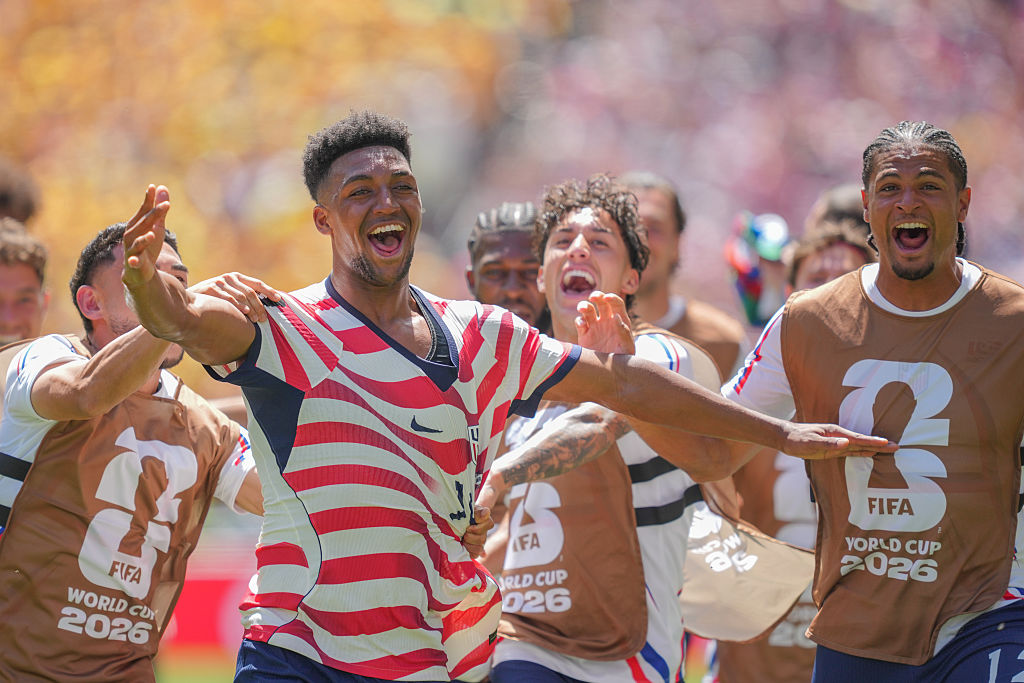
Alex Freeman, #16 of the United States, celebrates a goal during the FIFA World Cup 2026 Group D match between USA and Australia at Seattle Stadium on June 19, 2026, in Seattle. —John Todd—ISI Photos via Getty Images

Two straight soccer wins for the United States during a World Cup group stage? Neither of which were the result of some lucky bounce or referee whistle, which sometimes happens in this game? 

Believe it. 

In both of their victories thus far at the 2026 World Cup, the Americans have been, by far, the superior all-around team. And in the second triumph, a 2-0 win over a physical Australian side on Friday afternoon at Seattle Stadium, the team’s best player, Christian Pulisic, didn’t even dress. 

This was always the hope, the promise, of this so-called golden generation of American soccer players: guys like Pulisic—who missed the game with a calf injury—Weston McKennie, and Tyler Adams, all of whom honed their crafts in top European leagues. They were supposed to be primed for the 2026 World Cup on home soil and take a program long considered mediocre at the elite world level to new frontiers.

Under Argentine coach Mauricio Pochettino, imported by U.S. Soccer in 2024 to correct the team’s course in time for the sport’s monumental moment in America, the plan is clicking better than expected.

Read more: ‘Why Not Us?’: At the World Cup, America Can Start Dreaming Bigger

Which is an odd feeling, for a men’s soccer fanbase so used to disappointment. 

In all those modern-era years the U.S. reached the knockout stage—1994, the quarterfinal push in 2002, 2010, 2014, 2022—never did they win consecutive games in the group play. In fact, the last time the U.S. won two straight games in a World Cup was 1930, the inaugural event, when the U.S. reached the semis. 

Now, the American men are already through to the knockout stage, though in this expanded edition of World Cup, the team must contend with an extra layer of games: the round of 32. With Paraguay’s 1-0 over Turkey on Friday, the U.S. clinched first place in Group D. The team will play its Round of 32 game on July 1 in Santa Clara, Calif., against a third-place team from another group. Pochettino will have to determine whether to treat the U.S.’s final group stage game, on June 26 against Turkey, as a sort of scrimmage—an opportunity, perhaps, to give players who haven’t seen the field much at this World Cup some action.  

Swedish superstar Zlatan Ibrahimovic, who’s winning plaudits for his no-nonsense commentary on Fox Sports during this World Cup, played for clubs like Barcelona, AC Milan, Manchester United, and Paris Saint-Germain. He has little reason to shill for the States. Ibrahimovic said yesterday, without reservation, that this American team could go all the way.   

What’s the evidence? Start with the American crowd, which led a stirring rendition of the National Anthem in Seattle, giving the players goosebumps. Seattle Stadium, home of the NFL’s Seahawks—it’s typically called Lumen Field, except during the World Cup, due to FIFA sponsorship rules—is known as the loudest in the land. Seattle’s soccer culture is strong—66,925 people packed the stands Friday—and with the stadium just steps from downtown, near the water, the game had the true feel of a global gathering. If the USMNT wins on July 1 and reaches the Round of 16, the team would return to the Pacific Northwest, a boon to American players and supporters alike. 

As expected, Aussies brought the roughhousing. Adams, for one, spent a fair portion of the first half on the grass, writhing in pain. But the Americans tussled right back, and never totally lost their cool. “You need to play into it a little bit and understand what the game requires, and that’s what it required today,” says Adams. The Socceroos won the yellow card contest, 4-3.   

At events like the World Cup or the Olympics, stars are born. So far, Folarin Balogun, who had his choice of three national teams—the U.S., England, and Nigeria—to play for but chose Americans, has been a breakout hit. After notching two goals in the team’s 4-1 win over Paraguay on June 12, Balogun instigated the American scoring, in the 11th minute, on Friday. He dribbled fast toward the Australian goal, at a tough angle from the left side, before shoveling the ball to Ricardo Pepi, Pulisic’s replacement in the lineup, in the middle. Australia’s Cameron Burgess could only clear the ball into his own net.

Officially, it’s an own-goal. But give Balogun full credit. “I want to be dangerous,” Balogun says. “I want to create opportunities. It might not always be myself that scores. But if I can force an error that gives us the lead, then for me it’s like a goal as well.” 

Does Balogun believe he has a hat trick in this tournament? “Something like that,” he says with a laugh. 

Defender Alex Freeman’s insurance goal in the 43rd minute wasn’t just notable for the athleticism Freeman displayed on a leaping header. Or that Freeman had just suffered a head-on-head collision with Paul Okon-Engstler of Australia moments before (he was cleared to play after a concussion check, drawing criticism from some head trauma experts). Rather, it was the celebration that really stood out. Freeman was originally called offsides, but the replay booth took a look: After confirming the goal, about a dozen bench players charged after Freeman as he ran into a far corner of the field. 

Read more: ‘I’m Ready.’ U.S. Soccer’s Male Player of the Year Refuses to Miss Another World Cup

Freeman, who plays for Charlotte FC in Major League Soccer, is appearing in his first World Cup at age 21. “There’s just certain guys that in the changing room, in and around the team, are always positive,” says Adams. “Whether he’s playing, not playing, playing well, playing bad, it doesn’t matter. He’s grown so much in the past couple of years. For him to put the cherry on top in a moment like that, you see what it means to the team.” 

These Americans are quick to celebrate each other’s successes. “I’ve told these guys that this is the most fun, special, enjoyable group that I’ve been around,” says Tim Ream, the team’s 38-year-old captain who’s played every minute so far of this World Cup. “And I’ve been around a long time. That’s not to say that other groups weren’t special, that other groups weren’t fun, that guys didn’t put in everything they possibly could. But there’s something about this one that just feels different. As long as we continue to enjoy ourselves, we’re going to be in a place where we want to be.” 

The World Cup is setting viewership records. All those big New York Knicks watch parties you saw online during the team’s run to its first NBA championship in 53 years? They’re also happening all over for the USMNT. 

Something’s brewing. And Ream, for one, can feel it. He grew emotional when joining his teammates to celebrate yesterday’s win. 

I’m sure that won’t be the last time during this tournament that will happen,” he says.   

Source link