Tehran’s New Weapon Is Not a Bomb. It Is an Invoice.

August 3, 2026:

Tehran’s New Weapon Is Not a Bomb. It Is an Invoice.

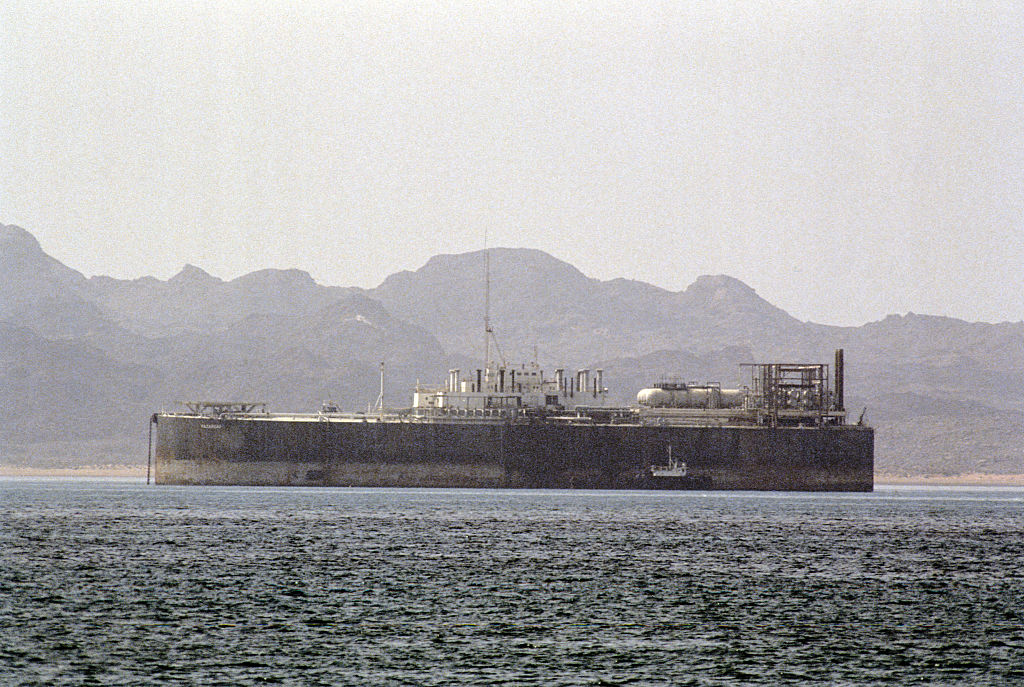
An oil tanker in the Strait of Hormuz accessing Iran’s premier maritime gateway of Bandar Abbas Port, Iran, 1988. —Barry Iverson-Getty Images

Iran is expanding the theater of war with an eye on the Strait of Hormuz. Last week, according to U.S. Central Command, more than 30 Iranian-directed drones attacked American forces and Saudi energy installations near Riyadh and the Eastern Province. On July 28, the Islamic Revolutionary Guard Corps (IRGC) spread the battle to Jordan, firing a fresh volley of ballistic missiles at U.S. forces in the country.

American and Saudi aircraft answered in Iraq, striking targets across seven provinces, where the Popular Mobilization Forces—militias funded by, and loyal to Tehran—counted 20 dead. There were strikes on targets in Iran, too, and threats of more to come. President Donald Trump, who only four days earlier had called off a 13-day bombing campaign, promised that the Islamic Republic was “going to get a beating.”

Oman’s most recent attempt to find an off-ramp that would satisfy all the belligerents collapsed. Muscat had reportedly handed Tehran a Gulf-backed plan for joint management of the Strait of Hormuz, under which Iran would not exercise sole control and any fees would be voluntary. Iran’s deputy foreign minister, Kazem Gharibabadi, rejected it. The Islamic Republic, he countered, should run one full lane through its own waters and part of the other—and Tehran would consider “any action” to keep control of the strait, including resuming the war.

And so, here we are: Iran has restarted its on-again, off-again war with the U.S. over the administrative terms of a shipping lane. The American-Saudi response, punitive in its immediate purpose, must also be understood as an effort to break Iran’s grip on the strait. This is not where we began. When the U.S. and Israel struck Iran on Feb. 28, they had a list: regime change, elimination of the nuclear program, destruction of missile capabilities, dismantling of proxy militias.

Tehran initially turned Hormuz into an instrument of defense, closing the strait to make the conflict unaffordable for everyone else. The U.S. answered with a naval blockade to make it unaffordable for Iran. Each was using the waterway to force the other to stop. Somewhere in the past five months, the instrument became the objective. In March, I argued in these pages that the strait was Iran’s real nuclear option—a weapon cheaper than a nuclear bomb and immune to American or Israeli bunker-busting munitions. That was right as far as it went. But I misjudged the ambition.

Tehran has spent the summer turning a blockade into a business. And now it is going on the offensive to protect it. Consider what a ship’s master must now do to enter the Persian Gulf. According to Windward, a According to Windward, a maritime intelligence firm, he must first communicate with the Persian Gulf Strait Authority, a regulatory body that Iran established in May. Then he must file a Vessel Information Declaration: ownership, insurers, crew manifest, cargo and intended routing. A permit follows once the paperwork is accepted and a fee is paid.

No official tariff has been published, but Lloyd’s List has reported vessels paying as much as $2 million per transit, and since mid-March, every recorded passage using the corridor controlled by the IRGC rather than the normal route. J.P. Morgan estimates that a fully operational regime could earn Tehran $70 billion to $90 billion a year.

Minefields are lifted when wars end; customs houses are not.

The Malacca model with a twist

The Omani plan deserves more credit than it has received. Contributions of the kind collected in the Strait of Malacca—where Indonesia, Malaysia, and Singapore charge ships fees for navigation assistance, environmental protection, and search-and-rescue services are entirely lawful. Article 43 of the Law of the Sea Convention encourages strait states and user states to cooperate. One Western diplomat likened the scheme to a voluntary carbon offset for airline passengers: check the box if you like.

But the Malacca fund works because Indonesia, Malaysia, and Singapore have never claimed the right to stop a ship. Nobody pays them for permission, because permission was never theirs to sell. Iran has stopped the ships, and says it will stop them again.

India, Pakistan, Thailand, and the Philippines have all since made their own arrangements with Tehran. But one of very states whose model Oman hopes to replicate has refused to do so. Asked in Parliament whether his country would negotiate passage or pay Iran a toll, Singapore’s foreign minister Vivian Balakrishnan minced no words: “It is not a license to be supplicated for. It is not a toll to be paid.”

Once a state establishes the right to charge, buying it back gets expensive. A little history lesson: Denmark charged tolls on ships entering the Baltic for more than four centuries, and it took a treaty, in 1857, and a large cash payment to stop the practice. Designed to prevent a repeat of that episode, Articles 26, 38 and 44 of the Law of the Sea Convention forbid any coastal state from charging ships merely for passing through an international strait.

Another instrument, the Montreux Convention, allows Turkey to recover costs, but not to impose a transit fee for passage through the Bosphorus, the Sea of Marmara, and the Dardanelles. The rules for canals, like the Suez canal and the Panama canal, are different because they are not natural bodies of water: somebody had to dig them.

Iran signed the Law of the Sea Convention in 1982 but never ratified it, objecting from the start to the transit-passage rule it is now defying. A state that objects consistently from the beginning is not bound by an emerging custom. Iran has been that objector for four decades, and now it proposes to collect.

On Mar. 30, Iran’s parliament passed a law to formally impose transit fees on commercial vessels passing through the Strait of Hormuz, codifying Iranian sovereignty over the strait “while also creating a source of revenue,” as Mohammadreza Rezaei Kouchi, an Iranian lawmaker, told Iranian state media. “We provide its security, and it is natural that ships and oil tankers should pay such fees.”

Except that some ships don’t pay. Malaysia’s transport minister announced in March that Iran’s ambassador had exempted Malaysian vessels “because we are a friendly party.” A charge that can be waived for friends is not a fee so much as a tribute.

What Washington signed

The International Maritime Organization saw the danger in April. A spokesperson for the UN shipping agency explained that no international agreement permits tolls for transit through straits, and a toll of ships sailing through Hormuz would set a “dangerous precedent.” Only days earlier, Trump had mused to ABC News about a joint U.S.-Iranian toll system. A charge on Hormuz, he said, would be a “beautiful thing.”

Two months later, Trump signed an initial agreement that seemed to formalize the arrangement. Paragraph 5 of the Islamabad Memorandum of Understanding, which Trump signed at Versailles on June 17 during a dinner with President Emmanuel Macron of France, has Iran undertaking to arrange safe passage for commercial vessels “with no charge, for 60 days only.” Sixty days sounds suspiciously like a trial subscription. The agreement also committed Iran to talks with Oman “to define the future administration and maritime services” in the Strait of Hormuz, in line with “the sovereign rights of coastal states” of the strait.  

The agreement conceded that the strait has an administration, and that it is a matter for the coastal states. It conceded that free passage now has an expiration date. That expiration falls around Aug. 16.  General License X, a waiver issued by Department of Treasury’s Office of Foreign Assets Control, that made the reopening commercially possible, lapses five days later. Nobody has agreed on what comes next.

But Iran’s latest missile and drone attacks must be read as a statement of intent: Tehran is ringing the bell, and the tolls are coming for us all.

Source link