HomeNews Supreme court rules against Colorado ban on ‘conversion therapy’ in decision rebuked by one justice – US politics live | US news
Supreme court rules against Colorado ban on ‘conversion therapy’ in decision rebuked by one justice – US politics live | US news
March 31, 2026:
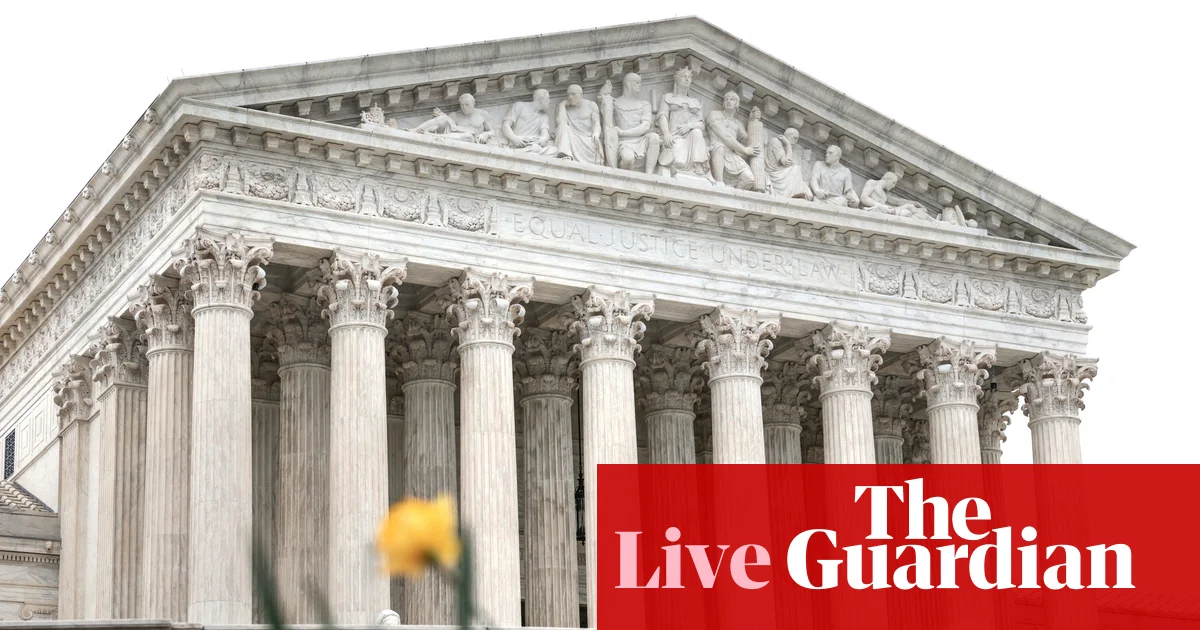
Supreme court rules against Colorado ‘conversion therapy’ ban
The supreme court did, however, issue an opinion today, ruling against the state of Colorado’s ban on “conversion therapy” – a practice that seeks to change minors’ sexual orientation or gender identity.
In an 8-1 decision, the justices reversed a lower court’s decision that had upheld the law in a case brought by psychotherapist Kaley Chiles, who argued that the ban violated her first amendment right to free speech. The law applies to licensed mental health clinicians who seek to change a patient’s gender identity or sexual orientation, discredited tactics that major medical associations have said are ineffective and harmful.
In a lone dissent, Ketanji Brown Jackson – one of the three liberal justices on the bench – issued an opinion rebuking her colleagues’ decision.
“The majority has failed to appreciate the crucial context in which Chiles’s constitutional claims have arisen. Chiles is not speaking in the ether; she is providing therapy to minors as a licensed healthcare professional,” Jackson wrote. “It cannot also be the case that Colorado’s decision to restrict a dangerous therapy modality that, incidentally, involves provider speech is presumptively unconstitutional.”
Colorado is one of more than 20 states in the US that have banned conversion practices. The ruling in favor of the Alliance Defending Freedom (ADF), a Christian legal group, now makes these laws across the country vulnerable to similar challenges.
Key events
A day ahead of blockbuster oral arguments at the supreme court, the line to get a seat has already started forming in Washington DC, according to local journalist Andrew Leyden.
Justices will hear a case challenging one of Donald Trump’s most controversial actions since he returned to the White House – an executive order preventing babies born in the United States from being granted citizenship if their parents are in the US either illegally or temporarily.
Lower courts have ruled Trump’s executive order unconstitutional in legal challenges over the last year, saying that the attempt to gut birthright citizenship violates a key clause of the fourteenth amendment, which guarantees American citizenship to “all persons born or naturalized in the United States”.
In Trump v Barbara, the challengers also argue that the administration’s efforts run afoul of the citizenship clause, codified after the Civil war, to overturn the supreme court’s Dredd Scott decision. The ruling which stated that enslaved people were not citizens of the US, and therefore were not entitled to protection from the federal government.
Last year, initial attempts to block Trump’s attack on birthright citizenship were limited by the supreme court. In a 6-3 decision the bench ruled that federal judges could not issue universal injunctions that would obstruct executive orders.
On Wednesday, the judges will hear arguments on the merits of the case. The administration argues that the president’s executive order is meant to return to the original meaning of the citizenship clause, which ensured citizenship to formerly enslaved people, instead of “the children of aliens who are temporarily present in the United States”. In a brief to the court, US solicitor general D John Sauer argues that “aliens who are just passing through the United States, and those who cross our borders illegally, lack ties of allegiance and do not obtain the ‘priceless and profound gift’ of citizenship for their children.”
Joseph Gedeon
When US federal workers were missing paychecks and the partial government shutdown entered its seventh week, Lindsey Graham, a Republican senator from South Carolina, was doing what any responsible lawmaker would do: riding Space Mountain and carrying a bubble wand at Disney World in Florida.
Naturally, TMZ had photos of the vacationing senator on its homepage a few days later.
The celebrity tabloid empire – better known for staking out actors and artists outside restaurants, gas stations, courthouses and their palatial estates – has turned its paparazzi prowess on a new and maybe equally chaotic subject: the US Congress. And America’s lawmakers may find themselves uniquely ill-equipped for the Hollywood experience.
The outlet last week put out a public call for tips on lawmaker sightings as the partial government shutdown dragged on, leaving thousands of Department of Homeland Security employees without pay.
Graham’s Disney World excursion earned him the headline: “Living in Fantasyland as Government Shutdown Drags On.” Senate majority leader John Thune, Senate majority whip John Barrasso and senator Ted Cruz also appeared in the outlet’s dispatches, with Cruz sitting as the lead story on the site.
But TMZ doesn’t play sides: it highlighted how Seth Magaziner, a Democratic congressman of Rhode Island, is headed to a Real Housewives watch party this week during the shutdown. The outlet also photographed Robert Garcia, a Democratic California representative, at a Las Vegas casino, which he addressed on X: “Actually I don’t mind what TMZ is doing here,” Garcia wrote, noting he had been visiting his father, and blamed Mike Johnson, the US House speaker, for sending everyone home in the first place.
Read the full report here:
Reuters now has more on that ruling, which came in a class-action lawsuit filed in August by three people from Venezuela, Cuba and Haiti and the advocacy group Venezuelan Association of Massachusetts. They argued the Trump administration’s action constituted an abrupt, unlawful move to strip immigrants of their parole status and work authorization.
Per my last post, such immigrants had been generally granted two-year terms of humanitarian parole after using the Biden-era app CBP One to schedule an appointment to cross the US-Mexico border. Biden’s homeland security department had begun requiring many asylum seekers to use the app in an effort to alleviate chaos at the border.
Donald Trump, shortly after returning to the White House in January 2025, moved to shut down use of the app, as his administration began to implement his hardline immigration and mass deportation agenda.
In April 2025, many non-citizens who received parole through the CBP One process got an email from DHS saying it was exercising its discretion to terminate their parole. The email said:
Do not attempt to remain in the United States_the federal government will find you. Please depart the United States immediately.
Trump administration unlawfully terminated status of migrants using Biden-era app, US judge rules
A federal judge has ordered Donald Trump administration to reverse the revocation of the legal status of thousands of migrants who had been allowed to temporarily live in the United States by using an appointment app utilized by his predecessor Joe Biden’s administration.
US district judge Allison Burroughs in Boston ruled that the US Department of Homeland Securityacted unlawfully when it sent mass emails in April 2025 notifying up to 900,000 people who had entered the country using the CBP One mobile app that it was “time for you to leave the United States”.
The app – a cornerstone of the Biden administration’s strategy to create and expand legal pathways to enter the country in an attempt to discourage illegal border crossings – allowed people to make appointments to request legal entry to the US.
Since January 2023, more than 900,000 people were allowed in the US after using the app to schedule appointments with immigration officials and apply for asylum. They were generally allowed to remain in the US for two years with authorization to work under a presidential authority called parole while awaiting their cases to be heard.
The sudden shutdown left thousands of people with scheduled appointments left in limbo at the border, while the DHS sent emails to those already living in the US temporarily urging them to “abandon the US” and “self-deport”.
The White House has added a 5pm ET executive order signing to the Donald Trump’s official schedule today. This will be open to the press, and we’ll bring you the latest lines.
We’ll be keeping an ear out for the any comments about the war on Iran, the ongoing partial shutdown of the Department of Homeland Security (DHS) and the scheduled arguments at the supreme court in the case challenging the president’s executive order that seeks to end birthright citizenship.
On Truth Social, Trump posted a nearly two-minute video rendering of his proposed presidential library in Miami.
Set to dramatic music, the mock-up showed an enormous mirrored skyscraper emblazoned with his name and the American flag. The video uses AI to show guests mingling in the entrance of the library, with golden escalators, a replica of what appears to be Air Force One, and reconstructions of Trump’s prized ballroom – that remains under construction.
There’s also a replica of the Oval Office, rooftop gardens and a large gold statue of Trump.
A credit says the design comes from Bermello Ajamil, a Miami-based firm. Trump posted the video with no explanation beyond a link to a new website for the library. The website says, “coming soon”, with a link to donate money.
On Monday, Florida governor Ron DeSantis signed a bill directing the Palm Beach international airport to be renamed to the President Donald J Trump international airport.
Trump’s family business filed a trademark application for the airport name in February. If approved, the name change would take effect on 1 July. Before the airport’s name can be changed, a formal request must be submitted to the Federal Aviation Administration, which then must process the change in various flight charting and navigation databases, and the airport signs must be changed.
Supreme court rules against Colorado ‘conversion therapy’ ban
The supreme court did, however, issue an opinion today, ruling against the state of Colorado’s ban on “conversion therapy” – a practice that seeks to change minors’ sexual orientation or gender identity.
In an 8-1 decision, the justices reversed a lower court’s decision that had upheld the law in a case brought by psychotherapist Kaley Chiles, who argued that the ban violated her first amendment right to free speech. The law applies to licensed mental health clinicians who seek to change a patient’s gender identity or sexual orientation, discredited tactics that major medical associations have said are ineffective and harmful.
In a lone dissent, Ketanji Brown Jackson – one of the three liberal justices on the bench – issued an opinion rebuking her colleagues’ decision.
“The majority has failed to appreciate the crucial context in which Chiles’s constitutional claims have arisen. Chiles is not speaking in the ether; she is providing therapy to minors as a licensed healthcare professional,” Jackson wrote. “It cannot also be the case that Colorado’s decision to restrict a dangerous therapy modality that, incidentally, involves provider speech is presumptively unconstitutional.”
Colorado is one of more than 20 states in the US that have banned conversion practices. The ruling in favor of the Alliance Defending Freedom (ADF), a Christian legal group, now makes these laws across the country vulnerable to similar challenges.
A reminder, we were watching for opinions in three highly anticipated cases today.
Louisiana v Callais: A high-stakes voting rights case in which the court’s conservative majority appears poised to gut one of the most powerful provisions of the Voting Rights Act.
Trump v Cook: Donald Trump’s case for firing Federal Reserve governor Lisa Cook, as he continues to exert greater control over the US central bank.
Trump v Slaughter: A case which examines the legality of Trump’s firing of a Federal Trade Commission (FTC) member, Rebecca Slaughter.
None of these opinions were issued, so we’ll make sure to bring you the latest when the court sets its next decision day.
Supreme court set to issue decisions
It’s another decision day at the supreme court, and we’re watching for rulings in key cases we’ve covered throughout this term.
The court has brought out one box of decisions, which typically means one or two opinions.
Trump confirms King Charles visit to the US
Donald Trump confirmed that King Charles and Queen Camilla, will travel to the US for a state visit from 27 to 30 April.
The president said that the trip will include a banquet dinner at the White House on 28 April. “I look forward to spending time with the King, whom I greatly respect. It will be TERRIFIC!,” Trump wrote on Truth Social.
This will be Charles’s first state visit to the US since taking the throne in 2022.
He is also expected to make an address to Congress and attend events marking the 250th anniversary of US independence.
King Charles III and Queen Camilla with Donald Trump and his wife, first lady Melania Trump, at Windsor Castle, Berkshire, 18 September 2025. Photograph: Aaron Chown/PA
A reminder that Democratic congressman Ro Khannarequested a meeting with King Charles during his upcoming visit to the US. Khanna said he’d like to bring survivors of the late sex offender Jefferey Epstein to the meeting. This comes after Charles’s brother – Andrew Mountbatten-Windsor – was arrested in February on suspicion of misconduct in public office relating to his ties to Epstein. Peter Mandelson, a former UK ambassador to the US, was also arrested in February on similar allegations.
Donald Trump is in Washington today. Per the official White House schedule, we’re not expected to see the president until 7.30pm ET when he heads to the Kennedy Center to watch the opening night of “Chicago” with first lady Melania Trump.
We’ll keep an eye out for latest lines upon his arrival.
Hegseth repeated the president’s frustrations with European nations for their reluctance to assist in the reopening of the strait of Hormuz.
Earlier, we reported that Donald Trump chided countries like the UK to learn “how to fight for yourself” because the US “won’t be there to help you anymore”.
At his Pentagon press conference today, the defense secretary said there are countries around the world “who ought be prepared to step up on this critical waterway as well”.
Hegseth reiterated the administration’s frustration with allies. “Last time I checked, there was supposed to be a big, bad Royal Navy that could be prepared to do things like that as well.” hesaid. “So the world ought pay attention and be prepared to stand up. President Trump has been willing to do the heavy lifting on behalf of the free world to address this threat of Iran. It’s not just our problem set going forward.”
Hegseth: next days in Iran war will be ‘decisive’
Tom Ambrose
The next days of the Iran war will be “decisive,” Pentagon chief Hegseth says.
“The upcoming days will be decisive. Iran knows that, and there’s almost nothing they can militarily do about it,” Hegseth tells the news conference, his first in nearly two weeks.
He adds:
We have more and more options, and they have less… in only one month we set the terms, the upcoming days will be decisive.
Iran knows that, and there’s almost nothing they can militarily do about it.
Tom Ambrose
Hegseth starts the press conference by saying he visited the Middle East on Saturday and spoke with US troops.
He claims morale is high and there is an appetite among the military personnel to “finish the mission” and that they want bigger bombs and weapons to attack Iranwith.
He says:
These troops want to finish this fight for their kids and their grandkids.
This is about history, this is about legacy.
The defence secretary says that while previous presidents were “all talk”, Trump is “all action”.
Follow along with the latest here:
Defense secretary Pete Hegseth and joint chiefs of staff Dan Caine are due to give an update on the military campaign in Iran on the hour.
It comes as Donald Trump described Iran as having been “decimated” by the US-Israeli war.
We will have all the latest news lines from that over on the Middle East crisis live blog:
Donald Trump tells allies, including the UK, to go to the strait of Hormuz and ‘just take’ fuel
Donald Trump has urged other countries to buy oil from the US and go to the strait of Hormuz to take the fuel for themselves.
He also warned allies, including the United Kingdom, to learn “how to fight for yourself” because the US “won’t be there to help you anymore’.
Writing on Truth Social, he said:
All of those countries that can’t get jet fuel because of the Strait of Hormuz, like the United Kingdom, which refused to get involved in the decapitation of Iran, I have a suggestion for you: Number 1, buy from the U.S., we have plenty, and Number 2, build up some delayed courage, go to the Strait, and just TAKE IT.
You’ll have to start learning how to fight for yourself, the U.S.A. won’t be there to help you anymore, just like you weren’t there for us. Iran has been, essentially, decimated. The hard part is done. Go get your own oil! President DJT
A federal panel will meet today to consider exempting oil and gas drillers operating in the Gulf of Mexico from a decades-old law meant to protect endangered species including whales, birds and sea turtles.
The meeting of the Endangered Species Committee for the first time in more than 30 years is the latest effort by US president Donald Trump’s administration to unwind regulations it says hold back domestic energy production.
The committee, nicknamed the ‘God Squad’ because it has the power to grant exemptions to the Endangered Species Act, has convened only a handful of times since its creation in 1978. In an executive order last year, Trump ordered the committee to meet at least quarterly.
The meeting, called by interior secretary Doug Burgum, will be broadcast online starting at 9:30am local time.
Average US fuel prices have crossed $4 per gallon for the first time in four years, piling pressure on drivers as Donald Trump’s war on Iran continues to boost oil markets.
The nationwide average climbed to almost $4.02 on Tuesday, according to AAA data, capping an extraordinary rise from $2.98 just a month ago. It has not been this high since August 2022.
On the west coast, many drivers filling up cars and trucks are grappling with prices far higher than the US average. In California, the average is $5.89per gallon; in Washington state, the average is $5.35.
Prices at the pump have historically proven costly for political incumbents in the White House. Trump faces his the biggest electoral test of his second term later this year, with Republican control of Congress in the balance ahead of November’s mid-term elections.
Oil prices have surged since the US and Israel launched their war on Iran, with Brent, the global benchmark, hitting $115.48 per barrel.
Congestion at airport security eases as TSA workers receive backpay but shutdown drags on
Hello and welcome to the US politics live blog.
Security lines have eased at airports, clearing the worst of the bottlenecks as Transportation Safety Administration (TSA) officers began receiving backpay for working during the government shutdown.
Lines that at times stretched to four hours at Houston’s George Bush Intercontinental Airport shrank to waits of 10 minutes or less on Monday.
In other previous trouble spots such as Atlanta and Baltimore-Washington International Airport, travelers were moving smoothly to their flights.
Weary travelers hope the overdue paychecks will end the seemingly endless security lines and missed flights many experienced, AP reported.
It remains unknown how long federal immigration officers will maintain a visible presence in airport terminals as the busy spring break travel season continues.
TSA workers told union leadership Monday that they received some, but not all, of their back pay, according to Johnny Jones, secretary-treasurer of the TSA chapter of the American Federation of Government Employees.
He said the rest is expected by next week. Some employees also reported incorrect backpay amounts, including missing overtime, the union said.
“None of my colleagues feel like they’ve been made whole,” Jones said. “Their finances are destroyed.”
President Donald Trump on Friday ordered the Department of Homeland Security to pay TSA officers immediately to ease the lines plaguing airports.
Trump had rejected bipartisan efforts to fund the TSA while negotiations over ICE continue with Democrats, who have refused to approve more funding without restraints on Trump’s immigration enforcement and mass deportation operations.
Trump’s order left other DHS employees unpaid.
In other developments:
Allegations swirl that a broker for Pete Hegseth inquired into an investment in key defense companies before the Iran war began. The Morgan Stanley broker allegedly made an inquiry with BlackRock regarding an investment into a defense-focused equity fund. The Pentagon denied the allegations calling them “entirely false and fabricated”.
Florida Governor Ron DeSantis signed a bill to rename the Palm Beach International Airport after Donald Trump. This would make the airport the latest in a long list of institutions, government programs, buildings and even money named after the president.
The US government has directed all of its embassies and consulates to launch coordinated campaigns against foreign propaganda. Marco Rubio signed a cable on Monday directing the embassies to coordinate with the US military’s psychological operations unit to address disinformation. It suggested using Elon Musk’s social media platform X to carry out the campaign.
José Guadalupe Ramos, a Mexican national, becomes the 14th known person to die in Immigration and Customs Enforcement custody since the beginning of the year. He was found unconscious in his bunk last week at the Adelanto detention center in California and pronounced dead after being taken to a nearby medical center.
The army is investigating a helicopter fly-by at Kid Rock’s hillside swimming pool in Tennessee on Saturday. Two army choppers on a training run visited and hovered by the rocker’s house as he saluted them. According to the army, there was no official request for the fly-by, which triggered the administrative review.