Scientists Discover a Planet With the Most Earth-like Conditions Yet

July 16, 2026:

Scientists Discover a Planet With the Most Earth-like Conditions Yet

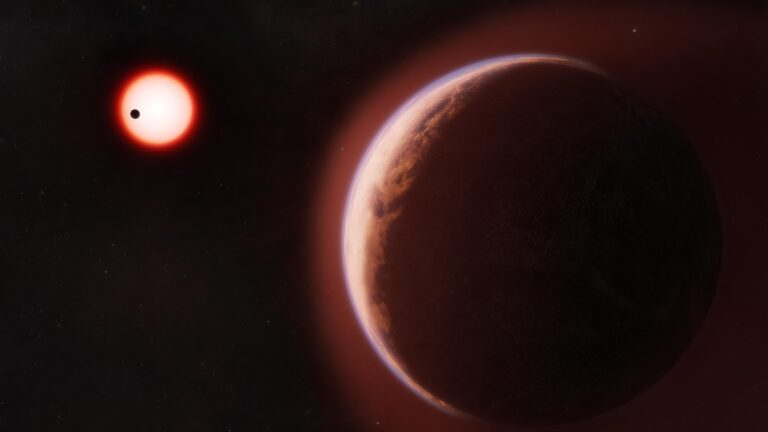
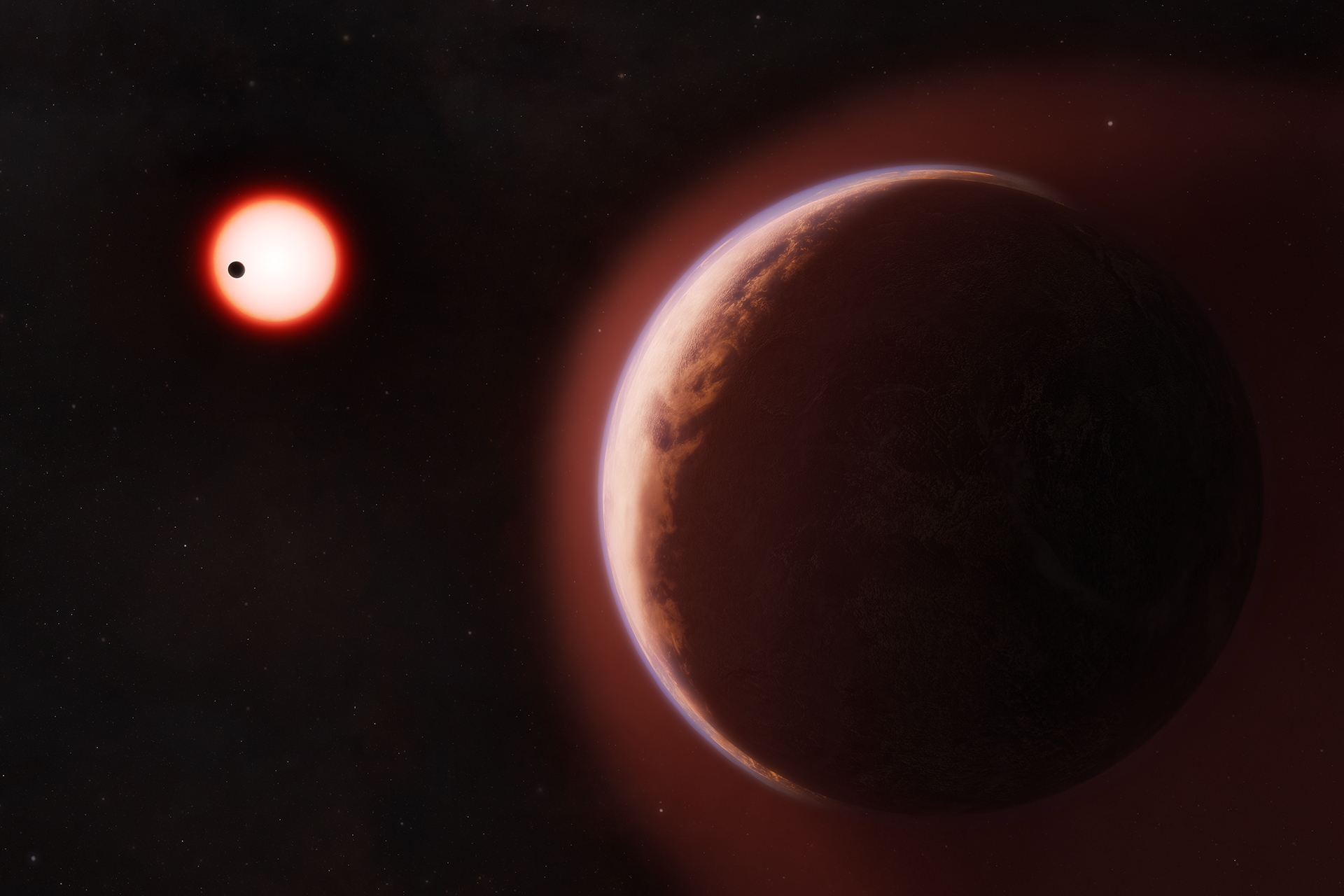
An artist’s conception of planet LHS 1140b with its red parent star in the background. —Melissa Weiss—CfA

The search for exoplanets—or worlds orbiting other stars—is astronomy’s great Easter egg hunt. It was in 1992 that professional stargazers discovered the first known exoplanet, a distant body orbiting a pulsar 2,300 light years from Earth. Since then, astronomers using both space-based and Earth-based telescopes have found more than 6,200 exoplanets scattered across the skies, leading them to conclude that there is at least one planet orbiting virtually every existing star.

The known exoplanets are something of a grab bag—some large, some small, some hot, some cold, some gaseous like Jupiter and Neptune, some rocky like Earth and Mars. For astronomers looking for extraterrestrial life, the true jackpot planet would be Earth-like: smallish and rocky, with an atmosphere, orbiting its parent star in the so-called habitable zone, that sweet thermal spot that is not too hot and not too cold, allowing water to exist in liquid form. In the 34 years exoplanets have been studied, no world that checks all of those boxes has ever been spotted—until now. 

According to a new study published in Science, just such a planet, going by the decidedly unlyrical name LHS 1140b is at last known to exist, orbiting a star a mere 48 light years from Earth—down the block by astronomical standards. If one potentially organic world is out there, countless others could be too—dramatically boosting the odds of extraterrestrial life.

How do scientists determine if a planet has the right conditions for life?

A living world, says planetary scientist Collin Cherubim of the University of Chicago, lead author of the new paper, “has got to be the right temperature to sustain liquid water on the surface, and it has to have an atmosphere to hold that water in place and to shield the surface from ionizing radiation. LHS 1140b has all three of these things. That puts it at the forefront for studying astrobiology and habitability and looking for life outside the solar system.”

LHS 1140b is actually not new to the astronomical canon. The planet was discovered in 2017 by investigators using what is known as the transit method. As a planet orbits its parent star it periodically moves in front of the star, briefly blocking a tiny bit of its light. The difference is not much—the equivalent of removing one light bulb from a board of 10,000 of them—but that’s enough for sensitive telescopes to detect. The frequency of the dip reveals how fast the planet completes one orbit, and the precise amount of light blocked reveals the planet’s diameter. In the alternative, astronomers also hunt for exoplanets using the so-called radial velocity method—looking for the tiny wobble that occurs in a star as it is tugged by the gravity of the moving planet. The degree of wobble reveals the planet’s mass.

The star LHS 1140b orbits is known as a red dwarf, a relatively small, relatively cool body with surface temperatures of 3,100°F to 5,800°F, compared to the 10,000°F heat of our own sun. About three out of every four stars in our galaxy are thought to be red dwarfs. For a planet orbiting a red dwarf to stay warm enough to sustain liquid water—and potentially life—it has to snuggle up close to the solar fires, and LHS 1140b does that, orbiting about 9 million miles from its star, about a tenth of the 93 million-mile-distance the Earth maintains from the sun. The planet is about 1.7 times the diameter of Earth and, thanks to additional calculations using the radial-velocity method, was determined to be 5.6 times our mass. It orbits its star once every 24.7 days compared to Earth’s one-year period.

What do we know about the atmosphere on planet LHS 1140b?

With the planetary size and solar distance boxes checked, the last piece of the puzzle was to search for an atmosphere—and Cherubim and his colleagues found it. They began by using a computer model Cherubim developed when he was earning his Ph.D. in Earth and planetary sciences at Harvard University. Factoring in all of the data known about the planet’s diameter, density, age, orbital period, and gravitational pull—which helps determine its ability to hold onto atmosphere—the computer model spit out the prediction that  LHS 1140b would have an atmosphere and ought to be leaking telltale helium into space. A very light gas that easily escapes gravity, helium could serve as a readily detectable marker of a complex atmosphere underneath. 

Cherubim and his team next checked that prediction, making direct observations of the planet using the transit method. “When the planet passes in front of the star, some of that starlight filters through the atmosphere of the planet,” Cherubim says. “If there are any molecules or atoms like helium in the planet’s atmosphere, they can absorb or block very specific wavelengths of light.” Those absorption markers were present, proving that LHS 1140b indeed had a helium bleed.

An inert helium atmosphere is not the same as our dynamic, chemically interactive air blanket made principally of nitrogen and oxygen, as well as methane, carbon dioxide, water vapor, and more. But Cherubim believes some of that complexity may be present on LHS 1140b, beneath the helium smoke screen.

“My models do predict carbon dioxide to be the second most abundant gas, and carbon monoxide to be present, and also small amounts of O2 molecular oxygen,” says Cherubim. “From our climate modeling, we’ve also predicted a lot of water on this planet.” All of that, especially the water, indeed represents the basic recipe list if you’re looking to bake a biological cake.

What is the star like that planet LHS 1140b orbits?

One other potential break LHS 1140b caught concerns the star it orbits. Red dwarfs are very volatile bodies, giving off enormous amounts of X-rays and ultraviolet energy, both of which can destroy extant life or prevent it from getting started in the first place. The closest star to Earth, Proxima Centauri b, which is part of a three-planet solar system circling a red dwarf 4.25 light years away, receives up to 400 times the X-ray radiation Earth does, which has all but certainly sterilized the planet. The star LHS 1140b, by contrast, is a quiet one, bathing the planet in just 10 times the X-ray energy that streams toward Earth, which would not rule out biology.

“Right now on LHS 1140B, the amount of X-ray flux would not really be threatening to life as we know it at all,” says Cherubim. 

None of that means life is actually present on LHS 1140b—or perhaps even possible given the countless chemical and thermal things that have to go right for biology to emerge. But the study does provide some tantalizing promise. There are trillions of planets at large in a universe fairly awash in organic chemistry. The odds favor at least some of them having conditions similar to that of the early Earth—including a protective atmosphere. If life could emerge here, there is no reason it couldn’t out there too.

Source link