HomeNews Magyar says his government will work for a ‘free, European’ Hungary in break with Orbán era – Europe live
Magyar says his government will work for a ‘free, European’ Hungary in break with Orbán era – Europe live
April 13, 2026:
From
09.57 BST
Magyar says his government will work for ‘free, European’ Hungary
Despite late night celebrations, it does not look like Peter Magyar has had a chance to lie in a bit longer today.
Earlier this morning, he thanked the voters once again on his Facebook, saying:
“Thanks to every Hungarian at home and across the world!
It is a huge honour that you have empowered us with the most votes ever to form a government and to work for a free, European, well-functioning and compassionate Hungary over the next four years. The Tisza government will be the government of every Hungarian person.”
Key events
Waiting for Péter Magyar press conference
EU ready to work with new Hungarian government ‘as soon as possible’
‘People do not normally dance in streets over politics’
Who is Péter Magyar, Hungary’s likely next prime minister?
What Europe does in response will determine if Magyar can succeed
‘No far-right leader can fill Orbán’s shoes’
‘After defeating Orbán, Magyar now faces daunting task of fighting Orbánism’
Magyar says his government will work for ‘free, European’ Hungary
Orbán allies in Czech Republic, Slovakia congratulate Magyar with praise for Orbán
Magyar’s win sends ‘very clear signal against right-wing populism,’ Germany’s Merz says
Morning opening: Change of regime, not just government
12.48 BST
Waiting for Péter Magyar press conference
Jakub Krupa
in Budapest
We are now waiting for Péter Magyar’s press conference at which he is expected to take some questions from the international media. It should get under way in the next half hour.
The conference will be hosted at a massive theatre-stylevenue, reflecting the incredible level of truly global interest in Hungary’s next prime minister – and the life after Viktor Orbán. This is not just any other election in the region.
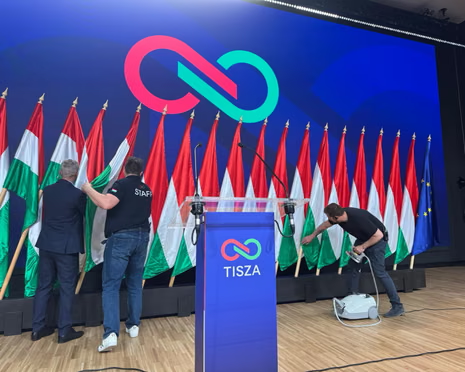
Tisza’s staff are taking it very seriously too: as I type, they are… ironing the flags so they look absolutely spotless on stage – and, to be fair, they do look great!
Tisza staff put final touches to Hungary and EU flags behind the podium at which the party leader and presumed next prime minister of Hungary, Peter Magyar, is about to address international media. Photograph: Jakub Krupa/The Guardian
12.24 BST
EU ready to work with new Hungarian government ‘as soon as possible’
Jennifer Rankin
in Brussels
The EU will start work with the new Hungarian government “as soon as possible” to make progress on issues including energy and the release of frozen European funds, the head of the European Commission has said.
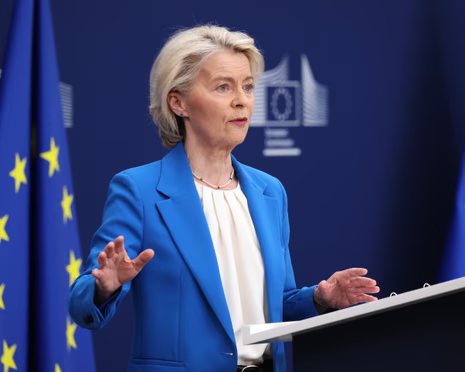
European Commission president Ursula von der Leyen speaks during a media conference at EU headquarters in Brussels, Belgium. Photograph: Omar Havana/AP
Ursula von der Leyen reiterated her warm welcome to the election victory of Péter Magyar, declaring that “today Europe is Hungarian without any question” and that “the people of Hungary have spoken and they have reclaimed their European path”.
Brussels has a lot to talk about with Magyar’s incoming government: rule of law and anti-corruption reforms that will enable the release of €17bn frozen EU funds; action to tackle Russian influence, the Druzhba pipeline dispute with Ukraine and the €90bn loan for Kyiv, vetoed by the defeated prime minister, Viktor Orbán.
Asked by a Euronews reporter about these topics, von der Leyen said:
“We will start working with the government as soon as possible on the topics you mentioned and much more to make a swift and overdue progress to the benefit of the Hungarian people.”
She also said the EU needed to consider lessons from recent experience, reiterating her support for an end to vetoes over foreign policy decisions.
“I think moving to qualified-majority voting in foreign policy is an important way to avoid systematic blockages as we’ve seen in the past. And we should use the momentum now really to move forward on that topic.”
That is probably easier said than done. Even some countries toasting the end of the Orbán era would be reluctant to give up the veto, as they do not want their own government outvoted on sensitive foreign policy issues.
12.14 BST
‘People do not normally dance in streets over politics’
Jakub Krupa
Ashifa Kassam and I spoke with our colleague Martin Belam for the Guardian’s First Edition about some of our behind the scenes experiences covering the vote on the ground in Budapest.
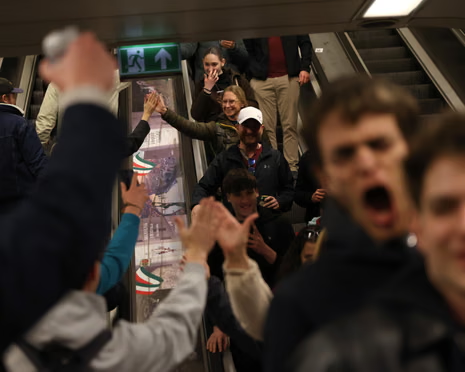
Joyful revellers greet one another in an underground metro station as they celebrate the resounding Tisza party win in Hungarian parliamentary elections. Photograph: Sean Gallup/Getty Images
“It has been an extraordinary night in Budapest – one which resembled more a World Cup triumph than an election night. People do not normally dance in the streets over politics.”
Monday briefing: Hungary chooses Péter Magyar over Viktor Orbán
Read more
11.43 BST
Who is Péter Magyar, Hungary’s likely next prime minister?
Ashifa Kassam
in Budapest
As a child growing up in Budapest, Péter Magyar had a poster of Viktor Orbán – at the time a leading figure in the country’s pro-democracy movement – hanging above his bed.
Opposition candidate Péter Magyar is seen at the Tisza election evening event in Budapest, Hungary. Photograph: Jaap Arriens/NurPhoto/Shutterstock
Orbán was one of several political figures who adorned his bedroom, Magyar told a podcast last year, hinting at his excitement over the changes sweeping the country after the collapse of communism.
Now Magyar, 45, has been the driving force behind the ousting of Orbán, whose 16 years in power transformed the country into a “petri dish for illiberalism”.
Few could have predicted the meteoric rise of Magyar and his Tisza party. “He has built an opposition movement at amazing speed,” said Gábor Győri of Policy Solutions, a Budapest-based political research institute.
Never, since the history of this post-transition Hungary, have we seen a party rise this quickly.
Conversations with those who know Magyar often alternate between admiration and antipathy. Many praise the tremendous movement he has built and the discipline he has shown as he crisscrosses the country, giving up to six speeches a day, while also describing him as someone with a short temper and a style that can be abrasive at times.
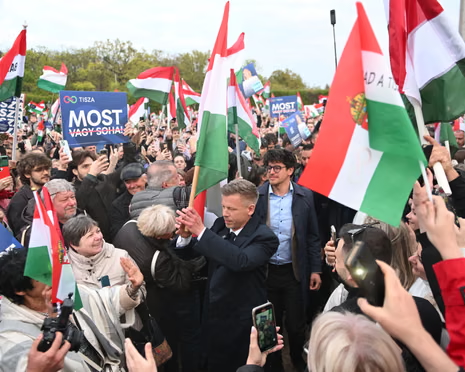
Peter Magyar, prime minister candidate of the Tisza Party, holds his final campaign rally in Debrecen, Hungary. Photograph: Balint Szentgallay/NurPhoto/Shutterstock
Others see him as the perfect fit for the magnitude of the moment. “I think, like all politicians, he can be a difficult person,” said Tamás Topolánszky, a film-maker who was part of a team that spent the past 18 months following Magyar for a film on the wider change sweeping Hungarian society.
Topolánszky described Magyar as authentic and passionate, but also someone who could be impatient at times. “I think that this is something that we Hungarians now see was necessary to get us to this point.”
Péter Magyar: Hungary’s next leader energised voters but is ‘a dark horse’
Read more
11.17 BST
What Europe does in response will determine if Magyar can succeed
Zselyke Csaky
This is a moment of history for Hungary and Hungarians. And the outcome is momentous for the rest of Europe too. A 16-year-long illiberal, anti-democratic experiment is at an end, and this is the time for celebration. But with a large majority comes an immense responsibility for the new government in Budapest. Europe too has urgent lessons to learn.
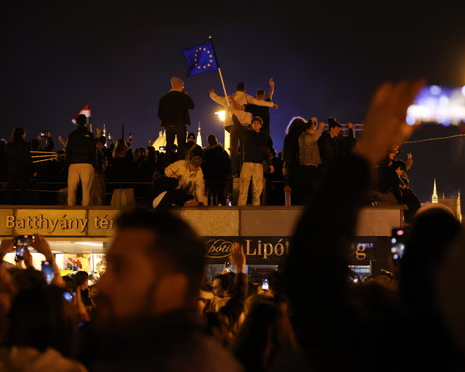
Revellers, including one waving the flag of the European Union, celebrate the resounding Tisza party win in Hungarian parliamentary elections in Budapest, Hungary. Photograph: Sean Gallup/Getty Images
Across EU capitals and in Brussels, Péter Magyar’s victory has brought huge sighs of relief. But the bated breath before the vote, and the fact that many EU leaders were simply hoping the “Orbán problem” would go away after this election, exposes a deeper issue: the EU still lacks a coherent strategy for tackling democratic backsliding within its ranks. That could come back and bite the union again, sooner than expected.
Magyar’s election offers Europe an opportunity to emerge stronger and to confront its underlying problems. This is a chance to finally give Ukraine the support it needs, to lock in an ambitious seven-year EU budget, push forward enlargement, and to chip away at the unanimity requirement in foreign policy that has allowed individual member states to hold the continent hostage.
With 2027 elections approaching, the EU needs to act fast. What Europe does in the months ahead will determine whether Magyar’s win marks a genuine turning point, or merely a temporary reprieve.
10.36 BST
‘No far-right leader can fill Orbán’s shoes’
Cas Mudde
Stanley Wade Shelton UGAF professor of international affairs at the University of Georgia, and author of The Far Right Today
Hungary’s election is a reminder that much of the public discourse wildly overstates the strength of authoritarianism and the weakness of democracy. Orbán’s acceptance of the result also again drives home how exceptional Donald Trump is in refusing to recognise his election defeat in 2020.
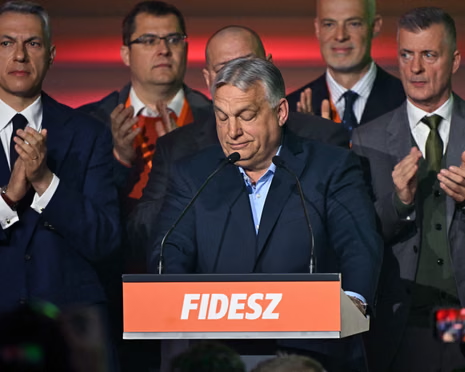
Hungary’s prime minister Viktor Orbán addresses supporters at the Balna centre in Budapest during a general election in Hungary. Photograph: Attila Kisbenedek/AFP/Getty Images
The result will be used for all kinds of fallacious claims, from this marking the end of the far right in Europe to the idea that Orbán lost because of his association with the toxicity of the Trump regime.But in fact, this was a specifically Hungarian event, to be explained by specifically Hungarian factors – such as 16 years of corruption and economic mismanagement – rather than international ones, including JD Vance’s visit to Budapest.
This result nevertheless has a strong symbolic value for European politics. Orbán replaced Marine Le Pen as the unofficial leader of the still heavily divided European far right during Europe’s 2015 so-called “refugee crisis”. He has also given the far right a permanent presence in the European Council from where he vetoed or obstructed many EU decisions, and in the European Commission (Hungary’s commissioners have shown more loyalty to Orbán than to the EU).
Orbán is gone, for now. And while there are many other far-right politicians (Giorgia Meloni for example) and European disrupters (such as Slovak premier Robert Fico), none have the intent, power or resources to step into the void that Orbán’s defeat creates.
10.24 BST
‘After defeating Orbán, Magyar now faces daunting task of fighting Orbánism’
Zsuzsanna Szelényi
Programme director of the CEU Democracy Institute, and author of Tainted Democracy: Viktor Orbán and the Subversion of Hungary
Magyar’s improbable rise was made possible by the government’s worsening economic record and growing anger over its pro-Russian, anti-European stance. For years, Hungarian voters had felt trapped between an authoritarian government and a feeble, fractured opposition. Magyar broke that deadlock.
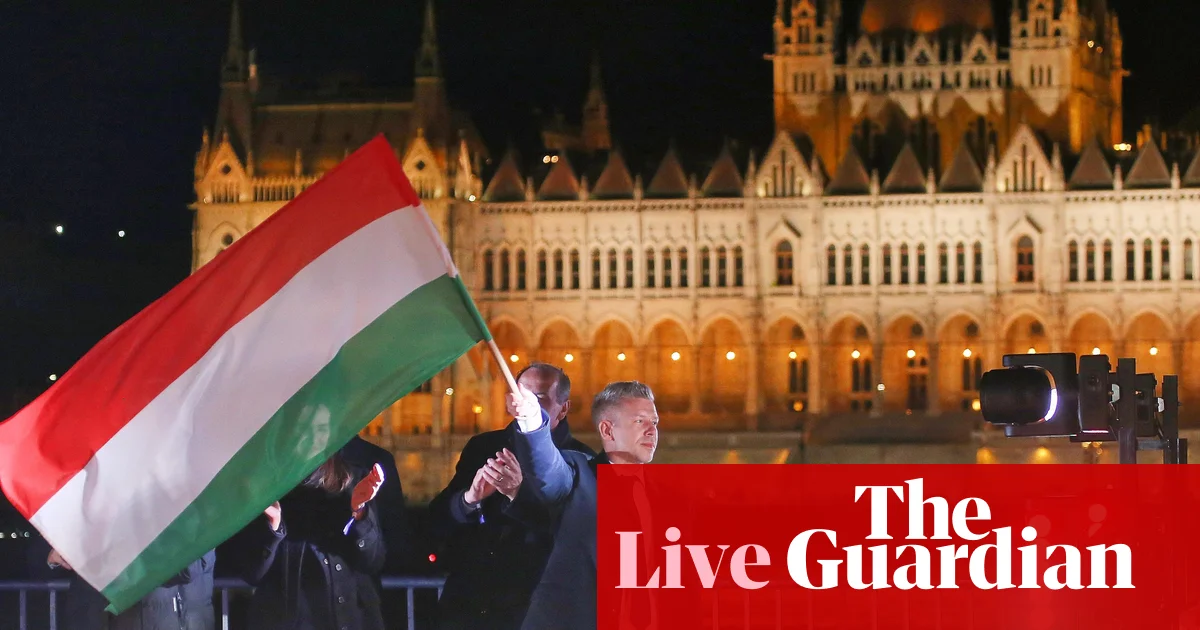
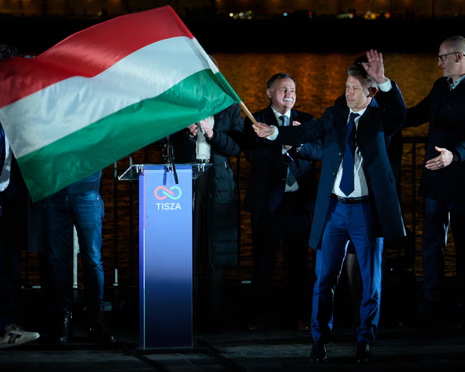
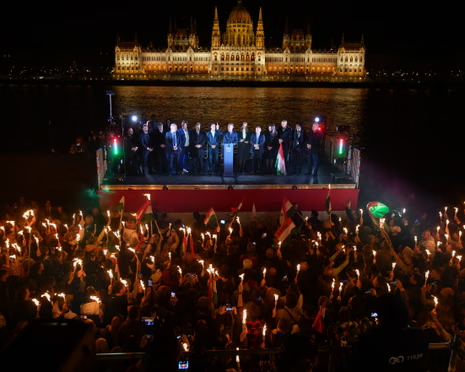
Peter Magyar (C), leader of the pro-European conservative TISZA party, addresses supporters on the banks on the river Danube with the Parliament building in the background in Budapest, Hungary Photograph: Ferenc Isza/AFP/Getty Images
That he did so is remarkable. He was forced to confront a party-state: a system sustained by vast institutional, financial and propaganda resources, and defended by relentless smear campaigns. I know how daunting that can be, having faced it myself as an opposition politician only a few years ago.
In his victory speech, Magyar made ambitious promises to restore the rule of law and repair relations with the EU and Nato. These promises will also be extraordinarily difficult to fulfil. Magyar may have won power, but he has not inherited a normal state. He faces severe economic pressures, immense public expectations and an opposition in Fidesz that, even in defeat, retains extensive informal power and influence. Orbán’s system has infiltrated the state, the media, the economy and the political culture itself.
Removing Orbán from office is one thing. Dismantling Orbánism is quite another.
And yet, a decisive threshold has been crossed. In the end, the Orbán regime’s strategy of devoting every available resource to its own perpetuation produced not durability but exhaustion. The system hardened, overreached and finally broke.
But the hardest question of all is not whether Orbán can be defeated, but whether the political, legal and moral wreckage he leaves behind can truly be repaired.
09.57 BST
Magyar says his government will work for ‘free, European’ Hungary
Despite late night celebrations, it does not look like Peter Magyar has had a chance to lie in a bit longer today.
Earlier this morning, he thanked the voters once again on his Facebook, saying:
“Thanks to every Hungarian at home and across the world!
It is a huge honour that you have empowered us with the most votes ever to form a government and to work for a free, European, well-functioning and compassionate Hungary over the next four years. The Tisza government will be the government of every Hungarian person.”
09.35 BST
Orbán allies in Czech Republic, Slovakia congratulate Magyar with praise for Orbán
Meanwhile, the Slovak prime minister Robert Fico and the Czech prime minister Andrej Babiš, two close political allies of Viktor Orbán, congratulated Peter Magyar on his win in yesterday’s election.
Fico, who worked closely with Orbán as they repeatedly clashed with Ukraine together over the issue of Russian energy imports, said on Facebook he was “ready for intensive cooperation with the new Hungarian prime minister,” while he also expressed his “gratitude” to the ousted prime minister.
Babiš said Magyar “must not disappoint”, and pledged to “always work constructively with whoever voters choose”.
“Facing such a strong opponent as Viktor Orbán was never easy, yet [Magyar] earned the trust of the majority of Hungarians and carries great hopes and expectations,” he noted.
09.09 BST
Magyar’s win sends ‘very clear signal against right-wing populism,’ Germany’s Merz says
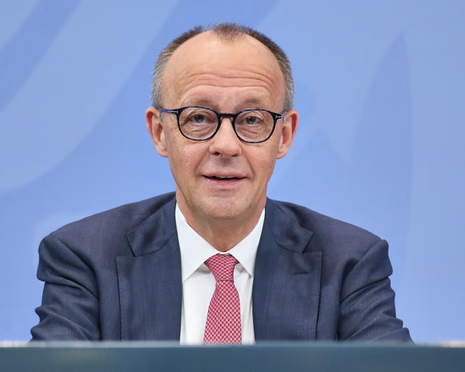
Speaking at a press conference in Berlin, German chancellor Friedrich Merz praised Péter Magyar’s win over Viktor Orbán as “a good day,” sending “a very clear signal against right-wing populism.”
Friedrich Merz at a press conference in Berlin, Germany. Photograph: dts News Agency Germany/Shutterstock
“Hungary has sent a very clear signal against right-wing populism across the whole world. In that respect, [yesterday Sunday’s election day] was… a good day,” Merz said in comments reported by Reuters.
He said that decision-making process in the EU, including on things to do with Russia, should get easier as a result of the vote.
He also praised the resilience of the Hungarian society against attempts to interfere with the vote.
“This [win] demonstrates that our democratic societies are evidently much more resilient against Russian propaganda and further external interference in such elections,” said Merz.
(No prizes for guessing what other “further external interference” he might have been thinking of there, just days after JD Vance’s not-so-subtle visit to Budapest…)
08.47 BST
Morning opening: Change of regime, not just government
Jakub Krupa
Good morning from Budapest, as the city reluctantly and not without some difficulties wakes up from the celebrations the night before, which went on to 5am and beyond.
Joyful revellers greet one another in an underground metro station as they celebrate the resounding Tisza party win in Hungarian parliamentary elections in Budapest, Hungary. Photograph: Sean Gallup/Getty Images
With 98.94% of votes counted, Péter Magyar’s Tisza party is projected to get 138 seats in the new parliament, with just 55 for Viktor Orbán’s Fidesz and six for the far-right Mi Hazank (Our Homeland) party.
These numbers mean that the new government will have the critical two-thirds majority (133 or more seats) required to comprehensively overhaul the country’s laws, creating a real chance to genuinely break with the Orbán era.
Or, as András Bíró-Nagy of Policy Solutions put it to me,
“Because if [they have] the constitutional super-majority, this is when he can do a change of regime, and not only a change of government … then dismantling the Orbán regime is really possible, meaning that both the economic and the political capture of the [Orbán] regime could be adressed with the two-thirds majority.”
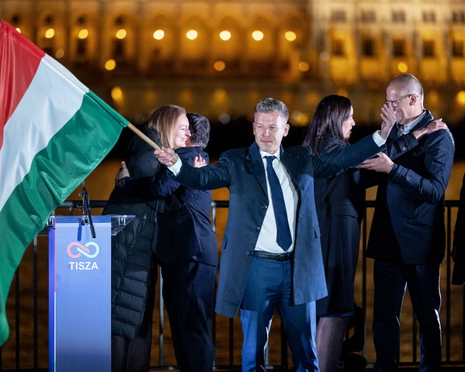
Peter Magyar (C), lead candidate of the Tisza party, speaks to supporters after polling stations closed during Hungarian parliamentary elections in Budapest, Hungary. Photograph: János Kummer/Getty Images
We are going to hear from Magyar again today as he is expected to give a press conference to offer a more detailed reaction to the vote and talk about his plans for the new administration.
Separately, we should also hear from the team of international observers who monitored the vote as they present their early findings.
And, well, we are still waiting for any reaction from the White House. Donald Trump and JD Vance had so much to say about the election before it happened, but are uncharacteristically quiet since last night.
It’s Monday, 13 April 2026, it’s Jakub Krupa here, and this is Europe Live.