HomeNews Kash Patel sues the Atlantic for $250m over article alleging heavy drinking and absences – US politics live
Kash Patel sues the Atlantic for $250m over article alleging heavy drinking and absences – US politics live
April 20, 2026:
From
15.50 BST
Kash Patel sues the Atlantic over article alleging heavy drinking and absences
FBI director Kash Patel has filed a lawsuit against the Atlantic magazine over an article, published last week, that details Patel’s alleged chronic drinking and frequent absences from work.
In a court filing with the Washington DC district court, Patel has sued the Atlantic, and the author of the piece, Sarah Fitzpatrick. According to the filing, Patel seeks $250m in damages, listing the nature of the suit as “libel, assault and slander”. A full copy of the complaint was not immediately available.
The article cites a number of conversations with current and former officials, who spoke on the condition of anonymity, who claim that the FBI director drinks to excess and has been unreachable at times during his tenure in office. The piece also stated that Patel is concerned he might soon be fired.
Patel telegraphed he was likely to sue the Atlantic over the story last week. “Print it, all false, I’ll see you in court – bring your checkbook,” he told the publication.
Key events
Kash Patel sues the Atlantic over article alleging heavy drinking and absences
Fisa negotiations continue on Capitol Hill after lawmakers pass short-term extension
Trump administration launches portal to initiate tariff refunds
17.16 BST
Donald Trump dismissed his energy secretary, Chris Wright, who said gas prices are not expected to fall back under $3 a gallon until 2027, according to The Hill.
Over the weekend, CNN’s Jake Tapper asked Wright when he thought “it’s realistic for Americans to expect the gas will go back to under $3 a gallon”. Wright replied: “I don’t know. That could happen later this year. That might not happen until next year.”
“No, I think he’s wrong on that. Totally wrong,” Trump told The Hill on Monday, adding that gas prices will drop “as soon as this ends,” referring to the Iran war.
16.16 BST
My colleague Jeremy Barr has more on the lawsuit filed by Kash Patel against the Atlantic.
Patel’s legal team accused the magazine and reporter Sarah Fitzpatrick of publishing “a sweeping, malicious, and defamatory hit piece” on 17 April.
“Defendants are of course free to criticize the leadership of the FBI, but they crossed the legal line by publishing an article replete with false and obviously fabricated allegations designed to destroy Director Patel’s reputation and drive him from office,” the complaint reads. “Indeed, Fitzpatrick could not get a single person to go on the record in defense of these outrageous allegations, instead relying entirely on anonymous sources she knew to be both highly partisan with an ax to grind and also not in a position to know the facts.”
Patel’s lawyers accused the Atlantic of acting with actual malice – the legal standard for winning a defamation lawsuit against a public individual.
15.50 BST
Kash Patel sues the Atlantic over article alleging heavy drinking and absences
FBI director Kash Patel has filed a lawsuit against the Atlantic magazine over an article, published last week, that details Patel’s alleged chronic drinking and frequent absences from work.
In a court filing with the Washington DC district court, Patel has sued the Atlantic, and the author of the piece, Sarah Fitzpatrick. According to the filing, Patel seeks $250m in damages, listing the nature of the suit as “libel, assault and slander”. A full copy of the complaint was not immediately available.
The article cites a number of conversations with current and former officials, who spoke on the condition of anonymity, who claim that the FBI director drinks to excess and has been unreachable at times during his tenure in office. The piece also stated that Patel is concerned he might soon be fired.
Patel telegraphed he was likely to sue the Atlantic over the story last week. “Print it, all false, I’ll see you in court – bring your checkbook,” he told the publication.
15.32 BST
Oliver MilmanandDharna Noor
Democrats should get louder in championing clean energy’s affordability and resilience from global shocks, according to some of the party’s leading voices on the climate.
As the Iran war roils economies by raising the cost of oil and gas, countries are aiming to accelerate their shift to cleaner energy. But in the US, Donald Trump has sought to kill off any alternative to fossil fuels while opposing Democrats have been reluctant to tie the conflict to any action on the climate crisis.
The closure of the strait of Hormuz, where a fifth of the world’s oil and gas normally travels, in the wake of the US and Israel’s attack on Iran caused energy costs to spike around the world. In the US, the cost of gasoline has soared above $4.10 a gallon nationally, with Trump admitting the costs could even be “a little bit higher” by November.
“There’s a timely clash on climate and costs that Democrats can win, as long as we have the nerve to actually show up to the fight,” said Sheldon Whitehouse, a Democratic senator, who added “true energy independence will be achieved by powering our economy with renewable energy, the fuel sources for which are unlimited, free and independent of geopolitical events”.
The Iran war provides a “unique moment of opportunity” for Democrats to extol the advantages of lower-pollution options like electric cars but the focus should be on “reducing consumer costs, which should’ve been the message over climate protection all along”, according to Paul Bledsoe, a former climate adviser to Bill Clinton’s White House.
“I don’t think they’ve grasped the political opportunity yet,” Bledsoe said. “They have to stay really focused on how these next-generation technologies will provide a consumer benefit. When you pitch clean energy as cutting consumer costs first and improving the overall economy second, people are happy to cut emissions third.”
Read the full report here:
Democrats urged to link clean energy to affordability as Iran war hikes up prices
Read more
14.55 BST
Fisa negotiations continue on Capitol Hill after lawmakers pass short-term extension
Lawmakers on Capitol Hill will have 10 days to hash out negotiations on section 702 of the Foreign Intelligence Surveillance Act (Fisa), after both chambers agreed to a short-term extension last week.
Now, GOP leadership will have to unify their fractured conference to satisfy a need for reforms for the provision, which allows national security agencies to collect and review texts and emails sent to and from foreigners living outside the US without a warrant.
Several Democrats and hardline Republicans say that section 702, as it stands, threatens the privacy of American citizens implicated in any surveillance.
While John Thune, the Senate majority leader, has now vowed to head up the deliberations on his of the Capitol, it remains to be seen whether Mike Johnson, the House speaker, will also be able to rally representatives in the lower chamber.
14.24 BST
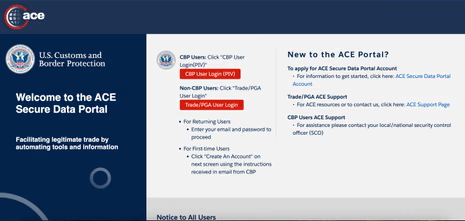
Here is a first look at the portal set up to process refunds for businesses who paid billions in Trump tariffs. This is part of the newly created Consolidated Administration and Processing of Entries (CAPE) tool, in order to streamline the refund process.
CBP portal. Photograph: CBP website
US Customs and Border Protection (CBP) estimates that businesses are owed about $166bn in tariff refunds, after the supreme court invalidated Donald Trump’s levies under the Internation Emergency Economic Powers Act (IEEPA).
Legal filings suggest the first phase of refunds would handle the majority of imports that were affected, according to a report from NPR.
Most importers eligible for a refund had signed up for electronic payments, an official reportedly told a judge last week, adding this group was owed about $127bn.
13.45 BST
Lauren Almeida
Oil prices have risen sharply and European stock markets have fallen after the US seizure of an Iranian vessel dented hopes for a peace deal.
Brent crude, the international benchmark for oil prices, rose by 4.8% on Monday to $94.69 a barrel.
The price changes followed Donald Trump’s announcement on Sunday that an Iranian cargo ship had been seized after trying to get past the US-enforced blockade near the strait of Hormuz shipping channel.
Oil prices rise and markets fall after US seizure of ship hits Iran peace deal hopes
Read more
13.26 BST
Donald Trump is in Washington today. He’ll spend most of the day in meetings, and at 3pm ET he’ll sign executive orders. None of these are open to the press, but we’ll let you know if anything changes and we hear from the president.
13.01 BST
Edward Helmore
After the supreme court struck down Trump’s tariffs in February, US businesses called for a swift process to pay refunds to US importers.
The US National Retail Federation, which represents a number of US retailers, from Walmart to small brands and manufacturers, called for “a seamless process to refund the tariffs to US importers” at the time.
“The refunds will serve as an economic boost and allow companies to reinvest in their operations, their employees and their customers,” it said.
The US Chamber of Commerce, too, called for swift return of tariffs covered by the ruling. Its chief policy officer, Neil Bradley, said: “Swift refunds of the impermissible tariffs will be meaningful for the more than 200,000 small business importers in this country and will help support stronger economic growth this year.”
“We encourage the administration to use this opportunity to reset overall tariff policy in a manner that will lead to greater economic growth, larger wage gains for workers and lower costs for families,” he added.
Dan Anthony, director of the business coalition We Pay the Tariffs, noted that the impact of the tariffs has been particularly hard on small businesses, which have taken out loans, delayed hiring and canceled expansion plans to accommodate import tariffs.
Refunds, he predicted, would allow businesses to reverse those trends.
The body published a national sign-on letter that said it was “imperative that that money is then given back without some of these onerous processes”.
“Full, fast automatic refunds is really where our focus is going to be,” it added.
“They’ve taken out loans just to keep their doors open. They’ve frozen hiring, canceled expansion plans, and watched their life savings drain away to pay tariff bills that weren’t in any budget or business plan,” the statement said. “But a legal victory is meaningless without actual relief for the businesses that paid these tariffs.”
12.56 BST
Donald Trump said US negotiators will be in Pakistan on Monday, and he again threatened to destroy its power plants and bridges if no deal is reached.
Trump did not say who would lead the delegation, but a White House official said it was vice-president JD Vance.
Talks are in doubt after Iran said it had no plans for any new negotiations, saying Washington had violated a ceasefire agreement from its implementation.
A spokesperson also said Tehran can’t forget US attacks on Iran during previous diplomatic talks as he insisted that Iran will continue defending its national interests.
As a reminder, the US-Israeli war on Iran, which began on 28 February, and the 12-day war last year both were launched when Iran and the US were in talks over Iran’s nuclear programme.
You can follow the latest developments in the war with Iran in our live blog:
Middle East crisis live: ceasefire under pressure as Iran says it has no plans for talks after US seizes ship
Read more
12.56 BST
Trump administration launches portal to initiate tariff refunds
Hello and welcome to the US politics live blog.
The Trump administration is expected to launch a refund system for businesses that paid tariffs later struck down by the supreme court. It is the first step in paying back $166bn in tariffs after justices ruled the Trump administration was overstepping its constitutional powers.
Importers and their brokers will be able to begin claiming refunds through an online portal beginning at 8am ET, according to US Customs and Border Protection (CBP), the agency administering the system.
It’s the first step in a complicated process that also might eventually lead to refunds for consumers who were billed for some or all of the tariffs on products shipped to them from outside the United States.
Companies must list the goods on which tariffs were levied. If CBP approves a claim, it will take 60-90 days for a refund to be issued, the agency said. CBP said in court filings that over 330,000 importers paid a total of about $166bn on more than 53m shipments.
More than 3,000 businesses, including FedEx and Costco, have sued the Trump administration to get refunds, the New York Times reports. FedEx has suggested customers could be in line for refunds for overpaid tariffs while Costco has said it may pass on refunds in lower prices for consumers.