HomeNews Hungary election live: voters head to the polls in contest that could see end of Viktor Orbán’s rule
Hungary election live: voters head to the polls in contest that could see end of Viktor Orbán’s rule
April 12, 2026:
Key events
2026 turnout by 5pm still far ahead of previous elections
Most Hungarians want better relations with EU, poll finds
23 years on from EU accession referendum, Hungary ‘once again … decides direction’ of country
Hang on: what’s the story and why does it all matter?
Hungary on course for record-high turnout as Orbán says ‘not a single patriot can stay home’
‘I am here to win,’ Orbán says after casting his vote
No election silence, but there are some restrictions on campaigning
What to expect when during the night?
Pre-election day polls suggest Tisza win but lots of questions remain
Magyar ends campaign in Debrecen as he attacks Fidesz’s positions
Orbán’s last rally showed key messages cut through with his supporters
Hungarians vote in hard-fought election that could oust Viktor Orbán after 16 years
Hungary votes as the future of Viktor Orbán’s 16-year rule hangs in balance
16.40 BST
2026 turnout by 5pm still far ahead of previous elections
Speaking about the turnout (17:20), we have just had the latest update, showing record-high levels of interest in the election.
More than 74% of the electorate has cast their votes by 5pm, up from 62% at the same time of the day in 2022.
16.28 BST
Most Hungarians want better relations with EU, poll finds
Jon Henley
Europe correspondent
After years of relentless EU-bashing by their nationalist, illiberal prime minister, an overwhelming majority of Hungary’s voters back its membership of the bloc, and most – including many of Viktor Orbán’s voters – now want a new approach to Brussels.
Days before elections at which Orbán, who has consistently painted the EU as an enemy of the Hungarian people, risks being ousted after 16 years in power, a poll has shown a huge appetite for a recalibration of the country’s relations with the bloc.
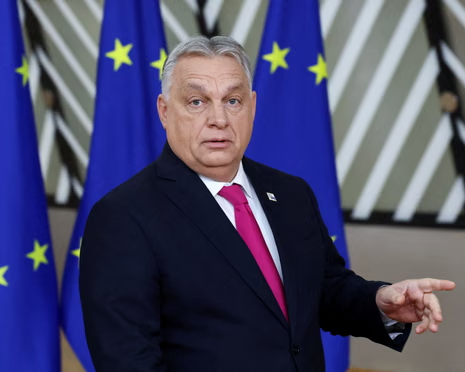
Hungarian prime minister Viktor Orbán gestures as he arrives at a European Union leaders’ summit in Brussels, Belgium last December. Photograph: Yves Herman/Reuters
The survey, by the European Council on Foreign Relations (ECFR) thinktank, found that 77% of voters support EU membership; three-quarters of respondents “trust” the bloc; and 68% want at least some degree of change in Hungary’s EU engagement.
Orbán has battled with Brussels – which has suspended billions of euros in funding – over a wide range of policies including on justice, migration, LGBTQ+ rights and aid for Ukraine, which, along with sanctions against Russia, he has consistently blocked.
EU leaders have largely steered clear of commenting on Sunday’s vote to avoid accusations of seeking to influence it, but Orbàn’s status as a far-right icon in Europe and beyond makes the election the bloc’s most consequential this year.
While the desire for change was strongest (91%) among supporters of Péter Magyar, the centre-right challenger whose Tisza party leads Orbán’s Fidesz by a double-digit margin in recent polls, nearly half (45%) of Fidesz voters also wanted a reset.
Majorities of Fidesz voters also said they supported Hungary’s continued membership of the EU (65%) and “trusted” the bloc (64%), while a large minority (43%, compared with 66% in the population as a whole) even backed Hungary joining the euro.
Most Hungarians want better relations with EU after years of Orbán Brussels-bashing, poll finds
Read more
16.25 BST
23 years on from EU accession referendum, Hungary ‘once again … decides direction’ of country
Ashifa Kassam and FloraGaramvölgyi in Budapest
Today’s election comes 23 years to the day after Hungarians voted overwhelmingly to join the European Union, drawing comparisons to that historic vote and its influence on the future of the country.
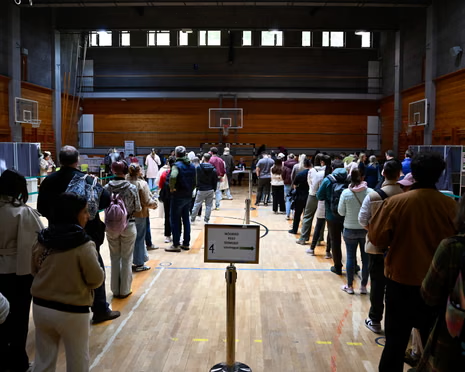
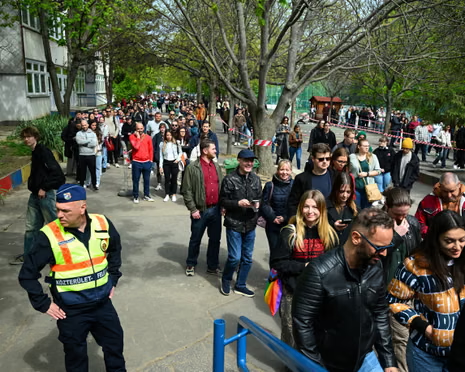
People queue up at a polling station during the Hungarian parliamentary election in Budapest, Hungary. Photograph: Dénes Erdős/AP
“Now, on 12 April, once again, voters are not simply choosing between parties, but deciding the direction, identity, and future of Hungary,” Tisza’s Anita Orbán, no relation to the prime minister, said on social media. “In many ways, this election is a referendum on whether Hungary returns to European values.”
It was a hint of how much has changed in Hungary since Orbán took power in 2010. What followed was, in the words of Zoltán Kész, a former member of the Fidesz party, nothing less than a “coup in slow motion,” albeit one that eschewed tanks for lawyers and clientelism.
The rightwing populist government had used its time in office to steadily whittle away at the checks and balances that constrained its power: rewriting election laws to its own benefit, manoeuvring to put loyalists in control of an estimated 80% of the country’s media, and retooling the country’s judiciary.
Meanwhile, Budapest has become a hub of thinktanks and conferences aimed at amplifying the idea of Hungary, in the words of one local journalist, as a “Christian conservative Disneyland” where the global far right feels at home.
Zebras, wealth and power: Hungary’s election tests Orbán’s grip on power
Read more
16.22 BST
Hang on: what’s the story and why does it all matter?
Jon Henley
Europe correspondent
Not a regular observer of Hungarian politics? We’ve got you.
The EU’s longest-serving leader, Orbán has since 2010 turned Hungary into what he calls an “illiberal democracy”, declaring himself Europe’s defender of traditional Christian family values against an onslaught of western liberalism and multiculturalism.
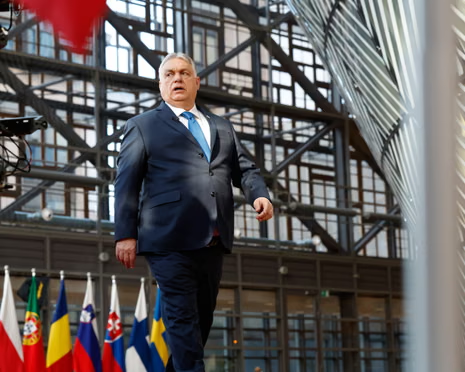
Hungary’s prime minister Viktor Orbán arrives for the EU summit at the European Council building in Brussels. Photograph: Geert Vanden Wijngaert/AP
His four successive governments have comprehensively eroded the rule of law in Hungary, packing the courts with judges loyal to him and turning up to 80% of the country’s media in effect into a propaganda machine for himself and his far-right Fidesz party.
He has become the EU’s disruptor-in-chief, battling with Brussels – which has suspended billions of euros in funding – over policies including on justice, migration, LGBTQ+ rights and, more recently, aid for Ukraine, which, along with sanctions against Russia, he has consistently blocked (including the latest €90bn loan).
Orbán is the EU’s most Moscow-friendly leader, continuing to buy Russian oil and gas and to meet Vladimir Putin since Russia’s full-scale invasion. Recent allegations that Budapest shared confidential EU information with the Kremlin have sparked EU outrage.
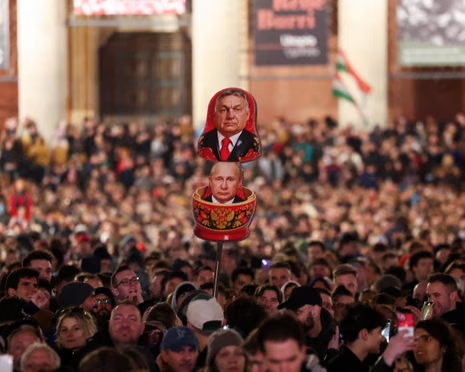
A person holds a placard depicting Hungarian prime minister Viktor Orbán and Russia’s president Vladimir Putin as a Matryoshka doll during a free concert in Budapest, Hungary. Photograph: Bernadett Szabó/Reuters
Orbán has inspired like-minded EU-obstructive leaders such as Slovakia’s Robert Fico and the Czech Republic’s Andrej Babiš, and boosted nationalist challengers such as France’s Marine Le Pen and the Netherlands’ Geert Wilders.
In short, the election will have consequences far beyond Hungary, a country that accounts for just 1.1% of the EU’s GDP and 2% of its population but has, under Orbán, come to play a role on the international stage out of all proportion to its size.
For more Q&As on what it’s all about and who are the key players, check our explainer here:
Hungary elections: what is at stake and who is likely to win?
Read more
16.20 BST
Hungary on course for record-high turnout as Orbán says ‘not a single patriot can stay home’
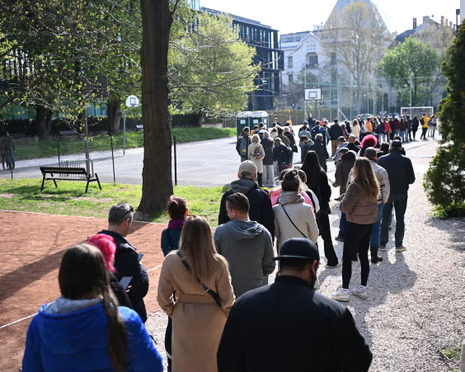
Early turnout data point to an unprecedented mobilisation across Hungary with long queues at polling stations, which is almost certain to lead to a record-high turnout at the end of the day.
People wait in queue to vote outside a polling station during the Hungarian parliamentary election in Budapest, Hungary. Photograph: Elisabeth Mandl/Reuters
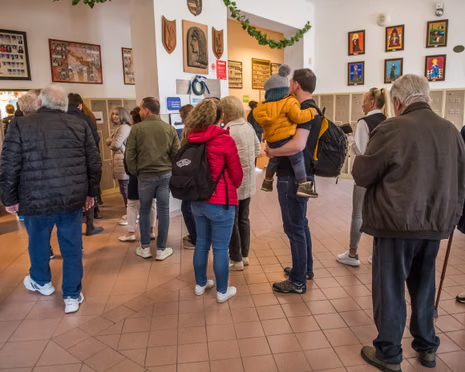
Hungarians queue to get their ballot papers at a polling station in Solymar, 20kms far from Budapest. Photograph: Ferenc Isza/AFP/Getty Images
At 11am, the turnout was 37.98%, over 12pp higher than in 2022 at the same time of the day. At 1pm, it was at 54.14%, up from 40.01%. At 3pm, it was 66.01% – up from 52.75%.
While the exact maths behind it is somewhat complicated, it is generally assumed that a higher turnout should help the opposition, although it is very much and to be expected that Fidesz will try to mobilise its voters too.
And Viktor Orbán appeared to acknowledge the pressure, with a rallying cry to his supporters on Facebook earlier today:
“Lots of people are voting, this meansone thing: if we want to protect the security of Hungary, not a single patriot can stay home!
16.16 BST
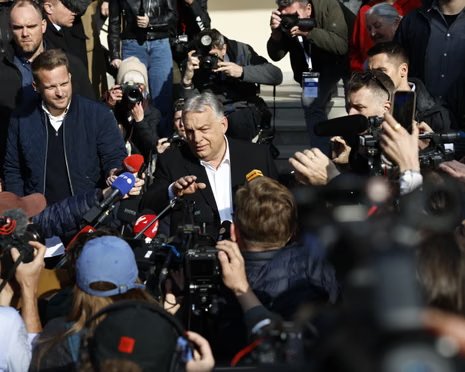
‘I am here to win,’ Orbán says after casting his vote
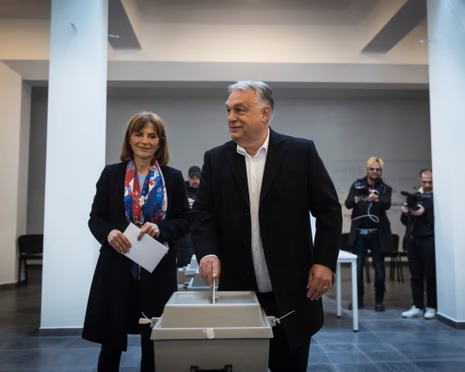
The Hungarian prime minister, Viktor Orbán, cast his vote early this morning in Budapest, accompanied by his wife, Anikó Lévai.
Hungarian prime minister Viktor Orbán (R), leader and prime ministerial candidate of the ruling Fidesz party, and his wife, Anikó Lévai (L), casting their votes in the general election in Budapest, Hungary. Photograph: Akos Kaiser/HUNGARIAN PM GENERAL DEPARTMENT OF COMMUNICATION/EPA
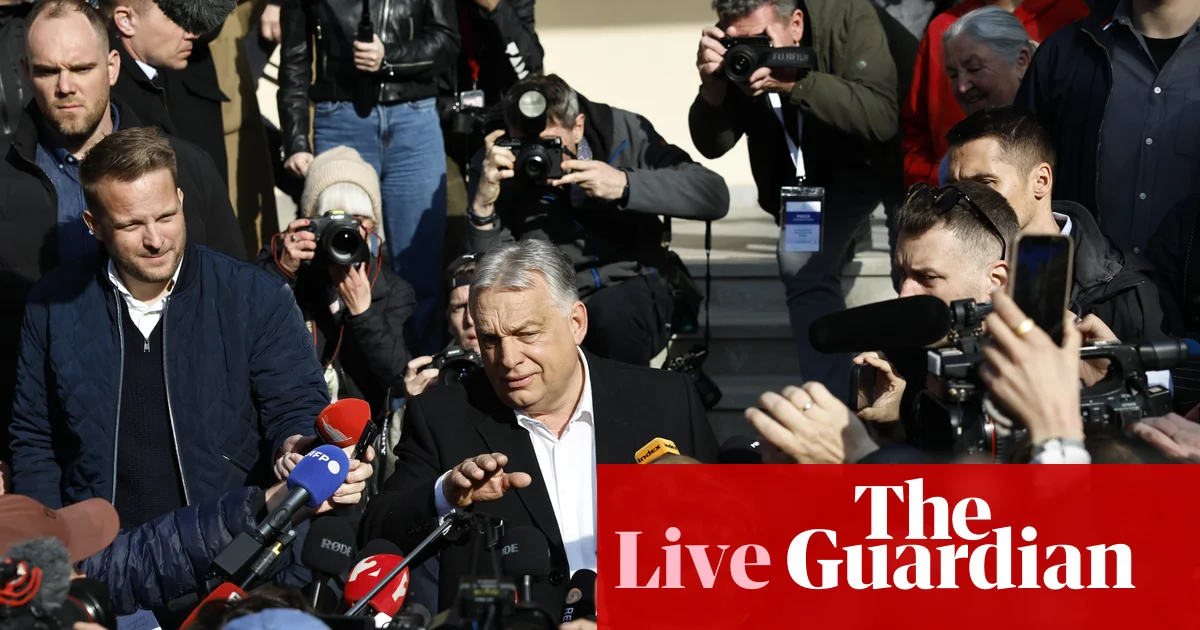
Talking to journalists after the vote, the Fidesz leader, who could lose his position after 16 years in power, insisted he was “here to win,” stressing he “likes to win.”
He also dismissed the possibility of results being contested by the EU, saying “they have to accept the intention and the will and expressed opinion of the people.”
“They can’t disrespect the Hungarian people,” he said.
Prime minister of Hungary Viktor Orbán speaks to press after casts his vote for the general election at a polling station in Budapest, Hungary. Photograph: Anadolu/Getty Images
Asked to compare today’s vote to the historic election in 1990, he said “the context is different.”
“The question is not to [establish] democracy or not, but how to operate the democratically elected government.”
He then said:
“We are heading towards major crises – not one, but several, coming together. So I think we need strong national unity to … resist the energy crisis, the financial crisis, the economic crisis [coming] towards us.”
Responding to a suggestion this could be his last election, he insisted: “I am a young man!”
Orbán also said it would have to be a “big” defeat for him to resign from the leadership of Fidesz.
16.11 BST
No election silence, but there are some restrictions on campaigning
Unlike many other countries, Hungary does not really have an election silence period, so some campaigning activity can still take place today.
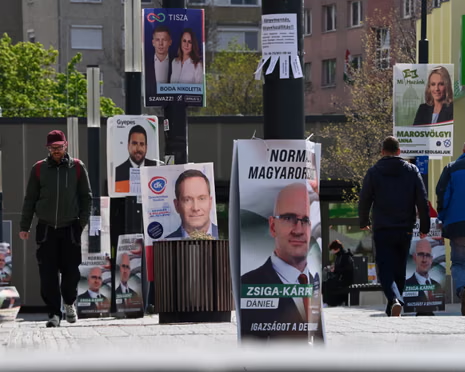
But there are some caveats and restrictions that effectively mean that no more major events (that’s why both candidates held their final rallies last night) are permitted and no campaigning can take place near polling stations (specified as 150 meters from the main entrance). All posters in place before the polling day can remain there, too.
Candidates for the upcoming general elections are seen on posters attached to poles in Budapest’s 3rd district. Photograph: Attila Kisbenedek/AFP/Getty Images
Having said that, people still come up with creative ways to make their views known to others: earlier today I saw a van driving in central Budapest, blasting Fidesz’s campaign song on full volume.
16.10 BST
What to expect when during the night?
The voting has started at 6am this morning, and will close 7pm local time (6pm UK).
We should get some new polls with data from this week – not exit polls! – around then, but it’s worth taking them with more than a pinch of salt. I will bring you the numbers, but take them with caution.
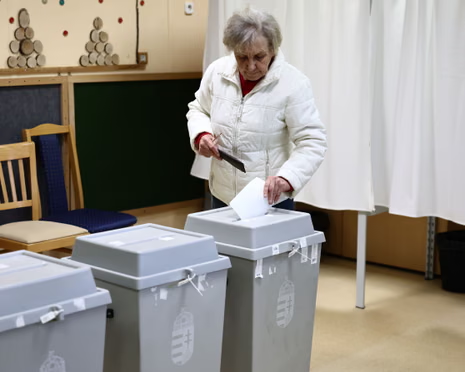
A person votes in the parliamentary election in Budapest, Hungary. Photograph: Jakub Porzycki/NurPhoto/Shutterstock
Despite all the excitement around this election, the situation is so tight and the polls are so all over the place that we would be well advised to wait for the official numbers before drawing any definite conclusions.
First partial results should start coming in the first 60 minutes after the polls close, and we should get to about a half of all votes counted by 10pm local time, and over 90% as we approach midnight. So strap in, this rollercoaster may need a few hours to get to its final stop.
If the result is particularly tight, we could then get into tricky situation as the last bit – the overseas votes – won’t be counted until, erm, Saturday.
16.09 BST
Pre-election day polls suggest Tisza win but lots of questions remain
While here was no shortage of polls before the election day,they were a bit all over the place – largely depending on their, erm, affiliation and proximity to the ruling party.
The more independent pollsters appeared to suggest that Péter Magyar’s Tisza party was on course for a victory, but the margin of that win – again – was not entirely clear with wildly different numbers on offer.
The consensus view appeared to be that they held around 10 percentage points lead coming into the final weekend.
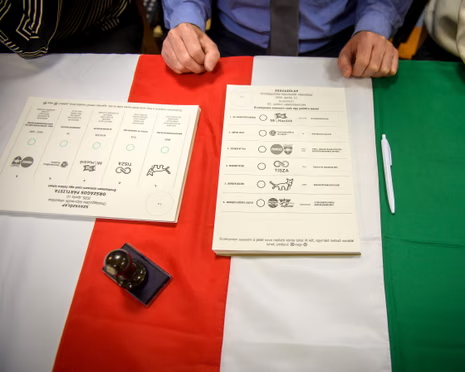
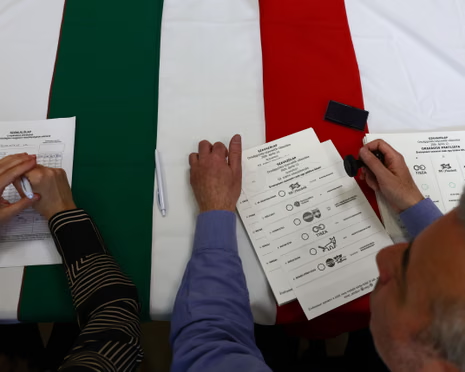
Ballot papers are placed on a Hungarian flag at a polling station in Budapest, Hungary. Photograph: Ferenc Isza/AFP/Getty Images
But, but, but…there is a lot of complexity in the Hungarian electoral process that mean we need to be pretty careful about interpreting these numbers.
It’s a mixed system, which was repeatedly reformed and redrawn by Orbán in a way that critics say resulted in a baked-in advantage for his party. But the top line is that there will be 106 MPs elected in single-member constituencies, and 93 from national party lists, decided with some pretty complex electoral maths behind it and a 5% party threshold to get in.
So, as difficult as it is going to be, we may have to be more careful than usual about drawing conclusions early in the night.
16.06 BST
Magyar ends campaign in Debrecen as he attacks Fidesz’s positions
Meanwhile, Tisza’s leader Péter Magyar closed his campaign in Debrecen, Hungary’s second-largest city.
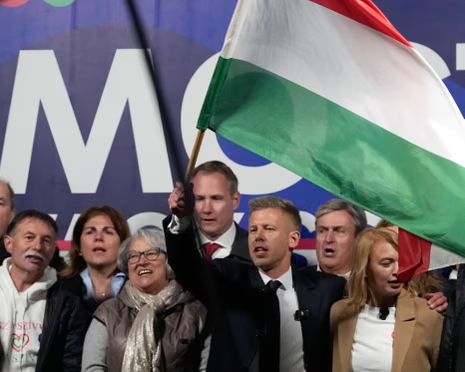
Péter Magyar, the leader of the opposition Tisza party waves a national flag during a rally in Debrecen, Hungary Photograph: Darko Bandić/AP
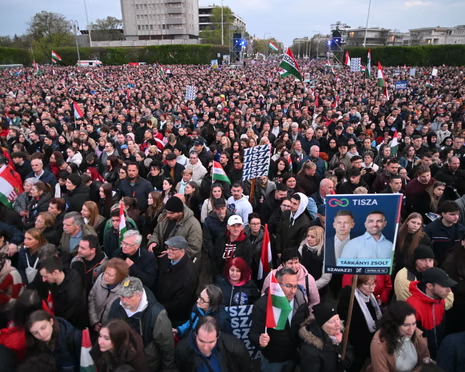
His rally gathered unexpectedly high number of supporters given the city has always been a Fidesz stronghold and seen as an pretty ambitious target for Tisza leader’s campaign.
András Bíró-Nagy of Policy Solutions in Budapest told me that Magyar’s decision to campaign in traditionally Fidesz parts of Hungary in the last days of the campaign seemed to suggest he was confident of making gains there.
Orbán’s party, Fidesz, has governed in Debrecen for 28 years, making it “the Fidesz capital of Hungary,” but “Orbán had to go there [earlier in the week] because even pro-government pollsters are indicating that the city might be up for grabs,” he said.
He said that Magyar’s decision to hold his last rally there was “very symbolic” and suggests “he feels that he can win even there … and if he makes it, it will mean the change of government [nationally], for sure.”
Péter Magyar, prime minister candidate of the Tisza Party, holds his final campaign rally in Debrecen, Hungary. Photograph: Balint Szentgallay/NurPhoto/Shutterstock
16.04 BST
Orbán’s last rally showed key messages cut through with his supporters
Jakub Krupa
in Budapest
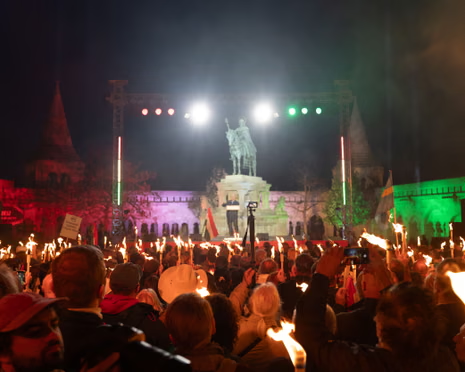
Viktor Orbán finished his electoral campaign at a rally in front of the Matthias Church in the centre of the Buda Castle District last night.
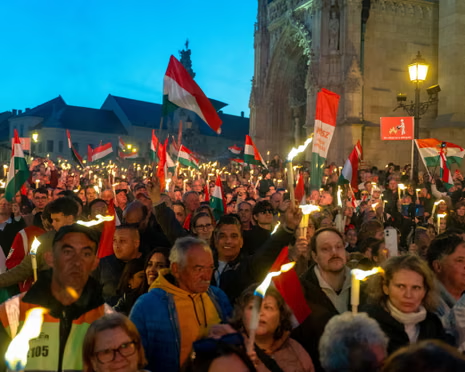
It wasn’t that busy as you would perhaps expect for the last rally of the campaign, but a few thousand people gathered there to express their hopes that Orbán will be re-elected for the fifth consecutive term.
People hold torches during a Fidesz party rally with prime minister Viktor Orbán in Budapest, Hungary. Photograph: Marek Antoni Iwańczuk/NurPhoto/Shutterstock
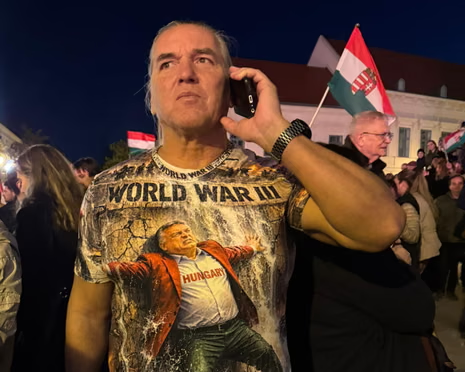
But Orbán’s key messages – his criticism of Europe’s support for Ukraine and warnings about the dangers of changing the government amid looming global uncertainty – appeared to land well, with many of his supporters enthusiastically reacting to his speech.
A Viktor Orbán supporter at his final rally in Budapest, Hungary Photograph: Jakub Krupa/The Guardian
Curiously, Hungary’s foreign minister Péter Szijjártó, who is at the centre of controversy over his contacts with his Russian counterpart Sergei Lavrov,also appeared on stage.
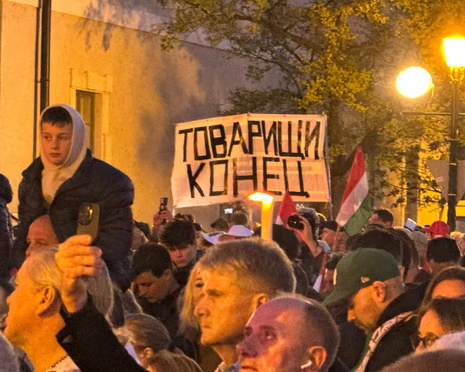
And a group of counterprotesters managed to briefly hold up a banner mockingly saying “It’s the end, comrades” before the prime minister’s supporters got it down.
An anti-government banner displayed at Viktor Orbán’s final campaign rally in Budapest Photograph: Jakub Krupa/The Guardian
Budapest is heavily leaning towards the opposition, but the rally served its purpose to close the campaign on a high, with strong visuals of Orbán in front of the Saint Stephen’s monument, in a place seen as particularly symbolic to the Hungarian state’s history.
Hungarian prime minister Viktor Orbán speaks to supporters at his campaign closing rally at Buda Castle in Budapest, Hungary. Photograph: Marek Antoni Iwańczuk/NurPhoto/Shutterstock
16.03 BST
Hungarians vote in hard-fought election that could oust Viktor Orbán after 16 years
Ashifa KassamandFlora Garamvolgyi in Budapest
In the campaign, Orbán – the EU’s longest-serving leader – has trailed in the polls as he faces an unprecedented challenge from Péter Magyar, a former elite member of Orbán’s Fidesz party.
Voters registered outside their home addresses queue in front of a polling station during the general election in Budapest, Hungary. Photograph: Attila Kovács/EPA
The challenge to Orbán’s power has sent rightwing leaders from across the globe scrambling to rally behind him. This week, JD Vance turned up in Budapest for a two-day visit, the US vice-president telling reporters that his aim was to “help” Orbán win.
The US president, Donald Trump, has also repeatedly endorsed Orbán, most recently on Friday, when he vowed on social media that he would bring US “economic might” to the country if Orbán is re-elected. Months earlier, leaders including Italy’s Giorgia Meloni and Israel’s Benjamin Netanyahu also made it clear that they were backing Orbán.
The result will be closely watched by the Maga movement and the global far right, many of whom have long cited Orbán as an inspiration and sought to follow his playbook.
Hungarians vote in hard-fought election that could oust Viktor Orbán after 16 years
Read more
15.45 BST
Hungary votes as the future of Viktor Orbán’s 16-year rule hangs in balance
Jakub Krupa
Hello from Budapest where Hungarians are voting in a closely contested election that could oust Viktor Orbán after 16 years in powerand potentially reshape the central European country’s relations with the EU, Moscow and Washington.
Hungarians turn out to vote in elections – video
Pre-election day polls appeared to suggest that Péter Magyar of the centre-right Tisza party could be on course to win the election, ending Orbán’s era, much criticised for weakening the rule of law and civil liberties, and raising hopes of a more pro-European government in Budapest.
But it’s still a long way to go before that happens. For what it’s worth, ignoring the noise, Orbán seemed pretty confident about the outcome in his final campaign appearances.
Hungarians vote in hard-fought election that could oust Viktor Orbán after 16 years
Read more
We will bring you all the latest in the coming hours with first-hand reports from polling stations, all the necessary background, and then – obviously – the results and reactions to the vote.
The voting closes 7pm local time (6pm UK).
Stay with us for all the latest from Hungary.
A voting card is seen at the polling station during the parliamentary election in Budapest, Hungary. Photograph: Jakub Porzycki/NurPhoto/Shutterstock
It’s Sunday, 12 April 2026, it’s Jakub Krupa here, and this is Europe Live from Budapest, Hungary.