September 23, 2026:


Sometime next year, the U.S. government will hit its debt ceiling again. It’s a moment that often plays out as a high-stakes partisan battle, with lawmakers demanding concessions from the President under the threat of a U.S. default.
If Democrats win control of one or both chambers of Congress, the next debt ceiling vote could yield another standoff. Or, just maybe, it could be an unexpected moment of bipartisanship.
President Trump has repeatedly called for eliminating the debt ceiling, putting him at odds with most of his party, but in line with a significant number of Democrats in Congress. The top Democrat on the House Budget Committee sees an opportunity to finally ditch the mechanism for good.
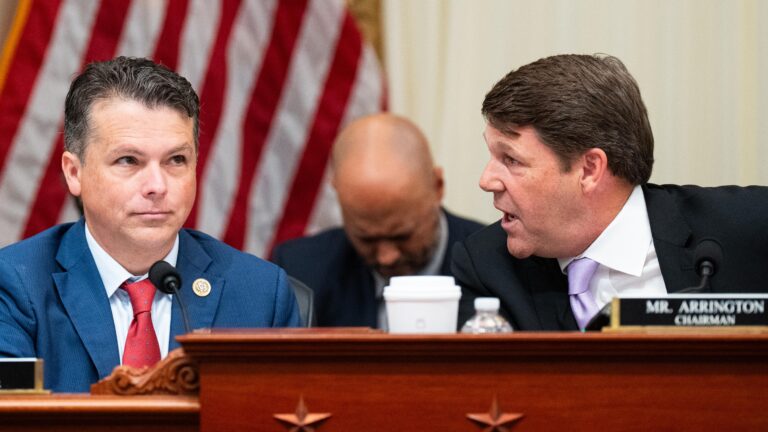
“I will not vote to simply kick the can down the road again and just raise the debt ceiling for another 18 months,” Rep. Brendan Boyle of Pennsylvania tells TIME in an interview. “My next vote on the debt ceiling will only be to permanently reform it to end the dysfunction around it once and for all.” After nearly a decade in the House, it would be the Philadelphia Democrat’s first time voting against raising the debt ceiling.
Congress last approved raising the debt ceiling in July 2025, by $5 trillion to $41.1 trillion. The Treasury Department is expected to hit that limit some time in 2027, although estimates vary. One projection puts the likely window between late winter and mid-summer. Once the limit is reached, the Treasury can rely on cash reserves and “extraordinary measures” for several more months before reaching the so-called X-date, when it could no longer meet all of the government’s obligations on time.
While lawmakers often frame debt ceiling votes as tests of fiscal restraint, raising the debt ceiling doesn’t actually authorize new spending or determine how much the government borrows in the first place. The debt ceiling caps the Treasury Department’s ability to borrow the money the U.S. government needs to pay for obligations Congress has already approved.
Past debt ceiling fights have led to credit downgrades and major drops in the stock market. Rep. Tim Burchett, a Tennessee Republican who voted for the last increase, subsequently called the debt ceiling “a joke” and “a relic of a bygone era.” Other Republicans, including outgoing Rep. Chip Roy of Texas, continue to argue that the ceiling should be preserved as a negotiating tool.
During Biden’s presidency, Trump urged his party to preserve the debt ceiling so they could use it as leverage in negotiations. Since returning to the White House, however, he has repeatedly called for eliminating the ceiling.
“I am very pleased to announce that, after all of these years, I agree with Senator Elizabeth Warren on SOMETHING,” Trump posted on Truth Social in June. “The Debt Limit should be entirely scrapped to prevent an Economic catastrophe. It is too devastating to be put in the hands of political people that may want to use it despite the horrendous effect it could have on our Country and, indirectly, even the World.”
If Democrats win the House, Boyle is all but assured to be chairman of the House Budget Committee, which oversees the debt limit votes. He sees Trump’s willingness to act on the issue as a golden opportunity. His preferred approach would not abolish the ceiling outright, but largely transfer the responsibility of raising it to the Treasury secretary, who would be able to suspend the debt ceiling for up to two years. Congress would retain the ability to block the suspensions through a joint resolution that would have to be signed by the president.
Boyle says his solution, which he introduced as the Debt Ceiling Reform Act in 2023, has drawn support from members from both parties. “I’ve had a number of House Republicans quietly tell me that they want to see the debt ceiling finally resolved in a manner that I propose because they’re sick and tired of voting on it,” he says.
The White House declined to comment on whether Trump would be open to working with Democrats to eliminate or reform the debt ceiling.
For most of its history, the U.S. did not have a debt ceiling. First adopted in 1917, raising the ceiling has become a bigger political headache in recent decades. In 2011, House Republicans used the approaching borrowing limit to force President Barack Obama into an agreement that imposed spending caps and created a bipartisan process for pursuing additional deficit reduction. But the standoff also brought the country close to default and was followed by the first downgrade of U.S. government debt.
Twelve years later, Republicans again used the debt ceiling to extract concessions from a Democratic president. The 2023 agreement negotiated by Speaker Kevin McCarthy and President Joe Biden capped discretionary spending for two years, rescinded more than $27 billion in unspent pandemic aid and $1.4 billion in IRS funding, and tightened work requirements for certain SNAP recipients. In return, Biden secured a suspension of the debt ceiling through the end of 2024, removing the immediate threat of default. The agreement was estimated to reduce deficits by roughly $1.5 trillion over a decade, but it also temporarily spiked short-term borrowing costs and led to another credit downgrade by a different credit agency.
“It is inevitable that the next time there’s a Democrat in the White House and there’s a Republican-controlled Congress, they will do exactly what they did to Barack Obama and exactly what they did to Joe Biden,” Boyle says.
But the situation may be reversed next year, with Democrats potentially controlling one or both chambers of Congress and a Republican in the White House. Some Democrats are already discussing the prospect of extracting concessions from Trump to secure a debt ceiling hike. During a recent retreat of the Congressional Progressive Caucus, Boyle was asked to give a presentation on the issue in order to encourage members to start thinking about the looming topic.
While Boyle hasn’t spoken recently with Minority Leader Hakeem Jeffries about the party’s strategy around the debt ceiling, he notes that Jeffries signed a 2022 letter with him and other House Democrats urging Congressional leaders to “permanently end the threat that the federal debt ceiling poses to our economy and our standing in the world.”
Boyle has already been laying the groundwork for a broader role on the House Budget Committee. During the current Congress, his office built a district-by-district database tracking the effects of Trump Administration policies on household costs and health coverage. The data played a central role in Democrats’ messaging strategy around healthcare and the 2025 government shutdown, as Democratic offices used the data to show voters in their districts how the expiration of enhanced Affordable Care Act tax credits could affect them.
As chairman, Boyle wants the committee to work to overhaul a congressional budget process that has turned dysfunctional. He also wants to reassert Congress’ constitutional power over federal spending, as the Trump Administration has repeatedly worked to withhold or redirect dollars lawmakers had appropriated. He intends to call Russell Vought, the director of the Office of Management and Budget and a central player in that Administration strategy, to a hearing on the issue. “I think he’s the most dangerous person in America that most Americans have never heard of,” Boyle says of Vought.
The potential chairmanship is also central to Boyle’s own calculation about his future in Congress. As Pennsylvania Sen. John Fetterman has grown increasingly critical of his own party and more comfortable with Republicans, many in the party doubt he could win a Democratic primary if he were to run for another term in 2028. Several House Democrats from Pennsylvania are said to be circling the seat, including Summer Lee, Chris Deluzio, and Boyle. Boyle tells TIME he plans to make a decision after the November elections. He sees the choice partly in terms of where he believes he would have the greatest influence over legislation if Democrats control Congress and the White House—is it better to be a freshman senator or chairman of a House committee that has become a central gateway for major fiscal legislation?
“The prospect of being the chair of the budget committee, if you have a Democratic trifecta and you’re doing reconciliation, that’s the chance to be front and center,” Boyle says. “The quarterback on what could be one of the most significant pieces of legislation in our lifetime.”
For now, with a Republican in the White House, Boyle is focused on the possibility of tackling a problem he has spent years trying to change, even as he acknowledges that the debt ceiling is unlikely to be a major issue for most voters.
“Truly, you know, I leave this place and I’ve done one thing—if you can tell me I’ve left here and I was a major reason why we permanently ended this debt ceiling dysfunction and danger, I’d be very proud of that.”