August 13, 2026:


Back in March, Republicans thought they had found the avatar for everything their base needed to fear in James Talarico. The never-married boyish seminarian who ran a remarkable campaign to become the Democrats’ Senate nominee in Texas got almost everything hurled at him: false allegations that he’s vegan, nicknames like “Talafreako,” whisper campaigns about his personal life. None of it stuck. Talarico continues to enjoy a slight edge in polling in a race that is on track to become the most expensive Senate campaign in U.S. history.
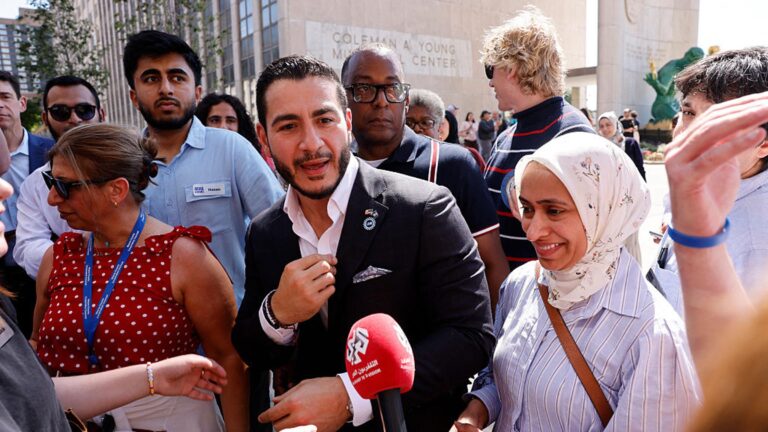
Now, a similar effort is underway to make Abdul El-Sayed the new face of the Democratic Party. This time, it’s not just the far-right ecosystem that has a problem with the newly nominated Senate hopeful. Jewish voters and staunch supporters of Israel are no fan of El-Sayed’s criticisms of Israel or his decision to campaign with Hasan Piker, an activist who has been accused of anti-Semitism. (El-Sayed has repeatedly declined to say if he’d campaign again with Piker, who has walked back his previous statements that the United States deserved 9/11.) Michigan’s Attorney General, Democrat Dana Nessel, who is Jewish, plans to skip the state party’s Aug. 29 convention out of fear for her safety in an environment where, she says, party officials aren’t doing enough to combat anti-Semitism.
It’s created a surprising coalition of El-Sayed skeptics that Republicans are more than eager to inflate. After trying and failing to make hay out of Talarico’s lifestyle and personal life, they’re approach with El-Sayed is much simpler: he’s Muslim.
“Every single Muslim holding public office in America is a trojan horse, and a threat to both national security and our republic,” tweeted Rep. Nancy Mace of South Carolina.
Piped up MAGA influencer Laura Loomer: “As I have been saying for years, Muslims need to be treated like enemy combatants.”
“Two VERY DIFFERENT Americas,” President Donald Trump posted with an image of two married couples—Trump and his wife on the left, El-Sayed and his hijab-wearing wife on the right.
The tableau reveals an ugly reality about U.S. politics right now. The attacks against Talarico, a white man, weren’t meant to register on the scare factor. The ones against El-Sayed, the son of Egyptian immigrants, unequivocally are.
There’s one glaring problem with this strategy: The Other becomes less frightening once they’re known. Support for LGBTQ rights rose like a rocket once folks realized they have gay neighbors. The same proved true with civil rights and immigrant rights.
To that end, El-Sayed already has started an effort to make him seem more familiar. In one of the best ads of this entire campaign year, El-Sayed’s grandparents speak directly to the camera to tell his story like any other family. In one of the ugliest of the year, Senate Republicans’ campaign arm is airing ads highlighting the Democrat’s full name: Abdulrahman Mohamed El-Sayed.
The naked play at fear-mongering has its limits, though. Ask two-term President Barack Hussein Obama. (For the record, Obama’s pastor became an issue in the 2008 campaign for his rhetoric, but it was still a Christian church.)
Or take another Democrat who got a trial as the boogeyman of the day: New York Mayor Zorhan Mamdani, whose parents are of Indian descent and is the first Muslim to lead the nation’s biggest city. The democratic socialist drew harsh fire during his campaign and early in his tenure; even Trump seemed fixated on him. Others in the party have followed suit. Sen. Ted Cruz of Texas, a conservative Republican, recently called both El-Sayed and Mandani “Islamists.”
“They want Sharia Law, they hate Jews, they hate Christians, they hate capitalism, and they hate America,” Cruz told Fox News.
Mamdani had other thoughts. Americans started hearing from him more than most mayors. His social media footprint, his podcast, his communication skills—all combined to make him less scary, and was not turning New York City into Moscow. A June poll from Siena University found 58% of New Yorkers had a favorable opinion of him.
It’s a lot to put on someone in the final three months of a campaign, but that is the task that now falls to El-Sayed. His positions and past statements aside—which some Democratic insiders see as disastrous for a candidate vying for a pivotal Senate seat in swing-state Michigan—the demonization of his religion and background are a different matter entirely. It’s a completely unfair side-quest, but one that is unavoidable—and somehow never falls to the white men in politics.