November 24, 2026:

Bottoms wants to overturn Georgia’s six-week ban, and I care about reproductive justice. But her record as Atlanta mayor still overshadows the symbolism of her historic win.

Every time I go to the ballot box, I am there reluctantly. Typically, it’s after a series of lectures about voting for the “lesser of two evils.” Too often, my choices are either a candidate whose positions I would never vote for or a moderate who has been shoved down my throat as the only winnable candidate.
This cycle repeated itself in November 2026 when I voted for Keisha Lance Bottoms, the former mayor of my hometown of Atlanta. Georgians like me helped her make history as the first Black woman to be elected governor of any U.S. state.
There was a time when having a Black woman as governor—specifically one named Keisha—would have brought me to tears and made me feel empowered. I know better now. The symbolism of a Black woman governor named Keisha does not mean that radical transformation will happen that favors Black liberation.
Even though I knew Bottoms had an opportunity to become the first Black woman elected governor in the country, I did not want her to be my governor.
In my view, she represents an unconvincing legacy of moderate Black Georgia Democrats who are beholden to “The Atlanta Way.” This local political phenomenon is built on pragmatic cooperation between Atlanta’s Black and white business and political leaders. But it leaves working people on the margins.
These officials protect and work with Atlanta’s elite, further the systemic oppression of working-class Black residents—and then call it progress because a Black person was at the helm.
Court decisions shape your rights.
Help us make sure you always hear about them.
Yet I voted for Bottoms because in Georgia, reproductive freedom has all but disappeared. At least two Black women in the state have died because of Georgia’s six-week abortion ban. At least one other is facing murder charges for managing her own abortion with mailed medications (in a sign of skepticism about the case, a judge set a symbolic $1 bond for her release).
Recently, Bottoms said she will push to repeal the dangerous restriction alongside Democrats in the State House of Representatives. I believed that Bottoms was our only shot at getting back any semblance of legal reproductive freedom. So I made the reluctant compromise of casting my ballot for her.
Metro Atlanta is often held up as a “Black Mecca.” This reputation derives, in part, from the fact that among its leaders and its elites are Black people—including the current mayor, Andre Dickens.
This is mostly a fictitious sign of racial progress.
Black leaders in Atlanta, including Bottoms, play a role in upholding the farce of Atlanta as a Black Mecca by parading alongside Atlanta’s Black and wealthy class and inviting them into decision-making rooms.
It creates the image that Atlanta is a land where any Black person can escape oppression under white supremacy. Metro Atlanta’s Black population saw a five-fold increase from 1970 to 2020, with many new arrivals moving there from up north in search of the Black American Dream.
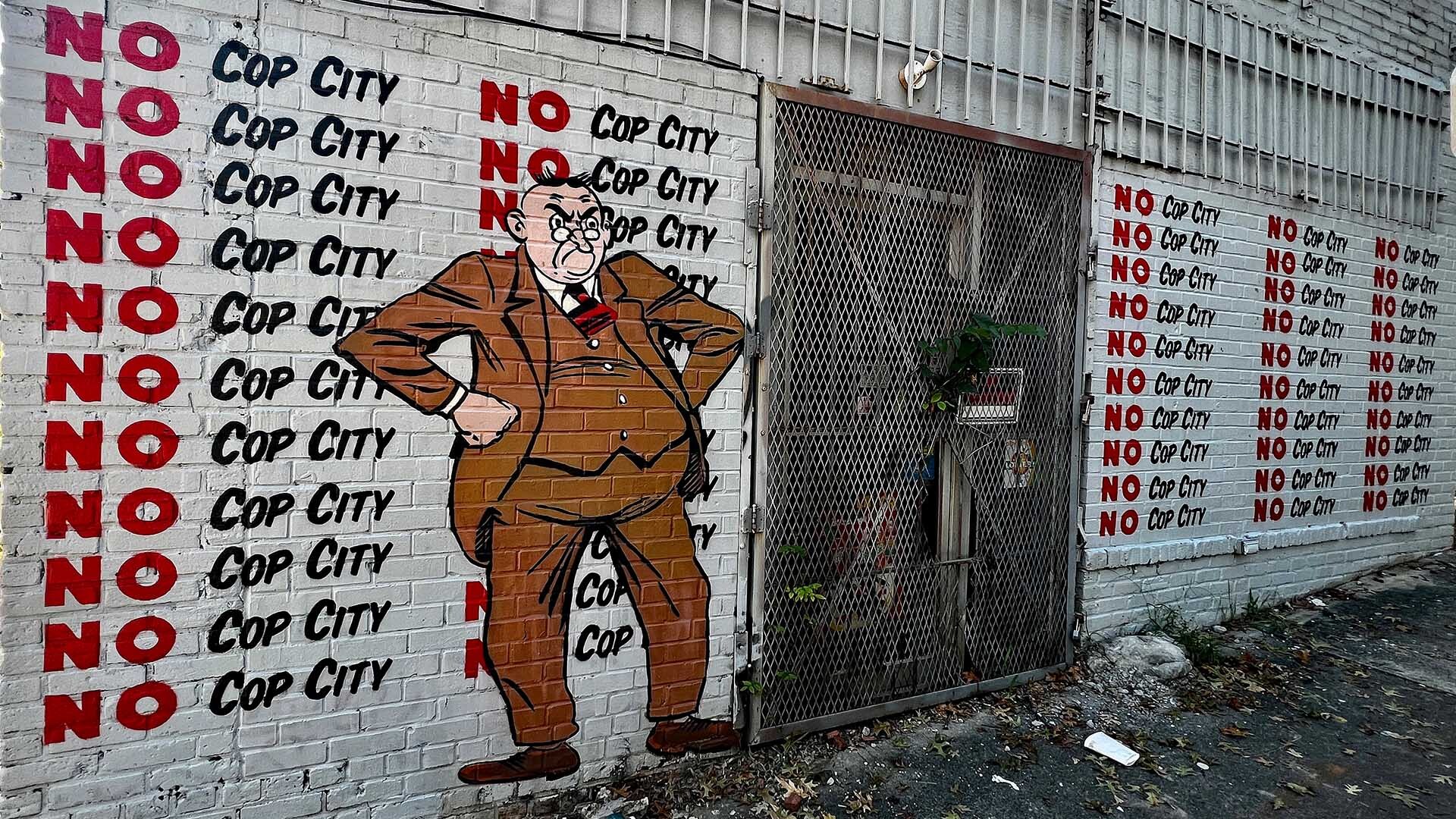
But the truth is that most working class Black people in Atlanta are facing high housing costs, evictions, and oversurveillance by law enforcement. When Bottoms was mayor, from 2018 to 2022, she made this last problem worse with a massive, controversial development called “Copy City.”
Officially called the Atlanta Public Safety Training Center, Cop City is a training city for police and firefighters. It has classrooms, shooting range, and even a mock city. This zone was constructed to look like residential areas of Atlanta, giving police a realistic training ground to sharpen their militarized practices in these communities.
Cop City is a monument to the neglect Atlanta residents consistently face from their officials and a breeding ground for the increased militarization of Atlanta’s police force. It is also an environmental hazard: At least 85 acres of Atlanta’s South River Forest—indigenously named the Weelaunee Forest—were cleared in 2023 to build the facility.
This removed a significant portion of a natural infrastructure that has prevented flooding and purified the air in surrounding Black communities
After the project was proposed in 2021, residents expressed these concerns in hours of public comment at city council meetings. At one 2023 meeting, the majority of people who spoke opposed the project.
Yet neither hours of public comment nor a ballot petition that garnered more than 100,000 signatures in 2023 deterred Atlanta officials from funding $67 million of the project’s $90 million construction budget.
While the rollout of the project was largely overseen by Mayor Dickens, the Bottoms’ administration conceived it in partnership with the Atlanta Police Department. In the aftermath of the 2020 Black Lives Matter movement for George Floyd, Bottoms argued that the new facility would help Atlanta recruit and retain more police officers.
Opponents felt ignored.
“Cop City got pushed through because there were a lot of bourgeoisie players that [wanted] to push it through over the will of the people that genuinely live here,” said Lonnie White IV, a library worker and organizer in the “Stop Cop City” movement.
White, who voted for Bottoms, sits in the same conflict as I do—making a tactical choice within this electoral system that offers us little choices.
The majority of the Stop Cop City movement happened during Dickens’ tenure. But White believes Bottoms shares accountability for the tangible harm that came from the city’s response to protestors. Multiple protesters and one journalist were arrested.
And in 2023, the environmental activist Manuel “Tortuguita” Esteban Paez Terán was shot to death when police raided the protestors’ encampment at the site.
“I have genuine issues with Keisha because Tortuguita died over her actions, and real people got harmed,” they said. “All that over what? Over not being heard, over not listening to the people that live here, and not listening to the people who had genuine concerns over trying to demolish the Weelaunee Forest for a militarized Cop City project.”
Still, White voted for Bottoms because, like me, they felt like there was no other choice. As a library worker, White hopes the new governor will work with unions to improve librarian working conditions. They also hope her election will spur mutual aid and organizing efforts to hold her office accountable.
“Do I think she can maybe get a Medicaid expansion put into place? Maybe,” White said. “Do I think maybe she can get some small reforms done? Maybe. But do I also think the police state will be furthered? Absolutely.”
I’m a health journalist who covers, among other topics, Black maternal health. I’ve also worked as a postpartum doula for two years, and was certified as an abortion doula earlier this year.
Because my work as a doula grounds me in the framework of reproductive justice, I knew that we needed to elect a governor who would consider expanding reproductive freedom in Georgia.
Neither Bottoms nor her Republican opponent, Rick Jackson, talked much about abortion on the campaign trail. But several organizations that fight for reproductive freedom, including Reproductive Freedom for All and the Planned Parenthood Action Fund, endorsed Bottoms.
Now, activists hope that Bottoms will make good on her pledge to help restore—and potentially advance—reproductive freedom in Georgia, even with Republicans still controlling the state senate.
I became a doula in part because I had covered Georgia’s abortion ban in real time. In 2022, before its passage, the majority of people who got abortions in the state were Black.
That means any abortion restriction in this state, where Black women are three times more likely to die from pregnancy related issues than white women, would disproportionately impact us.
And we have seen that happen in more ways than one. Black women have been at the center of many high-profile cases of death or criminalization related to Georgia’s hostility toward abortion.
Both of the women who died because of Georgia’s abortion ban—Amber Thurman and Candi Miller—were Black. Adriana Smith died at age 30 while she was pregnant, and her body was kept on life support for months because her fetus still had cardiac activity.
This was done against her family’s wishes. Smith’s son, Chance, was delivered prematurely at about six months into her pregnancy via cesarean section, in fragile health.
In March 2026, a Black woman in south Georgia was charged with murder for allegedly taking medication to induce an abortion. She faces potential prison time if convicted.
MK Anderson, communications director at the Feminist Center for Reproductive Liberation, a reproductive care clinic in Atlanta, said that because of Georgia’s six-week ban, they’ve had to turn away more people who are seeking reproductive care.
In addition to repealing the ban, Anderson hopes Bottoms will work with a coalition of reproductive justice organizations to pass the Reproductive Freedom Act. That legislation would enshrine the right to abortion into Georgia law, protect abortion providers, and remove harmful barriers to abortion that existed before the six-week ban.
Google’s AI update removed thousands of our pages from search, and our traffic fell by more than 60 percent.
Readers like you are how we stay independent.
“I hope that moving forward, we’re really able to push for the world we really want to live in instead of just trying to go back to the status quo,” Anderson said.
Even before Georgia banned abortion, patients seeking an abortion had to endure a forced 24-hour waiting period. Additionally, physicians treating minors were required to notify their parents at least 24 hours before providing abortion care, which can delay care or prompt abuse from opposing parents.
This practice still stands in Georgia’s current abortion law.
“[W]e can do better overall,” Anderson added. “And really vision for the world we want and not just go for the minimum.”
My hope, too, is that we get more than the bare minimum from Bottoms and her administration.
Georgia needs a leader who doesn’t just champion reproductive freedom but who understands reproductive justice—a more radical framework that encompasses the right to have a child, to not have a child, and the right to raise your family in a safe and healthy community.
For Bottoms to meet the moment for this final tenet, she must do more than push to repeal Georgia’s abortion ban. She should also avoid expanding the already militarized police state she helped to build.
And she must seek true community engagement from working-class Georgians—specifically the people of color who helped elect her—prioritizing their needs over the Democratic machine’s loyalties to corporations and billionaires.
Source