HomeHealth For Immigrant Families, ICE Is Turning Pregnancy and Birth Into a ‘Nightmare’
For Immigrant Families, ICE Is Turning Pregnancy and Birth Into a ‘Nightmare’
October 28, 2026:
Miscarriages in detention. Dangerously early labors. Homelessness. Single motherhood. Women share their stories of deaths, deportations, and crushed dreams.
When Iris Monterroso-Lemus got pregnant in December 2024, she and her fiance, Gary Bivens, couldn’t wait to welcome their first child together into the world.
Like many parents-to-be, she and Bivens—a U.S. citizen—were nervous. They ran to the doctor over any symptom, worried the developing fetus could be in trouble. At 12 weeks pregnant, Monterroso-Lemus went to the emergency room complaining of an ache in her lower abdomen. An ultrasound showed everything was fine. The doctor said the baby was “growing.”
A few weeks later, mid-April, 2025, federal immigration agents detained Monterroso-Lemus while she was walking home from her job at a greenhouse for failing to appear for a scheduled immigration court hearing. (Bivens said Monterroso-Lemus planned to attend, but a neighbor who “is not very fond of Spanish people” called the police on her son—a child from a prior relationship—creating a scene she had to stay and handle.)
Monterroso-Lemus, who is from Guatemala, bounced between multiple ICE facilities until landing at Richwood Correctional Center in Louisiana, hundreds of miles from her home in Tennessee.
Monterroso-Lemus recalled the days of her five-and-a-half-week detention as marked by morning sickness. At night, she slept on the floor to avoid a water leak above her bed. She turned cold, often cockroach-infested food into soup, using warm water from the shower.
Around the 18th week of her pregnancy, Monterroso-Lemus noticed her baby’s movements slowing. She spent days begging for medical care. But, she said, guards only yelled at her and dismissed her pleas. Eventually, the fetal movement stopped.
On April 29—three days into that terrifying stillness—officials took Monterroso-Lemus to Oschsner LSU Health’s Monroe Medical Center in Louisiana. There, she said, she was shackled to a hospital bed, and doctors induced labor. She delivered the stillborn fetus while ICE agents looked on—an experience she never envisioned when in 2014 she arrived in the U.S. seeking refuge from gang violence.
“Imagine having a child dead in my womb for three days,” Monterroso-Lemus told Rewire News Group. “It’s very difficult for me. That’s the honest truth.”
Miscarriage in an ICE ‘hell pit’
Immigration and Customs Enforcement (ICE) documented at least 18 miscarriages between January 2025, when President Donald Trump took office for his second term, and September 2025.
On Oct. 3, 2025, ICE ceased to make miscarriage data publicly available, according to The Guardian’s reporting. It also found that the agency stopped providing records tracking pregnant, postpartum, and nursing detainees in mid-January of 2026.
In internal documents provided to The Guardian, ICE attributed the missing data to a change in its medical accounting system. The Department of Homeland Security (DHS) has subsequently confirmed that it had no miscarriage figures available for October 2025 through June 2026.
Throughout Monterroso-Lemus’ detention in Louisiana, her fiancé, who was still in Tennessee, had little knowledge of her travails. He occasionally communicated with her using a contraband tablet belonging to her bunkmate, so he knew that she was in pain. He knew that she was worried about the unsanitary conditions and lessening fetal movement.
He knew she’d been rushed to the hospital. But he didn’t know that they’d lost the pregnancy until he got a call from the hospital informing him that his son had not survived and asking what he wanted to do with the fetal remains.
“I said, ‘Excuse me? No,’” Bivens said. “‘I just found out…that my baby, that my son is deceased—passed away.’ They were just pushing me to make rushy decisions.”
The last time Bivens saw Monterroso-Lemus, they had no concerns about her pregnancy. Suddenly, Bivens learned that the fetus had been in a bereavement cooling bassinet, or “cold crib,” for two days. The hospital needed him to make a decision.
“Dude,” he remembers saying, “that is the most disrespectful thing you could ever even ask me right now.”
His son, Gary Bivens Jr., was cremated.
The couple had been actively gathering Monterroso-Lemus’ Guatemalan birth certificate and other documents so that they could apply for a U.S. marriage license. They planned to wed with their baby boy in their arms.
Instead, Bivens said, his home country sent his fiance to a “hell pit.”
“It’s pretty much a concentration camp,” he said. “It doesn’t make me feel proud to be an American whatsoever.”
‘No prenatal care’
Federal immigration policy generally advises against detaining or deporting pregnant women, unless detention is required by law or the individual poses a national security concern or an imminent risk of death, violence or physical harm to another person.
Early in the Biden administration, between October 2021 and March 2022, ICE recorded 272 bookings of pregnant, postpartum and nursing people. Two years later, from October 2023 through March 2024, DHS reported the figure at 158.
The number of pregnant, nursing, and postpartum people in ICE detention has soared under Trump.
There were at least 498 bookings of pregnant, postpartum, and nursing immigrants between Jan. 1, 2025 and Feb. 16, 2026, according to DHS data provided to Sens. Patty Murray and Richard Blumenthal following a demand letter. At least 363 of them were deported.
More recent figures have not been made publicly available.
This population has special health needs. In a 2022 report to Congress, ICE outlined its requirements for medical care for pregnant, postpartum and nursing people in detention. It said detainees must receive an initial medical screening within 12 hours of arrival and a health assessment “as soon as practicable,” but generally within 24 hours.
The report also describes provisions for routine prenatal care, pregnancy testing, counseling, nutritional accommodations, and specialist referrals for high-risk pregnancies.
It is not clear whether these requirements are consistently met. ICE relies on private contractors to operate many of its detention facilities and provide health services, which complicates oversight and access to information. Detainees’ medical documentation may be held by multiple providers, and obtaining records directly from DHS can be a lengthy process.
In May 2026, Monterroso-Lemus claimed in the Nashville Banner that ICE medically neglected her during pregnancy, causing a miscarriage. Both she and Bivens later said in interviews with RNG that Monterroso-Lemus recall a single medical visit. She provided a urine sample, they said, and was prescribed numerous pills—including both prenatal vitamins and medication she could not identify.
The government disputes the couple’s allegation. In a June 2025 press release, then-Department of Homeland Security Assistant Secretary Tricia McLaughlin said ICE had provided “full” prenatal care.
But internal DHS emails obtained by The Intercept through a Freedom of Information Act request reveal a more limited account of that care.
In correspondence preparing the agency’s response to Monterroso-Lemus’ allegations, former DHS official Tricia McLaughlin listed several medical encounters at Richwood Correctional Center, including visits to nursing staff, two mental health appointments, and a provider visit concerning what the agency described as “prenatal-care noncompliance.”
The emails also state that prenatal care was ordered and a referral to an outside OB-GYN clinic was initiated, but do not establish whether Monterroso-Lemus received that care.
Hospital records reviewed by RNG state that her pregnancy was complicated by “no prenatal care.”
Dr. Deborah Ottenheimer, an OB-GYN and medical adviser to Physicians for Human Rights, said that when doctors make that kind of a notation, it does indicate that a patient did not receive prenatal care.
“ICE does not always use the greatest facilities,” Ottenheimer said. “The people who work in the prison system, by and large, even if they’re qualified, don’t have the equipment to do what needs to be done,” she added.
I’ve come across cases where they…just don’t know how to do prenatal care,” she said.
The doctor’s note cannot, however, establish that Monterroso-Lemus’s lack of care caused her miscarriage.
‘Explain to me what happened to my son’
On May 9, ten days after she delivered her stillborn son, ICE officers handcuffed Monterroso-Lemus and put her on a plane to Guatemala. The deportation was at her request—in a way.
After weeks in ICE detention, Monterroso-Lemus said she began asking to go back to Guatemala, believing she could at least get better pregnancy care and living conditions there.
Instead, she was deported after miscarrying. Hospital discharge records reviewed by RNG show that she was scheduled for her first postpartum follow-up appointment the same day ICE finally decided to deport her.
Follow-up care is important after a pregnancy loss, Ottenheimer said, to ensure “there is no remaining tissue that could cause bleeding or hemorrhage.”
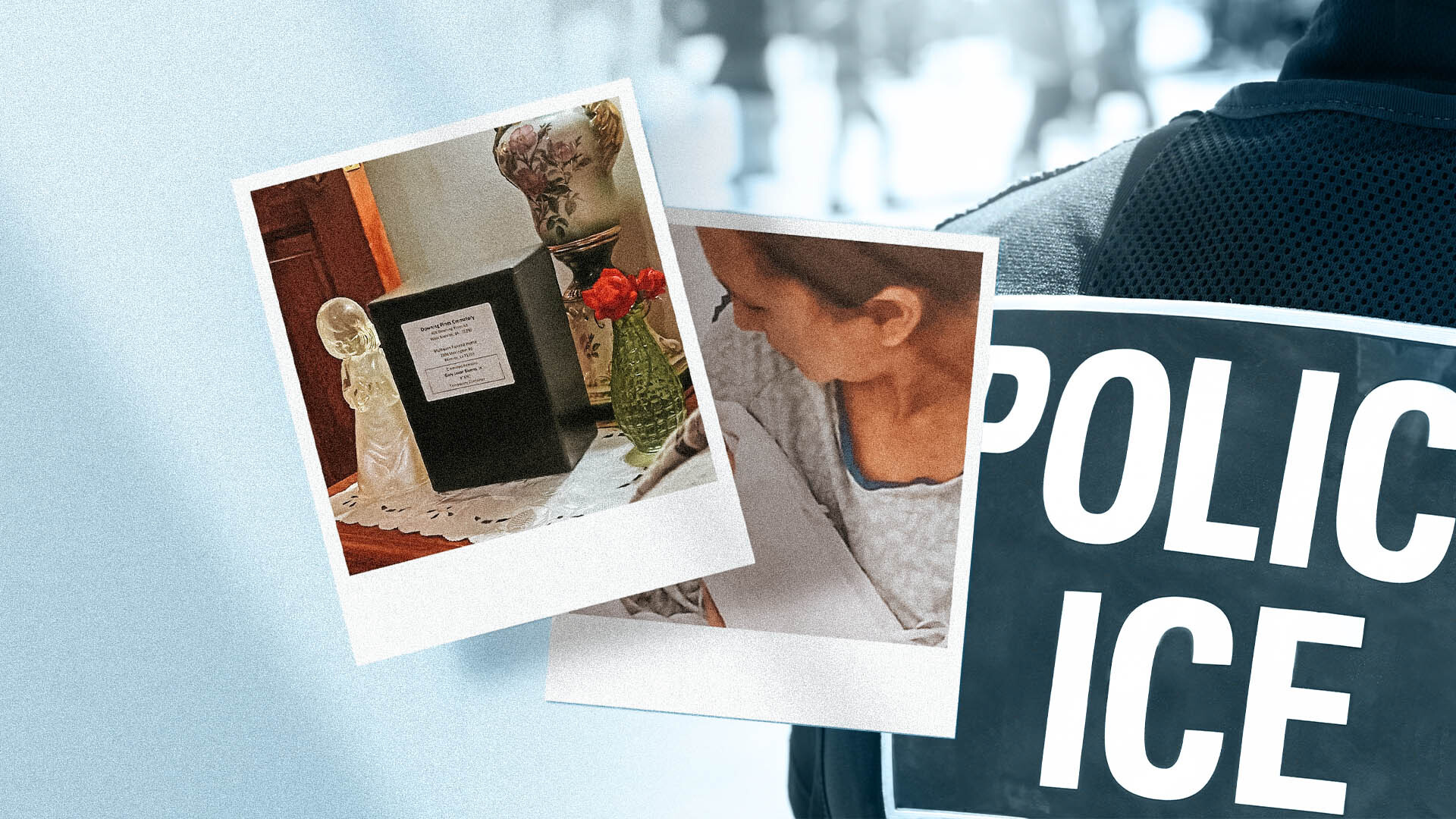
Bivens eventually received his son’s ashes in the mail. He sleeps next to the urn each night. He is working to send money to Monterroso-Lemus, who now lives in Guatemala, and to reunite her with their son’s remains. It would be his first time leaving the country.
“If that doesn’t tell you something,” Bivens said. “I’ve been born, bred, and raised here….I’m ready [to leave]. Just a horrific, horrific experience.”
Monterroso-Lemus and Bivens have accused the agency of fabricating evidence to shield itself from liability.
“I want [the government] to explain to me what happened with my son,” he added.
Pregnancy ‘became a nightmare’
Olivia was pregnant with twins and a parent to six children—three of her own, and three from her husband’s previous relationship—when ICE detained her husband in March 2025, upending her life.
That was the last time Adam, who immigrated from Mexico nearly three decades ago, saw his wife before she went into labor. (RNG has granted the couple pseudonyms to protect their safety and privacy.)
“My pregnancy, which was joyous, became my nightmare,” Olivia said.
Olivia is a U.S. citizen. But, deprived of Adam’s income from working at a trailer-parts company, she struggled to keep the family afloat. She sold whatever she could to make ends meet: cars, tools, jewelry.
“Every choice was difficult,” Olivia said. “Pay the bill or buy food; buy food or put gas in the car to get to doctor’s appointments; or look for money or work somehow. Either decision I made in any situation was a sacrifice.”
Olivia pleaded with federal agents and judges to have mercy on her family, telling them she was eight months pregnant. She even presented notes from physicians to the court, but she remembers feeling dismissed.
On one occasion, she said, an ICE agent on the phone retorted that “everybody has problems.”
A few weeks into Adam’s detention, Olivia went into labor and delivered the twins.
Both babies had serious medical complications, Olivia said, although she said her memory of that period is “in absolute shambles.” She recalls that the twins had trouble regulating their body temperature and circulation. She remembers episodes when they stopped breathing.
Adam never met his babies. They died after about three weeks in the neonatal intensive care unit.
Olivia blames their premature birth on the stressors the husband’s detention put on her pregnancy.
“Stress can have serious consequences,” she said, asking: “What more does this government want to take from me?”
Though studies have linked local ICE raids to upticks in preterm births and infants being born at low birth weights, the research around immigration enforcement’s link to birth complications is still developing. But experts have warned that many pregnant immigrants are under the kind of intense stress that takes a dangerous toll on the body.
“Could we draw a bright line? No,” said Ottenheimer of connecting Adam’s detention to Olivia’s early labor.
She added that pregnancy risk is compounded by “poor nutrition, poor housing, social and economic stressors.” And Olivia had “obviously not ideal living conditions” to keep her healthy at a vulnerable time, Ottenheimer said.
In May, roughly two months after Adam was released from detention, Olivia and her surviving children lost their home. For nearly two months, they shuttled between a homeless shelter and a workshop with a couch, refrigerator, electricity and water cooler jugs for showers.
A year later, Adam reunited with the family in an old two-bedroom house in Denison, Texas. It doesn’t have working air conditioning or heat. Adam hasn’t been able to return to work over fears that his employment would direct the government’s attention toward the company. He is still waiting to be approved for a work permit.
They have not recovered from going five months without Adam’s income.
“We are playing catch-up, and failing, honestly,” Olivia said, adding that they live in fear that ICE will come back.
“People are affected in serious ways, and the government could not care less,” Olivia added. “They know what’s for dinner tonight. People like me and my family have to rely on food banks and food stamps now because [the federal government] wanted to send a message.”
ICE ‘didn’t care’ about pregnancy
Cary López Alvarado, 29, was one week away from her due date when ICE raided her Hawthorne, California, job site on the afternoon of June 8, 2025.
Agents arrested López Alvarado and her cousin, who are both U.S. citizens. They also arrested her Guatemalan partner, Brian Najera.
They “didn’t even know his name” and had no warrant, López Alvarado said.
The three were first taken to an empty parking lot, where officers chained López Alvarado’s abdomen, wrists, and legs. She spent most of her ten hours in ICE custody standing in that gloomy parking lot as officers loaded other immigrants, including her partner and cousin, into vans.
The experience completely changed what she thought she knew about her rights as a U.S. citizen.
“They would tell me that my baby would be born here, but that I would be sent back to Mexico,” López Alvarado said. “I had let them know many times that I was born here and speak English, but they would ignore me.”
When López Alvarado said she had to use the restroom, they told her she’d have to wait—something that isn’t always realistic for pregnant women. After insisting, the ICE agents directed her to a nearby bush.
When she asked one agent if his colleagues would grant her a moment of privacy, she recalled, he responded, “They’re supposed to.”
But they didn’t. So, López Alvarado said, she lowered herself as deep into the bush as she could to be hidden from the watchful federal agents.
López Alvarado—who said she was arrested for obstructing officers after trying to prevent the agents from breaking a car window to reach her cousin and partner—spent the remainder of the night in an ICE facility. There, she said, she was also treated inhumanely.
“[The officers] would push me, yell at me, slam the door in my face,” López Alvarado said. “They were … manhandling us, knowing I’m pregnant and didn’t care. They told me that it was only my fault for putting myself in that situation.”
DHS did not respond to RNG‘s questions about López Alvarado’s arrest.
ICE released López Alvarado around midnight. Almost immediately, she began feeling sharp pains in her stomach and checked into a hospital to be monitored. Days later, Najera was deported to Guatemala. That same day, she remembers, she went into labor.
According to López Alvarado, midwives spent two hours draining her amniotic fluid before she was able to push. When trying to diagnose what caused the excess fluid, one nurse asked if she had recently experienced significant pressure to the stomach.
She’ll never know for sure, but only one possibility came to mind: the shoving and the chains.
Today, Alvarado López is raising her 16-month-old daughter in California with the help of her mother. Her child knows her father only via video chat.
“I believe anyone should be able to have a family,” Alvarado-Lopez said. “You’re creating a family with someone you love, and you’re going to watch that baby grow. I feel like that’s something beautiful and it shouldn’t be thought of as a criminal act or an invasion of any kind.”