


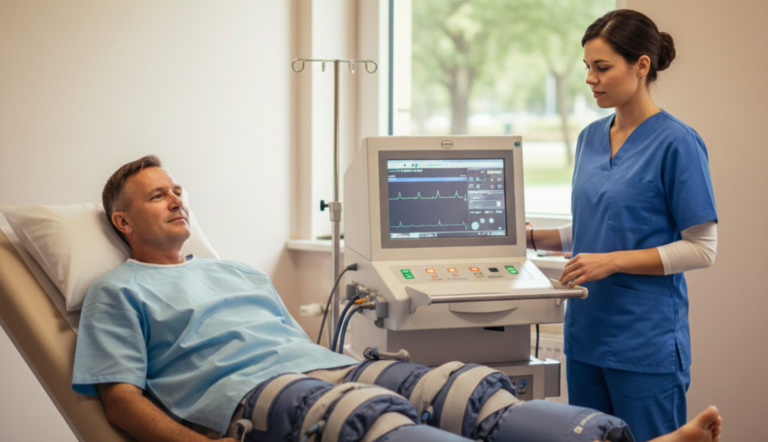
One of the most common causes of erectile dysfunction is poor blood flow. This may be localized to blockages in the penis, or it may be a general circulatory problem due to heart failure, atherosclerosis, or venous insufficiency.
Many of these conditions can be treated using Enhanced External Counterpulsation (EECP) therapy, and there is some evidence that the therapy also helps to improve erections in affected men.
What is Enhanced External Counterpulsation therapy?
Enhanced External Counterpulsation (EECP) therapy is a non-invasive medical treatment primarily used for people with chronic angina (chest pain) or heart failure, especially for patients who are not good candidates for surgery or stents.
EECP uses inflatable cuffs (similar to blood-pressure cuffs) wrapped around the calves, thighs, and buttocks. These cuffs inflate and deflate in sync with the patient’s heartbeat, guided by an ECG.
The therapy:
- Improves oxygen delivery to the heart
- Decreases cardiac workload
- Encourages development of new blood vessels (natural bypasses)
The treatment typically consists of a series of daily treatments over a period of six to eight weeks. Each treatment takes about an hour. Patients are awake and can read, watch TV, or listen to music during treatment.
EECP is currently FDA-approved for the treatment of chronic stable angina and heart failure with reduced ejection fraction. It is used off-label to treat many other circulatory problems.
Enhanced External Counterpulsation and Erectile Dysfunction
EECP has been investigated for the treatment of erectile dysfunction. However, the studies are small and were conducted many years ago.
An early (1998) study applied EECP to a small cohort of men with ED and found improvements in penile rigidity and peak arterial flow after daily treatment sessions.
A controlled observational study in 2007 evaluated changes in erectile function (using IIEF domains) in men with refractory angina and concomitant ED treated with EECP and found significant improvements in erectile function and patient satisfaction.
A 2018 review analyzed several small clinical studies and case series (including the ones above) evaluating EECP in ED, a found overall improvements in erectile function measures following EECP courses.
In another 2007 study, patients reported a significant improvement of penile rigidity after completion of the EECP treatment and a significant improvement of penile peak systolic flow was measured by Doppler sonography.
EECP versus Shockwave Therapy
EECP is sometimes compared to Low-Intensity Extracorporeal Shockwave Therapy (LI-ESWT) as a treatment for erectile dysfunction. The two therapies sound superficially similar because both are intended to improve blood flow. Both are non-invasive treatments that are administered in a series visits to a clinic.
However, EECP addresses issues with general blood flow and circulation, while LI-ESWT is specifically used to treat blockages in the blood vessels of the penis.
- EECP is better suited for men with ED and significant cardiovascular disease.
- LI-ESWT is better suited for men with ED and primary vasculogenic ED.
LI-ESWT has also been much more extensively studied as a treatment for ED (our staff has reviewed more than two dozen clinical studies).