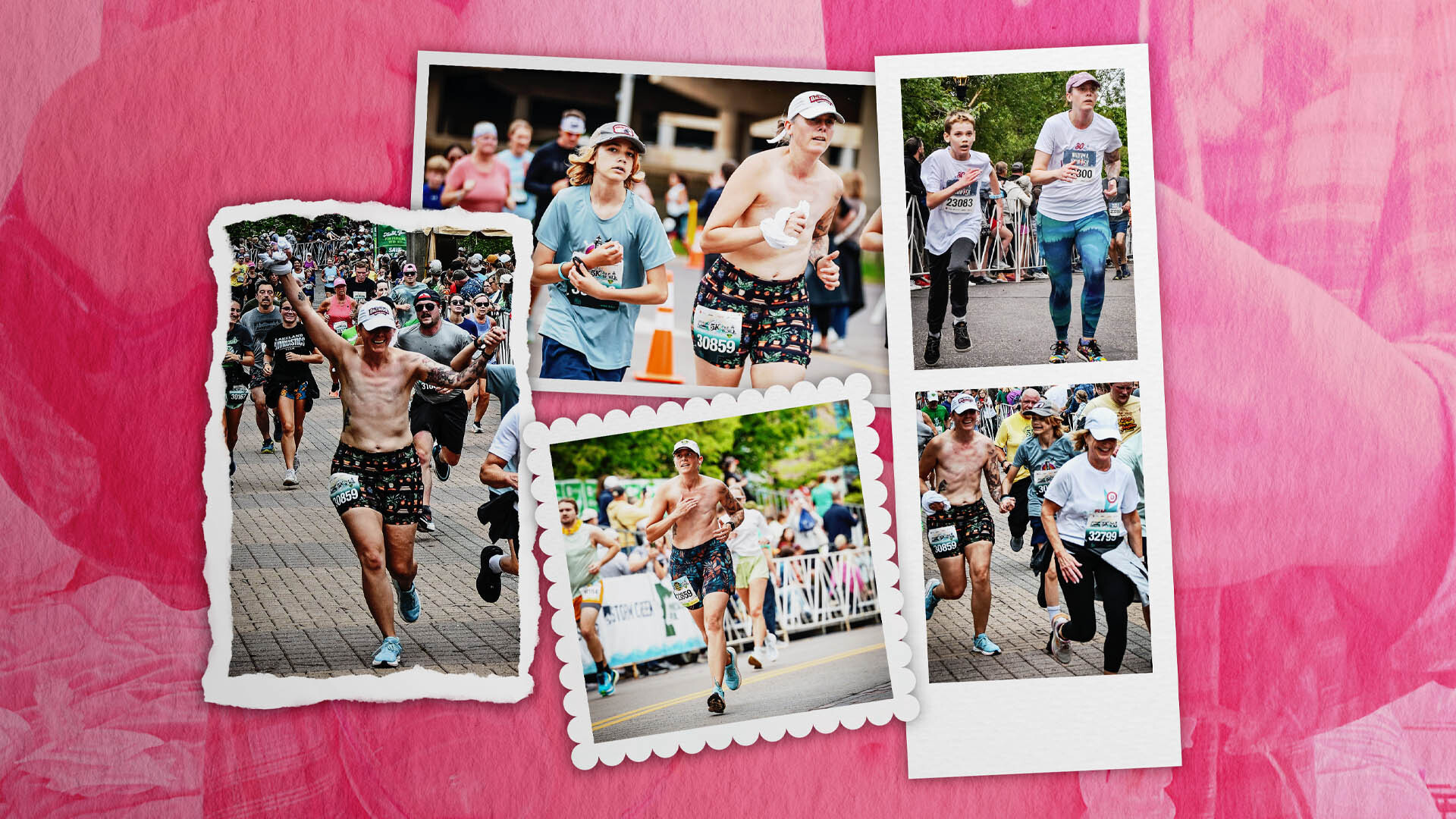
After Double Mastectomy, Minnesota Mom Runs Shirtless

October 28, 2026:

After Double Mastectomy, Minnesota Mom Runs Shirtless

 “In a world where a lot of people are fitting into a mold, you don’t have to,” said Katie Leonard of training for races with her new flat chest exposed.

Photos of Katie Leonard running races shirtless with her son.

On Oct. 4, 2026, Katie Leonard laced up her shoes, secured her race bib to her pink flamingo and unicorn running shorts, and commuted to the start line of the Medtronic Twin Cities 10 Mile race. She joined more than 9,000 runners on a course that weaved from Minneapolis to St. Paul, Minnesota.

But unlike many other runners, Leonard ran the race topless. 

Leonard began her topless running journey over the summer, while training with her teenage son on Duluth, Minnesota’s local running trails for upcoming races.

“It was scary at first, but now, it’s great,” Leonard said. “I am happy that I can walk outside without a shirt and feel good. That is not the Katie of last year.” 

Leonard is part of a growing number of people known as “previvors,” or those with a high risk of breast cancer who have opted to have their breasts surgically removed to prevent developing the disease later in life. This October, the avid marathoner ran her fourth race topless, hoping to start the conversation about breast health and body image that her family never had. 

“My family has been real quiet about their cancer stories, and that doesn’t have to be perpetrated for me and my daughter,” Leonard, 44, said, referring to her 8-year-old. “I want her to feel like she can talk about it and it doesn’t have to be a secret.”

After her mastectomy surgery in July 2023, Leonard opted for an aesthetic flat closure—what patients commonly refer to as “going flat”—instead of breast reconstruction. She trains for her races with her 13-year-old son in the “not quiet” places of town, like the Duluth Lakewalk, near where she and her family live in Minnesota.

Leonard said some people stare or yell when they see her running topless. Others cheer her on. The reactions prompt a range of emotions. Regardless, Leonard said, the runs have helped to normalize her post-mastectomy body—and prompt important discussions about breast cancer. 

“You can very much live a fulfilled life as a woman even though you don’t have your breasts,” Leonard said. “In a world where a lot of people are fitting into a mold, you don’t have to.”

Nipping cancer in the bud

Leonard’s family history of breast cancer goes back four generations on her mother’s side. 

Her great-grandmother, grandmother, great aunt, and three aunts all underwent mastectomy or lumpectomy procedures, and each received reconstructive surgery. Leonard said her relatives knew breast cancer was a threat, but none of them looked into whether there might be a genetic link. They each received medical care, underwent surgery and moved on, Leonard said.

“I think growing up, it was always pretty clear that breast cancer was something in our family, but no one had done any science around that.” 

And no one in her family talked about their experience once they completed treatment, she added.

She wanted her experience to be different.

At an annual physical and mammogram in 2019, her primary care provider suggested she undergo genetic testing to better understand her risk of breast cancer. The results of that testing showed that she inherited a mutation on her CHEK2 gene—which helps fix or destroy cells with DNA damage. The mutation would double Leonard’s lifetime risk for breast cancer. The mutation also increases her likelihood of developing colon cancer, she said. 

That high risk prompted extra medical surveillance. 

Every six months, Leonard rotated between a breast MRI and mammogram. She then waited for results and to hear whether she would need additional tests, like ultrasounds or biopsies. The twice-yearly process, which typically took about two weeks from start to finish, upended spring break trips and family plans. 

“[I] planned my life around the appointments because it was important for me to catch [a potential cancer], versus getting sick and not knowing,” said Leonard, who worried after each appointment that a breast cancer diagnosis—and a major surgery—could soon be coming. 

“I was going through this couple-week process wondering if this would be the time where they would tell me I’d have to pull the trigger and do the thing. Something in me said, ‘I don’t want my schedule to be dictated by these two weeks.’”

Instead of waiting, Leonard elected to “pull the trigger and do the thing” herself. On July 5, 2023, the day after her 41st birthday, she had a bilateral prophylactic mastectomy, a surgery that removes all breast tissue and typically the areola and nipples, with aesthetic flat closure. 

A new, flat normal

“Going flat,” has long been an option for patients, Dr. Melanie Crutchfield, a breast surgical oncologist in Memphis, said. A study of more than 650,000 breast cancer patients from 2004-2019 found more than 62 percent of women had flat closures.

“Some women may choose to go flat or have to go flat, and sometimes we can’t do reconstruction because it’s too dangerous,” Crutchfield said. “They just want to look ‘normal,’and they just want to have a day where no one’s asking, ‘How are you?’”

Crutchfield offers flat closures to all of her patients as an option. While the surgery can have complications like rib pain, she said, aesthetic flat closure has a quicker recovery time; has less risk of the need for follow-up surgeries that often come with breast reconstruction; results in less complications like infection or the rupture of implants; and can allow for more physical comfort from the lack of extra tissue. 

But in Crutchfield’s practice, many patients prefer reconstruction. “It’s rare that they are okay with being flat,” she said.

That’s in part, she added, because of advancements in reconstruction. It’s also because of self esteem and body image. 

Surgeries to remove breast cancer, coupled with treatments like chemotherapy, that sometimes lead to hair loss, can leave patients with a lot of physical changes in a short period of time. That can lead to an “identity crisis” for patients, Crutchfield said. 

“I think that society has taught us that breasts make us a woman,” Crutchfield added. “That’s ingrained. Every ladies’ shirt is made to accommodate breasts. If you no longer have them, they’re going to fit differently than they used to. It’s about perception of self.”

A 2006 study published in the journal Psycho-Oncology found that half of 546 women diagnosed with breast cancer between the ages of 22 and 50 had body image problems in the first months after treatment. Among the sexually active women in the study, having had a mastectomy and hair loss from chemotherapy were both associated with a higher risk of body image problems.

The chance to blend in—to be able to move through the world without explaining what happened to other people—is part of the draw of reconstruction, Crutchfield added.

“Sometimes you just want to hang out, and look like everyone else,” she said. “[Patients] just want to have a day when no one is asking, ‘How are you?’ If it’s something as notable as your breasts are missing, that might cause people to pay more attention than you want them to.”

For Leonard, an adjunct professor at the University of Minnesota at Duluth, the decision to forgo reconstruction for flat closure made sense.

She said she only really felt connected to her breasts when she fed her kids. 

“My boobs have not been a defining feature of my life. I thought they’d always been too small,” Leonard said. “I felt like I would be ready to grieve the loss of the amputation—because that is what it was—and get along.”

‘Allowing people to be shocked’

It took some time for Leonard to get used to the look of her smooth, flat chest in the mirror. But after going flat in 2023, Leonard said, her world transformed. The twice-yearly appointments and leave requests were deleted from her calendar. The two-week-long anxiety spirals disappeared, giving way for more self care, which included her love for running. 

Leonard had already begun running without a sports bra under her running tops. And she was curious about running without a shirt entirely, but she said she wasn’t fully comfortable. That is until a friend recommended she read Going Topless, a book written by Louise Butcher, a breast cancer survivor and marathoner who ran races without a top. 

“After reading it, I decided it was time,” said Leonard. “I talked about it with my son and he said he would be proud to run with me however I wanted to do it.”

So in June 2026, she ditched the tight sports bras and the sweat-drenched shirts and began training for the Garry Bjorklund Half Marathon in Duluth, Minnesota, with her son—all while topless.

“[It was] a leap for me to let people look and process what that means,” she said. “My first thought was, ‘What if they say something? What if they think I’m doing something illegal?’ Which they do.” (The Minnesota Supreme Court ruled in May 2025 that a woman’s chest can’t inherently be criminalized as “lewd.”)

Unlike Leonard, Crutchfield said none of her flat closure patients “have embraced the idea of going topless.”

She added that she often shows patients Beyoncé’s visual album, Lemonade, which features Paulette Leapheart, a cancer survivor who had a double mastectomy and appears topless. 

Still, “most [of] my patients don’t have the confidence to go topless,” Crutchfield said. But “I think it’s great.” 

Most of the stares and comments she gets while running come from men, Leonard said. “I’m allowing people to be shocked at a female presenting without a shirt,” she said. “I let them go through the motions of being angry, confused.”

She added that most of the negative comments come from men.

“The best one: He sees me coming and he is livid,” Leonard said. “He yells, ‘you can’t be out here not wearing a shirt; that’s illegal.’ I said, ‘I don’t even have nipples. You do, and you don’t have on a shirt.” 

But normalizing flat closures keeps Leonard going—sans shirt. 

“It’s more likely people will look at you and recognize this is an option,” she said. “It is important that women live their life.”

Source

Source link