July 10, 2026:

Conference Board Chief Economist Dana M. Peterson speaks to Fox News Digital about decelerating CEO confidence and her long-term inflation outlook.
American consumers hoping for a swift end to years of inflationary pressures are facing a harsh reality check.
While recent relief at the gas pump offered a temporary reprieve, corporate supply chain strains and the lingering effects of global trade and geopolitical shocks are expected to keep prices elevated for the foreseeable future. According to The Conference Board Chief Economist Dana M. Peterson, everyday Americans will continue to feel the squeeze at the grocery store, with the Federal Reserve’s 2% inflation target remaining out of reach until at least 2028.
“I think that consumers are going to continue to complain about elevated prices going forward because CEOs don’t really have much of a choice… Inflation, including the two big shocks of tariffs and the war, probably peaked in the second quarter of this year, and we’ll see inflation slowly decelerate over the course of this, but it’s still gonna be high,” Peterson told Fox News Digital.
“Headline [personal consumption expenditures] will probably peak in the third quarter of this year, again, as it’s going to reflect those pass-through prices from the shock from the war,” she added. “And of course, the [consumer price index] numbers are going to probably be higher because… they’re just different measures. But nonetheless, we’re not going to be anywhere close to 2% inflation by the end of this year, and probably not until sometime in 2028.”
FED’S FAVORED INFLATION GAUGE REMAINED ELEVATED IN APRIL
The result, the economist said, is a significant shift in how Americans are spending their money.

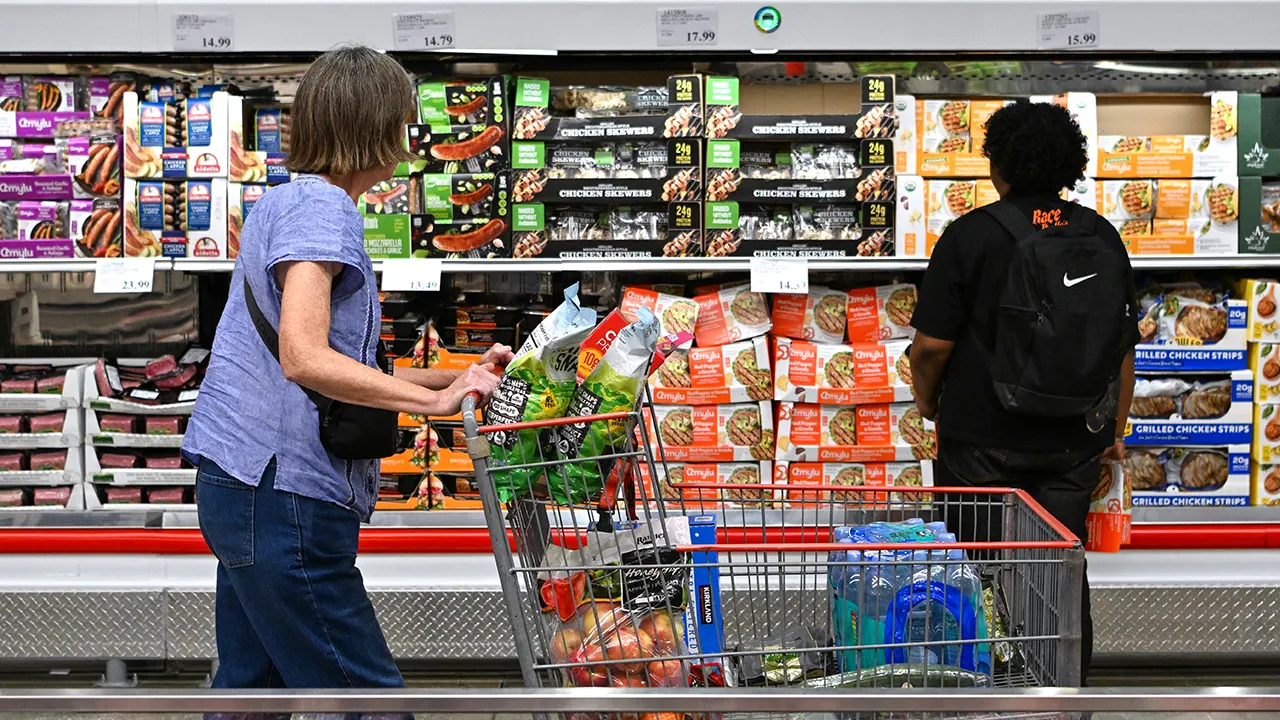
People shop for groceries at a store in Arlington, Virginia, on June 10, 2026. (Getty Images)
“Consumers are spending less on expensive goods and services and more on cheaper options. They’re also shifting the composition of their spending to things that are more necessary rather than discretionary,” Peterson said. “Consumers are shying away from those big-ticket items.”
In June, The Conference Board’s Measure of CEO Confidence, conducted in collaboration with The Business Council, surveyed 141 CEOs and found the overall score fell to 47 in Q2 from 59 in Q1. Any reading below 50 means negative economic outlooks outnumber positive ones.
Only 15% of CEOs say the economy is better than six months ago, down from 39% in Q1, while 47% say it’s worse, up from 8%. Additionally, 40% of respondents expect economic conditions to worsen over the next six months, compared with 13% who felt that way last quarter.
New York Fed President John Williams speaks live from the Federal Reserve, offering insights on the economy’s steady growth and stable labor market.
“It certainly wasn’t surprising that CEO confidence fell because the survey took place in the span of May 4 through May 18, which was the height of the conflict in the Middle East,” Peterson said, adding that peace negotiations with Iran are underway and thus alleviating immediate worries.
“So I would imagine CEOs’ confidence would be materially better today, even if it’s still somewhat negative. And indeed, the industries that would probably be the most harmed are those who use inputs like fossil fuels, fertilizer, chemicals like ammonia and sulfur to produce derivative products like groceries, and also aluminum in terms of construction. But also, the services around those things like restaurants and retailers – who are basically going to be feeling the crunch – will need to pass those costs on to consumers.”
The recent survey also found that 31% of executives plan to reduce their workforce. Peterson said those planned cuts are heavily concentrated in industries investing in automation.
“I think that consumers are going to continue to complain about elevated prices going forward because CEOs don’t really have much of a choice… Inflation… it’s still gonna be high.”
“Most of the layoffs are concentrated in industries that are actually creating new technologies like AI and quantum computing, the earlier adopters, and jobs that are easily automated. So those sectors definitely include tech… anything in finance,” she said. “I would also include transportation and warehousing industries, because a lot of what they’re doing can be automated. And then finally, I would say retail businesses that have very large online footprints and can outsource a lot of the customer service are also letting people go.”
While post-pandemic wages are technically higher on paper than the historical averages seen between the 2008 financial crisis and 2020, structural costs like housing, insurance and healthcare have fundamentally altered consumers’ purchasing power, according to the economist.
MacroMavens President Stephanie Pomboy breaks down the Fed’s growing divide, next week’s inflation report and what investors should expect as earnings season begins on ‘Mornings with Maria.’
“Many services are actually becoming more expensive, like housing, utilities, healthcare and insurance. Prices are also rising due to these structural changes like aging populations, technological advancement, natural disasters, increasing demand for healthcare, and also a dearth of affordable housing coupled with elevated mortgage rates. So all of these pricing pressures are forcing consumers to make tough decisions.”
Despite the pessimism among C-suite executives and many consumers, Peterson said she does not expect the U.S. economy to enter a downturn within the next six months.
“Do I expect slower growth because of the inflation shocks? Sure, but the U.S. economy can grow anywhere from 1.5% to 2% and be just fine,” she said. “One-percent [GDP growth] is kind of stall speed, and it feels like a recession, and it also increases the likelihood that you do go into a recession. That’s not what I’m anticipating.”
GET FOX BUSINESS ON THE GO BY CLICKING HERE
Instead, Peterson advised consumers to look past Wall Street’s day-to-day market swings and monitor government labor market data instead.
“I would not look at the stock market because financial markets are financial markets. They are not the real economy,” she said. “I think an easy measure for most people is jobless claims… They’re basically the number of people who file for unemployment insurance every month. And so far, that number’s been very low, close to historical lows. So if you start seeing that number [in] the course of a month – or several months – start to rise precipitously, that’s a signal that something’s wrong.”
READ MORE FROM FOX BUSINESS