HomeAuto World’s Oldest Bank Bids $39.8B for Two Rivals While Fighting Off Intesa
World’s Oldest Bank Bids $39.8B for Two Rivals While Fighting Off Intesa
August 23, 2026:
gettyimages.com
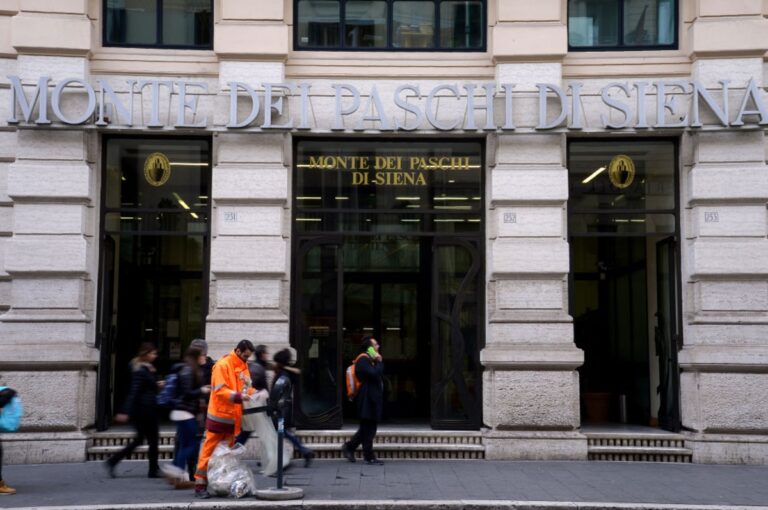
The world’s oldest bank — the very institution Italian taxpayers bailed out for €5.4 billion (approximately $6.3 billion) just nine years ago — became, on Friday morning, the first banking institution in modern European history to simultaneously exist as a hostile takeover target and an unsolicited acquirer of two separate rivals at once. It launched twin all-share offers for Banco BPM and Banca Generali before European markets opened.
Banca Monte dei Paschi di Siena, founded in 1472 in the Tuscan hilltop city of Siena, filed formal offer documents filed for twin voluntary all-share exchange offers for Banco BPM and wealth manager Banca Generali on August 21. The combined consideration is approximately €34 billion (approximately $39.8 billion) — a figure that exceeds the annual GDP of several European nations and that, if both transactions complete, would make MPS the anchor of Italy’s third major banking group.
The move is CEO Luigi Lovaglio’s most audacious response yet to the unsolicited €30.6 billion (approximately $35.8 billion) cash-and-share offer that Intesa Sanpaolo, Italy’s largest bank, launched for MPS in June 2026. Neither board has endorsed the other’s approach. Both offers remain technically live simultaneously — a configuration, the draft of the filing itself acknowledged, that has no modern precedent in European banking.
Italy’s Banking Standoff Breaks Every Historical Precedent
Under Italian takeover law, the Testo Unico della Finanza’s Italian passivity rule Article 104 — the so-called passivity rule — imposes a board neutrality obligation on any company that has received a hostile bid: its directors may not take defensive actions without first obtaining shareholder approval. That constraint has historically limited a target company’s options to lobbying regulators, seeking a white-knight acquirer, and fighting the valuation battle in the press.
Lovaglio’s strategy turns the passivity rule into an instrument of offense. Rather than waiting for a friendly merger partner to emerge — a path that collapsed in early August when Crédit Agricole saw no value in an MPS-BPM tie-up — he brought the proposal directly to the targets’ shareholders, bypassing the need for pre-agreement from their boards. MPS’s own shareholders will vote at an extraordinary general meeting convened for October 29, 2026, on whether to authorize both offers and the extraordinary distribution that accompanies them.
The structural novelty matters beyond the immediate Italian drama. No bank in Europe has previously launched simultaneous contested bids for two targets while itself remaining the subject of a live contested bid — and done so entirely in shares, with no cash component, while subject to the passivity rule requiring shareholder authorization before it can act. If Lovaglio’s strategy succeeds, it will establish a model for how European banks can escape hostile bids not by finding a white knight, but by becoming an aggressor on two fronts at once.
The Numbers
Under the Banco BPM offer, MPS is proposing Banco BPM exchange ratio terms of 1.567 newly issued MPS shares for each Banco BPM share, implying a price of €16.729 per share (approximately $19.57) and a total consideration of approximately €25.35 billion (approximately $29.7 billion). The offer carries no premium over official August 19, 2026, market prices once MPS’s proposed extraordinary shareholder distribution is factored in.
The Banca Generali offer is structured at Banca Generali offer pricing terms of 6.958 new MPS shares for each Banca Generali share, implying a price of €74.284 per share (approximately $86.91) — a 10% premium over recent market prices — and a total consideration of approximately €8.72 billion (approximately $10.2 billion).
In the event both offers are fully accepted and the Mediobanca integration (completed September 2025) is accounted for, the resulting combined group ownership structure would give existing MPS shareholders approximately 50.1% of the combined group, Banco BPM shareholders approximately 37.2%, and Banca Generali shareholders approximately 12.7%.
The combined entity would carry a MPS pro forma balance sheet of approximately €466 billion (approximately $545 billion) in total assets, with €245 billion (approximately $287 billion) in customer loans, €315 billion (approximately $369 billion) in direct funding, and approximately €810 billion (approximately $948 billion) in total financial assets under management. MPS projects the combined group would rank as Italy’s third-largest banking group by total assets and would carry a projected pro forma market capitalization of approximately €80 billion (approximately $93.6 billion).
MPS also projects approximately €2.6 billion (approximately $3.0 billion) in annual pre-tax synergy projections and cumulative dividends of €15 billion (approximately $17.6 billion) over the 2026–2030 period.
Alongside the two bids, MPS proposed an extraordinary distribution to MPS shareholders of €4 billion (approximately $4.7 billion), partly in cash and partly in Assicurazioni Generali shares representing approximately 4.5% of the insurer. That figure slightly exceeds the €3 billion (approximately $3.5 billion) extraordinary distribution Intesa Sanpaolo offered MPS shareholders as part of its rival bid, making MPS’s proposal directly competitive on shareholder-return terms.
How the World’s Oldest Bank Got Here
Founded in 1472 as a mount of piety — a public institution designed to lend money to the poor — MPS spent much of the past two decades as a cautionary tale. A disastrous €9 billion (approximately $10.5 billion) acquisition of Banca Antonveneta in 2007, timed almost exactly to the global financial crisis, triggered a decade of impairment, scandal, and shrinking capital. By 2017, Italian taxpayers funded a 2017 Italian taxpayer bailout of €5.4 billion (approximately $6.3 billion), and the Italian Treasury held a 64% stake in the bank — a position it was obligated to reduce as a condition of European Commission approval for the rescue.
The turnaround began in 2022, when Lovaglio arrived from UniCredit and began a restructuring that cut roughly one-fifth of the workforce while the interest-rate environment was moving sharply in banks’ favor. The Treasury reduced its Italy Treasury stake reduction progressively, reaching approximately 11.7% before the Mediobanca deal and approximately 4.9% after it.
The pivotal move came in January 2025, when Lovaglio launched a surprise all-share bid for Mediobanca — the prestigious Milanese investment bank that also held a roughly 13% controlling stake in Assicurazioni Generali, Italy’s largest insurer. The Mediobanca offer was bitterly contested, delayed by a criminal investigation into market manipulation involving Lovaglio and two major MPS shareholders (business tycoon Francesco Gaetano Caltagirone and Delfin, the holding company of the late Ray-Ban billionaire Leonardo Del Vecchio’s heirs), and ultimately completed in September 2025. Lovaglio has denied wrongdoing and the MPS board has repeatedly reaffirmed its confidence in his leadership.
That acquisition fundamentally changed MPS’s strategic position. By controlling Mediobanca, MPS inherited Mediobanca’s 13% stake in Generali, catapulted itself to Italy’s third-largest bank by assets, and acquired a coveted platform in investment banking, wealth management, and insurance distribution. It also made the bank newly attractive to Intesa Sanpaolo.
Intesa’s Bet and Rome’s Problem
Intesa Sanpaolo CEO Carlo Messina launched Intesa’s €30.6 billion tender offer for MPS on June 8, 2026, structured as 16 newly issued Intesa shares plus €1 in cash for every 10 MPS shares tendered, valuing MPS at approximately €30.6 billion (approximately $35.8 billion) at launch — a 12.5% premium at the time. Messina described a combined entity that would become the eurozone’s second-largest bank by market value, behind Santander alone, and projected acquisition of most of MPS’s Mediobanca subsidiary and its Generali stake.
Rome’s reaction was cool from the start. Prime Minister Giorgia Meloni had made it a policy goal to create a competitive third major banking pole — alongside Intesa and UniCredit — rather than allowing Italy’s banking landscape to concentrate around just two giants. Her government had already opposed UniCredit withdrew its BPM bid in 2024-2025 (using golden power rules, and ultimately successfully, as UniCredit withdrew its offer in July 2025). Economy Minister Giancarlo Giorgetti signaled Italy would impose conditions on any deal that threatened competition.
Intesa’s plan specifically included Intesa’s plan for MPS branches of selling approximately 635 MPS branches to Unipol and folding them into the BPER network — a proposal that alarmed Tuscan institutions worried about job losses and branch closures in the region where MPS has operated for more than five centuries.
Why Does Italy’s Government Care Who Owns a Bank?
Italy’s government has used its “golden power” — a legal authority to impose conditions or veto foreign acquisitions of strategic assets, established under Law No. 4/2026 golden power and its predecessor Law 56/2012 — to intervene in banking M&A more actively than any other major EU economy. The European Commission infringement procedure opened a formal infringement procedure against Italy in November 2025, arguing that its golden power application in banking overlaps with the ECB’s exclusive supervisory authority under the Single Supervisory Mechanism and restricts the free movement of capital.
That tension — between Rome’s desire to direct Italian banking consolidation toward political goals (creating a domestic third pole rather than allowing cross-border or intra-Italian concentration) and Brussels’ insistence on a unified internal market for financial services — is the broader frame within which MPS’s counter-bid lands. Whether Italy’s golden power applies to a purely domestic Italian-to-Italian combination (Intesa buying MPS) is a separate and contested question from whether it applied to UniCredit buying Banco BPM. Sources indicate the government has not formally triggered a golden power review of Intesa’s bid, but neither has it endorsed it.
What Is Italy’s ‘Passivity Rule’ and Why Does It Matter Here?
Under Article 104 of Italy’s Testo Unico della Finanza, a company that has received a bid from a third party is subject to a board neutrality requirement: before taking any action that could interfere with the bid — including launching competing offers — its board must first obtain shareholder approval. This is why MPS had to convene an extraordinary general meeting for October 29, 2026, rather than simply launching its counter-bids immediately. The passivity rule creates a mandatory gap between the decision to act and the authorization to do so — a structural delay that Intesa may attempt to exploit in shareholder communications.
The Specific Obstacles
The path to completion of either MPS counter-offer is formidable.
Crédit Agricole holds approximately 29% of Banco BPM’s shares — sufficient to effectively block any major strategic decision BPM’s management and remaining shareholders might otherwise approve. The French bank has engaged Crédit Agricole’s own strategic options with Deutsche Bank and Rothschild to evaluate, with sources indicating that a combination of Crédit Agricole’s Italian operations with Banco BPM remains on the table as an alternative. Having already signaled that an MPS-BPM combination would destroy value for BPM shareholders, it is deeply uncertain whether Crédit Agricole will tender its shares into MPS’s offer.
Regulatory approval is a separate layer. Any transaction of this scale requires green-lights from the Bank of Italy, the European Central Bank (as supervisor under the Single Supervisory Mechanism), Italy’s markets regulator Consob, and potentially competition authorities. Because Intesa’s bid for MPS remains technically active, MPS’s launch of competing offers simultaneously triggered the passivity rule obligations that require the October 29 EGM vote before MPS’s board can formally commit to proceeding.
The Banco BPM offer also carries no premium over market prices — a point that BPM’s independent advisors will likely highlight when they publish a fairness opinion, and one that weakens MPS’s negotiating leverage with BPM shareholders who might otherwise be indifferent between MPS’s all-share offer and independent operation.
Both offers are also conditioned on MPS shareholder approval, on achieving a minimum acceptance threshold of 50% plus one share in each target, and on full regulatory clearances. Either can proceed independently of the other.
The Strategic Logic
Beyond its defensive character, MPS frames the proposed combination as an industrial project with a clear rationale.
Acquiring Banca Generali — Italy’s largest listed private bank by assets under management — would deepen the wealth management franchise MPS inherited from Mediobanca, extending it to a distinctly affluent client base and dramatically increasing cross-selling opportunities between MPS’s broader retail network and Generali’s high-margin advisory services. This Banca Generali wealth management rationale anchors the industrial logic of the Generali offer.
Acquiring Banco BPM would strengthen MPS’s geographic footprint in a region where it is historically underrepresented. BPM is Italy’s third-largest bank by market value in its own right, with roots in Lombardy and deep penetration into Italy’s affluent industrial north — a counterpart to MPS’s Tuscan concentration. Together, the two lenders would hold approximately €245 billion (approximately $287 billion) in combined customer loans.
The MPS return-on-equity projections that MPS cited on its analyst call — rising from approximately 13% pro forma in 2025 to more than 19% by 2029 — reflects management’s confidence that synergy realization and cross-selling will transform what is today a defensive maneuver into a durable competitive position. MPS’s advisors UBS Europe and BofA Securities have underwritten the industrial logic of the plan, per the MPS investor call projections.
Where Europe’s Banks Stand
Italy’s saga does not occur in isolation. Across Europe, a years-long consolidation wave is reshaping the financial landscape as banks seek the scale needed to compete with American giants. UniCredit’s lengthy pursuit of Commerzbank — which moved toward formal merger talks in August 2026 after years of hostility — is the other major theater in Europe’s banking consolidation drama.
Italy has historically been shielded from the most aggressive forms of hostile banking takeovers by a combination of cross-shareholding structures, government-aligned bank foundations, and the golden power rules — all of which created informal barriers to contested control changes. That dam has broken in the space of roughly two years. UniCredit launched a hostile bid for Commerzbank in Germany; MPS took Mediobanca in a contested offer; Intesa launched an unsolicited approach for MPS; and now MPS itself is bidding — simultaneously — for two rivals while remaining a takeover target.
That cascade is what TechTimes’s Commerzbank/UniCredit coverage identified as European banking’s most significant cross-border test since the 2008 financial crisis. The MPS counter-bid extends that transformation to domestic Italian consolidation: if Lovaglio can build a €80 billion ($93.6 billion) institution out of a bank that Italian taxpayers almost lost to bankruptcy, the definition of what constitutes a viable European bank is being rewritten in real time.
Currency conversions are based on an EUR/USD rate of approximately 1.17, as of August 21, 2026, and are approximate.
Frequently Asked Questions
What makes MPS’s counter-bid historically unprecedented?
MPS is the first banking institution in modern European history to simultaneously exist as a hostile takeover target and an unsolicited acquirer of two separate banks at the same time, while subject to Italy’s Article 104 passivity rule mechanics — a legal obligation that requires shareholder approval before its board can formally commit to the defensive acquisitions it launched Friday. No European bank has previously mounted simultaneous contested bids for two separate targets while itself remaining the subject of a live contested bid.
Why can’t MPS’s shareholders simply reject Intesa’s offer and be done with it?
Rejecting Intesa’s offer requires enough MPS shareholders to decline to tender their shares during the acceptance period, which is not scheduled to open until the first half of December 2026. In the meantime, Intesa’s offer remains technically live, and MPS’s board cannot take formal defensive actions without the passivity rule shareholder approval requirement at the October 29 extraordinary general meeting. Even after MPS shareholders vote on October 29, the counter-bids themselves require Banco BPM and Banca Generali shareholders to tender at least 50% of each company’s shares — which means MPS cannot control the outcome unilaterally.
What is Crédit Agricole’s role, and why does it matter?
Crédit Agricole, France’s second-largest bank, holds Crédit Agricole’s 29% BPM stake in Banco BPM — the single largest stake, enough to effectively block any major strategic decision BPM’s management cannot otherwise secure supermajority support for. The French bank has already indicated it sees no value creation in an MPS-BPM combination. Whether it tenders its shares into MPS’s offer is the single largest variable determining whether the Banco BPM deal succeeds. Crédit Agricole is separately evaluating Crédit Agricole’s own strategic options with Deutsche Bank and Rothschild, with a merger of its Italian operations with Banco BPM as an alternative outcome.
What does this mean for Italian banking customers?
If Intesa Sanpaolo successfully acquires MPS, Italy’s banking market would be dominated by two institutions — Intesa and UniCredit — rather than three. Competition authorities and Italy’s government have both signaled concern that this concentration would reduce choice and pricing competition for retail banking customers, particularly in Tuscany and southern Italy where MPS has historically anchored local lending. The Meloni government’s third-pole strategy — creating a competitive third major institution — is designed explicitly to prevent that outcome. Whether MPS’s counter-bid achieves it depends on Italy’s banking competition concerns and shareholder decisions not expected before mid-2027.