August 22, 2026:


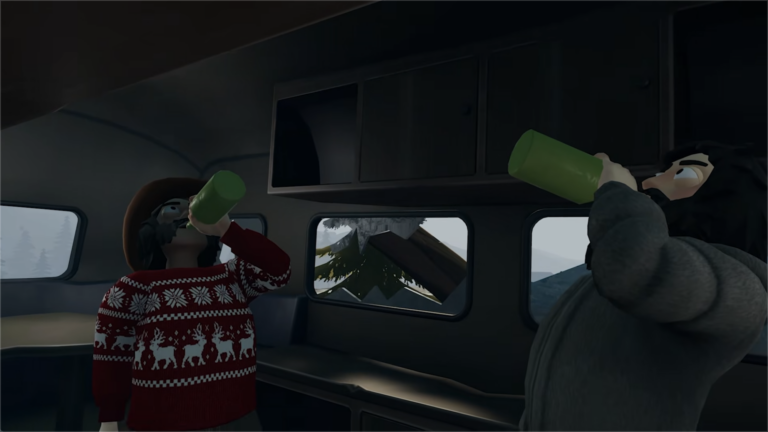
Rerouted, a wilderness survival game from indie developer Tooman, is now wishlisting on Steam with a mechanic that positions it alongside — and explicitly apart from — a wave of co-op horror games that have used the same audio pipeline for very different purposes: the wildlife in this game can hear players talking through their microphones. Bears and wolves defending their territory will react when players speak near them, turning every off-hand comment into a potential threat from a creature that does not want you there. The distinction matters because TechTimes readers are already familiar with how this works in horror — what Rerouted does is apply it to a completely different emotional register.
Two weeks ago, TechTimes covered Voidwood, a co-op horror title from Santa Barbara Games whose predator AI listens to real-time microphone amplitude and hunts players based on sound level, independent of what they actually say. That article detailed how proximity voice chat works at the architecture level: a game server continuously tracks player positions, calculates distances between characters, and applies an audio attenuation curve that fades volume with distance and cuts transmission entirely beyond a defined radius. In horror games, the same pipeline that lets teammates hear each other becomes the detection system that brings the monster.
Rerouted routes the same pipeline through a completely different logic. The animals in the game are not supernatural hunters patrolling the map in search of noise. They are territorial animals defending the land they occupy. A bear does not care that you exist until you enter its territory and start talking — at which point the proximity chat signal registers as a real-world intrusion into a real-world (simulated) space. That framing shifts the emotional stakes from horror to something closer to the chaos of a camping trip gone wrong: the game’s own store description puts it plainly — “the only thing more dangerous than the wilderness is your friend.”
The precedent for non-player characters receiving proximity voice chat audio as a behavioral trigger goes back to Phasmophobia, the co-op ghost investigation game that has sold more than 25 million copies across PC and console. In Phasmophobia, the ghost AI processes spoken keywords — a speech recognition layer on top of the spatial audio system — and responds to specific phrases players say aloud. Voidwood removed the keyword layer and made the detection pure amplitude: sound level, not content, determines whether the predator tracks you.
Rerouted appears to work differently still. Based on Tooman’s Steam page description, the wildlife mechanic is tied to territorial behavior rather than a map-wide detection system. Animals “defend their territory, react to your presence, and can even hear you through proximity voice chat.” That construction — territory first, presence second, voice third — suggests the detection hierarchy is spatial before it is acoustic. Getting too close to a bear’s territory triggers a behavioral response; speaking near it adds an escalation layer. The practical difference from Voidwood’s amplitude-detection model is meaningful: Rerouted players are not required to maintain silence discipline throughout an entire run, only when within range of an animal that has claimed the space around it.
The implication for co-op play is comedic as much as tactical. Voidwood’s design punishes every syllable. Rerouted’s design punishes the group member who announces a bear sighting at full volume while standing next to the bear. These are different genres of social failure, and Rerouted’s version is, based on Tooman’s own framing, the funny one.
The voice-and-wildlife mechanic is Rerouted’s most immediately distinctive feature, but its navigation design may be the more structurally unusual choice for 2026. According to Rerouted’s official Steam page, the game has no waypoint markers and no minimap. Players navigate with a physical map, a compass, and natural landmarks — rivers, ridgelines, forest clearings, mountain passes. Tooman’s design language on the Steam page frames this as a return to wilderness literacy: “Read your map, use your compass, navigate by natural landmarks, and carve your own path through dense forests, swamps, rivers, and mountain passes.”
This is a countercultural position in a genre that has broadly moved toward automated wayfinding. The friendslop wave — the string of successful co-op titles including PEAK, R.E.P.O., and Lethal Company that have dominated Steam’s multiplayer charts since 2023 — tends to emphasize accessible, frictionless group entry: pick up and play, die together, laugh, and queue again. Rerouted’s navigation system raises the floor. Getting home is the game’s stated goal, and doing it wrong means being more lost, not just less efficient. Whether that raises the ceiling for streaming potential (navigation failures are watchable in a way that wrong-turn markers are not) or limits the game’s audience to players willing to invest in reading a map remains to be seen.
Beyond navigation and wildlife encounters, Rerouted is a full wilderness survival loop. Players hunt, fish, forage, cook over open fires, and craft tools from available materials. The cold is a constant threat — a mechanic the game takes seriously enough that camp construction is not optional infrastructure but an ongoing survival requirement. Shelters need to be built and upgraded, fires maintained, and the warmth-versus-exposure balance managed across the journey home.
The camp design has a social dimension built in. Tooman’s own copy describes the scenario of deciding “who gets stuck sleeping at everyone else’s feet” when a shared shelter fills up — a detail small enough to be throwaway in most games and specific enough here to signal that the studio is building around group friction as much as group cooperation. Rerouted supports solo play and online co-op for up to four players, with Family Sharing confirmed.
Tooman has a minimal public presence. The Steam community discussion page for Rerouted includes posts noting that searching for Tooman returns no results — the studio has no prominent web presence outside the Steam listing itself, with a Discord linked from the store page. That level of opacity is not unusual for a solo developer or very small team at pre-announcement stage, but it does mean that details about the studio, its members, or its development history are not yet available.
System requirements are listed as TBD across all fields except storage, which will require 10 GB of available space. No price point has been announced, and no release date has been given beyond “coming soon.” The game supports 10 languages at launch — English (with full audio), plus French, Spanish, Russian, Ukrainian, German, Japanese, Polish, Portuguese-Brazil, and Simplified Chinese with interface and subtitle support — suggesting a global launch is planned from the start.
Yes — that is the central wildlife mechanic Tooman has confirmed for the game. Bears, wolves, and other animals in Rerouted defend specific territories, react to player presence, and can also hear players speaking through proximity voice chat. The game’s own design advice for wildlife is that the smartest move around wildlife is sometimes to stop talking and stay out of their way. This is architecturally similar to how Phasmophobia routes voice chat audio to a ghost AI, but applied to naturalistic territorial animal behavior rather than supernatural detection — meaning the risk is situational (near an animal’s territory) rather than constant.
Rerouted removes the minimap and waypoint markers that most survival games include and replaces them with a physical map, a compass, and natural landmarks: rivers, ridgelines, forest clearings, and mountain passes. This means players have to read and orient a map against the actual landscape rather than follow an indicator toward a destination. It is a design choice that raises the skill ceiling compared to most co-op survival games on Steam, where navigation is handled automatically or with minimal player input.
Voidwood, which TechTimes covered on August 11, is a co-op horror game in which a predator AI tracks real-time audio amplitude across the entire map — every word players speak at any moment is a potential detection event, making silence a constant survival discipline throughout each run. Rerouted uses a different logic: its wildlife is territorial, reacting to players entering and speaking within their territory rather than tracking sound across the whole map. The emotional register is also completely different — Rerouted is a comedy-chaos survival game where your friends are the danger, not a horror experience designed to produce fear.
Tooman has not announced a release date beyond “coming soon.” Rerouted is available to wishlist now on Steam. No price has been announced, and system requirements beyond 10 GB of storage space are still listed as TBD.