November 25, 2026:


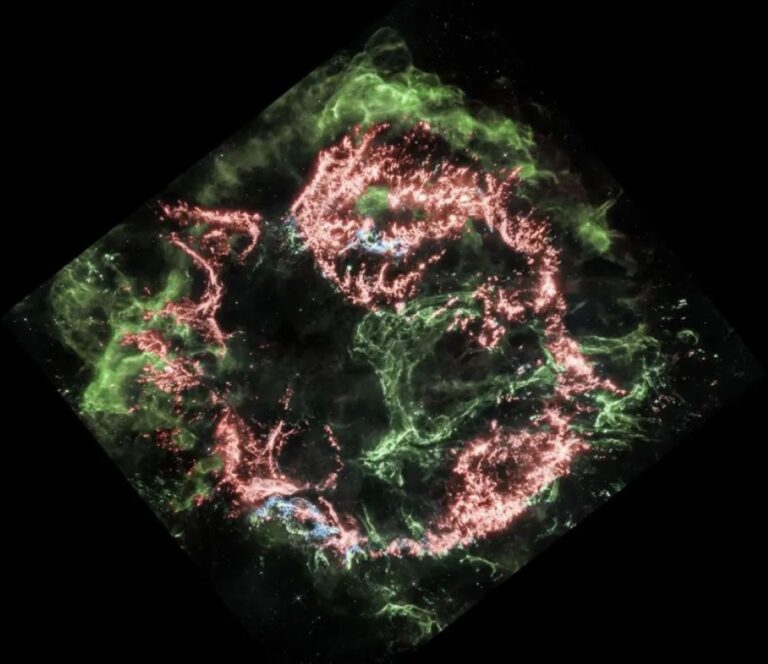
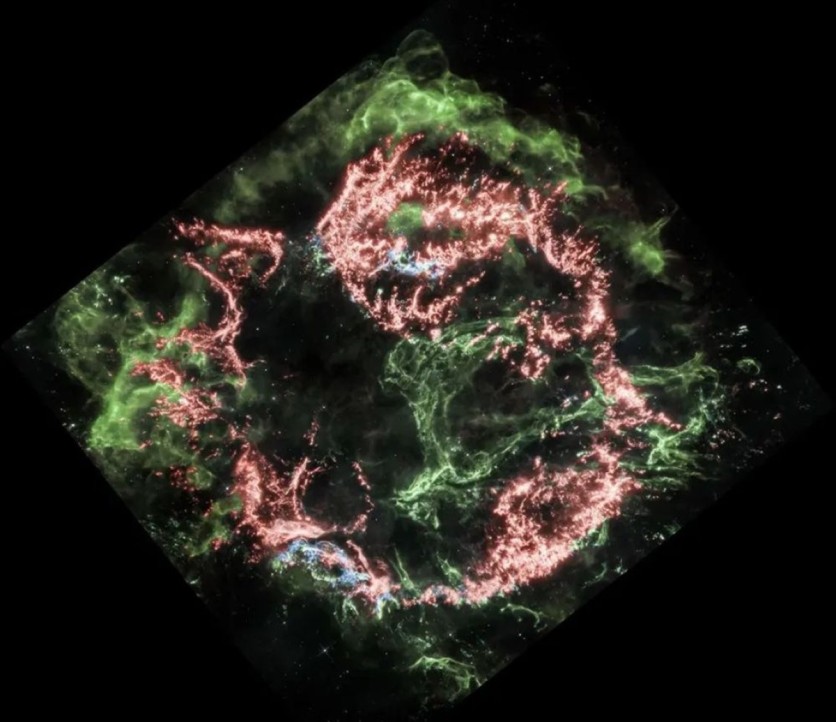
NASA’s James Webb Space Telescope has mapped supernova dust inside Cassiopeia A (Cas A), a supernova remnant about 11,000 light-years (about 65 quadrillion miles) from Earth, and the chemistry of individual clumps fits a “shell merger,” in which layers of different elements mixed inside the star possibly just hours before it exploded. A team led by Tea Temim of Columbia University reported the result Monday, Nov. 23, in The Astrophysical Journal Letters.
Astronomers cannot watch the last hours of a massive star, so the result matters for what it offers: a way to test a process that stellar models predict, using dust the star left behind. Toshiki Sato’s team at Meiji University calls the final hours before collapse challenging to observe directly. The claim is an inference from dust and X-ray chemistry in one remnant, not a direct view of a stellar interior, and NASA’s own wording is that the data support a scenario in which the star’s interior changed dramatically, possibly just hours before its demise.
The team used Webb’s Mid-Infrared Instrument (MIRI) in its Medium-resolution Spectrometer mode, which lets astronomers identify dust species clump by clump instead of from one blended spectrum. MIRI covers roughly 5 to 27 micrometers (about 0.0002 to 0.001 inches) of mid-infrared light.
NASA’s retired Spitzer Space Telescope could not resolve fine detail but identified three regions for Webb to observe. Cas A spans approximately 10 light-years (about 59 trillion miles), and its explosion was seen from Earth about 340 years ago.
| Region | Where the material came from | Dominant dust |
|---|---|---|
|
Reverse-shocked clump (P1) |
Explosion ejecta |
Silica (SiO₂), with bright argon emission |
|
Reverse-shocked clump (P3) |
Explosion ejecta |
Carbon, with neon emission much brighter than P1 |
|
“Green Monster” (P2) |
Material shed before the explosion |
Magnesium silicates (likely Mg₂SiO₄) |
Two targets sit in Cas A’s reverse-shocked region, where an inward-moving shock wave meets debris thrown outward by the explosion, and the third is the “Green Monster,” a structure first discovered by Webb. Region labels and species follow Universe Today’s account of the paper.
Massive stars build onion-like layers, and each layer burns a different fuel. Oxygen burning yields mostly silicon and sulfur plus argon isotopes, while carbon burning yields mainly oxygen, neon, sodium and magnesium. The balance of argon to neon in a clump therefore hints at which layer supplied it, and some of the scattered elements condense into dust grains.
Spitzer spectra had already linked argon-rich knots to silicate dust and neon-rich ejecta to a spectrum with no silicate features that best fit alumina dust, though the authors note the dust identification is not unique. Webb’s finer view isolates single clumps: silica with bright argon in P1, and carbon with stronger neon in P3. Universe Today reports that the P1 finding supports a carbon-oxygen shell merger in the progenitor.
In a shell merger, convection lets one burning layer swallow its neighbor. A study led by Sato, using Chandra data, reports that part of a silicon-rich layer traveled outward and broke into a neighboring neon-rich layer, with the paper placing the start of mixing within roughly 10,000 seconds (under three hours) of collapse as an upper bound. NASA’s Webb release uses oxygen-burning and carbon-burning shells as its example of what could merge.
Three-dimensional simulations of a 20-solar-mass star show entrainment and erosion of stable regions driving such mergers, with convective velocities far above what one-dimensional mixing-length models predict.
One grid of single and binary-stripped star models finds that silicon-burning and oxygen-rich layers merge in about half of its models. A 2018 estimate summarized in a later multidimensional review put the share of 16-to-26-solar-mass stars collapsing during an ongoing shell merger at 40%. The team behind the Chandra result reports that about 61% of exploding models in its 17-to-20-solar-mass grid experienced mergers, while the mechanism is still debated.
If mergers are that common, dust chemistry could become a way to test the prediction in other remnants, but Cas A is a single case: Sato’s team calls it the first observational evidence of the final burning process rapidly altering a star’s internal structure. Cas A’s progenitor is estimated at roughly 15 to 20 solar masses, inside or near the range those grids cover.
Webb sees only dust that survived. One set of Cas A models puts unshocked ejecta at 0.6 to 0.8 solar masses of silicate dust and estimates destruction at 74% to 94% in dense clumps and 92% to 98% overall. Cas A’s dense circumstellar environment produces an unusually strong reverse shock, so those authors argue that the average destruction across supernovae is probably lower. How much dust survives those shocks determines how much reaches interstellar space, a question co-author Ilse De Looze says the Webb results help address, according to Universe Today.
Composition matters, but models disagree on how. One analysis finds that 11.8% of silicate dust and 15.9% of carbon dust survive the reverse shock, while a later study computed survival as a function of grain size, material and clump density and concluded that a significant amount of newly formed dust can be destroyed. How strongly destruction skews the surviving mix toward silica or carbon is therefore unsettled, and NASA’s release reports no dust masses or survival fractions.
The Green Monster is rich in complex magnesium silicates, likely Mg₂SiO₄, and came from material the star shed before exploding, so its dust differs from the ejecta dust. The 2024 paper that characterized it ties it to circumstellar material lost during an asymmetric mass-loss phase and places it in front of Cas A, with X-ray blueshifts in a companion paper supporting that placement. That makes it a control: pre-explosion wind and explosion debris leave different chemical fingerprints.
NASA says Webb’s map builds on X-ray observations from Chandra and the JAXA-led XRISM mission, and that together the data indicate the merger was underway shortly before the explosion. The White House’s fiscal 2027 request lists $0 for Chandra, down from $63 million enacted for fiscal 2026, and would trim Webb from $208 million to $140 million, according to a Planetary Society comparison. The House Appropriations Committee advanced a bill May 13 that funds Webb at $208 million and lists Chandra as supported.
The Senate Appropriations Committee released its draft Nov. 12 with $7.43 billion for NASA science, against $3.9 billion in the White House request, and stopgap funding expires Dec. 11.
Universe Today’s coverage hedges the result: the paper’s own title says the dust points to a shell merger, and the exact timing and the links between regions and processes reflect the authors’ interpretation. Sato’s team adds that no full simulation has yet followed a shell merger from its start to gravitational collapse.
For readers, the takeaway is a testable idea with named limits: dust in a remnant more than three centuries old may record a merger no telescope can watch, but one remnant, one interpretation and a dust-destruction filter stand between that record and a general method. The next tests are other remnants, full merger simulations and, for the X-ray half of the evidence, a funding fight that must be settled or extended by Dec. 11.
Late in life, a massive star burns different elements in nested layers. A shell merger happens when convection lets one burning layer entrain and absorb its neighbor, mixing fuel and ash that normally stay separate, and simulations identify entrainment and erosion as the main mechanisms.
NASA calls it the youngest known remnant of an exploding massive star in the galaxy. Purdue’s Dan Milisavljevic has called it the best opportunity for a kind of stellar autopsy.
Light from the explosion is estimated to have reached Earth in the 1660s, give or take 30 years, and there is no definitive record of anyone seeing it.
NASA presents the dust map as a new method for inferring a star’s internal structure from its remnant. Cas A is the only remnant where dust destruction in the reverse shock can currently be measured, and its unusually strong reverse shock means other remnants may need different corrections.