October 6, 2026:


NASA’s Webb NGC 7129 release on October 6, 2026 gave astronomers the James Webb Space Telescope’s first detailed infrared portrait of NGC 7129, a stellar nursery 3,300 light-years away in the constellation Cepheus — and what it shows is a region of space where the very act of making a star sets the conditions for its nursery’s destruction. The observatory’s NIRCam camera pierced the molecular dust cloud that had kept hundreds of young stars and protostars hidden from prior telescopes, revealing a cascade of births, outflows, and shock fronts that demonstrate star formation as a self-disrupting process rather than a quiet cradle.
The new image divides into two visually distinct regions, but astronomers read them not as parallel scenes but as stages in a single connected story.
On the left, a sweeping golden cavity approximately 3.5 light-years across — large enough to contain more than 3.5 light-years of Sun-to-nearest-star distance — is dominated by NGC 7129’s most massive and most mature resident: LkHα 234 (pronounced Lick-H-alpha), a pre-main-sequence star estimated to weigh between five and eight times the mass of our Sun. Confirmed by NASA’s description of the image’s central star and its diffraction pattern, LkHα 234 has finished gathering most of its mass and is contracting under gravity — a process that raises its internal temperatures until hydrogen fusion eventually ignites, placing it on the main sequence of stellar life, as our own Sun occupies today.
LkHα 234’s earlier outflows carved into the surrounding hydrogen gas cloud, compressing some regions and blowing others away — the dual effect that defines stellar feedback compresses and disperses gas. The compression part works in the nursery’s favor: pockets of gas squeezed by the outflows are dense enough to collapse into new stars. The dispersal part does not: every cubic light-year of molecular gas that gets blown away or heated until its hydrogen molecules break into individual atoms is gas that cannot later form another star.
At the sharp ridge where the golden cavity meets the denser surrounding cloud, Webb’s NIRCam resolved something no prior instrument had captured in NGC 7129 with this clarity: a photodissociation region, or PDR. A PDR forms wherever far-ultraviolet photons from young, hot stars penetrate a molecular cloud and split hydrogen molecules (H₂) into individual hydrogen atoms. It marks the boundary between the star-forming molecular gas inside the cloud and the increasingly hostile environment outside — and it functions as a natural countdown timer on the nursery’s productive phase.
Research published in Astronomy & Astrophysics in July 2026, drawing on SOFIA observatory data, found that molecular clouds hosting their first massive young stars erode on two- to ten-million-year timescales from the point at which that erosion begins. NGC 7129 already harbors at least one star — LkHα 234 — massive enough to drive this erosion. The PDR ridge in this image is where that process is actively occurring. The youngest protostars forming in the cloud’s denser regions today may represent among the last generation this particular molecular cloud will produce.
The broader significance: stellar nurseries do not simply exhaust their supply of gas through star births. They actively accelerate their own depletion. Each new star energizes the surrounding gas, further driving the PDR boundary inward and reducing the molecular reservoir available to future generations.
The right side of the image tells a younger story. A clumpy, flame-shaped plume of red-tinted material is packed with protostars still accumulating mass — objects still in the earliest stage of stellar development, still actively gathering mass from the surrounding cloud of gas and dust. The protostar stage comes before the pre-main-sequence stage and occurs when molecular gas pockets first collapse and fragment.
As protostars accumulate mass, they eject high-speed outflows along their rotational axes. Those jets slam into the surrounding gas at supersonic speeds, generating shock fronts — the glowing, textured structures known as Herbig-Haro (HH) objects. Herbig-Haro objects track protostellar activity and are named for astronomers George Herbig and Guillermo Haro, who independently identified and classified them in the 1940s. Webb’s angular resolution resolves multiple overlapping outflows from different protostars in this region simultaneously, producing the chaotic layered texture visible in red. Each jet is a forming star announcing its existence — and reshaping the gas around it in ways that complicate the formation of neighbors.
Higher in the frame, additional protostellar outflows emanate from a blue-tinted nebula. At its center sits a protostar surrounded by a toroidal disk of infalling material — a rotating ring of gas and dust from which the star continues to draw mass. That disk casts a distinctive shadow against the illuminated nebula behind it, a geometry previously called the Bat Shadow when Hubble captured an analogous structure in a different star-forming region.
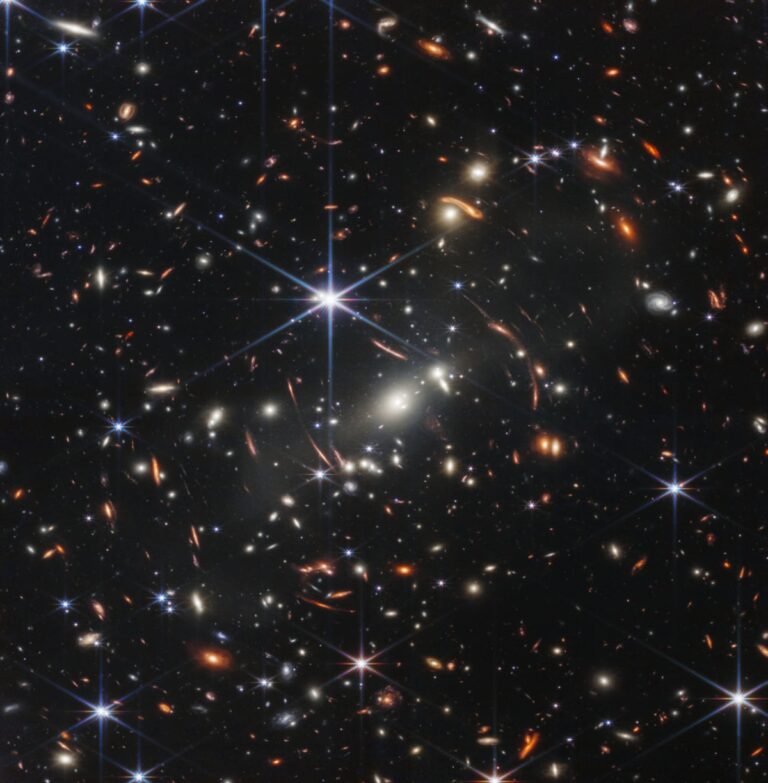
The release includes a direct comparison between this new Webb image and the best prior infrared view of NGC 7129 from NASA’s now-retired Spitzer Space Telescope, which observed the region more than two decades ago. Spitzer’s 0.85-meter (2.8-foot) primary mirror rendered the region as blurry lobes with few resolvable structures. Webb surpasses Spitzer’s NGC 7129 view thanks to its 6.5-meter (21-foot) primary mirror, which provides approximately 58 times the light-collecting area, along with angular resolution fine enough to separate individual stars, resolve fine filamentary gas structures, trace the morphologies of individual jets and bow shocks, and reveal dozens of background galaxies scattered through the field.
The NIRCam wavelength range and mirror geometry place it at wavelengths between 0.6 and 5 microns — near-infrared wavelengths at which the molecular dust blanketing NGC 7129 becomes largely transparent. Optical telescopes and human eyes, limited to visible wavelengths, see only the dust’s surface. NIRCam sees through it. Webb’s characteristic eight-pronged diffraction spikes — artifacts of its 18-segment hexagonal mirror geometry — appear around the brightest point sources in the image, including LkHα 234 itself.
Bow shocks — curved arcs of compressed gas created where stellar winds plow into the energetic surrounding medium — appear with striking clarity near several of the pre-main-sequence stars embedded in the cavity. Each bow shock marks a star actively pushing back against its environment, carving out a small bubble around itself even as the larger molecular cloud presses in. These structures were present in the Spitzer data only as suggestions; in the Webb image, they are individual, resolvable features.
By galactic standards, NGC 7129 is a relatively compact star-forming region — far smaller than the Tarantula Nebula or the Orion Nebula, which Webb has also imaged. Its scientific value comes precisely from its scale and proximity. At 3,300 light-years, it is close enough for Webb’s resolution to pick apart individual structures that would merge into a blur in a more distant equivalent. With more than 130 young stars inside, most under one million years old, the cluster spans a range of developmental stages from still-forming protostars to near-main-sequence heavyweights — making it a natural laboratory for watching the full arc of early stellar evolution in a single field of view.
Astronomers will continue analyzing the Webb NGC 7129 dataset to study how the embedded stars and protostars influence the surrounding gas and dust at both large and small scales — and what that means for models of how stellar systems like our own emerged from similar environments roughly 4.6 billion years ago.
The James Webb Space Telescope is an international partnership between NASA, the European Space Agency (ESA), and the Canadian Space Agency (CSA), with science operations managed by the Space Telescope Science Institute in Baltimore.
NGC 7129 Flower Bud Nebula background: NGC 7129, sometimes called the Flower Bud Nebula, is a molecular cloud and young open star cluster in the constellation Cepheus, approximately 3,300 light-years from Earth. It was first documented by astronomer William Herschel in 1794. Its scientific value lies in its proximity and youth: it hosts more than 130 stars estimated to be less than one million years old, spanning a full range of developmental stages from earliest-stage protostars to stars on the verge of igniting hydrogen fusion. That diversity makes it a rare natural laboratory where astronomers can study every phase of early star formation within a single field of view.
Young stars are typically surrounded by the same dense molecular gas and dust from which they formed — a cocoon that blocks visible light entirely. NIRCam infrared wavelength range covers 0.6 to 5 microns, a range at which molecular dust becomes largely transparent. Combined with Webb’s mirror dwarfs Spitzer’s in collecting power — Webb’s 6.5-meter (21-foot) mirror gathers approximately 58 times more light than Spitzer’s 0.85-meter (2.8-foot) mirror — NIRCam can resolve individual protostars, gas filaments, and shock structures inside clouds that Spitzer could image only as indistinct blobs. The characteristic eight-pronged diffraction spikes visible around bright stars in Webb images are a direct artifact of its 18-segment hexagonal mirror geometry.
A photodissociation region (PDR) forms where far-ultraviolet radiation from young, hot stars penetrates a molecular cloud and breaks hydrogen molecules (H₂) apart into individual hydrogen atoms. In the Webb image of NGC 7129, the sharp ridge at the top of the golden cavity is this boundary: the radiation from LkHα 234 and the other embedded stars is actively eroding the molecular cloud from the inside out. SOFIA FEEDBACK program erosion timescales from research published in 2026 show that once the most massive young stars in a region begin producing this kind of erosion, the parent molecular cloud typically dissipates within two to ten million years. The youngest protostars forming in NGC 7129 today may be among the last generation this particular cloud can produce — making the image, in a sense, a portrait of a nursery in the late stages of its productive life.
Herbig-Haro objects shock fronts are bright arcs and knots of glowing gas created when high-speed jets from protostars slam into the surrounding molecular material at supersonic speeds, heating it until it glows. Named for astronomers George Herbig and Guillermo Haro, who independently catalogued them in the 1940s, HH objects are reliable tracers of active protostellar activity: where you see them, a protostar is actively gathering mass and ejecting material. In the right side of the NGC 7129 image, multiple overlapping HH structures from multiple protostars appear simultaneously — indicating that several stars are forming at roughly the same time, their jets interacting in ways that both reveal and complicate the region’s star-forming dynamics.