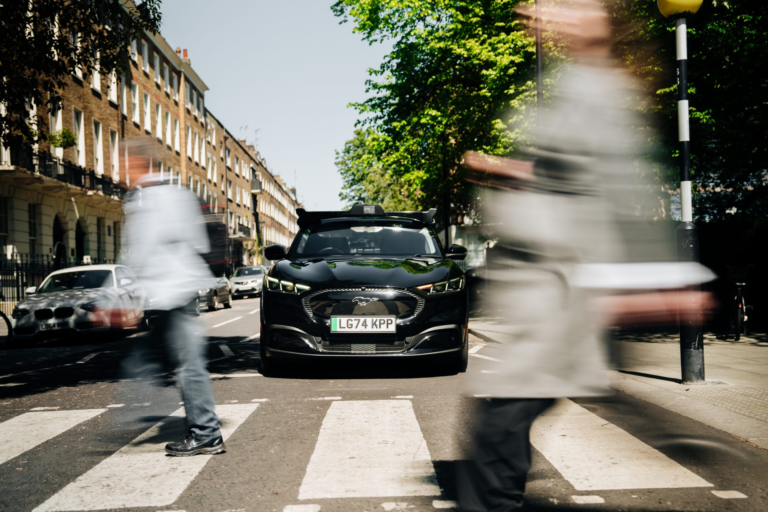
HomeAuto Wayve Wins London Robotaxi Race With Mapless AI, Safety Driver Still Required
Wayve Wins London Robotaxi Race With Mapless AI, Safety Driver Still Required
September 3, 2026:
Uber Technologies, Inc. and Wayve today launched supervised autonomous rides in London, marking the first time autonomous trips are available in the United Kingdom. Starting today, Londoners requesting an UberX, Uber Electric, or Uber Comfort may be matched with a Wayve ride at no extra cost, with upfront fares shown in-app. Wayve.ai
London launched its first commercial robotaxi service today, with Wayve-powered, Uber-operated Ford Mustang Mach-E vehicles now bookable through the Uber app — and the technical reason it happened here first, ahead of Waymo, comes down to a bet on artificial intelligence that the rest of the industry spent years dismissing. Wayve’s “AI Driver” navigates London’s medieval road network using a single neural network trained on experience alone, with no pre-built maps, no LiDAR arrays, and no geographic zones telling it where it is and isn’t permitted to drive. In the Automotive World’s coverage, London’s first self-driving taxi service launched on September 3, confirming the service is fully operational today.
The caveat every rider needs to know: a trained safety driver remains in the front seat of every Wayve vehicle, legally responsible for the trip at all times. Under UK law, today’s service is licensed as a private hire vehicle operation — the same regulatory category as any Uber ride — and no company, Wayve included, has yet completed the formal Vehicle Certification Agency registration required before a car can legally operate in Britain without a human behind the wheel.
How Wayve’s AI Actually Works — and Why It Matters for London
The fundamental difference between Wayve and virtually every other serious autonomous vehicle developer is architectural. Waymo, Baidu, and most first-generation systems use what engineers call a modular stack: discrete software modules that first detect and classify objects, then predict where those objects will go, then plan a path around them, then issue control commands to the vehicle. Each module can be audited. Each module’s failures can be traced. And each module depends on a pre-built, centimeter-accurate map of the road network to function reliably.
Wayve throws that stack out entirely. Its AI Driver is a single end-to-end neural network — a foundation model for driving, similar in spirit to the large language models underlying modern AI assistants — that maps raw sensor inputs directly to steering, brake, and accelerator commands. The network learns what driving looks like by watching millions of kilometers of it, then generalizes: it drives in places it has never explicitly been trained on, because it has learned the concept of driving rather than a memorized set of routes. A ZenML database entry documents how Wayve’s end-to-end foundation model approach runs as a single 75-watt system deployable in production vehicles.
The sensor suite is deliberately modest. Wayve’s vehicles use surround cameras and radar — no LiDAR, the expensive laser-ranging sensor that Waymo uses to generate 3D point clouds of every intersection. LiDAR hardware costs have fallen sharply in recent years, but even solid-state units add cost, weight, and integration complexity. Wayve’s system processes its camera and radar data within the vehicle itself, running at reportedly just 75 watts of power on an NVIDIA Orin system-on-chip — an onboard computer already standard in many production vehicles.
The result is a system that is, in principle, cheaper to install at scale and faster to deploy geographically. To demonstrate this, Wayve ran what it calls its AI-500 project: a proof that a single AI model could drive zero-shot across 500 cities globally without city-specific fine-tuning before the London commercial launch.
That geographic flexibility is exactly why it suits London. Pre-mapped systems require city-by-city ground preparation before deployment — survey vehicles, HD mapping runs, point-cloud databases — a process that costs time and money at each new location. London’s road network, which has been accumulating complexity since the medieval era, is particularly punishing for systems that expect predictable geometry. Wayve’s AI was trained from the start on those conditions.
What Today’s Launch Actually Is — and What It Isn’t
London’s 100,000-plus residents who joined Uber’s interest list since June can now be matched with one of the 15 licensed Wayve vehicles when they request an UberX, Uber Electric, or Uber Comfort ride. The Automotive World’s launch-day report confirms more than 100,000 Londoners signed up to try the service. The fare is standard Uber pricing with no surcharge. An interactive screen inside the car, available in 64 languages, lets passengers follow the vehicle’s planned route in real time. At the end of the trip, there is no tip prompt. The in-app experience, if you’re matched with one of the 15 vehicles against the city’s more than 100,000 conventional licensed PHV cars, is functionally identical to any Uber ride — with one difference visible through the windscreen.
But the phrase “self-driving taxi” requires a precise unpacking that the headlines may obscure. Transport for London confirmed the vehicles are licensed as private hire vehicles, not as automated vehicles. Its stated position: a key requirement of PHV journeys is that a licensed PHV driver be present and responsible for the vehicle at all times.
This is not a technicality. The UK’s Automated Vehicles Act 2024 — the legislation specifically designed to govern true self-driving operations — requires a multi-step approval pathway before any vehicle can operate without a human driver in Britain. Operators must first register their vehicle with the Vehicle Certification Agency (VCA) as capable of self-driving, then secure a Vehicle Special Order, then obtain an Automated Passenger Service permit from a local authority such as TfL. A June 2026 Jones Day analysis explains the UK’s three-step driverless approval pathway in full.
As of today, no company operating in the UK has completed even the first of those steps. Automotive World confirmed no operator has completed VCA registration toward unsupervised service. Wayve co-founder and CEO Alex Kendall declined to provide a timeline for driverless operation when asked by reporters at the launch, saying only that the company is “pushing as fast as we can.” That caution is well-placed — analysis from Jones Day suggests a realistic earliest timeline for approved driverless operation in Britain extends into 2027 at the earliest, with the full AV Act framework not expected to be in force until late 2027.
A Bloomberg journalist who took a test ride in the Wayve vehicle found that Bloomberg’s test ride showed two interventions in approximately 40 minutes — once to avoid blocking oncoming traffic while merging into gridlock, and once to navigate around stationary vehicles by changing lanes. The safety driver’s hands hovered just below the steering wheel the rest of the time.
Does Wayve Actually Beat Waymo?
The first-mover claim is accurate but contextually narrow. Waymo, the Alphabet-owned robotaxi company that operates fully driverless services across more than a dozen US cities and completes hundreds of thousands of rides per week, began testing Waymo’s 100-vehicle London testing fleet of Jaguar I-Pace electric vehicles across a 100 square-mile area of London in April 2026. Unlike Wayve’s PHV-licensed supervised service, Waymo has publicly stated it intends to launch in London without a safety driver from the start — a more ambitious regulatory goal that requires completing the VCA/VSO/APS pathway that no operator has yet cleared.
Waymo also aims to compete via its own standalone Waymo One app rather than through Uber’s platform — a structurally different competitive posture that puts it in direct competition with Uber rather than in partnership. That dynamic makes the Uber-Waymo relationship in London notably awkward: the two companies partner in Phoenix and Atlanta (though that partnership is reported to be winding down as Waymo moves toward exclusive app-based operations), while competing head-to-head in the UK’s largest market. Earlier this year, Uber’s own CTO called it scary when a viral Waymo incident in the United States circulated online.
What first-mover advantage genuinely provides, regardless of these caveats: Wayve will now begin collecting real-world commercial passenger data on London streets under genuine service conditions, building the operational evidence base that regulators will evaluate when Waymo and Wayve both eventually apply for driverless approval.
Uber’s $10 Billion Bet Isn’t a Bet on Anyone in Particular
Uber’s investment in Wayve — which includes a $300 million contingent tranche tied specifically to the London deployment — is best understood not as a conviction bet on Wayve’s technology winning the AV race, but as one node in a portfolio that also includes Waymo, Zoox, Baidu, Nuro, and several others. Automotive World’s coverage of Uber’s $10 billion AV portfolio commitment notes the company has created two internal divisions — AV Labs and Uber Autonomous Solutions — to manage them.
That portfolio approach sits alongside a visible tension in Uber’s public positioning. The company has simultaneously allied with driver unions in US states including New Jersey and Washington DC to slow robotaxi deployment, advocating for regulations that would require a minimum share of rides to be fulfilled by human drivers on any platform offering autonomous service. Andrew Macdonald, Uber’s president and COO, has acknowledged that this position “might feel ironic” given the company’s history as a disruptor of traditional taxi markets.
Wayve’s own funding story reflects the institutional confidence the architecture has attracted. The company raised Wayve’s $1.5 billion Series D round in February 2026, led by investors including Uber, Mercedes-Benz, Stellantis, and Nissan — valuing the company at $8.6 billion and making it one of Europe’s most highly valued AI startups. Uber’s initial investment came as part of Wayve’s $1.05 billion Series C in May 2024 led by SoftBank, which also brought in NVIDIA and Microsoft as backers.
The Wayve-Nissan partnership is particularly significant for what it signals about commercial scale. Wayve’s AI Driver is vehicle-agnostic, adapting to new car models with roughly 100 hours of sample data. Nissan will integrate Wayve’s system into the LEAF platform using Nissan LEAF with DRIVE Hyperion platform, with a planned deployment in Tokyo later in 2026. Tokyo is next in the planned 12-market international rollout that Uber and Wayve have committed to under their partnership.
What the UK Regulatory Path Actually Requires Next
The government’s economic projections for autonomous vehicle technology — 38,000 jobs and £42 billion (approximately $53 billion) added to the UK economy by 2035 — rest on a regulatory framework that is still being built around the vehicles now on London’s streets. Jones Day’s analysis documents the UK government’s £42 billion economic projection and its dependence on the regulatory framework taking shape.
The Automated Vehicles Act 2024 established the legal architecture: it created the Authorized Self-Driving Entity (ASDE) liability model, which shifts legal responsibility for incidents from the human driver to the company that authorized the vehicle to operate autonomously. That shift in liability — away from individuals and onto corporate entities — is what makes driverless operation legally coherent. But the Act’s provisions are intended to come fully into force only in late 2027, with the APS permit framework having been fast-tracked separately by the government in May 2026 to allow the current supervised pilot program to proceed. A Jones Day breakdown explains the AV Act’s liability framework in detail.
The practical sequence for Wayve or Waymo to achieve fully driverless operation in London: (1) apply for VCA vehicle self-driving registration; (2) receive a Vehicle Special Order; (3) apply for an Automated Passenger Service permit from TfL. None of these steps has been taken. Regulators must then evaluate each company’s safety case — the documented evidence that the system performs at least as well as “a careful and competent human driver” under UK law. That standard is deliberately high, and building a sufficient safety record under supervised conditions is explicitly part of why these pilot services exist.
Is This the Future of Urban Transport — and Is It Safe?
The safety question is the one that will follow every autonomous vehicle incident, whether in London or elsewhere, until regulators and the public have enough experience to form independent judgments. Waymo’s US record — more than 100 million autonomous miles and fewer injury-causing collisions per mile than human drivers — is the most complete dataset the industry has, but Waymo uses different sensors, a different architecture, and has operated in cities with significantly simpler road geometries than London.
The OECD AI Incident Monitor classified London robotaxi trials as hazardous in June 2026, identifying the density of vulnerable road users — pedestrians, cyclists, and motorcyclists prominent in London traffic — as conditions that create credible risk even where no incident has occurred. London’s taxi drivers have been more direct: Steve McNamara, general secretary of the Licensed Taxi Drivers’ Association, described fully autonomous London taxis as belonging to “fantasy land,” and the GMX report confirms the LTDA chief called it fantasy land via The Guardian. Elly Baker, Labour’s transport spokesperson in the London Assembly, warned that existing taxi and private hire drivers “shouldn’t risk being left behind” by a technology transition that claims to create 38,000 new jobs while potentially displacing more.
The more immediate question, for the 100,000 Londoners who signed up to try the service: whether the 15-vehicle fleet, distributed randomly across Uber’s network, will produce a meaningful chance of an actual autonomous ride. At current fleet scale — 15 vehicles against more than 100,000 licensed PHV cars — the probability of a random match is roughly one in 7,000. Wayve has been explicit that the fleet will grow “thoughtfully” in line with demand, readiness, and regulation. How fast that growth happens, and when the safety driver’s hands finally come off the wheel, is the story that follows today’s.
Exchange rates as of September 3, 2026; conversions are approximate.
Frequently Asked Questions
Is today’s Wayve robotaxi in London actually driverless?
Not yet, under current UK law. Every Wayve vehicle operating today carries a trained safety driver who holds a Transport for London Private Hire Vehicle license and is legally responsible for the trip at all times. The vehicles are licensed as private hire vehicles under existing UK taxi regulations, not as autonomous vehicles under the Automated Vehicles Act 2024. True driverless operation requires completing a separate multi-step approval process — Vehicle Certification Agency registration, a Vehicle Special Order, and an Automated Passenger Service permit — that no company operating in the UK has yet completed. Fully driverless rides in Britain appear unlikely before late 2026 at the earliest, and the AV Act framework full implementation is planned for late 2027.
What makes Wayve’s technology different from Waymo’s?
The core architectural difference is how each system represents the road. Waymo builds detailed 3D high-definition maps of every street it operates on and uses those maps — combined with LiDAR, camera, and radar sensor data — to navigate. Wayve uses no pre-built maps at all. Its AI Driver is a single end-to-end neural network that processes camera and radar data directly into driving commands, having learned from millions of kilometers of real-world driving experience across more than 500 cities. This makes Wayve’s system potentially faster and cheaper to deploy in new cities, since it doesn’t require pre-mapping each one. The tradeoff is that end-to-end networks are harder to audit — engineers cannot easily inspect why the model made a specific decision in the way they can with modular systems.
How does the UK Automated Vehicles Act affect when fully driverless rides will arrive?
The Automated Vehicles Act 2024 is the legislation that will govern commercial self-driving operations in Britain, but its full framework is not expected to be in force until late 2027. To operate without a safety driver before then, companies must apply through a pilot scheme that requires: registering the vehicle as self-driving with the Vehicle Certification Agency, obtaining a Vehicle Special Order, and securing an Automated Passenger Service permit from the relevant local authority (in London’s case, TfL). The UK law requires self-driving vehicles to demonstrate safety at least as high as “a careful and competent human driver” — a standard that companies will need to demonstrate through their supervised pilot operations. As of today’s launch, no operator in the UK has completed even the first step of this process.
What happens to London’s existing taxi drivers?
The immediate impact is negligible: 15 autonomous vehicles among more than 100,000 licensed PHV cars in London represents a mathematical rounding error. Uber has stated it expects its total number of human drivers to be higher in ten years than it is today, even as autonomous vehicle deployments grow. However, if driverless operations scale substantially after regulatory approval, the competitive displacement risk for the licensed taxi and PHV driver community is real and acknowledged by London political figures. The UK government projects that autonomous vehicle technology will create 38,000 new jobs — in manufacturing, operations, and AI engineering — but the geographic and skills distribution of those jobs differs significantly from the roughly 100,000 PHV driver licenses currently held in London.