HomeAuto Victorian Psycho: Maika Monroe’s Governess Kills Because Class Made Her Invisible
Victorian Psycho: Maika Monroe’s Governess Kills Because Class Made Her Invisible
September 8, 2026:
Bleeckerstreetmedia.com
Winifred Notty does not get away with murder because she is brilliant. She gets away with it because she is a governess in 1858 — the one category of human being that the Victorian aristocracy’s social architecture trains itself not to see. That is the actual argument inside Victorian Psycho, Zachary Wigon’s Gothic horror comedy that opens in theaters November 13 via Bleecker Street, and it is a sharper argument than the film’s blood-soaked reputation suggests. Where Patrick Bateman, Bret Easton Ellis’s 1980s investment-banker psychopath, is concealed by social power — he is too rich and too connected to be seriously investigated — Winifred is concealed by social erasure. The mechanism that protects her is the same one that produced her, and the neuroscience, toxicology, and sociology underlying the film all converge to prove the point.
The distinction matters because it changes what kind of film this is. American Psycho is a satire about what capitalism does to men who have everything. Victorian Psycho — based on Spanish author Virginia Feito’s 2025 Liveright novel of the same name, adapted by Feito herself for Wigon’s direction — is a satire about what class does to women who have nothing. Feito told NPR’s February 2025 interview that she gave Winifred “a condition as a psychopath” and noted the Victorian era was “full of violence, repression, and a lack of agency for women and children.” The horror-comedy premiered in the Un Certain Regard section of the 2026 Cannes Film Festival on May 21, earned a 77% Rotten Tomatoes score from 26 critics with an average rating of 7.1/10, and received a mixed 52 out of 100 on Metacritic.
Winifred Notty Is Not Hidden by Cunning — She Is Hidden by Class
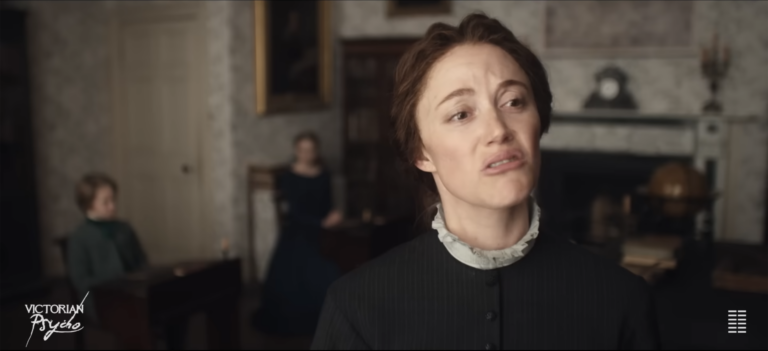
When Winifred (Maika Monroe) arrives at Ensor House, the remote Gothic manor on the Yorkshire Moors where the Pounds family resides, she is shown to the servants’ entrance. That single visual fact encodes the film’s entire sociological argument. A governess in 1858 inhabited a position that the British class system had specifically designed to produce maximum social ambiguity: she was educated enough to teach, too educated to be a servant, and too poor to be a social equal of her employers. The 1851 Census recorded 25,000 women earning their living in this role in England and Wales. As historian Kathryn Hughes has noted in her British Library article on governesses, “the governess was simultaneously a status symbol for the household and a reminder of how precarious female respectability was.”
The Victorian Web summarizes the structural contradiction of governess liminality plainly: the governess was “neither a servant nor a member of the family. She was from the social level of the family, but the fact that she was paid a salary put her at the economic level of the servants.” This liminality had a practical consequence that the film understands. Winifred’s access to all domestic zones — the kitchen, the nursery, the bedroom, the cellar — was simultaneously her professional assignment and her only operational vector. She could be anywhere in the house without question. Her employers, the comically oblivious Mr. Pounds (Jason Isaacs) and Mrs. Pounds (Ruth Wilson), cannot see her as a threat because they have been trained not to see her at all.
Feito’s choice to pit this character against the Bateman archetype is explicitly deliberate. While Bret Easton Ellis’s Patrick Bateman functions as a metaphor for narcissism and hypercapitalism, Winifred gives sociopathy, murder and the lust for revenge a feminist spin. But the distinction is deeper than “female Bateman.” Bateman commits his murders in a world where no one seriously examines them because he is powerful. Winifred commits hers in a world where no one seriously examines them because she is, to her employers, functionally beneath serious examination. Both mechanisms are effective. They are opposite.
What Neuroscience Says Winifred’s Brain Actually Looks Like
The film frames Winifred’s psychopathy not as a supernatural condition but as a personality configuration — which is neurobiologically accurate. Psychopathy, formally assessed via the Hare Psychopathy Checklist-Revised (PCL-R), is associated with measurable structural and functional differences in specific brain regions identified by decades of neuroimaging research.
Research published in May 2025 in the European Archives of Psychiatry and Clinical Neuroscience examined 39 male psychopathic subjects and found that PCL-R Factor 2 scores — measuring impulsive and antisocial behavior — were negatively associated with volumes of the pons, basal ganglia nuclei, thalamus, and several orbitofrontal and insular cortical regions, suggesting dysfunction in specific frontal-subcortical circuits governing behavioral control. The consistent pattern across multiple imaging studies is decreased connectivity and structural volume in what researchers call the “paralimbic system” — a distributed network including the amygdala, anterior cingulate cortex, orbitofrontal cortex, and insular cortex that governs socio-affective control.
Winifred’s particular profile maps most cleanly to PCL-R Factor 1 — the interpersonal and affective dimension of psychopathy, characterized by superficial charm, goal-directed calculation, and absence of remorse, as opposed to the impulsive-antisocial Factor 2 profile. Different brain regions, different expression. This “successful psychopath” type — controlled, masked, functional until the mask slips — is associated primarily with decreased cortical connectivity rather than the volume reductions found in the impulsive variant. She knows she is different. She is not confused. She is strategic. And the environmental profile the film gives her — a woman of ambiguous social origin, denied legitimate recognition by a biological father who is also her employer (Mr. Pounds), raised in Victorian institutional conditions — maps with uncomfortable precision onto the documented developmental risk factors for callous-unemotional traits: early adverse environments, neglect, and social rejection.
Heritability estimates for psychopathy run between 40% and 60%, but the literature consistently emphasizes that genetic predisposition is expressed through environment. Winifred’s brain did not develop in isolation from Victorian England’s specific architecture of exclusion.
Arsenic and Agency: Why the Weapon Chose the Governess
Early critical descriptions of the film mention Winifred “serving a spoonful of sugar with a little arsenic on the side.” This is not mere metaphor. It is a precise historical observation about the relationship between female agency and arsenic trioxide (As₂O₃) in mid-Victorian England — a relationship so overdetermined that the film’s choice of weapon is almost structurally inevitable.
By 1858, British manufacturers could estimate that approximately 100 million square feet (not miles, as sometimes reported) of arsenic-colored wallpaper lined the homes of Britain — documented in Victorian wallpaper history — and that is before accounting for the substance’s presence in candles, food dyes, medicinal tonics, pesticides, clothing dyes, and over-the-counter pharmacy products. Arsenic trioxide was tasteless and colorless in solution, with symptoms closely mimicking cholera or gastroenteritis, making it nearly impossible to detect without specialized chemical analysis. The Marsh Test, developed in 1836, could identify arsenic in stomach contents, but its use in criminal investigations was still contested and not yet court-standard.
The Arsenic Act of 1851 required sellers to know their buyer and record the sale but was widely considered ineffective: it left loopholes wide open for abuse. A House of Lords Select Committee re-examined poison sale regulations in 1857 and proposed a new bill, but it did not take effect until December 31, 1858, and the more systematic Pharmacy Act was not implemented until 1868. Winifred arrives at Ensor House in the exact historical window — 1858 — during which arsenic was at maximum availability and minimum legal restriction.
On October 30, 1858 — the same year in which Winifred begins her tenure at Ensor House — a confectioner in Bradford, Yorkshire, accidentally substituted approximately 12 pounds (5.4 kilograms) of arsenic trioxide for a harmless bulking agent called “daft” (a plaster-of-Paris substitute), producing at least 40 pounds (18 kilograms) of peppermint lozenges that caused roughly 20 deaths and left more than 200 people sickened. The Bradford poisoning did not happen in a Gothic manor. It happened in a commercial kitchen, because arsenic was simply around — in the same unlabeled containers as harmless white powders, available from the same grocery shelves as flour and sugar.
The chemistry of arsenic’s toxicity is as direct as its social history. Arsenic trioxide achieves its lethal effects by binding to sulfhydryl groups on proteins and disrupting cellular respiration in the mitochondrial electron transport chain — shutting down the molecular machinery of energy production at the cellular level. The symptoms this produces (vomiting, diarrhea, abdominal pain) were in 1858 indistinguishable from cholera, still a common cause of death in a country with poor sanitation. A governess who administered arsenic through the household’s food and medicine was not choosing an exotic weapon. She was reaching for the nearest thing to hand in a domestic environment already saturated with the substance.
Criminologists and historians of Victorian crime have noted that arsenic was strongly gendered as a “female crime” in the cultural imagination of the period. Women were disproportionately accused of arsenical murders, often targeting husbands or employers. Poison was constructed as the weapon of the powerless — requiring no physical strength, deliverable through the domestic labor (cooking, nursing, food preparation) that women were already assigned. Winifred does not choose arsenic because she is clever. She chooses arsenic because arsenic is what a governess in 1858 has.
Gothic Architecture as a Criminological Enabler
Ensor House is not incidental set dressing. Critics noted that Wigon’s unusual camera movements and strange angles create a sense that the space itself is warped around Winifred’s perception. Environmental psychology supports this: high ceilings, long corridors, isolated moorland locations, and dim natural light are associated in the research literature with heightened anxiety and diminished social connectedness in typically developing individuals. For someone with Winifred’s psychopathic profile, however — with a significantly blunted fear response documented across multiple neuroimaging studies of the amygdala — the same environment functions differently. The isolation is not threatening. It is enabling.
Criminologist Marcus Felson’s routine activity theory, developed with Lawrence Cohen, holds that criminal behavior is facilitated by the convergence of three elements: a motivated offender, a suitable target, and an absent guardian. Ensor House in 1858 — on the Yorkshire Moors, staffed by an employer too socially grand to notice what happens below his sightline, remote enough to eliminate external witnesses, before systematic death investigation and forensic chemistry were court-standard — is precisely this environment. The Gothic manor is not merely a dramatic backdrop. It is a criminological enabler. The architecture, the location, and the social hierarchy of the household are all doing active work on Winifred’s behalf.
The Yorkshire Moors themselves carry a specific psychogeographic charge in English literary culture. Emily Brontë’s Wuthering Heights (1847) established the moorland as a space where social norms are thinned by distance and weather. To set a film about a psychopath on the moors in 1858 is to invoke this tradition deliberately — the land as accomplice.
Monroe, McKenzie, and the Cannes Reception
Maika Monroe — known to horror audiences from It Follows (2014) and Longlegs (2024) — delivers what IndieWire’s Cannes review described as a performance in which “Winifred practically vibrates with the need to hold things together. It does not always work for her, but it is nearly always funny, deliciously and dementedly so.” Opposite her, Thomasin McKenzie (last seen in Edgar Wright’s Last Night in Soho) plays Miss Lamb, the house nurse. Jason Isaacs and Ruth Wilson round out the Pounds family as the oblivious aristocrats who cannot see what is standing in front of them — which is, of course, the point.
Cineuropa praised the Cannes premiere as “a blend of classic Victorian novels — including Jane Eyre and Wuthering Heights — and murder stories tinged with deprivation.” The ICS Film review noted Monroe “plays a murderous governess with glee and perfect comedic line delivery; at times the film feels like Edgar Allan Poe on acid.” The most negative major review — Variety’s Cannes assessment — nonetheless acknowledged that “there’s promise in the idea of a prim, well-spoken but forever subjugated nanny wreaking bloody revenge on England’s cruelly non-negotiable class system.”
The film initially held a September 25, 2026 US release date; Bleecker Street moved it to November 13, 2026, repositioning it for awards season consideration, per Dread Central’s August 5 report. Whether it performs in awards season or finds its audience on VOD, the intellectual architecture Virginia Feito built beneath the blood-soaked surface is sturdy enough to hold either outcome.
Where Victorian Psycho Leaves Patrick Bateman Behind
The standard comparison — American Psycho transplanted to Victorian England — gets the relationship between the two films half right. Both feature a first-person confessional psychopath narrator whose detached, precise observations of social norms function as indictments of those norms. Both are satires whose violence is the instrument, not the subject. But the comparison understates the distance between them.
Mary Harron’s 2000 American Psycho is a satire of capitalist masculinity: Bateman’s murders are an extension of the same competitive performance that defines his professional life, and the fact that nobody takes him seriously as a murderer reflects the period’s specific form of social insulation — wealth, whiteness, and Ivy League credentials as an invisibility cloak against accountability. Feito’s Victorian Psycho is a satire of something older and harder to name: the mechanism by which an entire social class trains itself not to perceive the humanity of those who serve it. Bateman’s crimes are concealed by power. Winifred’s crimes are concealed by its absence.
“Victorian Psycho invites us into the mind of a psychopath — trapped in a world she cannot control, living on the border between insurrection and total madness,” reads the official Cannes program description. The phrase “living on the border between insurrection and total madness” is doing significant work. Winifred is not simply unhinged. She is operating at the boundary where individual psychology and structural violence meet — the precise location where the most interesting horror has always lived.
Frequently Asked Questions
Is Victorian Psycho based on a real governess or real murders?
The film and novel are both fictional, based on Virginia Feito’s 2025 novel published by Liveright. However, the setting is historically precise: 1858 is the year of the Bradford Sweets Poisoning, a real incident in Bradford, Yorkshire, in which arsenic trioxide accidentally substituted for a harmless bulking agent, causing approximately 20 documented deaths and sickening more than 200 people. Feito’s research into the Victorian period was extensive — she has described five years of preparation. The film’s specific year also sits in the exact window between the ineffective Arsenic Act 1851 and the more restrictive regulations that took effect starting in 1860.
How similar is Victorian Psycho to American Psycho?
Both share a first-person confessional psychopath narrator whose detached observations indict the social milieu they inhabit, and Feito’s novel was reviewed in The New York Times under the headline “If Patrick Bateman Were a 19th-Century English Governess.” The structural difference, however, is significant: Bateman is concealed by social power — his class and wealth make serious scrutiny unlikely. Winifred is concealed by social erasure — her role as a governess means the aristocracy’s own class architecture renders her invisible. The satire operates differently in each case because the mechanism of concealment is different.
What is the neuroscience behind fictional psychopaths like Winifred Notty?
Psychopathy is a real clinical construct assessed via the Hare Psychopathy Checklist-Revised (PCL-R). Research published in May 2025 in the European Archives of Psychiatry and Clinical Neuroscience documented structural brain volume reductions in the orbitofrontal and insular cortices, basal ganglia, and thalamus of psychopathic subjects, consistent with the paralimbic dysfunction model — the idea that the problem is not a single broken brain region but a disrupted system of interconnected structures governing socio-affective control. Winifred’s particular profile — high superficial charm, goal-directed planning, absence of remorse, with apparent absence of the impulsive antisocial dimension — maps to the PCL-R Factor 1 pattern, which is associated primarily with decreased connectivity in paralimbic circuits rather than the volume reductions linked to antisocial impulsivity. She is what researchers call a “successful psychopath”: masked, controlled, functional.
Why was arsenic specifically the poison of choice in Victorian England?
Arsenic trioxide was cheap, widely available (sold in grocery shops alongside flour), tasteless in solution, and produced symptoms virtually identical to cholera — still a common and feared cause of death in 1858. The Marsh Test existed from 1836 but its use in criminal investigations was not yet standard. Arsenic was also saturating the Victorian domestic environment in ways that went far beyond deliberate use: approximately 100 million square feet of arsenic-colored wallpaper lined British homes by the 1850s, saturating Victorian domestic environments, and it appeared in candles, cosmetics, food dyes, and medicinal tonics. For a governess with access to the household’s kitchen and medicine cabinet, arsenic was not an exotic choice. It was the nearest thing to hand.