August 31, 2026:


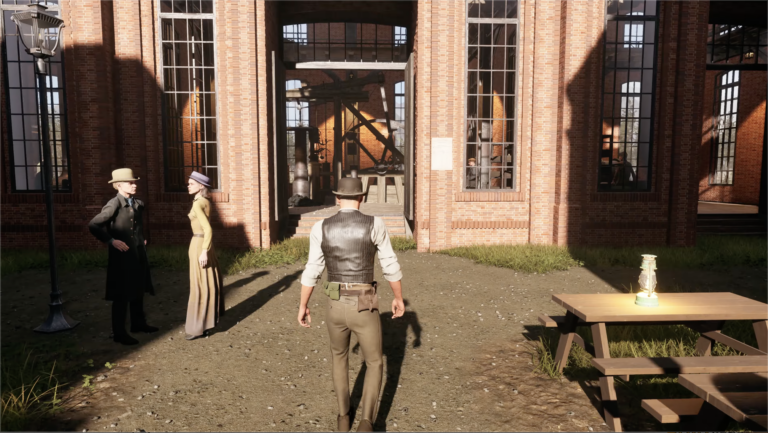
Active Fungus Studios and Toplitz Productions revealed Prospera at Gamescom 2026 last week: a Victorian city builder that abandons the overhead view entirely, placing players at street level as both construction worker and industrial magnate. The studio world-premiered the title at Webedia’s Find Your Next Game Showcase on August 26, 2026, and released a full gameplay trailer on August 29, placing the game in front of the largest strategy-game audience of the year.
City builders have required players to manage from above since SimCity established the genre in 1989. Anno 1800 on Steam, the current benchmark for industrial-era city builders, communicates supply chain status through color-coded overlays and statistics panels — information the player reads from a map, not from the street. Prospera replaces that overhead abstraction with something more immediate: you lay the rails yourself, haul crates across cobblestones, and walk the boulevards you designed to see whether they actually function.
“Gone are the times of isometric viewpoints of classic city builders,” the studio announced in its official press release. “Once you taste the immersion of building houses, laying train tracks, or decorating a sprawling settlement in full first-person view or from a third-person perspective, you will not want to go back.”
The game is built in Unreal Engine 5 by a Munich-based team of twenty developers led by Jakob Braun, who founded Active Fungus Studios in 2020. This is a significant pivot for the studio: their previous released title was Inspector Schmidt – A Bavarian Tale, a narrative mystery game that earned 83% positive ratings on Steam and won Best Story at the German Dev Days 2024, according to the Active Fungus Studios press page, before the team turned toward city building.
The central challenge for any first-person city builder is information delivery. A player who cannot see the whole map at once must receive feedback about systemic conditions — population satisfaction, supply bottlenecks, infrastructure strain — through other means. Prospera‘s answer is the Prosperity System: a mechanic that converts aesthetic quality into a quantifiable gameplay resource, making the state of the city legible from the street level.
Parks, clean streets, architecture, and the absence of industrial pollution generate Prosperity. Grime, overcrowding, and neglect reduce it. Prosperity then drives population growth, attracts wealthier residents, and unlocks further technology research, as described in the Prosperity System on Steam. In effect, a player walking their city’s boulevards is not simply admiring their work — they are reading the city’s health through its appearance. A street with flowerpots and functioning streetlights is telling them something different from one choked with factory smoke and scattered refuse.
This design also resolves a longstanding tension in city-building games: players who optimize for economic efficiency typically produce functional-but-ugly sprawl, while beauty-building modes (offered in Anno 1800 on Steam) are typically decoupled from strategic outcomes. The Prosperity System treats aesthetics as strategically equivalent to logistics — making the player’s desire to make the city look good mechanically identical to the decision to make it work better.
Active Fungus Studios CEO Braun named the design lineage directly in the official announcement: “When we started development, the core question was, what would it feel like to merge the Victorian atmosphere of Anno 1800 with titles like Satisfactory and games like Medieval Dynasty or Bellwright, while adding a heavy sprinkle of city management?”
Notably, publisher Toplitz Productions official site already publishes Medieval Dynasty — the ground-level survival/settlement-builder that Braun names as a partial inspiration. The partnership is not coincidental: Toplitz has direct publishing experience with precisely the genre hybrid Prospera is attempting, and head of business development Stefan Berger confirmed publisher alignment in the press release: “Their vision for the game, paired with the technical expertise, dedication and passion is a perfect fit for us.”
The comparison points reveal what Prospera is and is not. Anno 1800 provides the industrial production-chain complexity and Victorian setting — multi-stage supply chains where goods move between production buildings along transport networks, with city growth gated on meeting population needs. Medieval Dynasty provides the embodied ground-level perspective: a player character who physically exists in the world, walks between buildings, and experiences the settlement as a spatial environment rather than an abstract resource flow. Coffee Stain Studios’ factory builder Satisfactory provides the automation ambition — the progression from manual assembly to fully mechanized industrial complexes. Prospera targets the intersection of all three.
The game’s production chain structure scales from early handcraft industry to railway-networked manufacturing, as detailed in the full feature list on Steam. Players begin as a lumberjack, construct basic production facilities and residential buildings by hand using tools and blueprints, then advance toward merging individual factories into industrial complexes and laying railway networks across an open world. Outposts unlock new resource deposits and extend the economic geography of the city.
Prospera targets a specific player profile: someone who has spent hundreds of hours in Anno 1800 or Workers & Resources: Soviet Republic managing production chains at arm’s length, and has wondered what it would feel like to stand inside the factory they designed. It is singleplayer only. It includes Steam Achievements and Family Sharing, per the Steam playtest and wishlist page.
The minimum hardware requirement calls for an Intel Core i7-8700, an NVIDIA GeForce GTX 2060, and 16 GB of RAM, targeting 1080p at 30 frames per second on low settings. The recommended configuration — an Intel Core i7-12700 and an NVIDIA GeForce GTX 4060 Ti, same RAM — targets 1080p at 60 frames per second on high settings, according to the system requirements on Steam. Both targets require DirectX 12 and Windows 10 (64-bit) at minimum, with Windows 11 (64-bit) required for recommended settings. The game requires 25 GB of storage. These specifications are more demanding than most city builders in the genre (Anno 1800 recommends an Intel Core i7-4770R and an NVIDIA GeForce GTX 970) — consistent with a game that renders a detailed, fully walkable Victorian city in Unreal Engine 5.
The game ships in nine languages, with full voice acting in English and German, as shown in the nine-language support table. Interface and subtitles extend to French, Spanish (Spain), Japanese, Korean, Polish, Russian, and Simplified Chinese.
A playtest is currently open for access requests on Steam. No Early Access date has been announced. Prospera is planned for release in Q2 2027.
Most city builders operate from a top-down or isometric camera. Prospera is one of the few mainstream titles designed from the ground up around first- and third-person perspectives as the primary play modes rather than optional camera angles. Medieval Dynasty (also published by Toplitz Productions) allows ground-level play in a settlement-building context, but without the industrial production-chain complexity that Prospera targets. Whether the approach proves mechanically successful at the scale of a full city depends on how well the Prosperity System and the walking-the-streets feedback loop hold up in extended play — something only a released build can confirm.
The Prosperity System converts the visual and sanitary quality of your city into a measurable gameplay resource. Parks, clean streets, architectural quality, and the absence of industrial pollution generate Prosperity. Pollution and neglect reduce it. Prosperity then drives population growth and technology research — meaning that making your city look like a place people actually want to live is not just aesthetic preference but strategic investment. The mechanic is designed to prevent the functional-but-ugly sprawl that players who optimize for efficiency tend to produce in other city builders.
Active Fungus Studios CEO Jakob Braun named design inspirations directly in the official announcement: Anno 1800, Satisfactory, Medieval Dynasty, and Bellwright. Analytically: Anno 1800 provides the production-chain complexity and Victorian industrial setting; Medieval Dynasty provides the embodied ground-level perspective; Satisfactory provides the automation-and-logistics ambition. Prospera targets the overlap of all three, with the Prosperity System as the distinctive mechanic that none of those predecessors share.
Prospera is planned for release in Q2 2027 on PC via Steam. A playtest is currently open for access requests directly through the Steam store page — interested players can submit a request and will be notified when developer Active Fungus Studios opens playtest slots. No specific Early Access date or launch price has been announced.