HomeAuto Ultraman Teo Episode 11: Bodyroba Controls Hosts in Real Time; Earth Parasites Cannot
Ultraman Teo Episode 11: Bodyroba Controls Hosts in Real Time; Earth Parasites Cannot
September 22, 2026:
Tsuburaya-prod.com
Episode 11 of Ultraman Teo, “The Mysterious Boy,” aired Saturday, September 19, 2026 on the TV Tokyo Network at 9:00 a.m. JST (8:00 p.m. ET on September 18), and what it delivered was not one science concept but three — each of which maps onto a real and unresolved scientific problem. A translation badge that compresses two distinct unsolved challenges in AI bioacoustics into a palm-sized device. A child who pierces a disguise that trained adults have missed for eleven episodes, in a way developmental cognitive science can partially explain. And Bodyroba, the Possessing Star Bem, whose mechanism of action — direct neural substitution at real-time speed — is the one thing that separates it from every real-world parasitic mind-control organism on Earth. None of these are arbitrary fiction. All three are the show thinking carefully about what the real science cannot yet do, and what that gap implies.
The convergence arrives at a franchise milestone. Tsuburaya Productions and Benelic Co., Ltd. confirmed through a September 22, 2026 merchandise reveal that the full lineup for Japan’s first permanent ULTRAMAN STORE has been announced. Per the official ULTRAMAN STORE announcement, the store opens October 9 at Ikebukuro PARCO B2F in Tokyo, with a second location to follow in November 2026 at LUCUA South in Osaka. The store’s exclusive merchandise — sofubi vinyl figures, finger puppets, and two original art series — encodes sixty years of franchise material culture in three product categories, each of which says something different about how Tsuburaya reads its own history as an object.
Episode 12, “A Hero’s Determination,” will air Friday, September 24 at 8:00 p.m. ET (Saturday, September 25 at 9:00 a.m. JST) on TV Tokyo, with the English dub streaming simultaneously on the Ultraman Official YouTube Channel at 9:30 a.m. JST.
What Ultraman Teo Is: An Alien Who Never Hides Behind a Human
Ultraman Teo is the 31st entry in the Ultra Series (41st overall) and the franchise’s 60th-anniversary series, which began airing July 4, 2026, with same-day worldwide streaming in more than fifteen languages. Its protagonist, Ibuki Mitsuishi, is the last survivor of Planet H12 — a world so biologically similar to Earth that he can enroll in a veterinary medicine program at Meishin University without drawing suspicion. He arrived on Earth after his home was destroyed by space kaiju. He has found something like peace in the university’s Astronomy Club, caring for a miniature kaiju companion named Pucchi, and has tried to keep his alien identity from the humans around him. When the same monsters that killed his world arrive on Earth, he transforms into Ultraman Teo, a blue giant of light who has never quite made peace with the fact that protecting lives requires him to be capable of violence.
What distinguishes Teo from most of its predecessors is that Ibuki never merges with a human host. He is always, behind every interaction, an alien in a human body — an immigrant in permanent code-switch, whose peace depends entirely on a secret. The September arc of the series breaks that equilibrium from two directions at once.
Kanna’s Translation Badge and the Two Problems AI Has Not Solved
Episode 11 opens with the Astronomy Club celebrating a new device club member Kanna has built: a translation badge that converts Pucchi’s internal emotional states into human-readable language. In the universe of Teo, this is treated as a university club project accomplished over a few weeks. In the real world, some of the most ambitious scientific programs operating today are still working on the two separate problems the badge claims to have already solved simultaneously.
The first problem is signal acquisition: determining what medium a non-human organism actually uses to express internal states. Pucchi is a kaiju — an extraterrestrial entity — and no human scientist has access to its species biology, its evolutionary history, or any annotated dataset from its home world. Kanna built a device from scratch, with no training data. That is the first shortcut the badge takes.
The second problem is semantic translation: mapping detected signals to something that corresponds to human emotional vocabulary. Project CETI’s whale research has spent years analyzing sperm whale coda sequences using machine learning, identifying distinct coda types with properties resembling linguistic complexity once thought to be uniquely human. But predicting what a sperm whale will do next based on its clicks is not the same as knowing what the whale is currently feeling. Behavior prediction is tractable; emotional inference is not yet.
The Earth Species Project annual report documents NatureLM-audio — the first audio-language foundation model for bioacoustics, whose AVEX animal vocalization encoding paper was accepted at the International Conference on Learning Representations (ICLR) in 2025. Karen Bakker, a professor at the University of British Columbia and author of The Sounds of Life, has characterized the current state of the field succinctly: “AI is a phenomenal pattern recognition machine — but that only takes us so far. In order to truly understand animal communication, we do have to link this back to behaviour.”
What Kanna’s badge does easily in fiction is what a planet’s worth of researchers has not yet managed in combination. The badge’s confidence is the show’s most technically optimistic claim — and, for a series whose protagonist is himself a non-human mind in a human body struggling to be understood, it is also the show’s most thematically necessary one.
The Mysterious Boy: Why Children Detect What Adults Filter Out
After Teo and Giant Pucchi repel Bodyroba and force its retreat, Ibuki approaches a parent and child who had been caught near the combat zone. The young boy makes a casual remark that, per the official episode synopsis, “completely sees through Ibuki’s true identity.” Trained adults around Ibuki — including UTTF investigator Kyoko, who has been closing in on the Astronomy Club with concrete evidence — have not managed this in eleven episodes.
The developmental cognitive science basis for this is real. Research in infant and child cognition has established that young children process biological motion and social-gaze cues with sensitivity that exceeds adult performance on the same raw detection tasks. Adult conceptual filters — the assumption that the person in front of you is human, the learned suppression of anomalous micro-signal data, the social cost of being wrong — take years to consolidate through development. Before those filters are in place, children may register low-level perceptual signals with greater fidelity: subtle timing anomalies in micro-expressions, atypical galvanic response patterns, or bioluminescent micro-pulses below adult conscious detection thresholds.
The larger question the episode raises is whether the basic premise — that Planet H12 and Earth could have independently arrived at nearly identical humanoid biology — is scientifically coherent. Evolutionary biology finds independent convergent evolution to that degree implausible without invoking a common cause. The most scientifically coherent reading of Ibuki is the one directed panspermia theory supports. Directed panspermia — first formally proposed by Francis Crick and Leslie Orgel in their 1973 paper in the journal Icarus — describes the theory that organisms were deliberately transmitted between planetary systems by an advanced civilization. Crick and Orgel cited the universality of the genetic code and the unexpected prevalence of molybdenum in living organisms as weak supporting evidence.
Under this reading, what the child detects is not a truly foreign alien. He detects a distant biological cousin — one whose lineage branched from the same seeded stock but whose 200,000 years of different evolutionary history left micro-signatures in biological motion that an unfiltered child’s perceptual system registers as “not quite this.” The child is not smarter than the adults. He is less thoroughly socialized into dismissing what his perception reports.
Bodyroba, the Possessing Star Bem: Why Real Parasites Cannot Do What It Does
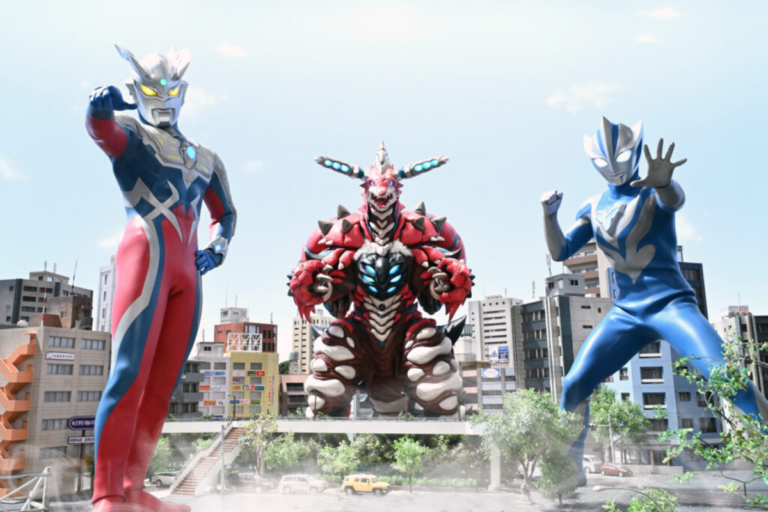
The kaiju that arrives from outer space in Episode 11 is Bodyroba, the Possessing Star Bem — an entity that occupies the body of Black Doglf, the Dog-Wolf Kaiju, and drives it as a vehicle, suppressing or displacing the host creature’s own cognitive processes in real time. This is the tokusatsu genre’s most technically sophisticated kaiju archetype, and Bodyroba’s specific mechanism is the one piece of Episode 11’s science that sits not at the frontier of current research but beyond it — in territory biology has observed but cannot yet build.
Real-world parasitic mind control exists and has been studied rigorously. Ophiocordyceps fungi infect carpenter ants and induce them to climb to a specific height on vegetation, bite down on a leaf vein, and lock their mandibles there until they die — an act of precise behavioral control that serves spore dispersal. Critically, Penn State researcher David Hughes and colleagues found, using fluorescent 3D microscopy, that the fungus never enters the ant’s brain. It controls at the muscle-fiber level, through bioactive compounds — including guanidinobutyric acid (GBA) and sphingosine, two chemicals that interact with motor pathways while leaving cognition intact.
Toxoplasma infects 2 billion people chronically, and is documented to modify rat behavior by hijacking the amygdala’s threat-response pathway. A December 2025 RVC study on parasite dopamine confirmed that parasite-encoded tyrosine hydroxylase (TgTH) contributes to dopamine dysregulation in the host — the mechanism by which a rat that should flee from cat urine instead becomes attracted to it. Nematomorpha (horsehair worms) induce their cricket hosts to seek water and drown, facilitating the parasite’s aquatic reproductive cycle.
What all of these real organisms share is a bottleneck: they work through neurochemical gradients. Chemical signaling is slow. It operates over hours or days. It cannot be switched on and off in real time, and it does not substitute the parasite’s own cognition for the host’s — it modifies existing circuitry.
Bodyroba, by contrast, operates at a qualitatively different architectural level. It is depicted as an intelligence that installs itself into the host organism’s neural substrate and drives the body from there, in real time, as its own vehicle — what philosophers of mind would call substrate-independent cognition. The concept of substrate independence holds that a cognitive process is not inherently tied to any specific physical implementation, which is why it underlies the theoretical possibility of mind uploading and whole-brain emulation. Bodyroba appears to have evolved biological substrate independence: its cognition can run on whatever nervous system it encounters, overriding the original process. The real-world bottleneck it would need to overcome is signal bandwidth — neurochemical signaling is too slow for real-time takeover, which would require direct electrical signal-level interface with the host’s nervous system at speeds and fidelity biology has not been documented to achieve across species boundaries.
This is the one science gap Episode 11 depicts that is not currently being closed by any active research program. The other two — bioacoustic translation, directed panspermia as an origin theory — are open scientific questions. Substrate-independent parasitic cognition is something else: a capability whose mechanism would require a qualitative leap beyond anything terrestrial evolution has produced. In the logic of the Ultra universe, Bodyroba is a Star Bem — a space entity whose origin and biology are explicitly extraterrestrial. The show is not claiming Earth biology can do this. It is imagining what billions of years of evolution on a different world, optimized for host occupation rather than individual survival, might eventually produce.
The 52-Year Mentor Chain: Ultraseven to Leo to Zero to Ibuki
Ultraman Zero first appeared in 2009 in Mega Monster Battle Ultra Galaxy: The Movie, and his appearance in Episode 11 brings with it 52 years of franchise mythology. The pedagogy he carries into Ibuki’s world is not the franchise’s invention — it is a precise map of how the Ultra Series has transmitted its philosophy of growth across generations.
The chain runs: Ultraseven trained Ultraman Leo on barren Planet L77 in 1974’s Ultraman Leo, demanding and withholding praise, teaching form while operating from the vulnerability of having lost his own transformation ability. Ultraman Leo trained Ultraman Zero on Planet K76 starting in 2009, rehabilitating a volatile young warrior through the same demanding methods he had received. Ultraman Zero, voiced by Mamoru Miyano, now arrives in Ibuki’s world and overwhelms Ibuki with his combat capabilities before asking a single question: do you have the determination to fight?
The question is not rhetorical. It is a diagnostic instrument, and performance psychology research describes its mechanism precisely. The Meijen et al. TCTSA framework, published in Frontiers in Psychology in 2020, provides a psychophysiological framework for how individuals cognitively appraise high-stakes encounters. In a challenge state, the individual perceives their resources as exceeding the demands — characterized physiologically by increased cardiac output and reduced vascular resistance, predicting better performance. In a threat state, demands exceed perceived resources — increased cardiac output with increased vascular resistance.
Zero’s method — demonstrating overwhelming superiority, then asking the existential question — is the specific condition that the TCTSA predicts will sort intrinsically motivated individuals from extrinsically motivated ones. An individual whose motivation is identity-fused (protecting others is who they are, not merely what they want to achieve) will respond to Zero’s dominance with renewed commitment rather than withdrawal — a challenge reappraisal rather than a threat response. Zero is administering the same diagnostic that Leo once gave him, and that Ultraseven gave Leo before that.
Does a Child Who Sees Ibuki See an Alien — or a Cousin?
Episode 11’s most quietly provocative moment is the one that happens off the battlefield. Before the episode’s three detection threads converge — Kanna’s badge reading Pucchi, the boy reading Ibuki, Kyoko closing in on the Astronomy Club — the episode asks a question the prior TechTimes preview article could not yet address, because the episode had not aired: when the child makes his remark, what exactly has he perceived?
The answer the show implies — through Ibuki’s shocked reaction and the episode’s structural positioning of the moment — is that the child has noticed something sub-cognitive. Not a conclusion but a datum: this person moves wrong, or holds still wrong, or something in the micro-timing of his social responses is not calibrated to a species that grew up here. Adults who have known Ibuki across ten episodes have not registered this. Their conceptual architecture — trained to dismiss biological anomalies when the face and language check out — has filtered it out.
The directed panspermia reading deepens this. If H12 and Earth share seeded biological ancestry, then Ibuki is not detecting-proof-of-an-alien but detecting-a-distant-relative — one whose evolutionary divergence has left detectable micro-signatures that a pre-filter child can read. The child is not a supernatural seer. He is a human child who has not yet learned to stop seeing.
Meanwhile, Kyoko closes in on the Astronomy Club from the opposite direction: not intuition but evidence, rational inference from observations, a trained investigator’s methodology that is everything the child’s perception is not. Both are closing in on the same truth by entirely different routes. This is the episode’s structural argument: the recognition problem has multiple solutions, and the ones that work best are the ones that get out of their own way.
ULTRAMAN STORE Tokyo and What the Merchandise Categories Actually Mean
Japan’s first permanent ULTRAMAN STORE opens Friday, October 9, 2026 at Ikebukuro PARCO Main Building B2F (1-28-2 Minami-Ikebukuro, Toshima-ku, Tokyo), with hours of 11:00 a.m. to 9:00 p.m. A second location is scheduled to open in November 2026 at LUCUA South 12F (3-1-1 Umeda, Osaka), with hours of 10:00 a.m. to 8:00 p.m. Both locations are operated by Benelic Co., Ltd. in partnership with Tsuburaya Productions.
The store’s concept — “A place to awaken the hero within your heart” — is franchise boilerplate, but the three merchandise categories disclosed encode something more specific about how Tsuburaya reads sixty years of its own material culture.
The store-exclusive sofubi vinyl figures and finger puppets are the category with the longest institutional memory. Sofubi (ソフビ, short for “soft vinyl”) is the manufacturing tradition that produced the first commercially available Ultraman collectibles. In 1966, the same year as the franchise’s first television broadcast, toy company Marusan Shoten’s 1966 kaiju figures marked the beginning of the soft vinyl kaiju boom that aligned with the popularity of Ultra Q. The production method — liquid PVC compound introduced into a sealed rotational metal mold, cured under heat, demolded by hand, painted by hand — has remained essentially unchanged across six decades. The slight variance in surface texture from figure to figure, the characteristic “give” of the material, the brushwork visible on hand-painted details, are not defects. They are how sofubi communicates that the figure was made by a person: the same artisanal signaling that distinguishes handmade ceramics from industrial ones. In an era when most collectible production has shifted to injection-molded precision, store-exclusive sofubi is a deliberate positioning statement — one that the craftsmen who have continued this tradition since the 1960s describe as preserving what made the originals matter.
The “Cosmic Art” series, depicting Ultra heroes from each generation, is the franchise as generational taxonomy. Each piece is simultaneously a visual object and a chronological record — Showa, Heisei, and Reiwa eras mapped onto a single curatorial concept. This approach treats the franchise’s internal history as its own distinct subject, a strategy Japanese art museums have applied to long-running manga and animation canons: organizing by era, not character, and framing the evolution of visual style as the content itself.
The “Ultra Art Museum” series, rendering Ultraman scenes in oil-pastel style, is the most deliberately category-crossing of the three. Oil pastel — with its characteristic impasto texture, soft color bleeding, and matte finish — is a medium associated in Japan with fine art and children’s book illustration. Applying it to tokusatsu battle scenes performs a category shift: it frames kaiju combat as art-historical subject matter. The choice is not accidental. It claims a different institutional status for the franchise’s iconography — the salon, not the toy aisle — in the same year that the franchise is opening its first permanent retail location.
The store’s opening lottery system (pre-registration details to be confirmed at launch) is timed precisely two weeks after the Ultraman Zero two-parter that marks the series’ most significant legacy-character arc of the year. The temporal alignment is unlikely to be coincidental.
What Episode 12 Will Deliver — and What the Recognition Problem Means
Episode 12, “A Hero’s Determination,” will air Friday, September 24 at 8:00 p.m. ET on TV Tokyo (Saturday, September 25 at 9:00 a.m. JST), directed by Takanori Tsujimoto and written by Shigenori Tanabe. It will feature Ultraman Zero’s full combat demonstration, the resolution of Ibuki’s response to Zero’s diagnostic question, the conclusion of the Bodyroba arc — which now includes Nebora, the Subterranean Kaiju, as a second threat — and the Astronomy Club’s decision about what they are willing to do to protect Pucchi.
The parallel structure is the episode’s thesis. Ibuki’s confrontation with Zero asks: is your motivation to protect sufficient to sustain you through violence you do not want to commit? The Astronomy Club’s conversation with Professor Minobe asks the same question in civilian register: what do you owe the thing you love, when protecting it requires you to become something you didn’t plan to be?
For a Saturday-morning tokusatsu series, this is an unusually sophisticated ethical question. It is also what all three of Episode 11’s STEM concepts, taken together, were pointing toward. The translation badge, Bodyroba, and the child’s perception are all versions of the same problem: recognizing the presence of a mind that is not identical to yours. The translation badge is the technological attempt to solve the problem. Bodyroba is what happens when a mind optimized by evolution to solve it does so by overriding rather than decoding. And the child is what the problem looks like when the human cognitive architecture has not yet installed the filters that make it harder.
60 years into the franchise, Tsuburaya is still asking the question that justified the original Ultraman in 1966: what does it mean to understand what something else is?
Frequently Asked Questions
What makes Bodyroba scientifically distinct from real-world parasitic mind control?
Every confirmed example of parasitic mind control in terrestrial biology — Ophiocordyceps fungi in carpenter ants, Toxoplasma gondii in rodents, Nematomorpha in crickets — operates through neurochemical gradients: slow-acting compounds that modify existing neural circuits over hours or days without substituting the parasite’s own cognition. The Penn State research team found that Ophiocordyceps never enters the ant’s brain at all, controlling instead from the muscle fibers. Bodyroba, as depicted in Episode 11, performs something qualitatively different: real-time cognitive substitution across species boundaries, running its own intelligence through the host’s nervous system as a vehicle. This is substrate-independent cognition — a concept from philosophy of mind that describes the theoretical separability of a cognitive process from its physical implementation. No terrestrial organism has been documented to achieve this, and the bottleneck is signal bandwidth: electrical neural signaling is fast enough for real-time override, but interfacing across species at that bandwidth would require a biological technology evolution has not produced on Earth.
What are the two unsolved problems Kanna’s translation badge compresses into one device?
The badge addresses signal acquisition (detecting what medium a non-human entity uses to express internal states — vocalizations, pheromones, galvanic skin response, or something biology has not yet catalogued) and semantic translation (mapping those detected signals onto something equivalent to human emotional vocabulary). Project CETI has demonstrated that sperm whales combine click codas in structurally complex sequences with properties resembling human linguistic patterns. But predicting a whale’s next behavior from its clicks is not the same as reading what the whale currently feels. The Earth Species Project annual report documents the NatureLM-audio model (accepted at ICLR 2025) — capable of classifying species and life stages from vocalizations — but the gap between pattern recognition and emotional inference remains the field’s central open question.
Why did a child see through Ibuki’s disguise when trained adults did not?
Developmental cognitive science research indicates that young children process biological motion and social-gaze cues before adult conceptual filters are consolidated — the learned dismissal of anomalous micro-signal data that adult cognition applies to maintain socially plausible interpretations. A child’s perceptual system may register micro-timing anomalies in movement or expression that a trained adult’s brain categorizes as noise. The deeper scientific question is whether the premise is coherent at all: evolutionary biology finds independent convergent evolution to identical humanoid morphology implausible. Directed panspermia — first proposed by Francis Crick and Leslie Orgel in their 1973 Icarus paper — provides the more scientifically defensible reading: H12 and Earth may share common seeded ancestry, making Ibuki a distant biological relative rather than a truly alien entity.
What does the ULTRAMAN STORE’s merchandise reveal say about the franchise at sixty years?
The three announced merchandise categories each encode a different claim about the franchise’s relationship to its own history. Store-exclusive sofubi manufacturing tradition connects to the 1966 manufacturing lineage that produced the first Ultraman collectibles — Marusan Shoten’s original soft vinyl figures, made using the same rotational mold casting method still in use today. The “Cosmic Art” generational lineup treats the franchise’s internal chronology as visual content in its own right. The “Ultra Art Museum” oil-pastel series frames kaiju combat imagery within the aesthetic conventions of fine art and illustration. Taken together, the three categories argue that the franchise’s material culture is now worth curating — not just selling — which is precisely what a permanent store, as opposed to a pop-up or event shop, is designed to do.