October 4, 2026:


Scotland’s only remaining orbital rocket startup has pushed its first trip to orbit back to 2030 — a four-year retreat from the target it set just twelve months ago — after completing a hotfire test of a scaled-down version of a first-stage engine that, if it ever reaches qualification, will be a genuine engineering world first. Payload Space broke the story this week.
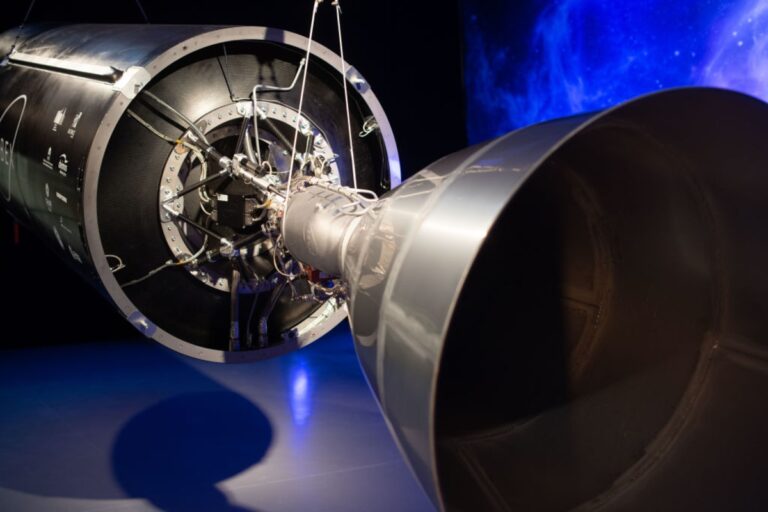
The Edinburgh-based company completed a 45-second burn of a subscale version of the 70 kN (15,700 lbf) powerplant that will propel the first stage of its three-stage Skyrora XL orbital rocket. The test data will inform development of the full-size unit — and the gap between “subscale hotfire” and “nine qualified flight engines on a completed first stage” measures in years, not months.
Skyrora COO Jack-James Marlow, disclosing the revised schedule to Payload Space, was direct about the philosophy behind it: “Our strategy is not to sprint towards orbit. We’ve seen other companies increase their opex, grow drastically. I see rocket companies want to be rocket companies, rather than stable businesses. Where my view is, we’ve got to be a stable business first, rather than one big 10-year gamble.”
That framing lands differently now that Isar Aerospace — a German launch startup founded a full year after Skyrora — successfully reached orbit on September 5, 2026, on only its second test flight, lifting off from Andøya Spaceport in Norway, deploying multiple payloads. Isar raised more than €400 million ($444 million) over its life — far more than Skyrora’s approximately $65.9 million in venture financing — and met the European Launcher Challenge’s requirement to reach orbit by 2027 a full year early.
The central reason 2030 is believable — and optimistic — is the engine Skyrora is trying to build.
The 70 kN powerplant uses a staged combustion cycle, the most efficient and most technically demanding architecture in liquid rocket propulsion. In staged combustion (also called a closed cycle), all propellant passes through both a preburner and the main combustion chamber, eliminating the losses of an open-cycle gas-generator design where turbopump exhaust is dumped overboard. The Space Shuttle’s main engines used staged combustion. So does SpaceX’s Raptor. Both run on cryogenic propellants — liquid oxygen and hydrogen, or liquid oxygen and methane — that have been studied extensively for staged combustion applications.
Skyrora’s engine instead uses high-test peroxide (HTP) as its oxidizer, paired with kerosene as fuel. HTP is a highly concentrated (85–98%) solution of hydrogen peroxide that decomposes in contact with a catalyst into a jet of steam and oxygen — making it storable at room temperature and considerably less hazardous than cryogenics. The UK has deep heritage with HTP: the Black Arrow rocket, which in 1971 made Britain the sixth nation to independently reach orbit, ran on HTP in its upper stages. But Black Arrow did not use staged combustion.
No commercial staged combustion engine has ever flown on an HTP/kerosene propellant combination. If Skyrora qualifies this engine, it will be the first. The design draws inspiration from Black Arrow’s Gamma8 engine, but the underlying cycle is an order of magnitude more complex.
The company prints the engines in-house at its Cumbernauld, North Lanarkshire factory using its proprietary Skyprint 2 hybrid 3D-printing process and has already completed what it describes as a 70 kN “final development test” under its ESA Boost! programme contract. The hotfire announced this week is a separate, subscale test feeding data back into the program — it is not the qualification campaign itself.
Getting from a successful subscale hotfire to nine qualified flight engines bolted to a completed first stage requires a full-scale qualification campaign, then serial production, then stage integration testing — each stage a multi-year gate on its own. ESA Commercial Services Manager Jorgen Bru has noted that engine qualification represents “one of the key objectives” of the pre-commercial launch service development activities the agency supports under Boost!
The Skyrora XL stands 22.7 m (74.5 ft) tall and 2.2 m (7.2 ft) in diameter; NASASpaceFlight’s technical profile puts its lift-off mass at 55,838 kg (123,100 lbs). It is a three-stage vehicle designed to deliver 315 kg (695 lbs) to sun-synchronous orbit (SSO) at altitudes between 500–1,000 km (310–620 miles) — a payload class comparable to Rocket Lab’s Electron. Nine Skyforce engines powered by the 70 kN design will cluster on the first stage; a single engine of the same design will power the second stage; a smaller 3.5 kN unit handles the third.
The vehicle would launch from SaxaVord Spaceport on Unst in the Shetland Islands — the northernmost point of the UK, and an ideal geometry for SSO missions — under Skyrora’s August 2025 CAA licence, granted by the UK Civil Aviation Authority. That licence — the first and only vertical launch operator licence issued to a UK-based rocket company — authorizes up to 16 Skylark L suborbital flights per year.
What makes the 2030 projection particularly stark is the vehicle that has been waiting even longer than the XL.
Skyrora’s Skylark L2 suborbital rocket has been operationally ready since 2022, according to Marlow — four years of sitting idle while the regulatory framework and physical spaceport infrastructure caught up and then, still, no UK pad became available. SaxaVord opened its doors to foreign competitors instead. Germany’s Rocket Factory Augsburg (RFA) and HyImpulse have both signed agreements with the spaceport and are establishing their own launch facilities there, with RFA targeting a maiden orbital flight in the second half of this year.
“The technology was outpacing the regulations, and the actual physical locations for spaceports,” Marlow said. “Our second suborbital vehicle, the Skylark L2, has been ready since 2022 — now it’s been waiting, ready to launch.”
Skyrora is exploring international launch sites as a workaround for the Skylark L2 — the same path the company took when it launched from Iceland in October 2022, a flight that ended when a software fault ditched the rocket into the Norwegian Sea approximately 500 m (1,640 ft) from the launch site. The company is tentatively targeting a second Skylark L2 suborbital mission for 2027.
The environment Skyrora is navigating has narrowed severely in the eight months since Orbex — its closest domestic rival — entered administration in February 2026, ceasing trading on February 18 with approximately 163 UK employees made redundant, most based at its Forres, Scotland headquarters.
Orbex attracted £138.5 million (approximately $182.8 million) in total funding — £105.1 million in equity ($138.7 million) and £33.3 million ($43.9 million) in grants — including £76.7 million (approximately $101.2 million) in public investment from the UK Government, the Scottish National Investment Bank, and Highlands and Islands Enterprise. The company had been, by its own account, on the cusp of its first test flights when it collapsed after The Exploration Company’s acquisition fell apart and all remaining fundraising avenues closed.
Skyrora expressed interest in acquiring select Orbex assets — including a position at Sutherland Spaceport — for up to £10 million in assets (approximately $13.2 million). Whether that acquisition has progressed has not been publicly disclosed.
What the collapse did do was validate, in Marlow’s reading, Skyrora’s aversion to the sprint model. “We’ve seen from other competitors who were sprinting, and increasing operational costs drastically,” Marlow said. “So we’re happy to keep the company fixed at a set headcount whilst extending our timeline.”
Virgin Orbit, which collapsed in April 2023 after failing to sustain its commercial launch program despite a successful California launch record, provided an earlier lesson from the same graveyard.
Skyrora occupies a genuinely unusual structural position: it holds the only UK vertical launch operator licence but cannot yet use it for anything the UK government’s space program ultimately needs — orbital missions. In the meantime, it generates revenue through component sales, facility rentals, and 3D-printing contracts, including a partnership with Spirit AeroSystems.
The gap between that revenue stream and the approximately $130 million total Marlow estimates will be needed to reach orbit — roughly double what Skyrora has raised — is the central tension of the company’s strategy. The plan is to close the gap through the same diversified revenue mix rather than a single large fundraising round, a model that keeps the company stable but leaves the orbital timeline dependent on commercial throughput rather than a funded development sprint.
The UK government, meanwhile, published a new Space Strategy in September 2026 committing £7.8 billion (approximately $10.3 billion) in investment through the 2029–30 financial year, centered on domestic launch capability from SaxaVord. A November 2025 House of Lords committee report declared that the UK space sector lacks strategic direction for success and warned explicitly that “a sovereign launch capacity would strengthen national security, underpin the growth of the UK’s space and satellite industries.” Skyrora itself quoted that report approvingly, calling sovereign launch “a strategic necessity.”
The problem is that the only UK-owned rocket capable of providing that sovereignty is four years away, at best. And the spaceport infrastructure that sovereign rocket would use is increasingly busy with German companies doing the orbiting instead.
Currency conversions in this article are based on rates as of October 2, 2026, and are approximate.
The only UK-headquartered company currently developing an orbital launch vehicle, Skyrora, is tentatively targeting 2030 for a first orbital flight of its Skyrora XL rocket. That target represents a four-year slip from the company’s 2026 ambitions and depends on first qualifying a 70 kN engine whose subscale development test was completed this week. No UK-owned rocket has placed a payload in orbit since Black Arrow in 1971, though foreign launch companies operating from UK soil could reach orbit sooner.
The Skyrora XL’s first-stage engine uses a staged combustion cycle — the most efficient but most technically complex rocket engine architecture — burning high-test peroxide (HTP) as its oxidizer and kerosene as fuel. No commercial staged combustion engine has ever been qualified on this propellant combination. The UK has historic heritage with HTP rockets (Black Arrow used it in 1971) but none of those engines used the more demanding staged combustion cycle. This week’s subscale hotfire is a development milestone, not a qualification test — a full-scale qualification campaign, followed by serial production of nine flight engines, must still be completed before the Skyrora XL can fly. The ESA engine test documentation confirms that engine qualification remains among the key objectives of the company’s Boost! programme contract.
Orbex — Skyrora’s closest domestic rival — entered administration in February 2026 after raising £138.5 million (approximately $182.8 million) in total funding, including £76.7 million ($101.2 million) in public investment from UK and Scottish government bodies, and still failing to reach its first test flight. The company had been described as on the cusp of a maiden launch when its planned acquisition by The Exploration Company collapsed and all other funding avenues closed. Approximately 163 UK jobs were lost, primarily at its Forres, Scotland headquarters.
Germany’s Isar Aerospace — founded in 2018, one year after Skyrora — reached orbit on September 5, 2026, on only its second test flight, deploying multiple payloads. It did so from a Norwegian spaceport, using a liquid oxygen/propane engine, and met the European Launcher Challenge’s 2027 orbital demonstration requirement a year ahead of schedule. Skyrora, by contrast, is targeting 2030 and has not yet commenced a full-scale engine qualification campaign. Both companies received ESA Boost! programme support, but Isar raised an estimated €400 million ($444 million) versus Skyrora’s approximately $65.9 million.