HomeAuto Ukraine Stops 90% of Propeller Shaheds but Only 57% of Jet Ones; Russia Designed It That Way
Ukraine Stops 90% of Propeller Shaheds but Only 57% of Jet Ones; Russia Designed It That Way
September 30, 2026:
Sergei SUPINSKY/AFP via Getty Images
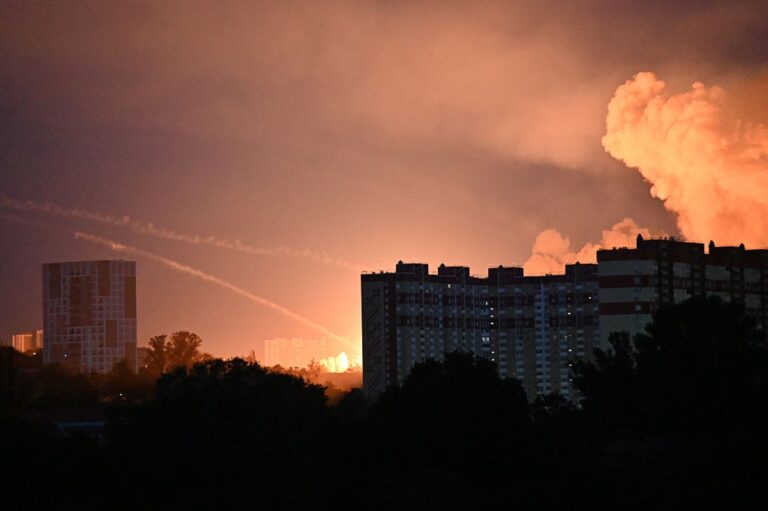
Ukraine’s air defenses logged an interception rate exceeding 90% against propeller-driven Shaheds by March 2026 — a result built across three years of engineering iteration, tactical adaptation, and attritional experience. By September 28, 2026, they were catching only 57% of the jet-powered variants — a gap that did not emerge by accident. Russia deliberately redesigned its Shahed loitering munitions to fly at speeds the cheap interceptor drones Ukraine had mastered simply cannot match, and the casualty count from a single day of attacks made the consequences concrete: nine people killed across Ukraine, including in a jet-powered Shahed strike on the National Academy of Sciences building in Kyiv.
What the Numbers Actually Mean
President Volodymyr Zelenskyy disclosed the figures in his September 28 evening address. Ukraine’s overall drone interception rate — combining both propeller-driven and jet-powered types — stood at 70%. But that headline figure obscures the fault line.
Against conventional propeller-driven Shaheds, Ukraine’s defenses have become genuinely formidable: the interception rate for piston-engine Geran-2 variants now exceeds 90%, confirmed in Ukraine’s March 2026 Ministry of Defense statistics. Against the jet-powered variants — the Geran-3, Geran-4, and Geran-5 — that rate collapses to 57%.
On September 28, the Air Force reported Russia had attacked with 124 strike UAVs during a single daytime window, 86 of them jet-powered. Ukrainian defenses shot down or neutralized 86 of the 124 total — but only 49 of the 86 jet-powered drones were stopped.
Why Speed Is the Wall Ukraine Cannot Simply Train Over
The reason 57% is not a training problem or a production problem is best understood through the physics of interception. When a drone is traveling at 180 km/h (112 mph) — the speed of a conventional propeller-driven Shahed — Ukraine’s Sting interceptor, which can reach approximately 280–343 km/h (174–213 mph), has a velocity advantage substantial enough to pursue, close, and engage from behind. The math works: pursue, close the gap, detonate.
Russia’s Geran-4, the jet-powered variant now produced in the largest numbers, maneuvers at 300–400 km/h (186–249 mph) and can accelerate to 500 km/h (311 mph), according to Ukraine’s Defense Intelligence structural disclosure. At the lower end of that range, the Sting’s closure advantage approaches zero. At the top end, it disappears entirely. The Geran-5 — a variant that functions more like a cheap cruise missile than a loitering munition — flies at up to 600 km/h (373 mph), carries a 90 kg (198 lb) warhead, and has a range approaching 950 km (590 miles); the Sting has no meaningful tail-chase interception geometry against it. Ukraine’s military intelligence confirmed Geran-5 specifications in detail in January 2026.
The propulsion change that enabled this speed increase is specific: the Chinese-manufactured Telefly TF-TJ2000A turbojet engine, rated at approximately 200 kgf (441 lbf) thrust. This is not a general drone-improvement story. Russia replaced a piston engine with a turbojet engine, applied it to an existing loitering munition design, and thereby shifted the engagement physics against the cheap interceptor solution Ukraine had refined for the conventional threat. The intercept rate dropped from 90%+ to 57% precisely because Russia deliberately engineered faster drones.
Yuriy Ihnat, the Air Force’s spokesperson, stated in late August 2026 that the overall jet-powered drone interception rate had dropped to approximately 60% and attributed the difficulty specifically to the speed difference and Russian troops’ rapid changes in attack altitude and route, as reported by Reuters in September 2026.
Russia’s Counter-Attack on Ukraine’s Counter-Attack
The Sting’s success against propeller Shaheds is what triggered Russia’s pivot to jets. When Ukraine’s defense forces demonstrated they could intercept roughly 90–96% of slow-flying Shaheds using cheap interceptor drones priced around $2,000 each — Sting unit cost confirmed at roughly $2,100 — a fraction of the $20,000–$50,000 cost of the target — Russia faced an uncomfortable arithmetic.
Serhiy Beskrestnov — known by the callsign “Flash” and serving as a non-staff presidential adviser on defense technology — said in September 2026 that Russia had already reached a monthly production capacity of approximately 3,000 jet-powered drones, after Russia launched around 1,500 in July 2026 and more than 2,500 in August. According to Ukrainian intelligence figures Beskrestnov cited, Russia plans to produce 36,000–40,000 jet-powered UAVs annually — more than 3,000 per month — and he assessed that jet-powered models could account for roughly 60% of total Russian long-range drone production going forward. UATV English confirmed Beskrestnov’s production estimates from his on-air statements.
Russia’s 2026 defense order for all types of Shahed-class drones exceeded 100,000 units, according to Vadym Skibitskyi, Deputy Head of Ukraine’s Main Intelligence Directorate. Russian federal statistics showed drone-related production grew 117% year-on-year in April 2026, with Ukrainian intelligence separately estimating plans to manufacture 7.3 million FPV drones and 7.8 million additional combat drone units in 2026.
At a September 25 Supreme Commander-in-Chief’s Staff meeting, Ukraine reviewed Russia’s technological plans for 2027, including drone production capabilities and component supply schemes. Zelenskyy said new decisions were made — the president’s office confirmed jet engine production decisions — on establishing domestic production of various types of jet engines in Ukraine as a direct result. Ukrainian intelligence has also warned that Russia could reach a manufacturing pace of roughly 500 drones daily by 2027 if current investment trajectories hold.
Ukraine’s Answer: Build a Faster Interceptor
The flagship response to the slow-Shahed problem was the Sting, developed by the volunteer engineering collective Wild Hornets. The Sting became among the most effective systems against jet-powered Shaheds, and its operational data confirmed 9,000+ kills in the first half of 2026 alone, according to Wild Hornets’ company-reported figures.
The Sting’s stated maximum speed is approximately 280–343 km/h (174–213 mph). Its production scale became remarkable: monthly output exceeded 10,000 units, and the company has reported more than 3,000 kills against Shahed-type drones since operational deployment. Each unit costs around $2,000 — a fraction of the target’s cost.
But the same speed differential that makes jet Shaheds deadlier also puts the current Sting at or near the edge of its engagement envelope against faster variants. Wild Hornets has a next-generation “Sting 2.0” in combat testing: faster than the current model, somewhat more expensive, and featuring an auto-detection function with autonomous target guidance. The company’s public statements acknowledge the challenge of balancing speed against endurance — the faster an interceptor travels, the shorter its range.
The Ukrainian MoD commissioned a second answer on August 21, 2026: the Alexa Spatium, Ukraine’s first domestically produced jet-powered interceptor. The Alexa Spatium is a turbojet-powered aircraft measuring approximately 1.5 × 1.7 meters (4.9 × 5.6 feet), constructed from lightweight composite materials for high-G maneuverability, and launchable from a mobile catapult within minutes. Its primary mission is to engage the Geran-3, Geran-4, Geran-5, and Shahed-131. It can carry fragmentation, shaped-charge, or thermobaric warheads, and is reusable if a mission is aborted — a significant difference from the single-use Sting. Ukraine’s MoD confirmed Alexa Spatium’s full specs on commissioning day.
On September 15, Zelenskyy reported that Ukrainian companies had successfully tested new interceptors capable of engaging high-speed Shaheds. The Security Service of Ukraine separately unveiled a new interceptor developed by its military counterintelligence unit on September 19, with video of Geran-5 interception posted the same day.
Zelenskyy’s September 28 address made the urgency explicit: “We are pushing the developers to move faster. Every week, there must be more concrete results in terms of shoot-downs along the interception lines.”
What China’s Role Reveals About the Supply Chain
The Geran-4’s speed upgrade did not emerge from a Russian engineering vacuum. The Telefly TF-TJ2000A turbojet engine is Chinese-manufactured, and Chinese components appear throughout the disassembled electronics of Russia’s jet-powered drones. According to a May 2026 Wall Street Journal investigation citing Chinese customs data, China shipped drone components openly — engines, batteries, fiber-optic cables, microchips — to Russia and Iran, in many cases without the mislabeling that had previously characterized such shipments. The US Treasury sanctioned Iran drone suppliers — multiple China-based companies and other entities — in May 2026 for supporting Iran’s drone supply network.
Ukraine’s Defense Intelligence has documented 5,762 foreign components in 200 Russian weapons systems on its War & Sanctions portal. As of May 2026, the proportion of Chinese-made components in Russian drones was increasing — a trend that has continued even as Western sanctions tightened the supply of American and European components.
NATO’s €6 Billion Lesson From Ukraine’s 57%
The gap between Ukraine’s 70% overall rate and its 57% against jet types carries a direct warning for European air defense planning. European defense ministers agreed in September 2025 to develop a “drone wall” along Europe’s eastern flank — a network of sensors, jammers, radars, and interceptors from Finland to Bulgaria — with European Commission President Ursula von der Leyen pledging €6 billion (approximately $6.9 billion) to a drone alliance with Ukraine, as reported by the Financial Times, to transform Ukrainian ingenuity into battlefield advantage and into joint industrialization.
The design challenge that number must answer is Ukraine’s 57% problem writ large: the EU’s drone wall was conceived partly around interceptor drones proven against propeller-speed Shaheds. If the threat environment across Europe’s eastern border skews toward jet-powered variants — as Russia’s production shift suggests it will — those procurement decisions need to account for systems effective at 400 km/h (249 mph), not just 180 km/h (112 mph). An in-depth analysis of the drone wall noted the concept envisions a multi-layered network of detection and interception built on Ukrainian battlefield experience.
Ukraine’s frontline interception data is arguably the most detailed real-time counter-UAS performance dataset in existence. Every engagement with a jet-powered Geran — its altitude, its approach vector, the Sting’s success or failure — produces operational intelligence that no test range can replicate at speed. NATO defense planners and procurement officials relying on this data need to understand that the 57% figure represents not a temporary learning curve but a genuine physics boundary: the current generation of cheap interceptors was optimized for a target that Russia has already largely replaced.
Ukrainian drone makers were already in discussions to expand co-production with US and European firms as of early 2026, combining battle-tested designs and operational data with Western manufacturing scale and funding. A Ukraine–US interceptor production deal explicitly prioritized interceptor drones as the lead technology transfer item.
Zelenskyy on September 28 noted that new interceptors were actively undergoing testing, with some combat units already using them. “But, of course, some details still need to be refined to ensure sufficient effectiveness and sufficient scale.”
Speed Is the Variable — Not Pilots, Not Production
The most consequential thing the 57% figure reveals is that this is not primarily a quantity problem. Ukraine has built interceptor drone production to 10,000+ units per month. It has trained large numbers of operators. It has achieved 90%+ interception rates against the propeller-driven threat. None of that transferred to jet-speed targets, because the Sting’s pursuit geometry against a target approaching its own top speed is fundamentally different from a tail-chase against a much slower drone.
Classic intercept physics — first formalized by Pierre Bouguer in 1732 and later applied to missile guidance — shows that a pursuer can only capture a target from behind if the pursuer’s speed exceeds the target’s. As Russia pushes Geran-4 speeds to 400–500 km/h (249–311 mph) and Geran-5 speeds to 600 km/h (373 mph), the Sting’s 280–343 km/h (174–213 mph) envelope shrinks from adequate to marginal to zero. The interception math stops working — not because operators are inadequate, but because the physics dictates it. Sting 2.0 and Alexa Spatium represent Ukraine’s engineering answer to that arithmetic. The 57% rate will fall or stay, depending entirely on whether the faster interceptors can be produced at scale before Russia turns a tactical edge into a structural one.
Exchange rate as of September 29, 2026; currency conversions are approximate.
Frequently Asked Questions
Why can’t Ukraine just shoot down more Russian jet drones using the same techniques that work against regular Shaheds?
The key obstacle is speed. Ukraine’s Sting interceptors — the workhorses of its cheap drone-killer fleet — fly at around 280–343 km/h (174–213 mph). Propeller-driven Shaheds cruise at roughly 180 km/h (112 mph), giving the Sting enough speed advantage to pursue and destroy targets from behind. Russia’s jet-powered Geran-4 maneuvers at 300–400 km/h (186–249 mph) and can accelerate to 500 km/h (311 mph), which effectively eliminates or reverses the Sting’s tail-chase closure advantage. Adding more Stings doesn’t fix this — only a faster interceptor does, which is why Ukraine commissioned the jet-powered Alexa Spatium and is testing Sting 2.0. The 57% interception rate reflects a physics constraint, not a pilot-training or production-volume deficit.
What are the Geran-4 and Geran-5, and how are they different from the original Shahed drones?
The original Shahed-136, which Russia produces domestically as the Geran-2, is a propeller-driven loitering munition with a piston engine and a cruising speed of approximately 180 km/h (112 mph). The Geran-4 is a substantially redesigned aircraft fitted with a Chinese-manufactured Telefly TF-TJ2000A turbojet engine, a reinforced airframe with improved aerodynamics, and speeds reaching 500 km/h (311 mph). It carries a 50–90 kg (110–198 lb) warhead and has a range of about 450 km (280 miles). The Geran-5 is a larger step again — at 600 km/h (373 mph) and with a range approaching 950 km (590 miles), it functions more like a cheap cruise missile than a loitering munition. Ukraine’s military intelligence has documented both using Chinese-origin turbojet engines, components that continue to reach Russia despite US sanctions.
Does Ukraine’s 57% problem matter for NATO countries outside the conflict zone?
Significantly, yes. European nations are building what they are calling a “drone wall” along NATO’s eastern flank, designed to detect, track, and intercept drone threats using Ukrainian-tested technology. The EU has pledged €6 billion (approximately $6.9 billion) to a drone alliance with Ukraine to fund this. But the EU’s drone-wall concept was largely developed when propeller-driven Shaheds were Russia’s primary weapon of choice. Ukraine’s frontline data now shows that jet-powered variants — which are being produced at roughly 3,000 per month and climbing — require interceptors capable of effective engagement at 400 km/h or above. NATO procurement decisions being made today on the basis of performance against slow-flying drones may be calibrated for a threat Russia is already replacing. Ukraine’s 57% rate is the data point those procurement offices should be building around.
Can Ukraine close the gap quickly enough to matter?
Ukraine has commissioned its first jet-powered interceptor (Alexa Spatium, August 2026), successfully tested at least three additional intercept systems since mid-September 2026, and has multiple companies working on second-generation interceptors. Wild Hornets’ Sting 2.0 is in combat testing. The engineering challenge is that speed-optimized interceptors have shorter endurance — the tradeoff between how fast you fly and how far you can range is fundamental to airframe design. Zelenskyy’s public statements indicate he is pushing developers weekly for results. The question is whether Ukraine’s engineering ecosystem — nimble, battle-proven, and genuinely innovative — can close a 13-percentage-point deficit before Russia produces enough jet-powered drones to make the current interception rate structurally catastrophic. Russia’s intelligence-estimated 500 drones per day production pace by early 2027 is the clock they are racing.