HomeAuto Ukraine Kills Second Irreplaceable Tu-95MS Bomber in Six Weeks: $48,000 Drone
Ukraine Kills Second Irreplaceable Tu-95MS Bomber in Six Weeks: $48,000 Drone
August 29, 2026:
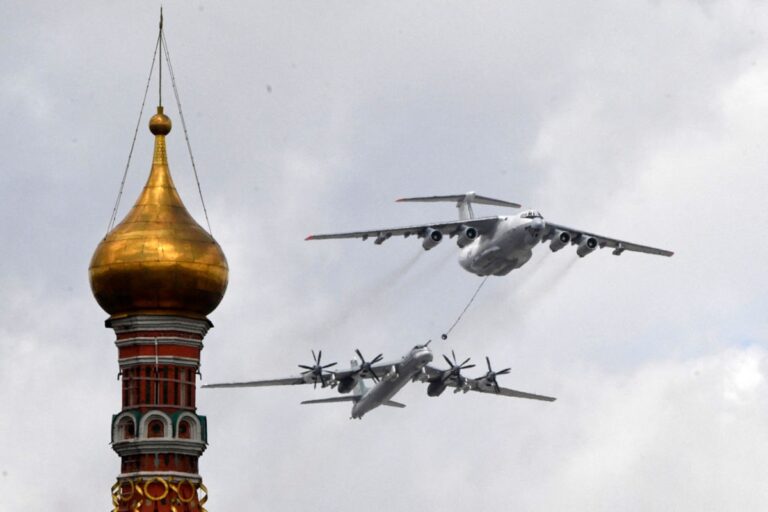
A Russian Tu-95MS strategic bomber and an Ilyushin Il-78 aerial refuelling tanker fly over the Kremlin and Red Square in Moscow on May 7, 2021, during a rehearsal for the Victory Day military parade. ALEXANDER NEMENOV/AFP via Getty Images
In the early hours of Friday, August 28, Ukraine’s Security Service (SSU) destroyed a Tu-95MS strategic bomber at Russia’s Engels-2 airbase in the Saratov region — roughly 800 kilometers (497 miles) from Ukraine’s border — using MICH 2000 long-range attack drones operated by SSU Special Operations Center “Alpha.” Defense Express reported that satellite imagery released afterward showed the bomber missing part of its wing, and analysts assessed the aircraft as non-repairable. Ukrainian President Volodymyr Zelenskyy confirmed the outcome the same morning.
It was the second Tu-95MS destroyed at Engels-2 in six weeks. The first was struck on July 16 by the same weapon, operated by the same SSU unit, from Ukrainian-controlled territory. What makes these two strikes significant is not just what Russia lost — two irreplaceable Soviet-era bombers it cannot rebuild — but what Ukraine demonstrated it has built: a serial-production autonomous weapon costing $48,000, manufactured in Ukraine at a rate of roughly 6,000 units per year, that can reach Russia’s strategic aviation bases from Ukrainian soil on demand.
Satellite imagery from AviVector and subsequent analysis showed the August 28 bomber with its right wing partially destroyed, structural damage consistent with assessment as a total loss given the aircraft’s age and the absence of any Tu-95MS production capability.
What Is the MICH 2000?
The MICH 2000 did not exist three years ago. It exists now because Beijing said no.
In the summer of 2023, China restricted exports of civilian drones that Ukrainian units had been purchasing and converting into deep-strike munitions. At the end of that year, a Ukrainian development team flew to a Chinese factory where ZTK-150 drones — Shahed lookalikes distinguished by a pair of forward canard foreplanes — were being assembled. They negotiated to buy the manufacturing technology outright. Management at the factory refused.
The intermediaries wanted the deal anyway and offered an alternative: assemble the drones somewhere without export restrictions and train Ukrainian pilots. The team took the training. “We came there to teach pilots to fly Chinese drones,” one team member told Ukrainian defense outlet Oboronka, which visited the manufacturer’s facilities. “And in parallel with the training we photographed everything that was there. Everything from the production process to the arrangement of the shelves and cabinets.” They returned to Ukraine with trained pilots and eight Chinese drones.
Two years later, the MICH 2000 costs $48,000 in its basic configuration — $2,000 less than the Chinese ZTK-150 original, which retails at $50,000. According to Euromaidan Press’s Oboronka factory report, virtually nothing of the Chinese drone survives in the MICH 2000 except its external silhouette. Ukrainian engineers replaced the internal components, achieving 85% domestic component localization. The manufacturer reinvests roughly $1 million per month into research and development.
The drone’s operational specifications: a range of up to 2,000 kilometers (1,243 miles), a warhead weighing between 25 and 60 kilograms (55 and 132 pounds), and a modular eight-configuration architecture that allows operators to select communications systems (analog, digital, or Starlink), warhead type, fuel tank size, and terminal guidance options including jam-resistant controlled reception pattern antennas. According to Tom’s Hardware on MICH 2000 production, current production runs at approximately 6,000 units per year, with a stated target of 10,000.
The MICH 2000 is used exclusively by SSU Special Operations Center “Alpha” — not by the Ukrainian Armed Forces broadly. The manufacturer says Alpha personnel have launched thousands of the drones against hundreds of targets, including a Wildberries logistics hub in Ryazan Oblast, an anti-Starlink electronic warfare system near Gelendzhik, and the port of Ust-Luga, where more than 20 MICH drones reached their targets in a single operation. Details of the SSU Alpha targets and operations have been documented by United24 Media.
A successor variant called the MICH+ is in development. It drops the canard foreplanes, carries a 70-kilogram (154-pound) warhead, incorporates terminal guidance, and is designed to reach targets at distances up to 600 kilometers (373 miles) — at a target price of approximately $40,000, according to Tom’s Hardware on MICH+ specs.
What Ukraine Hit — and Why Replacing It Is Impossible
The Tu-95MS is not simply aging hardware. It is Russia’s primary platform for delivering Kh-101 cruise missiles — the weapons that have struck Ukrainian power plants, hospitals, apartment buildings, and cities throughout the war. Each Kh-101 costs between $2 million and $2.4 million and is guided by inertial navigation with Doppler radar and terrain-matching updates, giving it a range of approximately 3,500 kilometers (2,175 miles). Wikipedia’s entry on the Kh-101 confirms the Tu-95MS is one of only two launch platforms for the Kh-101 — the other being the Tu-160 — and its loss permanently removes that delivery capacity from Russia’s order of battle.
What makes each loss particularly acute is that Russia cannot build more. The Tu-95’s production history records that the Tu-95MS rolled off Soviet production lines between 1952 and 1993. No new production capability exists, and the tooling no longer survives. According to Defense Intelligence of Ukraine (GUR), provided to Defense Express just two days before the August 28 strike, the Russian Aerospace Forces had 38 Tu-95MSs in operational condition — against an official roster of 47, with approximately 10 of the 47 unable to perform combat missions. After the August 28 destruction, the operational count stands at an estimated 37.
The airframe wear is not only shrinking the fleet — it is degrading the output of aircraft that remain. Defense Express noted that despite the Tu-95MS’s documented capacity for up to eight Kh-101 cruise missiles per aircraft, Russia is currently loading them with only four. The assessment: the extent of wear on surviving airframes prevents full loading. An aircraft that was once a delivery vehicle for eight Kh-101s — representing up to $19.2 million worth of munitions in a single strike — is now fielding four.
Compare that to what Ukraine expended. At $48,000 per MICH 2000, destroying one Tu-95MS costs Ukraine the equivalent of roughly one-forty-thousandth the cost of the bomber it eliminates — even without a published replacement price for the Tu-95MS, the asymmetry is structural. The Kh-101 missiles the bomber can no longer deliver cost more, individually, than the weapon that grounded it permanently.
From Covert Infiltration to Repeatable Attrition
To understand why the August 28 strike matters beyond its immediate tactical effect, it is necessary to place it in the context of Ukraine’s systematic campaign against Russia’s strategic aviation.
The watershed moment came on June 1, 2025: Operation Spiderweb. Over 18 months of planning, the SSU concealed 117 quadcopter drones in wooden containers mounted on flatbed trucks and dispatched the trucks — driven by unwitting Russian drivers — toward five Russian long-range aviation bases simultaneously: Olenya, Belaya, Dyagilevo, Ivanovo Severny, and Ukrainka. The roofs opened by remote control as the trucks approached their targets. Twelve to thirteen aircraft were destroyed or severely damaged across all bases, including Tu-95MS bombers and Tu-22M3s, at an estimated cost to Russia of $7 billion. Wikipedia’s documentation of Operation Spiderweb aircraft losses confirms the scale of the operation. Russian military commentators described the attack as Russia’s “Pearl Harbor” for its strategic aviation, per Wikipedia’s coverage of Russian reactions. The Institute for the Study of War noted that Russia’s Kh-101 strike capacity had been at least temporarily constrained.
Russia’s response was dispersal. Surviving Tu-95MSs were relocated to remote Far Eastern bases, most notably Ukrainka in the Amur region — more than 5,900 kilometers (3,665 miles) from Engels-2. A standard combat mission from Ukrainka now covers more than 12,000 kilometers (7,456 miles) round-trip, straining engines whose service life is already a limiting factor in Russia’s decision-making about redeployment. Defense Express noted that engine service life concerns likely prevent Russia from routinely repositioning aircraft from the Far East back to European bases, adding that the Russian military command appears more concerned about further losses from another Ukrainian operation than about managing the aircraft’s remaining engine hours.
Engels-2 is, in effect, an unavoidable chokepoint. The base houses the fuel, munitions, maintenance infrastructure, and trained ground crews necessary for arming Tu-95MSs with Kh-101s before strike missions. Aircraft stored in the Far East must still transit through or stage at Engels-2 for mission preparation. Ukraine demonstrated in July and again in August that it can reach that chokepoint repeatedly, from its own territory, with a weapon in serial production.
That is the strategic difference from Spiderweb. Operation Spiderweb required 18 months of planning, covert infiltration of agents and hardware into Russia, and a one-time operational window. The MICH 2000 campaign at Engels-2 requires neither. It requires a production line running at 6,000 units per year and a launch position inside Ukraine. The two Engels-2 strikes represent a transition from improvised deep-strike operations to a repeatable, industrial-scale attrition model.
Can Russia Absorb This Exchange Rate?
The arithmetic is unfavorable for Russia in ways that compound over time.
Each Tu-95MS lost is subtracted from a fleet that the Soviet Union spent decades building and that Russian industry cannot replenish at any price. Each MICH 2000 expended can be replaced within the current production cycle — 6,000 per year is roughly 16 per day. The asymmetry is not merely financial; it is structural. One side is drawing from a fixed, declining inventory. The other is drawing from a production line.
The strategic significance of this extends beyond Ukraine. What the MICH 2000 and Tu-95MS exchange demonstrates — at operational scale, with satellite-imagery confirmation — is that serial-production autonomous systems can impose permanent, irreversible degradation on any military’s non-replenishable legacy strategic aviation. Russia’s Tu-95 fleet is the case study. But the lesson applies wherever a military’s high-value bomber force has no replacement pipeline and faces an adversary with the industrial capacity to produce cheap autonomous systems faster than the targets can be protected. No existing air base defense architecture is designed to economically defeat an adversary with 6,000-unit annual drone production and repeated access windows.
The question for every defense ministry watching the August 28 strike is not whether their bombers face a similar vulnerability. The question is whether they have a production ecosystem that can close the exchange ratio before they run out of irreplaceable assets to lose.
What Every Defense Ministry Is Watching
The MICH 2000 is, at its core, a manufacturing story with strategic consequences. China restricted the export of the drone Ukraine needed. Ukraine responded not by accepting the constraint but by reverse-engineering the design from covert factory photography, rebuilding it from the components available, achieving 85% domestic localization, and scaling to serial production in under two years.
Defense Intelligence of Ukraine reports 38 Tu-95MS bombers in operational condition as of August 26, 2026 — down from approximately 60 when Russia launched its full-scale invasion in February 2022. Defense Express on Tu-95MS fleet provides the most recent confirmed figures. The August 28 destruction brings that to an estimated 37. Operation Spiderweb removed approximately 12-13 aircraft in one day. Two additional Tu-95MSs — destroyed at Engels-2 on July 16 and August 28 by a $48,000 drone produced in a Ukrainian factory — bring the cumulative attrition picture into focus.
The bomber that Russia used to terrorize Ukrainian cities is running out. The drone Ukraine used to destroy it is not.
Frequently Asked Questions
What is the MICH 2000, and who built it?
The MICH 2000 is a Ukrainian long-range one-way attack drone developed by an unnamed manufacturer working exclusively for the SSU’s Special Operations Center “Alpha.” It originated as a reverse-engineered copy of the Chinese ZTK-150 flying-wing drone — a Shahed lookalike distinguished by canard foreplanes — after China refused to sell Ukraine the manufacturing technology. Ukrainian engineers covertly photographed the Chinese production line during a pilot-training visit in late 2023, then rebuilt the design from scratch using available components, achieving 85% domestic content. The drone costs $48,000 in its basic configuration, carries a warhead of up to 60 kilograms (132 pounds), and can fly up to 2,000 kilometers (1,243 miles). Thousands have been launched against hundreds of targets in Russia and occupied Ukraine. Full details of the MICH 2000 origin and capabilities were reported by Euromaidan Press following the Oboronka factory visit.
Can Russia replace the Tu-95MS bombers it is losing?
No. Tu-95MS production ended in 1993 with the dissolution of the Soviet Union; neither the production line nor the tooling to restart it survives. Of the 47 aircraft officially listed in the Russian Aerospace Forces, only about 38 were assessed as operationally capable as of August 26, 2026 — and each of those is now carrying only four Kh-101 cruise missiles per sortie, down from a documented capacity of eight, because airframe wear on the aging fleet prevents full loading. The August 28 destruction brings the estimated operational count to 37. Each aircraft lost is permanently subtracted from Russia’s Kh-101 cruise missile delivery capacity, with no replacement possible. Defense Express on fleet attrition provides the full fleet breakdown.
Why can’t Russia simply base its Tu-95MS fleet farther from Ukraine to protect it?
Russia did disperse its surviving Tu-95MSs to remote Far Eastern bases — primarily Ukrainka in the Amur region, more than 5,900 kilometers (3,665 miles) from Engels-2 — following Operation Spiderweb in June 2025. The problem is operational, not geographic: Engels-2 houses the fuel infrastructure, munitions stocks, maintenance facilities, and trained ground crews required to arm Tu-95MSs with Kh-101 missiles before strike missions. Aircraft must still transit through or stage at Engels-2 for mission preparation. Dispersal reduced the standing target profile at Engels-2 but did not eliminate the base as an operational chokepoint. Defense Express noted that engine service life concerns also constrain Russia’s ability to routinely reposition aircraft between the Far East and European bases.
What does the MICH 2000 vs. Tu-95MS exchange mean for other countries’ air forces?
The exchange establishes a structural principle with implications beyond Russia and Ukraine: a military’s high-value, non-replenishable strategic aviation faces a permanent attrition risk from adversaries with serial-production autonomous weapons — regardless of how sophisticated the targeted aircraft is. The Tu-95MS can carry nuclear-capable cruise missiles, flies at nearly 925 km/h (575 mph), and requires a sophisticated ground crew to operate. None of those qualities protected it from a $48,000 drone produced at a rate of 6,000 per year. Any air force whose strategic bombers or maritime patrol aircraft lack a replacement pipeline and face an adversary with comparable autonomous production capacity is exposed to the same structural dynamic. The August 28 strike is the second data point in what is becoming an operational doctrine.