HomeAuto Ukraine AI Turrets Shoot Down Geran-5: First Capital-City Kill of Unjammable Russian Drone
Ukraine AI Turrets Shoot Down Geran-5: First Capital-City Kill of Unjammable Russian Drone
October 6, 2026:
Uforce.com
Twelve AI-guided ground turrets now stationed across Kyiv are doing something no electronic jammer Ukraine has ever fielded can do: intercepting Russia’s jet-powered Geran-5 drone, a weapon traveling at up to 600 km/h (373 mph) that routes its control signal through a glass fiber spool instead of a radio transmitter — leaving every jammer in Ukraine’s arsenal structurally irrelevant against it. Developed by Ukrainian defense firm UFORCE, the systems were AI-guided turrets deployed across Kyiv as of October 5, 2026, and represent the first deployment of autonomous kinetic anti-drone turrets at scale inside a capital city, with first confirmed Geran-5 intercepts recorded by the Air Force on the same date.
Fiber-Optic Drones Have No Frequency to Jam — That Is Not a Limitation, It Is Physics
Ukraine’s dominant short-range air defense tool since 2022 has been electronic warfare: radio-frequency jammers that overwhelm or spoof the guidance signals drones rely on to navigate and strike. Against the radio-controlled FPV drones Russia deployed in mass during 2022 and 2023 — and against early Shahed loitering munitions guided by GPS and commercial datalink — jamming worked, and worked well. Ukrainian commanders credited electronic warfare dominated drone intercepts during that period for the majority of short-range defeats.
Russia’s answer was to remove the radio link entirely. Fiber-optic-guided attack drones unspool a thin glass cable as they fly and transmit control signals as light pulses through that cable rather than through air. A jammer running at full power within direct line of sight of the drone has no effect: fiber-optic signal cannot be jammed because there is no electromagnetic frequency to flood, no GPS signal to spoof, no datalink channel to disrupt. The immunity is categorical, not a matter of jamming power or range. A control channel running through glass has no frequency, and a device that attacks frequencies cannot attack a channel that has none.
Electronic attack, electronic protection, and electronic warfare support — the three operational subdivisions of the EW toolkit — all share a single precondition: a signal propagating through the electromagnetic spectrum. Against a drone controlled through a glass cable, that precondition is never met. The turret program Ukraine has deployed in Kyiv does not attempt to improve on that approach. It abandons it entirely.
How the Lyut-Khyzhak Turret Detects, Tracks, and Fires Without Human Aiming
The Lyut-Khyzhak (Predator) turret, built by UFORCE, pairs a 7.62mm machine gun and thermal AI — FN MAG, M240, or PKT depending on configuration — with a two-camera thermal targeting module and an AI that closes the intercept window before a human operator could consciously react. The turret carries 700 rounds per load and expends one to four rounds per engagement, giving a fully loaded system a theoretical capacity of more than 100 drone intercepts before resupply.
The targeting architecture runs on dual thermal cameras and AI ballistics simultaneously: a 48-degree wide-angle lens for initial drone acquisition, and a 15-degree precision lens for engagement lock-on. A laser rangefinder measures the target’s distance while a convolutional neural network processes the thermal imagery to classify the threat. A ballistic computer then calculates the lead angle and firing solution, and dual-axis electric motors slew the weapon to the computed position. The entire detection-to-solution sequence runs without operator input. Effective engagement range is 800 meters (2,625 feet).
What the operator does is press one button. Under the autonomous weapons taxonomy developed by Bonnie Docherty in 2012, the Lyut-Khyzhak qualifies as human-on-the-loop: the AI detects, classifies, tracks, and computes; the human authorizes. The distinction matters operationally because a human manually aiming at an inbound drone traveling at 500 km/h (311 mph) is attempting a task that human reaction time cannot reliably complete. Within 800 meters (2,625 feet) of the turret, that target closes to zero in under six seconds. The AI handles the task that requires millisecond precision; the human retains authority over whether the weapon fires.
Gyro-stabilization allows the turret to engage threats while mounted on a moving platform — an armored vehicle, a naval drone, a helicopter — rather than only from a fixed emplacement. This design choice accounts for the system’s deployment flexibility and enabled the Kyiv installation across twelve separate positions throughout the city rather than as a single centralized battery.
UFORCE, the company behind the Lyut-Khyzhak, is UK-incorporated (January 9, 2025) with Ukrainian founders. Its CEO is Oleg Rogynskyy, the Silicon Valley entrepreneur who previously founded enterprise AI firm People.ai. The company’s board includes Oleksiy Honcharuk, former Prime Minister of Ukraine, and Sir Ben Wallace, UK Defence Secretary from 2019 to 2023. In March 2026, UFORCE closed a $50 million seed round in March at a valuation exceeding $1 billion — becoming Ukraine’s first defense-sector company to reach unicorn status.
Why the Geran-5 Is Harder to Intercept Than Any Drone Ukraine Has Faced Before
The Geran-5’s confirmed interception by Kyiv’s AI turrets is not a routine headline. It represents a meaningful capability threshold — because the Geran-5 is not, in operational profile, a slow loitering munition.
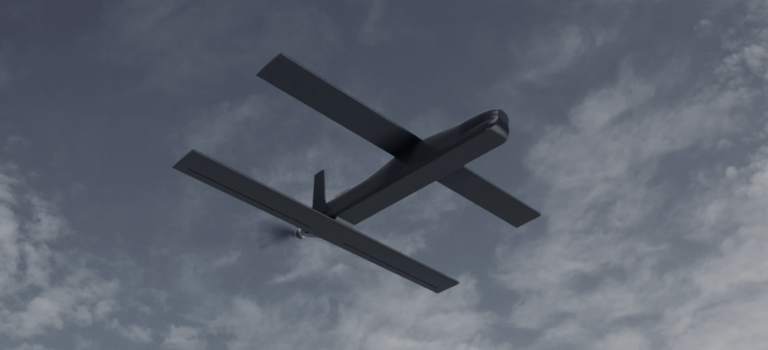
Russia first deployed the Geran-5 in combined aerial strikes against Ukraine in early January 2026, as HUR confirmed Geran-5 first combat use by Ukraine’s Defense Intelligence directorate (HUR). Unlike its Geran/Shahed predecessors — propeller-driven delta-wing munitions that cruise at roughly 185 km/h (115 mph) and are regularly intercepted by FPV drone teams and mobile fire groups — the Geran-5 uses a conventional fixed-wing airframe powered by a Telefly TF-TJ2000A turbojet engine producing approximately 200 kilograms-force (441 lbf) of thrust. According to the HUR technical assessment of Geran-5, the drone cruises at 450 to 600 km/h (280 to 373 mph), weighs approximately 850 kilograms (1,874 lbs), and carries a warhead of approximately 90 kilograms (198 lbs). Operational range is approximately 950 to 1,000 kilometers (590 to 620 miles). The drone can fly at altitudes up to 6,000 meters (19,685 feet), though most combat use has been recorded at lower altitudes.
At those speeds, the Geran-5 falls outside the engagement envelopes of conventional anti-drone rotary-wing aircraft, short-range interception UAVs, and mobile fire groups. Ukraine’s own intelligence assessment characterized a drone flying at 500 to 600 km/h (311 to 373 mph) as unreachable for existing anti-drone systems. In threat profile, analysts have placed the Geran-5 closer to a cheap cruise missile than to the loitering munitions it superficially resembles. Its total estimated cost is approximately $115,000 — roughly one-tenth the approximately $1.2 million cost of a Kh-101 cruise missile — giving Russia the economics to sustain high-volume launch campaigns with a weapon in the cruise-missile threat class.
HUR has also confirmed that the Chinese, American, and German components confirmed inside the Geran-5’s electronics highlight Russia’s continued reliance on external supply chains despite Western export controls. The drone uses a Kometa-M12 12-element anti-jamming GPS navigation system, and Russia is exploring air-launch option from Su-25 aircraft — a configuration that would extend the weapon’s effective reach beyond its current launch-point limitations.
Against this target, the Lyut-Khyzhak AI turret has achieved confirmed intercept rates of 50 to 70 percent intercept rate, according to reporting citing Brigadier General Andrii Lebedenko’s July 2026 press conference and confirmed by Air Force spokesperson Yurii Ihnat on October 5, 2026. For context, the same system achieves 85 to 92 percent Shahed intercept rates against conventional Shahed drones — the lower rate against the Geran-5 reflects the target’s speed and maneuverability rather than a limitation in the AI’s detection capability.
From Brave1 Concept to Frontline Brigade in Months: Ukraine’s Compressed Pipeline
The Lyut-Khyzhak turrets exist because Brave1 defense cluster connects startups directly to frontline units, compressing the path from prototype to combat deployment from years to months. Ukraine’s Brave1 is a government-backed program established by the Ministry of Digital Transformation, the Ministry of Defense, the General Staff of the Armed Forces, and the National Security and Defense Council.
Then-Defense Minister Mykhailo Fedorov confirmed the system’s frontline debut on May 9, 2026, releasing combat footage of the turret engaging drones under live field conditions: “For the first time on video — the real combat work of the turret against enemy drones. The collaboration with Brave1 and the military helped shorten the path from drawings to the front in the shortest possible time.” That initial deployment ran through the 20th K-2 Unmanned Systems Brigade before expanding to more than ten frontline units across key sectors.
Fedorov dismissed as Ukraine defense minister on July 15, 2026, replaced as acting minister by Yevhen Khmara. The Kyiv turret deployment proceeded under the subsequent ministry.
The Kyiv installation of twelve systems represents the program’s next scaling phase — from forward tactical positions to capital-city defense. Since their frontline rollout in late March 2026, dozens of Lyut-Khyzhak systems have intercepted hundreds of drones since March. Brigadier General Andrii Lebedenko, Deputy Commander-in-Chief of Ukraine’s Armed Forces, summarized the strategic logic in July 2026: “Drones have started to evolve, fly higher, and have become difficult targets for mobile fire groups. We set ourselves the goal of creating a new quality of old weaponry hybridised with AI-powered robotic turrets.” He added that experimental batteries protecting energy infrastructure had already demonstrated reductions in both ammunition consumption and required personnel relative to human-operated weapon teams.
Why Kyiv Gets Twelve: Speed, Symbolism, and the Logic of Capital Defense
Deploying twelve turrets in Kyiv, rather than concentrating additional systems at the front, is both a practical and a strategic decision.
Practically, Kyiv is Russia’s most frequently targeted urban area. Russian drone swarms — primarily Shahed and Geran-series munitions — have struck the capital hundreds of times since the full-scale invasion began in February 2022. The Geran-5’s combination of speed and range — capable of reaching any point in Ukraine from eastern launch positions — makes Kyiv’s layered air defense more demanding than it was when only slower munitions were in play.
The compressed decision timeline is the core reason. A human operator aiming manually at a target closing at 500 km/h (311 mph) has approximately 5.8 seconds of window at the turret’s 800-meter (2,625-foot) effective range — a window that includes acquiring the target visually, confirming it as hostile, physically aiming, and firing. That sequence is difficult for trained operators under optimal conditions and nearly impossible under the startle response of an incoming strike at night. The AI turret’s value in capital defense is specifically that it operates in the compressed timeline the threat demands, completing the full detection-to-fire sequence faster than the human threat perception cycle.
Symbolically, a deployment of this kind signals that Ukraine’s AI defense program has cleared a threshold: from experimental frontline testing to systematic urban protection. Deploying AI kinetic systems in a capital rather than only on forward positions represents institutional confidence that the technology performs reliably enough to protect the city where Ukraine’s government functions.
AI Kinetic Defense in Context: What Ukraine Has That Other Militaries Are Still Testing
Ukraine’s deployment is running in parallel with international AI integration into physical defense platforms — though the contexts differ substantially.
Korean defense AI company MakinaRocks has deployed its MakinaRocks Runway advisory system deployment — called “Runway” — aboard a Republic of Korea Navy First Fleet warship, where it provides automated tactical analysis for ship operations and maintenance decisions. The Korean Navy has also begun AI-assisted naval operations trials coordinating both crewed and unmanned vessels. Both programs route AI output through human decision-makers before any physical action follows.
Ukraine’s program is in a different category: not a trial, not an advisory layer, but an autonomous kinetic engagement system in active combat against a live and evolving threat. The difference between an AI that recommends and an AI that aims is the difference between the Korean and Ukrainian programs. Both represent genuine advances in military AI capability; only one involves the AI pulling the engagement trigger — with a human authorization step, but no human hand on the aim.
The pace of that evolution — from Brave1 program design to frontline brigade deployment to capital-city protection in under twelve months — reflects what compressed wartime necessity does to procurement timelines. Where peacetime acquisition programs measure progress in fiscal years, Ukraine has measured this one in months of live combat iteration under fire. The twelve turrets covering Kyiv are not a technology demonstration. They are what the program looks like after it has already worked.
Frequently Asked Questions
Why doesn’t electronic jamming work against fiber-optic-guided drones — and what makes kinetic AI the only countermeasure that actually applies?
Electronic jamming works by overwhelming or spoofing electromagnetic signals — radio frequencies, GPS bands, datalink channels. Fiber-optic drones replace those radio transmissions with light pulses running through a glass cable, which is physically immune to electromagnetic interference. There is no frequency to jam because no signal is being broadcast through the air. This is not a limitation that better jamming hardware can overcome; it is a categorical incompatibility between the countermeasure and the control medium. Electronic attack, electronic protection, and electronic warfare support — every branch of the EW toolkit — all require a signal in the electromagnetic spectrum to act on. Against a fiber-optic drone, that precondition is never met. Kinetic interception, which detects the physical object rather than its signals, is the only category of countermeasure that applies regardless of how the drone is controlled.
At what speed does the Geran-5 fly, and why does that speed make it so much harder to stop than earlier Shahed drones?
The Geran-5 cruises at 450 to 600 km/h (280 to 373 mph), powered by a Telefly TF-TJ2000A turbojet engine. Earlier Shahed loitering munitions use propeller-driven engines and cruise at roughly 185 km/h (115 mph) — slow enough for helicopters, interception UAVs, and mobile fire teams to engage. At the Geran-5’s speed, those options are outside their engagement envelopes. Ukraine’s own intelligence assessment called a drone flying at that speed “unreachable for helicopters, existing anti-drone UAVs, and mobile fire groups.” A human operator manually aiming at a target closing at 500 km/h (311 mph) has under six seconds at maximum engagement range — a window that is insufficient for reliable manual target classification, aim, and fire. The Lyut-Khyzhak’s AI completes the full detection-to-firing-solution sequence within that window; a human operator pressing the authorization button is what closes it.
Who operates the Lyut-Khyzhak turret, and does it fire without a person involved?
The turret is designed as a human-on-the-loop system. The AI handles every step that requires speed faster than human reflexes — detecting the incoming drone with its thermal cameras, classifying it, locking on, tracking its trajectory, and calculating the intercept solution. The operator’s role is to press a single authorization button; the AI has already done the aiming. This distinguishes the system from both a traditional weapon (where a human aims) and a fully autonomous one (where the AI fires without any human involvement). The turret carries 700 rounds and expends one to four per engagement, giving the system theoretical capacity for more than 100 drone intercepts per load before resupply.
Who built the Lyut-Khyzhak turret, and what is the company behind it?
UFORCE, a UK-incorporated company founded by Ukrainians, developed the Lyut-Khyzhak. Its CEO is Oleg Rogynskyy, the Silicon Valley entrepreneur who previously founded People.ai. The company’s board includes Oleksiy Honcharuk, former Prime Minister of Ukraine, and Sir Ben Wallace, UK Defence Secretary from 2019 to 2023. In March 2026, UFORCE raised $50 million at a valuation exceeding $1 billion — becoming Ukraine’s first defense-sector unicorn. The company also develops the Magura unmanned surface vessel, the Nemesis UAV, and the Sunray laser counter-drone system, making the Lyut-Khyzhak one element of a broader autonomous defense product line. See the UFORCE full product portfolio details for the company’s full range of autonomous systems.