HomeAuto UK Invests in Tungsten Mine but Weapons Refining Gap Stays China-Dominated
UK Invests in Tungsten Mine but Weapons Refining Gap Stays China-Dominated
September 5, 2026:
STRINGER/AFP via Getty Images
The UK Ministry of Defence has formally committed to cutting its dependence on China-dominated supply chains for tungsten and other critical minerals — the same materials that go into every armor-piercing round its soldiers fire and every radar system its aircraft carry. In a written parliamentary statement, Defence Minister Luke Pollard confirmed that the Ministry of Defence is actively coordinating with industry and allied nations to reduce exposure to single-source, high-risk suppliers. The announcement arrived ten days after the government committed up to £71 million (approximately $96 million) to restart the Hemerdon tungsten mine in Devon, giving British defense contractors their first domestic source of the metal since China’s 2025 export controls reshaped the global market.
The stakes are not abstract. China accounts for roughly 80% of global tungsten mining — 67,000 of the 85,000 metric tons produced worldwide in 2025, according to the US Geological Survey — and controls an even larger share of the downstream processing chain that turns raw ore into the powders and compounds that weapons manufacturers actually use. When Beijing began tightening export controls on tungsten in February 2025 — requiring exporters to obtain special licenses and prove materials would not be used in military applications — it set off a price spiral that has seen the benchmark tungsten intermediate, ammonium paratungstate (APT), rise from roughly $300 per metric ton unit in early 2025 to approximately $3,185 per metric ton unit by May 2026, a gain of around 900% in twelve months.
During 2025, China also dramatically increased its tungsten ore imports — pulling 20,400 metric tons of tungsten ores and concentrates into the country, up 64% from a year earlier — while simultaneously restricting outflows of processed intermediates. The effect is to centralize more of the global supply chain within Chinese borders while other buyers must scramble for alternatives.
That scramble has a hard deadline on one end of the Atlantic. US defense procurement rules, specifically DFARS 252.225-7052, will ban the use of Chinese-origin tungsten in qualifying defense applications from January 1, 2027. The US Army Contracting Command posted a sources-sought notice in late July 2026 for 120mm Advanced Tungsten Armor-Piercing, Fin-Stabilized, Discarding Sabot cartridges — the specific round that requires large volumes of high-quality tungsten alloy — underscoring how urgent the supply picture has become for NATO’s largest military.
Why Tungsten Cannot Be Substituted
Tungsten is not simply another industrial metal. It holds the highest melting point of any pure metal — 3,422°C (6,192°F) — and a density of approximately 19.3 grams per cubic centimeter, almost identical to gold. These two properties in combination make it the material of choice for kinetic energy (KE) penetrators: the long, dense rods at the core of armor-piercing fin-stabilized discarding sabot (APFSDS) rounds used by every NATO main battle tank. A modern 120mm tank gun fires a penetrator roughly 2–3 centimeters (about 1 inch) in diameter and up to 80 centimeters (31 inches) long at velocities between 1,400 and 1,800 meters per second (about 3,100–4,000 miles per hour). The penetrator’s mass and velocity concentrate kinetic energy on a point smaller than a fist, punching through steel armor that would deflect or shatter a conventional round.
Only two materials are dense enough to do this reliably at scale: tungsten and depleted uranium (DU). The US military prefers DU for its best tank rounds because DU undergoes a useful self-sharpening effect on impact — rather than mushrooming against armor as tungsten does, it shears cleanly, concentrating more energy deeper into the target. But DU is radioactive, politically contentious, and increasingly subject to environmental restrictions, which is why most NATO allies, including the UK, have made tungsten their primary penetrator material.
Here is the engineering constraint that makes Chinese supply dominance so consequential: tungsten cannot be cast like steel. Its melting point is too high for conventional foundries. Instead, tungsten penetrators are manufactured by powder metallurgy — tungsten metal powder is mixed with small amounts of nickel and iron or cobalt binder, cold-pressed into shape, and then sintered (heated to around 1,500°C, or 2,732°F) in controlled atmospheres. The result is a dense, homogeneous rod that can be precision-ground to the required tolerances. This processing route means that even a country with a perfectly adequate tungsten mine is not automatically capable of producing penetrator-grade material — it also needs APT refining capacity, tungsten powder production, and sintering facilities, all of which China has built up over decades.
What the Mine Does — and What It Doesn’t
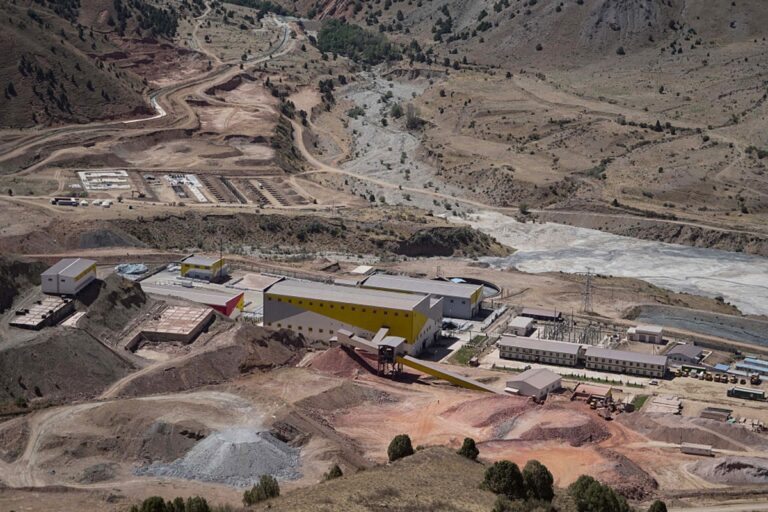
Hemerdon, located 11 kilometers (7 miles) northeast of Plymouth and operated by AIM-listed Tungsten West, holds one of the world’s three largest tungsten resources. The mine produced tungsten and tin between 2015 and 2018 under its previous operator, Wolf Minerals, before that company entered administration. Tungsten West acquired the site in 2019 and has spent the intervening years redesigning its processing layout and securing new environmental permits, benefiting from more than £170 million (approximately $230 million) in infrastructure already in place from the prior operators.
The National Wealth Fund’s investment — £36 million (approximately $49 million) in equity, giving the government a 7.42% stake in Tungsten West, plus up to £35 million (approximately $47 million) in debt financing — completes the capital the company needs to reach commercial production. The government also secured a limited negotiation window to conclude an offtake agreement covering up to 50% of the mine’s annual tungsten output from the 2025 feasibility study figures.
As of early September 2026, the Hemerdon site is in active commissioning. The Phase 1 fines gravity circuit — which uses the density difference between tungsten minerals and waste rock to separate concentrate — is operating at up to 100 tonnes hourly in its initial configuration, targeting full installed capacity of around 200 tph. The coarse gravity circuit is scheduled for the fourth quarter of 2026, with full plant commissioning — including new-build crushing, screening, and ore-sorting facilities — targeted for the first quarter of 2027 at 500 tph.
The mine produces tungsten and tin concentrates. What it does not produce is ammonium paratungstate, tungsten oxide, tungsten powder, or penetrator-ready material. Between concentrate and completed weapon component, the ore must travel through an APT refining stage, a reduction-to-metal-powder stage, and a sintering stage — and the West has built almost none of this intermediate processing capacity outside China. A senior industry witness before the UK Parliament’s Business and Trade Sub-Committee on Economic Security identified midstream processing as the decisive challenge for building any Western defense supply chain free of Chinese dependency.
This is not a criticism of Hemerdon. It is a structural observation about where the UK’s investment strategy stands: a domestic mine changes the ore extraction picture significantly and reduces exposure to Chinese concentrate exports, but it does not, by itself, secure the weapons manufacturing chain.
Geopolitical Wake-Up Call
The urgency driving this investment is measurable. China’s tungsten export controls now cover not only tungsten concentrate but also ammonium paratungstate and tungsten oxides — reaching across the middle of the supply chain that overseas manufacturers depend on most.
What the Ministry of Defence Is Building
Pollard’s parliamentary statement set out the shape of the department’s response. The Ministry of Defence is working on four tracks simultaneously: identifying alternative sources of supply, investing in allied capacity, securing supply and promoting recycling, and pushing substitution research to reduce reliance on single suppliers and high-risk geographies. It is coordinating with NATO allies and Australia to share intelligence on vulnerabilities before they become operational crises.
On the allied-sourcing side, the UK has moved to lock in a bilateral framework with Australia through formal diplomatic channels. On February 23, 2026, Pollard hosted Australian Defense Industry Minister Pat Conroy for the Australia-UK Defense Industry Dialogue (AUKDID), where both sides discussed cooperation on critical minerals essential to advanced defense technologies, improved information-sharing, and joint research. That groundwork fed into the June 10, 2026 Australia-UK Ministerial Consultations (AUKMIN) in London, where Foreign Secretary Yvette Cooper and Defence Secretary John Healey hosted senior Australian ministers including Deputy Prime Minister Richard Marles and signed a joint statement on critical mineral supply chains for defense.
The Australia partnership is strategically complementary. Australia holds substantial and geologically diverse critical mineral endowments, and is expanding its downstream processing capabilities — positioning itself as a credible alternative supplier to NATO-aligned nations at exactly the moment those nations need options.
How Recycling Closes Part of the Gap
Beyond new mines and bilateral agreements, the Ministry of Defence’s strategy incorporates recycling as a structural buffer — a recognition that even ambitious diversification will leave residual vulnerabilities.
Major industrial users have long collected and reprocessed tungsten scrap, and the UK has research institutions working to scale up the next generation of recovery techniques. The University of Birmingham has been commercializing a process for pulverizing used magnets into powder for remanufacturing — its HyProMag spin-out operates a demonstration plant and is building out European capacity. Queen’s University Belfast’s Ionic Technologies received £11 million (approximately $15 million) from the UK’s Advanced Propulsion Centre to advance rare earth recovery from end-of-life magnets using ionic liquids. These are modest programs by comparison with the overall supply shortfall, but they address the midstream processing problem from the recycling side rather than the mining side — which is where the real bottleneck lies.
Where This Leaves UK Contractors
For defense prime contractors and their supply chains, the Ministry of Defence’s policy direction is becoming concrete. The department’s commitment to improving visibility with industry suggests that procurement frameworks will begin to incorporate provenance requirements for tungsten, rare earths, and other dual-use minerals — pushing contractors to audit and certify their supply chains in ways that historically have not been required.
The UK is also home to Less Common Metals (LCM), the only Western producer of rare-earth magnet alloys — the same alloys used in the F-35 program — giving it a unique midstream position in the rare earth supply chain that parallels Hemerdon’s position in tungsten. USA Rare Earth acquired LCM in November 2025, which has further integrated it into an allied supply chain aligned with NATO demand.
The UK government’s exclusive negotiation window for Hemerdon’s offtake runs for approximately six months from the August 2026 investment date — meaning a binding supply agreement must be concluded by around late February 2027 to lock in the mine’s domestic anchor role. If those negotiations produce a contract, Hemerdon becomes the centerpiece of a credible domestic tungsten anchor for UK defense procurement. If they stall, the pressure on allied and multilateral channels intensifies.
Either way, the UK’s defense industrial base is being formally asked to treat tungsten as a front-line strategic variable rather than a background logistics assumption. For contractors who source from Chinese intermediaries today — directly or through their supply chains — that signal is likely to arrive as a procurement condition sooner rather than later.
How Does UK Mineral Policy Compare Internationally?
The UK is not leading this race. The United States has a harder deadline — the January 2027 DFARS ban on Chinese tungsten in defense applications — and has been investing more aggressively in domestic and allied processing capacity. The EU’s Critical Raw Materials Act has established binding domestic sourcing targets across the bloc. Japan, one of the world’s largest tungsten consumers, has seen its Chinese supply roughly halve and is accelerating procurement from alternative sources including Vietnam’s Masan High-Tech Materials, which supplies close to 30% of ex-China global tungsten demand.
Analysts have consistently noted that new supply cannot materialize quickly. Even well-funded projects in Spain, Brazil, Australia, and the United States face multi-year timelines. The advantage of brownfield restarts like Hemerdon — where the infrastructure already exists and environmental permits are in place — is precisely that they compress those timelines. Tungsten West is targeting full production at 500 tph by the first quarter of 2027.
The UK’s Vision 2035 strategy sets binding targets: at least 10% of annual critical mineral demand met through domestic production, 20% through recycling, and no more than 60% of any single mineral sourced from one country — all by 2035. Starting from a current domestic sourcing level of roughly 6%, those targets represent a substantial structural shift. The Hemerdon investment is the most concrete step yet toward making them real.
Chancellor John Healey’s assessment of the investment captured the new calculus plainly: “We are living in a more dangerous world, which is why backing British industry is more important than ever before. We are tapping into one of the largest deposits of tungsten in the world, right here in the UK.”
For UK defense contractors, the message is unambiguous: the era of treating tungsten sourcing as someone else’s logistics problem is over.
Frequently Asked Questions
What makes tungsten irreplaceable in military ammunition?
Tungsten’s combination of extreme density — about 19.3 grams per cubic centimeter, nearly as heavy as gold — and a melting point of 3,422°C (6,192°F) makes it the primary material for kinetic energy penetrators in armor-piercing tank rounds. The physics of penetration require a dense, hard rod fired at high velocity to concentrate kinetic energy on the smallest possible area. Only tungsten and depleted uranium achieve this at scale, and most NATO allies including the UK use tungsten because depleted uranium is radioactive and politically contentious. Tungsten can only be processed into weapon-grade material through powder metallurgy — mixing metal powder with binders, compressing it, and sintering it — which is why the manufacturing chain requires specialized facilities beyond the mine itself.
Why can’t the UK simply buy tungsten from countries other than China?
China accounts for roughly 79% of global tungsten mine production and controls an even larger share of the downstream processing chain — particularly the refining of tungsten into ammonium paratungstate (APT) and the production of tungsten powder and carbide that manufacturers use directly. Non-Chinese producers, including Vietnam’s Masan High-Tech Materials (which supplies about 30% of ex-China demand), Spain’s Saloro, and now Hemerdon in the UK, can provide ore concentrates. But the West has very limited APT refining and powder-production capacity outside China, meaning the chokepoint in the supply chain is not the mine — it is the processing chain downstream of the mine.
What does the Hemerdon mine actually produce, and how does that connect to weapons manufacturing?
Hemerdon produces tungsten and tin concentrates — the raw output of ore processing using gravity circuits and dense media separation. That concentrate must then be processed into APT by a refiner, reduced to tungsten oxide and then metal powder, and finally sintered into the rod-shaped components that ammunition manufacturers machine into penetrators. Hemerdon addresses the ore extraction part of this chain; the APT refining and powder production steps remain a gap in Western industrial capacity. The Ministry of Defence strategy acknowledges recycling and allied sourcing as partial answers, but building Western midstream processing capacity independent of China is the next challenge the Hemerdon investment does not yet solve.
What does the US tungsten ban mean for the UK?
From January 1, 2027, the US Defense Federal Acquisition Regulation Supplement (DFARS 252.225-7052) will prohibit the use of Chinese-origin tungsten in qualifying US defense procurement. This creates a direct commercial opportunity for Hemerdon and other non-Chinese producers, but it also signals the direction of allied procurement policy broadly: governments across NATO are systematically cutting Chinese critical minerals out of their weapons supply chains. For UK contractors who supply into US-facing programs — including the F-35 — the DFARS rule effectively sets a compliance requirement that will cascade through their own supply chains.