HomeAuto UK Cuts Dreadnought Nuclear Supplier After Security Review, Details Classified
UK Cuts Dreadnought Nuclear Supplier After Security Review, Details Classified
September 5, 2026:
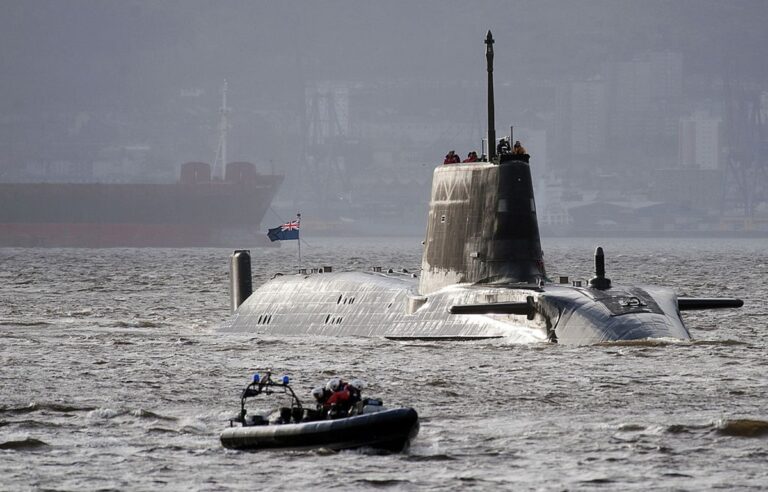
Andy Buchanan/AFP via Getty Images
Britain’s nuclear submarine programme has quietly shed a contractor following a secret security review — and the only reason parliament knows about it at all is because an accounting rule designed for mundane government bookkeeping requires the disclosure of money paid for nothing received.
Defence Minister Luke Pollard confirmed the Dreadnought termination Thursday in a written parliamentary answer, after Conservative MP Ben Obese-Jecty spotted a “fruitless payment” entry buried in the Ministry of Defence’s 2025–26 Annual Report and Accounts and asked what it referred to. “A contract within the Dreadnought supply chain was terminated following security reviews by the Defence Nuclear Enterprise,” Pollard replied. “The detail is unsuitable for disclosure due to the classification and sensitivity of the programme.”
That is the entirety of what the UK government is prepared to say publicly. The contractor’s name, the portion of the £31 billion (approximately $39.23 billion) programme it served, the contract’s value, and the specific security concerns that triggered the review all remain classified.
What the disclosure does illuminate — involuntarily, through the logic of mandatory accounting transparency — is a structural gap at the heart of how Britain oversees its most sensitive defense programmes. Ordinary parliamentary scrutiny can be blocked by a single phrase: “classified and sensitive.” But the accounting rules cannot be similarly silenced. A fruitless payment must appear in the annual accounts regardless of what caused it.
What an Accounting Entry Just Forced Into the Open
The category “fruitless payment” is defined in the Ministry of Defence’s own financial manual JSP 472 as payments the department receives nothing useful for and either should not have incurred the liability or could have taken appropriate action to avoid it. It is the same category that covers cancelled hotel bookings and incorrectly reimbursed expenses. Its appearance in connection with a classified nuclear security termination is, to put it mildly, unusual.
Obese-Jecty — a former British Army captain who served in Iraq and Afghanistan and is now one of the most prolific parliamentary questioners of the Ministry of Defence — spotted the entry and asked the question that produced Pollard’s answer. Without that intervention, the terminated contract would likely remain entirely unknown outside classified government channels.
Pollard, who as Minister of State for Defence is responsible for submarine delivery, artificial intelligence and innovation, and defense procurement at the MOD, made no elaboration beyond confirming the basic fact. His ministry’s annual report carried the accounting entry because accounting rules demand it. His written answer confirmed it because parliament asked. Nothing further is forthcoming.
What Is the Dreadnought Programme?
The Dreadnought programme is delivering four nuclear-powered ballistic missile submarines — HMS Dreadnought, HMS Valiant, HMS Warspite, and HMS King George VI — to replace the Royal Navy’s aging Vanguard-class fleet and carry Britain’s nuclear deterrent into the 2060s and beyond.
Each boat will measure 153.6 meters (504 feet) long and displace 17,200 tonnes — the largest submarines ever ordered for the Royal Navy. They are being built at BAE Systems’ submarine shipyard in Barrow-in-Furness, Cumbria, and powered by Rolls-Royce’s PWR3 naval reactor, which requires 30 percent less maintenance than its predecessor. The submarines carry Trident II D5 submarine-launched ballistic missiles drawn from a shared pool with the US Navy under the 1963 Polaris Sales Agreement (as amended), using a Common Missile Compartment developed jointly with the United States — the same compartment fitted to America’s Columbia-class SSBNs.
As of July 2026, BAE Systems had spent approximately £8.9 billion (approximately $11.26 billion) across more than 1,500 UK suppliers on the programme. The company received a fresh £5.9 billion (approximately $7.47 billion) contract in July 2026 as part of a wider £8.4 billion parliamentary-approved package, with a further £2.5 billion (approximately $3.16 billion) directed to the wider supply chain. The programme’s total estimated cost stands at £31 billion (approximately $39.23 billion) with a £10 billion contingency reserve. By March 2024, the government had committed some £17.4 billion (approximately $22.02 billion) across the programme’s concept, assessment, and early delivery phases, with £3.37 billion (approximately $4.27 billion) of the contingency already drawn down.
The Dreadnought programme is the core of the broader Defence Nuclear Enterprise (DNE), which supports an estimated 47,600 jobs across the UK — a workforce projected to rise to around 65,000 by 2030. Its supply chain spans more than 6,000 UK-based companies.
A security-driven contract termination within the DNE is not a routine event. Standard commercial contract terminations — for performance failure, cost overrun, or scope change — do not trigger the classification mechanism that Pollard invoked. The specific phrasing “security reviews by the Defence Nuclear Enterprise” indicates that a security concern about the contractor itself, rather than its work product, was identified and acted upon.
The question the government will not answer is what category of security concern that was. The possibilities are not equivalent in their implications.
Personnel vetting failures — where an employee or subcontractor is found to have undisclosed foreign connections, financial vulnerabilities, or other characteristics that create intelligence exposure risk — are handled within the UK’s developed vetting (DV) framework, the highest tier of security clearance.
Ownership and corporate structure concerns — where a contractor’s parent company, investors, or beneficial owners are found to have connections to foreign states or interests incompatible with nuclear programme access — are governed by the National Security and Investment Act 2021, which gives the UK government broad powers to block or unwind transactions.
Technology and data transfer risks — where a contractor’s operations or subcontracting relationships create exposure for classified technical data about the submarines’ design, propulsion, weapons systems, or stealth characteristics — represent a different category of threat again.
None of these can be confirmed or ruled out from the public record. What can be said is that the DNE’s security controls around the nuclear enterprise are, by design, among the most stringent in British government — and that a contractor cleared to those standards was subsequently found to fall short of them.
Supply Chains as Attack Surfaces: What the Classified Risk Landscape Looks Like
The UK’s national cybersecurity authority recorded 204 nationally significant cyber incidents in a single year in its 2025 Annual Review, a 130 percent increase over the preceding year. Some 80 percent of all cyber attacks now involve a supplier or vendor rather than a direct attack on the primary target.
The vulnerability pattern is structurally predictable. Nation-state intelligence services — primarily from Russia, China, Iran, and North Korea — have identified that well-protected primary targets can be reached more easily through smaller contractors with trusted access. This is precisely the threat model that applies to the Dreadnought supply chain: thousands of companies, many of them small and medium enterprises with limited security infrastructure, some with overseas components in their own supply chains, all with varying degrees of access to sensitive programme information.
The 2024 Ministry of Defence payroll breach provided an unusually concrete illustration. A suspected state-sponsored payroll attack on a third-party provider — not the MOD itself — exposed the names and bank details of up to 270,000 serving and former military personnel. The MOD was the intended target; the entry point was a contractor.
The Dreadnought supply chain presents a larger and more valuable attack surface. BAE Systems has acknowledged that its supply chain for the programme spans facilities around the country and includes overseas dependencies — including specialized high-strength hull steel contracted from a French supplier. The 2021 government acquisition of Sheffield Forgemasters was explicitly intended to reduce this kind of dependency by building sovereign capacity for specialized steel and nuclear reactor component manufacture.
The question of whether similar sovereign-capacity gaps exist elsewhere in the supply chain — and whether the terminated contractor’s role touched one of them — is, by definition, not answerable from public sources.
How Parliamentary Accountability Works — and Doesn’t
The routine mechanisms for parliamentary oversight of defense programmes — select committee hearings, National Audit Office reviews, oral ministerial questions — all depend, to varying degrees, on the government choosing to provide information. Classification provides an effective and legally sound basis for refusal.
What Obese-Jecty discovered is that the annual accounts function differently. The requirement to disclose losses and special payments — including fruitless payments — in government accounts is not subject to a classification exemption. The entry must appear. A sufficiently alert MP, reading a sufficiently large and technical document, can surface a classified event through a parliamentary question that the government is then obliged to confirm, even if it need not explain.
This is how the only fact known about this termination became public: not through proactive disclosure, not through a select committee investigation, not through a National Audit Office report, but through an accounting entry and an alert MP.
The Ministry of Defence’s position — that classification justifies withholding every detail — is legally and operationally defensible. The nuclear deterrent’s supply chain is a high-priority target for foreign intelligence services, and naming a terminated contractor, its role, or the nature of the security concern would, in the MOD’s judgment, create additional risk. That judgment is not unreasonable.
But it does mean that parliament and the public have learned the following: a contractor was cut, public money was forfeited, the reasons are classified, and the programme continues. Whether the gap the terminated contractor leaves has been filled, is being filled, or remains open is unknown. Whether the programme timeline toward CASD transition — the handoff from the aging Vanguard-class submarines to the Dreadnoughts in the early 2030s — is affected is unknown.
Continuous At-Sea Deterrence, the unbroken rotation of at least one armed ballistic missile submarine on patrol that Britain has maintained since April 1969, is described by the government as continuing without interruption. Whether the terminated contract affects the long-term delivery schedule for that capability is not something the public record can answer.
What Comes Next for Parliament — and for the Programme
The government is unlikely to volunteer additional detail. Pollard’s written answer is the public record on this matter. The Submarine Delivery Agency — which has held responsibility for nuclear submarine procurement since its launch in April 2018 — has not commented.
What remains on the record is what the accounting rules compelled and what a single parliamentary question extracted: a classified security failure occurred inside the UK’s highest-priority defense programme, money was lost, and the contractor is gone.
The gap in the programme’s supply chain — and what, if anything, replaces the terminated contract — remains firmly beyond public view.
Currency conversions in this article are based on an exchange rate of approximately $1.2656 per pound sterling as of September 4, 2026, and are approximate.
Frequently Asked Questions
What is a “fruitless payment” in UK government accounting?
A fruitless payment is defined in the MOD financial manual JSP 472 as money paid for which the department receives nothing useful in return — either because the liability should not have been incurred, or because appropriate action could have prevented it. All government departments must disclose fruitless payments in their annual accounts, regardless of the underlying subject matter. That mandatory disclosure requirement — which cannot be blocked by security classification — is the reason the Dreadnought contractor termination entered the public record at all.
How does security vetting work for UK nuclear submarine contractors?
Access to the Dreadnought programme requires the highest tiers of UK security clearance — up to Developed Vetting (DV), which involves extensive background checks on an individual’s finances, foreign contacts, and character. Companies operating in the nuclear enterprise must meet stringent standards set by the Defence Nuclear Enterprise and undergo ongoing review. A “security review” that leads to contract termination could reflect failures at the personnel level, the corporate ownership level, or the data-handling level — all of which are treated as serious risks given the sensitivity of submarine design and propulsion technology.
Could this affect the UK’s nuclear deterrent?
The government has stated that Continuous At-Sea Deterrence — maintained without interruption since April 1969 — continues. The Dreadnought programme overall is described as on schedule, with HMS Dreadnought expected to enter service in the early 2030s, replacing the existing Vanguard-class submarines. Whether the terminated contract creates any timeline risk to that transition is classified. What is documented is that a security concern serious enough to forfeit public money and end a contractor’s involvement was identified and acted upon inside a programme that carries the UK’s ultimate security guarantee.
Why won’t the government name the contractor?
The Ministry of Defence’s stated reason is that identifying the contractor, its role in the programme, or the nature of the security concern would itself create additional risk to national security. The nuclear deterrent supply chain is a documented priority target for hostile state intelligence services. Publicly confirming which specific component or capability was involved — even in the form of confirming which contractor supplied it — could help adversaries understand the supply chain’s structure and remaining vulnerabilities. This is legally and operationally defensible. It also means there is no further public accountability for what happened or what it cost. The full account of this termination was disclosed by Defence Minister Pollard’s written answer.