HomeAuto Tim Burton and Kazuo Ishiguro Announce Post-WW2 Japan Film on Collective Forgetting
Tim Burton and Kazuo Ishiguro Announce Post-WW2 Japan Film on Collective Forgetting
October 16, 2026:
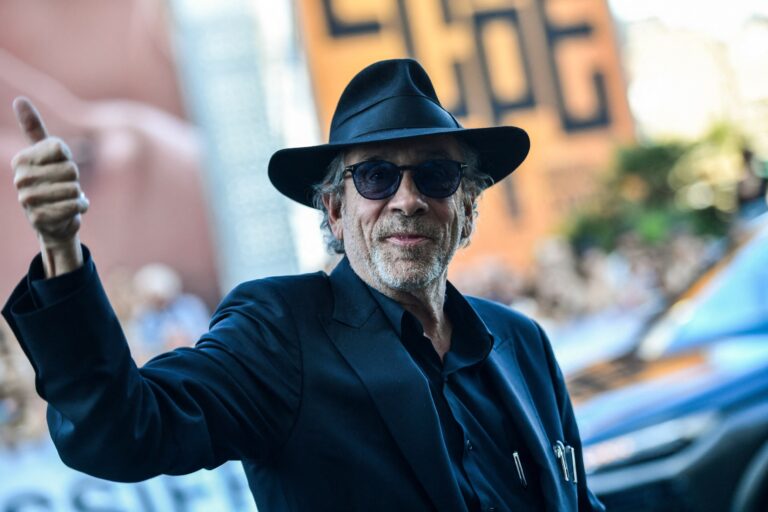
US director Tim Burton arrives to the 72nd San Sebastian International Film Festival in the northern Spanish Basque city of San Sebastian. ANDER GILLENEA/AFP via Getty Images
Tim Burton and Nobel Prize laureate Kazuo Ishiguro have developed an original screenplay together, set in post-World War II Japan, and Burton has committed to direct it — a pairing that places two of fiction’s most distinct aesthetic vocabularies on precisely the historical ground where neuroscience, epigenetics, and collective memory sociology all converge. Deadline confirmed the pairing on October 15, 2026, when Ishiguro announced it on the red carpet of the BFI London Film Festival world premiere of Klara and the Sun — the Taika Waititi film adaptation of his 2021 novel. No cast or distributor is attached, and the production has not yet been confirmed as Burton’s next film, but industry sources note the package is a strong candidate for the AFI Fest market in November 2026.
Post-WW2 Japan is not an incidental setting choice for either creator. It is the most historically charged possible laboratory for the subjects both have spent careers exploring: the mechanisms by which individuals and entire societies suppress what they cannot bear to remember. Sociology has documented how institutions shape collective forgetting. Neuroscience has established that traumatic memory reconsolidates — is rewritten, not merely retrieved. Radiation biology has since established that the fears which destroyed millions of hibakusha lives were grounded in a misunderstanding of nuclear genetics. A Burton-Ishiguro collaboration in that setting is not a prestige brand alignment. It is a structural match.
“It’s an original thing that Tim and I put together, privately, without any producers,” Ishiguro told Deadline on the red carpet. The phrasing is characteristic: the emphasis on the private origin, the labor done before any institutional claim on the work. It also signals something formally significant — this is not an adaptation of any existing Ishiguro novel, but an original screenplay developed between two collaborators who have each, in their own medium, spent decades examining what happens to people who must live with what they cannot say.
The BFI Red Carpet: A Development Without Distributor
The timing of the announcement was not accidental. The BFI London Film Festival premiere of Klara and the Sun — in which Jenna Ortega, Burton’s lead in Wednesday and Beetlejuice Beetlejuice, plays Klara, Ishiguro’s AI narrator from the 2021 novel — brought Ishiguro into Burton’s immediate cultural orbit. Ortega is, at this moment, the living bridge between the two creators’ active work: she is the face of Burton’s Wednesday Season 3 and the co-lead of Waititi’s adaptation of Ishiguro’s most recent speculative novel. That coincidence is not what made the Burton-Ishiguro project happen, but it illustrates the proximity the two creative worlds have developed.
The project’s status — no cast, no distributor, no production start date, no confirmed title — is standard for an early development announcement of this ambition. Ishiguro’s screenwriting track record (discussed below) establishes that he can move between literary prose and cinematic form without difficulty; Burton’s attachment signals that the creative collaboration has already produced a script he is committed to directing. What comes next is packaging: the assembly of cast, production partners, and a distribution deal, most likely targeting the November 2026 market window at AFI Fest. The question of when audiences will see the film is not yet answerable. The question of why it matters is.
Ishiguro Has Been Here Before: Japan as Literary Inheritance
Ishiguro’s first two novels are Japan-set examinations of exactly the emotional territory the Burton collaboration is entering. A Pale View of Hills (1982), set in post-war Nagasaki, follows Etsuko — a Japanese woman now living in England — whose memories of a neighbor gradually reveal suppressed guilt about her own daughter’s fate that she cannot directly confront. An Artist of the Floating World (1986) is narrated by Masuji Ono, a retired propaganda painter whose retrospective account continuously revises itself — each new detail making the previous revision more visible. Both novels were written before Ishiguro had returned to Japan as an adult; both are built around the same psychological architecture: the narrator who is not lying to the reader but is lying to themselves.
Ishiguro was born in Nagasaki in 1954 — nine years after the atomic bombing — and moved to the United Kingdom at age five. His relationship to Japan is that of an outside-insider: intimate enough to have absorbed the emotional grammar, distant enough to see the mechanisms clearly. That position, scholars of his work have argued, is what enables his narrators to perform the precise self-deceptions they perform. An author fully inside shame-culture logic cannot narrate its distortions; an author fully outside cannot inhabit them. Ishiguro does both.
His most recent screenplay, Living (2022), directed by Oliver Hermanus, was itself an adaptation of Akira Kurosawa’s Ikiru (1952) — a film set in post-war Japan about a civil servant dying of stomach cancer who decides to spend his remaining time building a children’s park. The film earning Ishiguro an Oscar nomination confirmed his continued facility with the specific register — restrained, elegiac, human-scale — that a collaboration with Tim Burton would need to accommodate and transform.
Two Gothic Traditions on a Collision Course
Burton’s visual language is rooted in German Expressionism, EC Comics horror, and the Victorian Gothic tradition: the distorted architecture of anxiety, the morality tale with a grotesque twist, the beautiful-horrible figure who does not belong in the world around them. Edward Scissorhands cannot touch what he loves. Corpse Bride is more alive than the living. Lydia Deetz is more at home with the dead.
Japan has its own ancient tradition of the uncanny: kaidan (怪談), the strange tales of wronged spirits and supernatural disturbance that run from Heian court literature through the Edo period to the J-horror films of the 1990s. The kaidan ghost is almost always someone who was silenced in life — a wronged woman, an unacknowledged dead — and who returns to demand that the silence be broken. The structural logic is identical to Burton’s: the suppressed thing that erupts through the surface of the ordinary.
Post-WW2 Japan was already generating its own dark-fantastic response to mass trauma in real time. Godzilla (1954) emerged directly from the Hiroshima and Nagasaki context as a monster made of radiation and collective dread — a kaidan for the nuclear age. The period is saturated in exactly the register Burton has spent his career developing in a Western idiom.
Adding a third layer: mono no aware (物の哀れ), the Japanese aesthetic concept of bittersweet awareness of transience — the melancholy of beautiful things passing away, first articulated by the 18th-century scholar Motoori Norinaga. Burton’s own aesthetic arrives at the same emotional frequency from a different cultural origin: his characters are almost always in mourning for something — an innocence, a belonging, a world that cannot accommodate them. “Burtonesque” is, structurally, a Western Gothic articulation of mono no aware: beauty inseparable from loss. In a post-WW2 Japan setting, this convergence is not pastiche but resonance — two traditions that had independently arrived at the same emotional structure, meeting in the historical moment that demanded them most.
What Neuroscience Now Understands About Ishiguro’s Narrators
Ishiguro’s literary insight into self-deceiving memory turns out to be neurobiologically grounded. Research on memory reconsolidation — demonstrated first by Karim Nader, Glenn Schafe, and Joseph LeDoux in their landmark 2000 Nature study — established that retrieved memories are not simply read out from storage but re-stabilized, sometimes in altered form. Each retrieval is simultaneously a revision. Memories shaped by shame or guilt are particularly susceptible to motivated distortion: the prefrontal cortex actively modulates hippocampal consolidation in ways that protect ego coherence.
Masuji Ono is not a literary device. He is a clinical portrait of how the human autobiographical memory system protects ego coherence in the face of moral catastrophe. In post-WW2 Japan, this was not individual pathology but the dominant mode of psychic survival for an entire generation.
The epigenetic dimension adds a further layer. Research on intergenerational trauma transmission — including the Dutch Hunger Winter studies, which documented measurable epigenetic differences in children of mothers who were starving during the 1944-45 famine — has established that the physiological effects of extreme stress can be transmitted across generations through changes in gene expression. For the hibakusha — atomic bomb survivors — this science carries particular historical irony.
The social stigma hibakusha faced, which barred many from marriage and employment for decades, was rooted in a specific fear: that radiation damage was heritable and potentially contagious. The Radiation Effects Research Foundation Life Span Study, tracking survivors and their descendants since 1950, found no statistically significant increase in hereditary genetic disease among hibakusha children — meaning the harm that destroyed millions of lives was produced by a fear that the actual biology, as subsequently measured, does not justify. People were socially destroyed by the transmission of a fear that was, at the genetic level, largely unfounded. Burton’s visual idiom — in which deformity and monstrousness are almost always social constructions projected onto an innocent outsider — is exactly suited to dramatizing this premise.
Maurice Halbwachs and Japan’s Institutional Forgetting
The sociologist Maurice Halbwachs argued in La mémoire collective (1950) that societies recall through collective institutions, rituals, and shared narratives that shape what any individual can remember. Applied to post-war Japan, the argument is stark: the American occupation’s Civil Information and Education Section (CIE) systematically directed what Japan was permitted to remember publicly, censoring atomic bomb reporting, directing filmmakers toward “democratic” themes, and prohibiting “feudalistic” or “militaristic” content. The public framework for Japanese collective memory was rewritten twice in a decade — first under imperial militarism, then under occupation democratization — leaving individuals whose private memories were calibrated to one framework having to perform a different public one.
This is exactly what Ishiguro’s The Buried Giant (2015) explored in a fantastical register: a post-Arthurian England covered in a magical mist of collective forgetting, where remembering threatened the social peace. The new Burton-Ishiguro film appears poised to operate the same mechanism through a realist-historical lens, in the setting where forgetting was not magic but policy.
Ruth Benedict’s 1946 study The Chrysanthemum and the Sword introduced the distinction between “shame cultures” (regulated by external social judgment, or haji) and “guilt cultures” (regulated by internal conscience), characterizing Japan as primarily shame-organized. Benedict’s specific binary has been critiqued and nuanced by subsequent anthropologists, but the underlying observation — that post-war Japanese social psychology was organized around the avoidance of public shame rather than the confession of private guilt — has proved durable. In a shame-culture framework, confession is not cathartic. It is catastrophic. The hibakusha who did not speak were not simply cowardly; they were responding rationally to a social system in which disclosure of victimhood or complicity carried irreversible social destruction.
Ishiguro, formed by both English guilt-culture tradition and Japanese shame-culture inheritance, occupies the analytical position to articulate this dynamic from the inside. Burton, whose cinema is obsessed with the moment when suppression gives way and the buried thing erupts, brings the visual grammar for what that moment looks like.
Both Creators Have Staked Out Positions on AI — and They Differ
The collaboration between Burton and Ishiguro is not taking place in a neutral technological moment. Both creators have gone on record about artificial intelligence, and their positions — while not identical — point in the same direction.
Burton told The Independent that AI’s use in animation and filmmaking is “disturbing” and “like a robot taking your humanity, your soul.” He reacted specifically to AI-rendered versions of Disney characters, describing the effect as analogous to cultures that believe photography steals the soul — a comparison that places his objection in the domain of the psychological rather than the merely economic.
Ishiguro’s engagement with AI is more structurally embedded. Klara and the Sun is narrated entirely by an artificial intelligence — an Artificial Friend called Klara — and Ishiguro has spent four years in public conversation about what AI consciousness, authenticity, and personhood mean. In a 2021 Guardian interview, he stated: “AI, gene-editing, big data … I worry we are not in control of these things any more.” At his Windsor Castle knighting ceremony, he and King Charles discussed the threat AI poses to creative people; Ishiguro subsequently told PA Media that he does not oppose AI training on creative works in principle, but insists on copyright respect: “Just because it’s AI, it shouldn’t be an excuse to just raid people’s intellectual property.”
That Ishiguro’s most recent major novel is literally narrated by an AI — and that the Taika Waititi film of that novel, starring Jenna Ortega, opened at BFI on the same evening Ishiguro announced a screenplay with Burton — is not incidental to the intellectual landscape this collaboration inhabits.
What Comes Next for the Burton-Ishiguro Project
The project has no distributor, no cast, no confirmed production timeline, and no title. Ishiguro’s statement that he and Burton developed it “privately, without any producers” suggests the screenplay exists but that formal development infrastructure is still being assembled. Industry observers note that the AFI Fest, opening in November 2026, is a natural window for packaging a prestige project of this profile — bringing together cast, director, and prospective distributors in the same forum where awards-season films attract attention.
Burton’s most recent completed major work is Wednesday Season 3 (Netflix), which wrapped late September 2026. Ishiguro’s most recent produced screenplay is Living (2022, dir. Oliver Hermanus). Both creators are available in the development sense: neither is publicly attached to competing projects that would delay this one.
Klara and the Sun — the Waititi adaptation, starring Ortega and premiering at BFI on October 15, 2026 — is scheduled for US theatrical release on October 23, 2026, a week from now. Its reception will form part of the commercial and critical context in which the Burton-Ishiguro announcement is evaluated by distributors and financiers. Two separate major films from Ishiguro source material in development simultaneously — one in production, one in announced development — constitutes a different kind of market signal than either would on its own.
Frequently Asked Questions
What is Tim Burton and Kazuo Ishiguro’s post-WW2 Japan film about?
No title, plot summary, or character details have been announced. What is confirmed: the film is set in post-World War II Japan, is based on an original screenplay Ishiguro wrote specifically for this collaboration (not an adaptation of any existing Ishiguro novel), and Burton has committed to direct it. Ishiguro’s confirmed on-record description — “It’s an original thing that Tim and I put together, privately, without any producers” — is the entirety of the public narrative content available. Based on both creators’ documented thematic preoccupations (Ishiguro’s unreliable narrators, post-war Japanese memory, speculative fiction; Burton’s sympathetic outsiders, Gothic expressionism, the suppressed thing that refuses to stay buried), the creative territory the film is likely to inhabit includes questions of historical forgetting, social stigma, and the collision of Western and Japanese traditions of the uncanny.
Is the Burton-Ishiguro screenplay an adaptation of an existing Kazuo Ishiguro novel?
No. Ishiguro confirmed the screenplay is “an original thing that Tim and I put together.” This distinguishes it from all other Ishiguro film projects currently in development or production: Klara and the Sun (adapted by Taika Waititi; US release October 23, 2026) and The Buried Giant (adapted by Guillermo del Toro, Netflix; in production). The post-WW2 Japan setting is, however, consistent with Ishiguro’s two Japan-set early novels — A Pale View of Hills (1982, set in post-war Nagasaki) and An Artist of the Floating World (1986) — making his thematic return to that territory well-documented even if this specific story is wholly new.
What does the neuroscience of memory reconsolidation tell us about Ishiguro’s unreliable narrators?
Research on memory reconsolidation — starting with Karim Nader, Glenn Schafe, and Joseph LeDoux’s 2000 Nature study — established that retrieved memories are not read out unchanged but re-stabilized, sometimes in altered form. Every act of remembering is simultaneously an act of revising. Memories shaped by guilt or shame are particularly susceptible to motivated distortion, because the prefrontal cortex actively modulates what the hippocampus is allowed to consolidate. Ishiguro’s narrators — Etsuko in A Pale View of Hills, Masuji Ono in An Artist of the Floating World, Stevens in The Remains of the Day — are clinically plausible portraits of this process: not liars, but rememberers whose retrieval systems are continuously protecting ego coherence at the cost of accuracy. In post-WW2 Japan, where an entire generation had to repudiate its own recent self to survive, this neurobiological dynamic was not individual pathology but a civilizational condition.
How does Kazuo Ishiguro’s work on Klara and the Sun connect to the Burton collaboration?
Klara and the Sun (2021), narrated by an artificial intelligence called Klara, is Ishiguro’s most recent investigation of what it means to have a consciousness that perceives the world differently from the people around it — and to be socially marginalized for that difference. The Taika Waititi film adaptation, starring Jenna Ortega (also the lead in Burton’s Wednesday), premieres in US theaters on October 23, 2026. Ishiguro announced the Burton collaboration on the BFI red carpet of that film’s world premiere, making the two projects part of the same cultural moment: Ishiguro’s AI-consciousness narrative entering mainstream cinema at the same time as his post-war Japan collaboration with Burton is entering development. Ortega’s simultaneous presence in both creative worlds is the clearest single illustration of how thoroughly Ishiguro’s speculative fiction and Burton’s Gothic cinema have converged.