HomeAuto Theo James Ruled Out Bond for His Kids’ Sake, Not His Age: What That Reveals About Bond 26 Casting
Theo James Ruled Out Bond for His Kids’ Sake, Not His Age: What That Reveals About Bond 26 Casting
August 24, 2026:
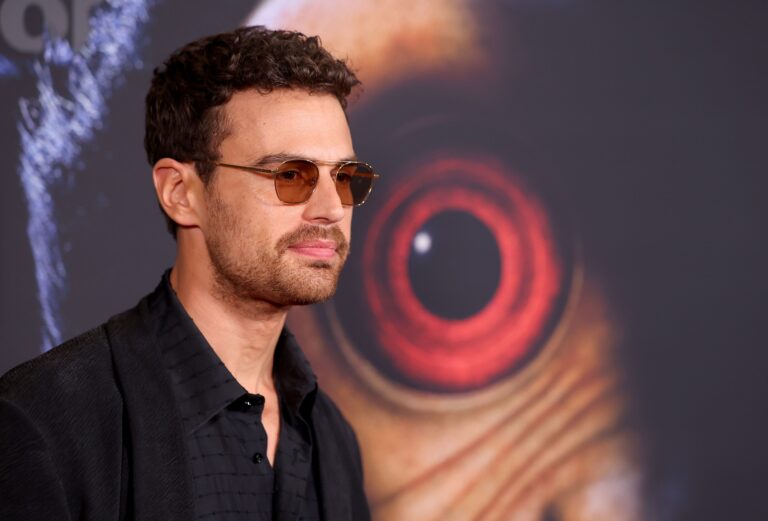
Theo James attends the Los Angeles Premiere Of Neon’s “The Monkey” at Immanuel Presbyterian Church on February 13, 2025 in Los Angeles, California. Leon Bennett/Getty Images
When Theo James told British GQ in August 2026 that he was “definitely too old” to play James Bond, he was not conceding physical decline. He was describing a balance sheet. At 41 — the same age at which Timothy Dalton debuted as 007 in 1987 and only a year older than Pierce Brosnan was when he took the role in 1995 — James’s self-assessment was never really about fitness. It was about how long a franchise built around one face needs to amortize its investment, and whether entering at 41 gives Amazon MGM enough runway to recover it. That is the calculation every serious Bond contender now runs before their agent picks up the phone.
But James gave a second reason, and it is the one that belongs on the front page. The Bond role, he said, is “somewhere you could never come back from,” and his stated concern was not his own career but his children: “What does that do to your kids, who are trying to find themselves in the middle of all that attention?” That sentence names something no franchise economics spreadsheet can quantify — the cost that the role imposes not on the actor but on the people the actor goes home to.
Franchise Math: What “Too Old” Actually Means for Bond 26
The “too old” discourse around Bond casting has been a recurring feature of every search since Daniel Craig’s departure — applied to Idris Elba at 43, Henry Cavill, who said “Maybe I’m too old now, maybe I’m not,” and now James at 41. Taken at face value, the language implies physical limitation. Taken seriously, it describes something quite different.
Dalton entered the franchise at 41, delivered two films, and exited at 43. Brosnan debuted at 42 and produced four commercially successful films over seven years. Craig debuted at 38 and committed to 15 years and five films, setting the commercial benchmark that has recalibrated every subsequent conversation about age. Martin Campbell, who directed Casino Royale, made the logic explicit when discussing Cavill: at 40, an actor playing Bond through a third film would be pushing 50, and Campbell confirmed the math plainly: “anything beyond that’s two, three years per Bond.”
Producers have long stated that casting Bond means a 10-to-12-year commitment — the same logic that effectively ruled out Elba and complicated discussions of Cavill. That target is what transforms James’s age into a liability — not 41 as a number, but 41 as the beginning of an arc that ends somewhere in his late 50s. The question is not whether Theo James can play Bond. It is whether Amazon MGM can plan three to four films around him and still have a commercially viable lead at the franchise’s projected endpoint. When James says he is “definitely too old,” he is translating that institutional calculus into the plain language of self-aware disqualification.
Research published in the Journal of Phenomenological Psychology by Donna Rockwell and David Giles (2009) describes what they call the “celebrity self-splitting” that follows extreme fame: the forced creation of two distinct identities, “one an image offered to the public, and one reserved for moments of privacy and intimacy.” Their four-phase model of celebrity experience — love/hate, addiction, acceptance, adaptation — has been directly confirmed through anonymous interviews with working celebrities. The Bond role represents an unusually severe version of this dynamic, because the character pre-dates every actor who has played him, will outlast each of them, and remains culturally continuous across decades. An actor who plays Bond does not merely add a role to a filmography. They become a numbered iteration of a centuries-old archetype — the British gentleman spy — evaluated and ranked in perpetuity against every predecessor.
James is acutely aware of this. His formulation — “somewhere you could never come back from” — maps precisely onto what scholars of celebrity call parasocial identity capture: when a fictional character is so pervasive in the public imagination that the actor’s own identity becomes subordinate to it. Roger Moore described Bond as a “straightjacket.” Daniel Craig, immediately after Casino Royale became a global phenomenon, said he would rather “slash his wrists” than play Bond again — before committing to four more films. That pattern is not a coincidence. It is the franchise’s documented toll.
“Finding Themselves in the Middle of All That Attention”: Children, Development, and the Cost No Salary Covers
James’s concern for his children drew on a dimension of the Bond role that the actuarial-table discussion never reaches. In Erik Erikson’s fifth stage of psychosocial development — identity versus role confusion, covering roughly ages 12 through 18 — adolescents need the freedom to explore, fail, and reconstitute their sense of self. James’s phrasing (“trying to find themselves in the middle of all that attention”) is a precise description of what researchers have begun to document as secondary fame exposure: the disruption that hyper-scrutiny of a famous parent can impose on a child’s normative identity development during exactly the period when that development is most fragile.
A child of a Bond actor would spend those years inside one of the most globally recognized and relentlessly documented fame systems in entertainment history. James’s decision to name this explicitly — rather than citing scheduling conflicts or creative fit — is unusual. Most actors in his position offer a diplomatic deflection. His transparency has the specific quality of someone who has actually thought through the mechanism, not just the inconvenience.
Who Remains: The Candidates After James’s Exit
With James confirming his departure, the casting field has consolidated around a notably younger cohort. Callum Turner, 36, who starred in Fantastic Beasts and Masters of the Air, reportedly met with Villeneuve in January 2026. At the 2026 Berlin Film Festival, Turner responded to a direct question with: “It’s very early for that question… I’m not going to comment on it.” Richard Osman described Jack Lowden, 34, best known as a lead in Slow Horses, as receiving “very serious” consideration from producers in mid-August 2026. Jacob Elordi, 28, has been the subject of unconfirmed reports — originating from celebrity gossip aggregator DeuxMoi and subsequently covered by Gulf News — that Amazon MGM offered him the role directly. Harris Dickinson, also 28, remains in the mix based on bookmaker odds and industry reporting.
Producer Amy Pascal told Euronews in August 2026 that a casting announcement before year’s end is “a good bet.” Bond 26 is targeting a 2028 theatrical release, with production expected to begin in 2027 following Villeneuve’s completion of Dune: Messiah, the third installment in his Dune adaptation. Deadline confirmed the 2028 production timeline shortly after Villeneuve’s hiring.
What Villeneuve’s Bond Will Ask of Technology
The Bond franchise’s relationship to real-world technology is not incidental — it is structural. André Millard, in “Equipping James Bond: Guns, Gadgets, and Technological Enthusiasm” (Johns Hopkins University Press, 2019), argues that Bond’s gadgets “articulate the leading edge of technological awareness at the time” of each film’s production. Ian Fleming drew directly from his wartime Naval Intelligence experience and his encounters with Charles Fraser-Smith, the Ministry of Supply operative who developed hollow golf balls for concealed messages and shaving brushes with hidden cavities. Q Branch was not pure fantasy. It was wartime tradecraft aestheticized.
What makes Villeneuve’s Bond specifically significant — and what makes the casting age a question about technology, not just demographics — is Villeneuve’s particular filmmaking obsession. In Arrival (2016), he built a film around the Sapir-Whorf hypothesis and the cognitive science of temporal perception. In Blade Runner 2049 (2017), he examined AI consciousness, memory formation, and synthetic biology. In Sicario (2015), drone warfare and surveillance architecture were moral actors in the narrative. This is a director who treats technology not as backdrop but as the source of his films’ ethical weight.
A Bond set in 2027–2028 will engage — by necessity — with the actual frontier technologies of that moment: AI-driven facial recognition, quantum-encrypted communications, autonomous weapon systems, biometric surveillance infrastructure. For Villeneuve, those are not gadgets. They are the conditions of his characters’ moral lives. Colin Burnett at Washington University in St. Louis, who has studied the Bond franchise as what he calls “a powerhouse production regime,” noted in April 2026 that Bond consistently arrives at the leading edge of technological anxiety. A Villeneuve Bond will be no different — but the edge it arrives at in 2028 is sharper and more contested than any franchise installment has previously navigated.
This is why the casting age is not merely a commercial question. A Bond played by a 28-year-old is a digital-native operative — someone who has never known a world without algorithmic surveillance, who carries no analog instincts. A Bond played by a 35-year-old represents a transitional figure, shaped by both registers. The franchise’s technological imagination is, in this sense, a live casting criterion. Villeneuve’s creative choices will determine which vision of the 2028 surveillance landscape Bond embodies — and the actor’s generational relationship to that landscape will be visible in every scene.
How Amazon MGM Is Reinventing the Machine
The structural context of this casting search is historically unprecedented. Amazon MGM Studios took creative control of the Bond franchise from Barbara Broccoli and Michael G. Wilson in February 2025, ending more than six decades of Eon Productions stewardship. Producers Amy Pascal, whose credits include the Spider-Man franchise, and David Heyman, best known for Harry Potter, bring a different institutional sensibility than Broccoli’s famously protective custodianship of the character.
Pascal has described Bond 26 as needing to be “something really different that is stirring and exciting.” Villeneuve’s statement on being named director characterized the responsibility as sacred territory: “I’m a die-hard Bond fan. To me, he’s sacred territory. I intend to honor the tradition and open the path for many new missions to come.”
The combination of Villeneuve’s direction, Steven Knight’s screenplay — Knight spent years mapping the moral inversions of institutional violence through Peaky Blinders — and a production team with deep franchise-universe experience (Pascal’s Spider-Man, Heyman’s Harry Potter) suggests a Bond universe that will interrogate rather than simply celebrate the mythology it inherits.
Amazon’s early management of the franchise has not been without friction. The studio initially removed firearms from original Bond movie poster artwork, prompting an immediate backlash from fans that led to a quiet reversal. The episode illustrated the degree to which even aesthetic decisions carry ideological weight for a franchise whose identity is inseparable from specific iconography.
How Does This Play Out?
Theo James’s exit from the Bond 26 candidate pool is, in one reading, a minor item of celebrity casting news. In another, it is a window into the full architecture of what the Bond role now costs — and what it costs in domains that are not negotiable with a salary increase. The “too old” discourse has always been a franchise-economics story dressed in the language of physical fitness. James’s willingness to name both the actuarial logic and the developmental cost for his children gives that architecture a human face — and makes the question of who accepts the role as interesting as who declines it.
Bond 26 is expected to begin production in 2027, with a 2028 theatrical release targeted. Whoever accepts the role will be committing to a decade-plus arc inside one of the most globally visible fame systems in existence — alongside a director whose entire filmography has been an investigation of what technology does to the people who live inside it. The candidate who signs will know, as James now does, exactly what they are accepting.
Frequently Asked Questions
Who is currently the frontrunner to play James Bond in Bond 26?
As of August 2026, no official casting announcement has been made. Callum Turner (age 36, Fantastic Beasts, Masters of the Air) and Jacob Elordi (age 28, Euphoria, Wuthering Heights) are the most frequently named candidates in current industry reporting, with Turner having reportedly met director Denis Villeneuve in January 2026 and Elordi the subject of unconfirmed offer reports. Jack Lowden (age 34, Slow Horses) has been described by commentators as receiving “very serious” producer consideration as of mid-August 2026. Producer Amy Pascal has stated that a casting announcement before the end of 2026 is “a good bet.”
Why does being “too old” actually matter for Bond — isn’t it just a number?
It is primarily a franchise-economics argument, not a fitness assessment. Amazon MGM wants a long-term commitment modeled on Daniel Craig’s 15-year, five-film tenure. An actor entering at 41 would need to sustain the role into his late 50s to deliver the full commercial arc the studio is planning. The “too old” language is a plain-language translation of that amortization calculation — the same calculation that ruled out Idris Elba at 43 and complicated discussions of Henry Cavill at 40. The franchise treats its lead actor as a long-duration asset, and age at entry determines how long the asset remains viable.
What does Bond 26’s casting age signal about its technological vision?
Quite a lot, under Denis Villeneuve. His filmography — from Arrival’s cognitive science of alien communication to Blade Runner 2049’s synthetic memory and Sicario’s drone warfare — treats technology as a moral and epistemological condition of his characters’ lives, not as set dressing. A Bond played by a 28-year-old will be a digital-native operative in a 2028 world of AI-driven facial recognition, autonomous weapons, and biometric surveillance infrastructure. A Bond played by a mid-30s actor carries a different generational relationship to those systems. André Millard’s scholarship on the franchise demonstrates that Bond has historically arrived at the leading edge of what its era considers both technically possible and ethically contested — which means Villeneuve’s casting decision is implicitly a statement about which surveillance future Bond will inhabit.
What did Theo James mean when he called Bond a role “you could never come back from”?
He was describing what celebrity researchers call parasocial identity capture — the phenomenon in which a role so dominates the public imagination that the actor’s own identity becomes subordinate to it. Scholars Donna Rockwell and David Giles documented in their 2009 phenomenological study of fame that celebrities under extreme public scrutiny report compensating by forming separate identities, one an image offered to the public, and one reserved for moments of privacy and intimacy. James’s specific and unusual concern was for his children: he named the risk that the hyper-scrutiny accompanying the Bond role poses to a child’s normative adolescent identity development — a period when, as developmental psychologist Erik Erikson documented, young people need the freedom to explore and reconstitute their sense of self without a global audience.