November 3, 2026:


An AI system that cross-references live satellite imagery with deep-learning models to confirm whether aircraft contrails are actually forming — not just predicted to form — has secured an institutional foothold inside Spain’s air traffic control ecosystem. The tool, called Aero-Trail Guard, finished second in ENAIRE’s fourth Business Ideas Competition, earning its creator, engineer Adrián López Grande, €3,000 and entry into the agency’s three-month incubation programme.
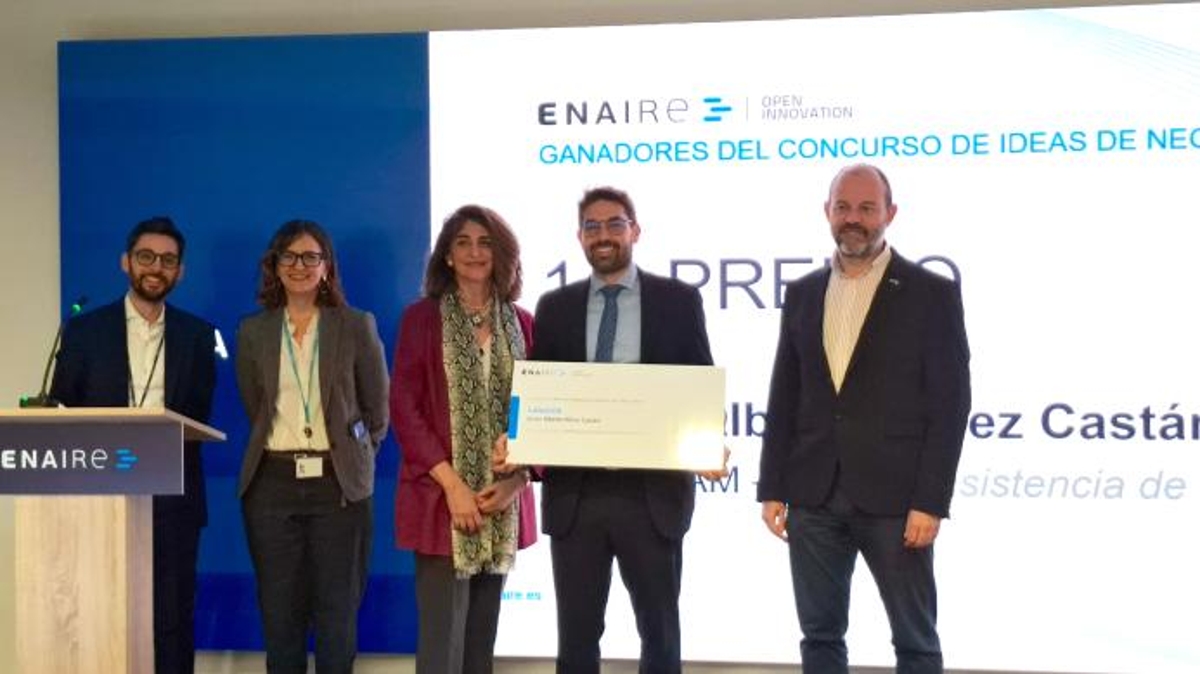
The first-place prize went to AVAM, a multimodal travel assistance application developed by Javier Alberto Pérez Castán, which took home €5,000. But the second-place recognition still carries considerable weight. This is not a grant from a climate research fund or a nod from a technology accelerator — it is an endorsement from Europe’s fourth-largest air navigation service provider, signaling that contrail management has crossed from fringe environmental concern into operational aviation priority.
Contrail science has long suffered from a verification gap. Atmospheric models can project where ice crystals are likely to persist given temperature, humidity, and wind data, but confirming those projections against real-world conditions requires satellite data processed at operationally useful speeds — faster and more reliably than legacy methods have managed.
According to ENAIRE’s official release, Aero-Trail Guard tackles that gap by ingesting real-time feeds from geostationary satellites and running them through convolutional neural networks — a class of deep-learning architecture trained to recognize visual patterns — to segment and physically confirm contrail presence. The distinction between predicting and verifying matters enormously: physical confirmation is what makes MRV certification feasible.
That MRV capability is where the commercial case sharpens. Under EUROCONTROL’s evolving reporting standards and ICAO guidance on aviation’s non-CO₂ climate effects, carriers will increasingly need auditable documentation — not internal modeling estimates — that route adjustments actually reduced warming-intensive contrail formation. A tool that delivers that evidence chain could prove commercially decisive as compliance frameworks tighten.
López Grande also claims a meaningful reduction in false positives under complex atmospheric conditions, a persistent weakness of earlier contrail-detection models when cloud cover and thin cirrus obscure satellite readings.
ENAIRE manages air traffic services across Spain’s entire airspace and provides aerodrome control at 21 airports, including Madrid-Barajas and Barcelona-El Prat. Its annual competition, run through R&D subsidiary CRIDA alongside the Polytechnic University of Madrid, is designed to surface ideas capable of moving from concept to ATC-sector deployment on a realistic timeline. Winners receive not just prize money but entry into a structured incubation programme: eight dedicated business development sessions and direct, ongoing mentorship from ENAIRE technical staff.
At the awards ceremony, ENAIRE’s Director of Strategy and Innovation, Mariluz de Mateo, noted that previous competition alumni had gone on to found startups and bring their concepts to market — a signal that the pipeline carries real commercial momentum beyond the prize stage.
Should López Grande complete a proof of concept that meets ENAIRE’s defined technical criteria, he becomes eligible for an additional €10,000 development grant — a second financial milestone that raises the total potential award well beyond the initial prize.
The ENAIRE prize lands inside a rapidly expanding global push. In March 2026, American Airlines and Google published results from a landmark 2,400-flight trial in which AI-generated routing recommendations — built directly into the airline’s existing flight-planning software — produced a 62% reduction in contrail formation among the flights that followed the suggested altitude adjustments. Participating aircraft as a whole saw an approximately 11.6% overall decrease, according to reporting from ePlane AI. Researchers estimated the warming effect from the adjusted flights dropped by roughly 69%.
Then, on August 18, 2026, the UK government announced Operation Blue Skies — a £5 million, 30-month programme involving Google, the Met Office, NATS, Imperial College London, the University of Cambridge, and Contrails.org. The initiative is billed as the world’s first government-backed trial to test AI-driven contrail avoidance across an entire oceanic airspace zone — the Shanwick corridor in the eastern North Atlantic, which accounts for roughly 5% of global contrail warming. Trial maneuvers are set to run during the lower-traffic winter periods of 2026–2027 and 2027–2028.
The financial and regulatory attention converging on contrail management reflects a growing body of evidence about their disproportionate warming effect. Persistent contrails — the white streaks that expand into cirrus-like clouds at altitude — are estimated to contribute warming over short time horizons comparable to all the direct CO₂ aviation produces cumulatively, according to research cited in EU-funded initiatives such as E-CONTRAIL, which specifically developed neural-network architectures to quantify contrail radiative forcing.
Unlike CO₂, which disperses over decades, contrail warming is concentrated in the hours immediately following a flight — making it both urgent and, in principle, more actionable than long-cycle carbon reduction strategies.
López Grande now enters ENAIRE’s three-month incubation phase, working through eight structured business development sessions with access to the agency’s technical staff and operational data infrastructure. The proof-of-concept milestone ahead is what determines whether Aero-Trail Guard eventually finds its way into pre-tactical ATC planning tools, gets licensed to airline dispatch systems, or attracts the investment attention that typically follows institutional ATC validation.
In a sector where regulatory buy-in is often the hardest part of the go-to-market journey, an ENAIRE prize does something a research paper or accelerator badge cannot: it places the technology inside the same conversations where flight operations decisions actually get made.