HomeAuto Thailand AI Exports Break 56-Month Record on Pre-Sold Hard Drives and PCBs
Thailand AI Exports Break 56-Month Record on Pre-Sold Hard Drives and PCBs
September 27, 2026:
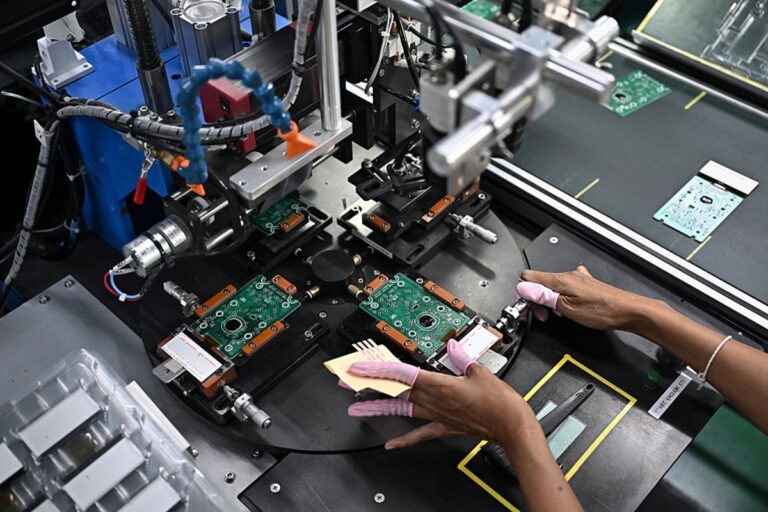
Lillian SUWANRUMPHA/AFP via Getty Images
Thailand’s outbound shipments surged 24.3% year-on-year in August to US$34.62 billion — the fastest growth in 56 months — and the two technologies driving it are already spoken for years into the future. The country supplies roughly 80% of the world’s hard disk drives and has become the primary Southeast Asian hub for printed circuit boards engineered specifically for Nvidia AI servers, and both product categories are producing order books that stretch well past this year. That combination makes the record monthly data released Friday by Thailand’s Commerce Ministry something more than a trade statistics beat: it is a concrete, monthly-updated measure of how fast the global AI infrastructure buildout is actually proceeding.
Why Thailand Is Winning the AI Hardware Race
Electronics account for roughly one-third of Thailand’s total export value, and the sector delivered outsized gains in August. Industrial-product exports climbed 27.1% for the month, logging their 29th consecutive year-on-year increase.
The individual component figures tell the hardware story in granular terms. Video-recording equipment and components rocketed 1,155.7%, a surge explained by the rapid deployment of AI-powered surveillance and network video recorder systems globally, each of which requires both high-bandwidth image-processing chips and high-capacity HDD storage for raw video data. Telephones and components rose 151.2%, printed circuits surged 126.8%, electrical transformers and parts climbed 55.6%, and computers and components — a direct bellwether for data-center buildout — rose 42.1%.
“The strong performance is partly driven by global AI investment, which has created insatiable demand for the hardware components Thailand specializes in manufacturing,” Nattiya Sujinda, deputy director of Thailand’s Trade Policy and Strategy Office (TPSO), told reporters Friday in Bangkok.
What AI Server PCBs Actually Are — and Why Thailand Makes Them
The most consequential technical shift inside Thailand’s electronics sector is the transformation of its printed circuit board industry. A standard server PCB has 10 to 16 layers of circuitry. An AI server PCB — the kind that connects Nvidia GPUs in training and inference clusters — requires 24 to 46 layers, uses ultra-low-loss M8-grade resin laminates instead of the commodity FR4 fiberglass that dominated the industry for decades, and demands thermal and power management systems capable of handling GPU loads in the hundreds of watts per chip. These are fundamentally more sophisticated products, and Thailand is now making them at scale.
The supply chain connection to Nvidia is direct. Victory Giant Technology — Nikkei Asia’s identified top Nvidia PCB supplier for AI servers and graphics cards — has opened its second factory in Thailand, in Ayutthaya, 60 kilometers (37 miles) north of Bangkok, and is ramping new equipment. Gold Circuit Electronics, a key PCB supplier for Nvidia switch trays (the components that connect GPUs in high-density clusters), is running its first Thai facility at full capacity. More than 60 PCB companies have established or expanded operations in Thailand in recent years, including the majority of the world’s top-tier PCB makers.
“Any suppliers that are involved in the AI supply chain are leading the formation of the Thailand PCB industry,” a manager at Ta Liang Technology, a drilling-machine provider that serves all of the top PCB makers, told Nikkei Asia.
The financial scale of this transformation is significant. Thailand’s Board of Investment (BOI) confirmed that the country has attracted more than 200 billion baht (approximately US$6 billion at current exchange rates) in PCB investment applications since 2022 and has emerged as ASEAN’s largest printed circuit board manufacturing base.
Hard Drives: The Quiet Engine Nobody Expected AI to Revive
If AI server PCBs are Thailand’s new story, hard disk drives are its old story with a stunning second act. Seagate and Western Digital together operate manufacturing facilities that account for roughly 80% of the world’s HDD supply, with both companies’ primary final-assembly operations based in Thailand. This was supposed to be a sunset industry: consumer PC demand for HDDs had been declining for years as solid-state drives became cheaper.
AI changed the math. Cloud hyperscalers building out AI training infrastructure require enormous volumes of high-capacity nearline storage to hold training datasets, model checkpoints, and inference logs — workloads where HDDs remain dramatically cheaper per terabyte than flash storage. The result: Western Digital CEO Irving Tan disclosed on the company’s Q2 FY2026 earnings call that the company’s entire 2026 HDD capacity sold to its top seven cloud customers, with long-term allocation agreements extending into 2027 and 2028. Cloud revenue now accounts for 89% of Western Digital’s total.
Seagate told investors the same story in its Q2 2026 earnings call: nearline capacity fully allocated through calendar year 2026, with long-term agreements in place with major cloud customers through 2027. Both companies have announced Thailand capacity expansions in response to renewed demand. Western Digital is in the process of a 23 billion baht Thailand expansion (approximately US$693 million) at its Bang Pa-in and Prachinburi facilities approved by the BOI.
This sold-out status — both producers, both committed to HDD production through at least late 2027 from Thai facilities — is what gives August’s export data its structural character. The shipments that produced the 24.3% August headline were not a demand surprise; they were the fulfillment of contracts already signed with the world’s largest hyperscale cloud operators.
United States Dominates Demand
The United States has been the dominant driver of this year’s growth, and August was no exception. Thai exports to the US surged 48.7% year-on-year, marking the 35th consecutive month of year-on-year gains. Electronics components — the building blocks of AI accelerator hardware and data centers — feature prominently in those shipments.
The tariff context matters here. Effective July 24, 2026, the US imposed an additional 12.5% Section 301 levy on most Thai exports, related to US concerns about Thailand’s forced-labor import rules. The levy is higher than the 10% rate applied to ASEAN peers such as Indonesia and Malaysia that have signed Agreements on Reciprocal Trade with Washington, and Bangkok is actively seeking parity. But the 12.5% rate is not as damaging to the AI hardware story as it might appear: integrated circuits and hard disk drives are among more than 2,120 Thai products explicitly exempted from the additional levy. The products at the heart of the AI buildout shipments — the ones driving 48.7% US-bound export growth — are largely not subject to the tariff.
There is, however, a live risk. A separate US Section 301 investigation into excess industrial capacity — involving Thailand and 15 other countries — is still underway, with tariff rates not yet announced. Thailand’s prime minister was expected to raise the issue directly with US President Donald Trump in a phone call around September 17 or 18; as of Friday, no deal on a reciprocal trade framework had been concluded.
China Demand: Durians and Data
On the China front, the August rebound was driven not by semiconductors but by tropical fruit. Chinese demand for fresh durian and mangosteen from Thailand’s southern provinces surged, helping agricultural exports return to growth for the first time in four months, with the category rising 4.2% year-on-year. Agricultural and agro-industrial exports combined rose 1.4%.
Thai exports to China climbed 15.5% year-on-year in August, adding to a broader market-diversification story. Shipments to the European Union rose 23.1%, Japan gained 19.6%, and Australia jumped 81%.
Does the Boom Have Structural Legs?
The IMF’s July 2026 World Economic Outlook identified Thailand alongside Taiwan, South Korea, and Malaysia as one of the world’s four leading net exporters of AI-related hardware — a category that covers computer equipment and components, semiconductor-manufacturing machinery, and processors and memory chips. The BOI subsequently recorded US$43.6 billion (approximately 1.47 trillion baht) in foreign and domestic investment applications during the first half of 2026 alone, a 37% year-on-year surge, with the digital sector accounting for US$33 billion of that total.
Since 2023, Thailand has attracted more than US$26.8 billion in investment applications in semiconductor and advanced electronics specifically, spanning 880 high-tech projects. Major electronics companies operating in the country now carry order books stretching three to five years ahead.
Thailand’s data-center investment pipeline provides the self-reinforcing backdrop. According to Cushman & Wakefield’s Asia Pacific Data Centre Investment report, Thailand is positioned to attract approximately US$15.9 billion (570 billion baht, approximately US$17.2 billion at September 2026 exchange rates) in data-center investments between 2026 and 2030, as hyperscale providers seek alternatives to Singapore’s increasingly constrained land and power resources. Pre-leasing activity has expanded ninefold year-on-year. Every data center built on Thai soil in this pipeline represents additional demand for the PCBs and HDDs that Thai factories already make — a demand loop that reinforces the export figures.
Narit Therdsteerasukdi, BOI Secretary-General and the architect of Thailand’s national semiconductor strategy, has framed the goal explicitly: Thailand needs to move beyond assembly into higher-value activities across the AI, semiconductor, and advanced-electronics supply chain. The National Semiconductor and Advanced Electronics Board finalized a strategy in January 2026 targeting more than 2.5 trillion baht (approximately US$75 billion) in semiconductor investment by 2050, with immediate priority on power, sensor, photonics, and analog semiconductor segments where Thailand’s existing manufacturing base is strongest.
Automobiles: The Structural Weak Spot
Not every category shared in August’s gains. Automobile and parts exports fell 7.1%, and motorcycles and related parts declined 12.9%.
These figures reflect a structural transition underway across Thailand’s legacy automotive sector, which faces mounting competitive pressure from Chinese electric vehicle manufacturers. Thailand’s total vehicle production fell from roughly 2 million units in 2019 to approximately 1.4 million units in 2025 — a 30% contraction — as domestic demand softened and Chinese EV makers began local assembly in the Eastern Economic Corridor. Honda closed its Ayutthaya vehicle assembly line and consolidated to Prachinburi; Nissan and Suzuki similarly restructured. Export production in May 2026 alone fell 36.2% year-on-year.
The automotive decline is not recoverable in the near term from the electronics surge alone — these are different labor forces, different industrial zones, and different export markets. It is the clearest sign that the AI-driven boom, while real and durable in electronics, is not lifting all sectors equally.
Where Does the Boom End?
The Commerce Ministry’s official full-year export growth forecast stands at 5–11%, but Nattiya said on Friday that full-year growth “is now likely to exceed 11% and could potentially reach 15%.” Achieving the 15% scenario would put Thailand’s full-year export value at a record US$391.27 billion, requiring average monthly shipments of around US$31 billion in the final quarter — a figure the country has already exceeded in each of the past several months.
In the first eight months of 2026, Thai exports totaled US$266.15 billion, up 18.9% from a year earlier.
The risks are real: tensions around the Strait of Hormuz could disrupt shipping lanes for both Thai exports and energy inputs, lifting freight costs and threatening automotive supply chains specifically. A second Section 301 excess-capacity tariff — the ongoing investigation involving Thailand and 15 other countries — could push levies beyond the current 12.5% and create meaningful headwinds for non-exempt goods, even if the core AI hardware categories remain shielded. And Nattiya cautioned that Thai exports could face headwinds in 2027 if global demand patterns shift.
For now, however, August’s figures cement Thailand’s position as one of the clearest emerging-market beneficiaries of the global AI buildout — not because of cheap labor or low-tax zones alone, but because its factories are delivering specific, technically sophisticated components that every AI data center on earth requires, on timelines that suppliers have already committed to years in advance.
Currency conversions in this article are approximate, based on an exchange rate of approximately 33.15 Thai baht per US dollar as of September 25, 2026.
Frequently Asked Questions
What specific components from Thailand are most important to the AI buildout?
Two categories dominate. First, printed circuit boards engineered specifically for AI servers — these require 24 to 46 layers of circuitry, ultra-low-loss materials, and precise thermal management, and Nvidia’s top PCB suppliers operate factories in Thailand’s Ayutthaya province. Second, high-capacity nearline hard disk drives: Seagate and Western Digital together produce roughly 80% of the world’s hard drive supply from Thai facilities, and both companies have fully committed their 2026 production capacity to major cloud hyperscalers, with long-term agreements extending into 2028.
Why are Thailand’s hard drive exports surging if everyone says SSDs are taking over?
The economics of AI data storage are different from consumer device storage. Training large AI models and storing the resulting datasets, model checkpoints, and video data requires enormous volumes of capacity where hard drives are still far cheaper per terabyte than flash storage. Cloud providers building AI infrastructure are locking in hard drive supply years in advance — Western Digital CEO Irving Tan disclosed that its entire 2026 capacity is sold out. That structural demand shift, driven specifically by AI, is what reversed the HDD industry’s long decline.
Does the US tariff on Thailand hurt AI hardware exports to the US?
Less than it might appear. The US imposed a 12.5% Section 301 levy on most Thai products effective July 24, 2026, but explicitly exempted integrated circuits and hard disk drives — the two most significant categories in Thailand’s AI hardware supply chain. US-bound Thai exports still rose 48.7% in August under the new tariff regime. The more significant risk is a separate, still-unresolved US investigation into excess industrial capacity involving Thailand and 15 other countries, whose tariff outcomes remain unknown.
Could Thailand’s export boom slow down?
The near-term pipeline looks durable: both major HDD producers are sold out through 2026 with orders into 2027-2028, AI server PCB order books stretch three to five years ahead, and the BOI recorded US$43.6 billion in H1 2026 investment applications. The structural risks are a second US tariff action on excess capacity, Middle East shipping disruptions through the Strait of Hormuz affecting freight costs, and the ongoing structural decline in Thailand’s automotive sector, which accounts for a separate and shrinking share of exports.