HomeAuto Ternus Bets Apple Wins AI Through Hardware, Not Models: Day One Sets Strategy
Ternus Bets Apple Wins AI Through Hardware, Not Models: Day One Sets Strategy
September 2, 2026:
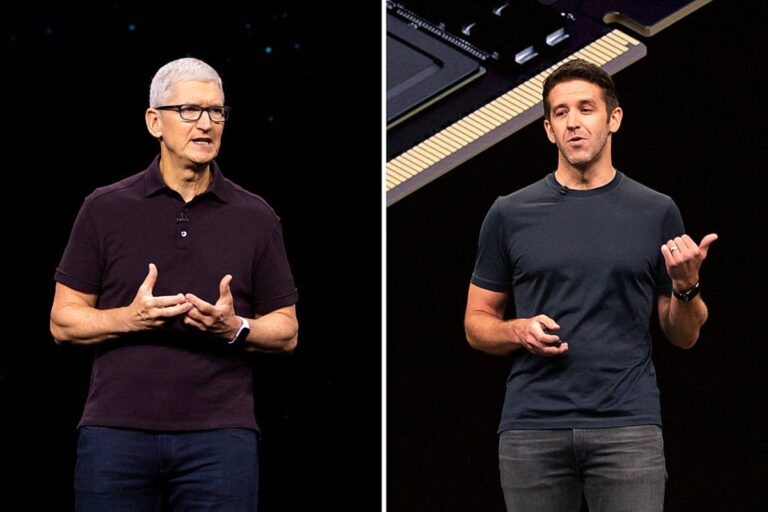
This combination of file photos created on September 1, 2026, shows Apple CEO Tim Cook (L) in Cupertino, California on September 7, 2022; and Apple’s Vice president of Hardware Engineering John Ternus in San Jose, California on June 3, 2019. Apple’s chief executive Tim Cook hands over the company’s reins to it’s vice president of hardware engineering John Ternus on September 1, 2026. Cook spent nearly three decades at Apple, which he has led as CEO since 2011. Brittany Hosea-Small/AFP via Getty Images
On his first morning as Apple’s chief executive, John Ternus sent employees a memo naming a “phenomenal” launch next week and, past that, the incredible products already in the works and the ones the company has yet to imagine. That sentence was not filler. It was a strategic position statement, and it is the clearest signal yet of how Ternus intends to answer the defining question of his tenure: whether Apple wins the AI era by owning the devices that deliver intelligence, or loses it by depending too deeply on a competitor’s model to supply it.
Ternus became Apple’s eighth chief executive officer on September 1, 2026, succeeding Tim Cook after 15 years. Cook moves to executive chairman, retaining specific diplomatic and policy responsibilities the new CEO has no documented track record in. The handover is clean on paper. The underlying strategic question it transfers is not.
Ternus Signals Product-First AI Strategy in Day One Memo
The full text of Ternus’s Day One memo, obtained by 9to5Mac and MacRumors, runs to four short paragraphs. He thanks employees for warm wishes. He praises Tim Cook and expresses gratitude that Cook will remain as executive chairman. Then he turns to product: he called the September 9 launch “phenomenal,” referring to Apple’s “Surprise and Shine” event. And then, one sentence further, he expressed excitement about what lies beyond — pointing to the pipeline of future hardware that Ternus spent much of his 25 years at Apple building toward.
Alongside the memo, Ternus established his first public social media presence, posting a single word to X: “hello.” That debut, reported by 9to5Mac and MacRumors, is a deliberate contrast to Cook, who used his X account for policy statements, farewell letters, and public advocacy on privacy. Ternus’s one-word opening is not evasion; it is the natural start of a leader whose public record, before today, was entirely inside the hardware engineering organization that built Apple’s products rather than in the arenas where Cook represented them.
What the Pipeline Actually Reveals
The most specific articulation of Ternus’s strategic thesis is not the memo — it is the product pipeline that Bloomberg’s Mark Gurman has documented over the past year, products Ternus personally oversaw as hardware chief and will now ship as CEO.
The immediately visible part of that pipeline is the September 9 event, where Ternus will take the stage for the first time as chief executive. The headliner is the iPhone Ultra, Apple’s first foldable iPhone, expected to use a book-style design with an outer display of approximately 5.3 to 5.5 inches (13.5 to 14 cm) and an inner display of approximately 7.6 to 7.8 inches (19.3 to 19.8 cm), with a titanium frame, an A20 Pro chip, and Touch ID integrated into the power button. Starting price is expected around $1,999. Also expected: the iPhone 18 Pro and Pro Max, powered by the A20 Pro on Apple’s first 2nm chip; Apple Watch Series 12; and Apple Watch Ultra 4.
Further out, Bloomberg’s reporting confirms Ternus has overseen work on camera-equipped AirPods that can interpret a user’s surroundings, smart glasses that Apple plans to build in-house, a home display attached to a robotic arm that can recognize who is speaking and tailor content to them, a home security camera system, and a camera-equipped pendant that can be worn as a necklace or clipped to a shirt. The scale of that list is striking. Cook’s 15-year tenure produced three new product categories: Apple Watch, AirPods, and Vision Pro. Ternus could oversee 10 new product categories.
The pattern in that pipeline is unmistakable: every item on the list is a sensor-rich hardware device that collects real-world context — visual, spatial, acoustic, biometric — and feeds it back through Siri and Apple Intelligence. Camera AirPods provide environmental awareness. Smart glasses provide first-person visual context. The robotic home display provides room-awareness and speaker recognition. The pendant provides ambient audio and camera data. None of these are standalone AI devices in the Humane AI Pin sense; Bloomberg notes all are expected to connect to and extend the iPhone, not replace it. Together, they represent a single strategic answer to the question of how an engineer-CEO intends to compete in the AI era: by multiplying the surface area of the physical world that Apple’s devices can sense, reducing the gap between what a user experiences and what Siri can act on.
What Apple Silicon Makes Possible — and Why It Matters for This Strategy
Ternus’s hardware-first thesis is not simply a preference. It is grounded in a specific architectural advantage that his engineering organization built and that no rival currently replicates at the same scale.
Every Apple Silicon chip — the M-series in Macs and iPads, the A-series in iPhones — uses a unified memory architecture (UMA) in which the CPU, GPU, and Neural Engine are physically integrated onto a single die, sharing one pool of LPDDR memory. In a conventional PC or Android architecture, the GPU maintains separate VRAM; when a processor needs to hand data to the graphics or AI accelerator, the data must be copied across a memory bus, consuming bandwidth and time. In Apple Silicon, because all compute engines draw from the same physical memory pool, that copy step is eliminated. The Neural Engine accesses model weights at full bandwidth — from 68.25 gigabytes per second (GB/s) on the M1 to 800 GB/s on the M2 Ultra.
For AI inference, the practical consequence is significant: tasks that would require offloading to a cloud server on conventional hardware can run locally on Apple Silicon because the Neural Engine can access a full-precision model in memory without the latency cost of a cross-chip data transfer. This is the engineering mechanism that makes Apple’s “privacy-first AI” framing technically credible rather than merely aspirational — and it is the mechanism that, if the thesis is correct, will expand to absorb more AI workloads over time as chips grow more capable.
The A20 Pro expected to power the iPhone Ultra and iPhone 18 Pro is Apple’s first chip built on TSMC’s 2nm process (technically the N2 node), which uses gate-all-around nanosheet transistor technology in place of the FinFET process used in the A19 Pro’s 3nm node. TSMC’s N2 process delivers 10–15 percent gains in performance at the same power level, or approximately 25 to 30 percent lower power consumption at the same performance level, versus N3E — along with roughly 15 percent or more improvement in transistor density. Apple is TSMC’s exclusive early customer for the N2 process in mass-market devices, which means the A20 Pro’s Neural Engine leads as the most energy-efficient smartphone AI accelerator on the market at launch — and will remain so until Android chip manufacturers access the same or comparable process nodes.
The iPhone Ultra’s Materials Tradeoff Buyers Need to Know
The iPhone Ultra illustrates both the strength and the constraint of Ternus’s engineering-first approach. His hardware organization produced a foldable that will debut at an expected starting price around $1,999 — the most expensive iPhone Apple has ever sold. The engineering that went into the titanium frame, the dual-cell battery, the integrated A20 Pro, and the hinge mechanism is by all accounts significant.
The inner display uses a different engineering tradeoff. Standard iPhones use Corning Gorilla Glass, which rates approximately 6 to 7 on the Mohs mineral hardness scale — meaning it resists scratching from most everyday objects. The iPhone Ultra’s inner display, which must flex without cracking at the hinge, uses ultra-thin glass (UTG) that achieves approximately Mohs 5 after chemical strengthening, with a polymer protective layer on top that rates approximately Mohs 2 to 3 — roughly the hardness of a fingernail. Apple shelved a stylus after display tests confirmed the inner display cannot withstand stylus-tip pressure without permanent marking.
Ternus’s engineering team built and tested a compact Apple Pencil prototype designed specifically for the iPhone Ultra, then shelved it after confirming the inner display cannot withstand stylus-tip pressure without permanent marking. Samsung encountered the identical constraint when it dropped the S Pen from the Galaxy Z Fold 7. The engineering path forward — either harder glass chemistry that maintains foldability, or a stylus tip redesigned to distribute pressure over a larger area — does not exist in commercial production as of 2026. Buyers spending $1,999 or more should weigh that durability tradeoff directly.
What Ternus’s Day One Silence on Policy Signals
Ternus’s policy record is not thin. It is, as of September 1, 2026, effectively nonexistent. He has not testified before Congress, not appeared in regulatory proceedings, not published positions on antitrust, data privacy, AI governance, or trade policy. His only documented political activity is a $2,900 donation to Sen. Chuck Schumer (D-NY) in 2021.
That blank slate was manageable when Ternus was SVP of hardware engineering. As CEO, it is the most consequential structural exposure of his first year. Apple faces an active Department of Justice antitrust lawsuit over the iPhone’s market position, filed in 2024, whose motion to dismiss was denied in June 2025. Apple made multiple settlement offers in 2026, and as of July the two sides were in talks — but no agreement had been reached and no trial date had been set. The EU Digital Markets Act continues to block Apple’s AI features in the EU, requiring compliance negotiations with European regulators that Cook personally initiated in June 2026.
Cook’s executive chairman brief, as Apple’s April announcement defined it with unusual specificity, includes engaging “policymakers around the world” — specifically meaning Apple’s relationships with the Trump administration and the Chinese government. Analyst Dan Ives of Wedbush captured the challenge directly: Ternus “knows Apple Park like the back of his pocket in terms of hardware. But on the global stage — that’s probably one of the biggest areas where he’s going to have to learn on the job.” Analyst Carolina Milanesi offered the optimistic reading: the arrangement “frees Ternus from a role Cook has handled alone for years,” letting the new CEO concentrate on product while Cook manages the institutional relationships that took 15 years to build. Whether that division of authority functions as seamless handoff or creates ambiguity about who speaks for Apple in a crisis is an open governance question with no precedent at a company of this scale.
The Falsifiable Thesis Under Ternus’s First Product Launch
The product pipeline Ternus signaled in his Day One memo — and the engineering architecture beneath it — represents a specific and falsifiable prediction about where the AI era’s decisive competition will be fought. His thesis, as Apple Silicon and the forthcoming device categories express it, is that the decisive AI battles are won in silicon, sensors, and device integration: that an AI assistant with access to real-time environmental context from a camera in an AirPod knows more useful things about its user than a cloud-based frontier model that does not. That thesis is powerful if frontier model capability and on-device AI inference capability converge over the next several years. It is a structural dependency if they do not.
The inherited piece of the puzzle is the Gemini deal that Cook negotiated. Apple agreed in January 2026 to pay Google approximately $1 billion yearly to license a custom 1.2-trillion-parameter Gemini model — roughly eight times the size of Apple’s own Apple Intelligence models — to power a rebuilt Siri capable of cross-app actions and multi-turn conversation. The heaviest Siri queries route to Gemini running on Nvidia B200 GPUs on Google Cloud, via Apple’s Private Cloud Compute architecture, which is designed to process those queries without data retention. Lighter tasks stay on-device, on the Neural Engine.
Cook’s framing, articulated to investors on his final earnings call, was that large language models are commoditizing and that renting the cloud brain is cheaper than the capital expenditure Google, Microsoft, Amazon, and Meta spend building their own. He also acknowledged, on the same call, that Apple does not yet have a complete plan for the compute bill as Gemini usage scales. That acknowledged open variable — an unresolved cost question at the center of Apple’s AI strategy — now belongs to Ternus.
Analyst Dan Ives of Wedbush and Counterpoint Research’s Tarun Pathak, among others, have argued that the challenge is not simply catching up to OpenAI or Google on raw model capability but proving that Apple can build products people trust and prefer around someone else’s AI model — without losing the product experience, cost control, or differentiation that outside dependency typically threatens. Ternus has not made a public statement diverging from the Gemini licensing arrangement, the Private Cloud Compute architecture, or Apple’s hardware-first philosophy. His first earnings call as CEO — expected in late October 2026 — will be the first moment he must characterize that strategy in his own voice.
The memory price crisis adds near-term pressure to the longer-term strategic question. In June 2026, Apple raised Mac and iPad prices by 17 to 33 percent, citing an extraordinary surge in memory chip costs driven by AI datacenter demand. Industry analysts estimate the same dynamic could add $150 to $200 to iPhone pricing at the September 9 event. SK Hynix’s chief executive warned in July 2026 that 2027 could be the worst year for supply shortages in the semiconductor industry’s history. Ternus did not create this dynamic. He cannot resolve it quickly. His first iPhone launch will reveal whether the price increases consumers face are within the range that a foldable iPhone’s engineering accomplishment can justify.
Cook’s $4.7 Trillion Foundation
The company Ternus steps into is categorically different from the one Cook inherited in 2011. Cook took over an Apple with a market capitalization of approximately $350 billion and leaves one worth approximately $4.7 trillion. Annual revenue grew from $108 billion in fiscal year 2011 to more than $416 billion in fiscal year 2025. Services — the App Store, iCloud, Apple Music, Apple TV+, Apple Pay — grew from a negligible contributor to a business generating approximately $109 billion annually, at margins substantially higher than hardware. Apple Watch became the world’s best-selling watch by units. AirPods created the modern wireless earbud category. The Apple Silicon transition is now studied in business schools as a case study in vertical integration.
Cook’s era also produced the Vision Pro — the mixed-reality headset that launched in early 2024 at $3,499 (the most expensive Apple consumer product until the iPhone Ultra), technologically extraordinary and commercially modest — and, most consequentially, a generative AI gap. Siri, promised a major rebuild at WWDC 2024, repeatedly slipped. Apple paid approximately $250 million to settle iPhone buyers’ Siri lawsuit over advertised capabilities that never shipped. The Gemini-powered Siri that will debut at September 9 is the functional delivery of features Apple first promised two years before. Ternus inherits both Cook’s extraordinary platform and the unresolved AI credibility gap the platform is still working to close.
AAPL rose on the day of the transition — modest but clear market acceptance of the handoff.
What Ternus’s First Eight Days Will Actually Show
The September 9 “Surprise and Shine” event in Cupertino is scheduled for 10 a.m. PT (1 p.m. ET). It will be Ternus’s first appearance as chief executive. The choices he makes on stage — how he introduces the iPhone Ultra, how he explains what the foldable form factor actually does for users, how he frames Gemini-powered Siri — will constitute the first legible evidence of what kind of CEO he intends to be.
His predecessor appeared on stages like this as an ambassador and a storyteller. Ternus will appear as the engineer who built the devices being introduced. That difference — the person who knows the screw count and the material tolerance rather than the market position — may matter, or it may not. What will matter is whether the devices he introduces are worth the prices Apple will ask for them, and whether the AI strategy they represent begins to close the gap with rivals rather than maintain it.
The product pipeline he signaled on Day One is a wager that the answer to AI is hardware: more devices, more sensors, more locally-processed context. September 9 is the first installment of evidence.
Frequently Asked Questions
What did John Ternus say in his first memo as Apple CEO, and what does it signal?
Ternus sent a company-wide memo on September 1, 2026, thanking employees and calling the September 9 iPhone launch “phenomenal.” He also expressed excitement for the incredible products already in the works and those yet to be imagined. The memo’s product-forward framing — rather than any policy or strategic-vision statement — signals that Ternus intends to lead as an engineer: product first, products further out second, and everything else as support infrastructure for those products.
How does Apple Silicon’s unified memory architecture specifically help with on-device AI inference?
In conventional computers, the GPU maintains separate video RAM (VRAM) and the CPU uses separate system RAM. When an AI model needs to run, data must be copied between those separate memory pools across a bus, consuming bandwidth and time. Apple Silicon places the CPU, GPU, and Neural Engine onto one die sharing a single physical memory pool — eliminating that copy step entirely. The Neural Engine accesses model weights at full bandwidth, ranging from 68.25 GB/s on the M1 to 800 GB/s on the M2 Ultra. The practical result: more AI tasks can run locally on-device without needing to route through a cloud model, which is the core technical enabler of Apple’s privacy-first AI strategy.
What are the real durability concerns with the iPhone Ultra’s inner display, and what should buyers know?
The iPhone Ultra’s foldable inner display uses ultra-thin glass (UTG), which achieves approximately Mohs 5 hardness after chemical strengthening — versus Mohs 6 to 7 for standard iPhone Gorilla Glass — with a polymer protective layer on top rated approximately Mohs 2 to 3. That polymer layer is roughly as hard as a fingernail. Apple built and tested a stylus accessory for the Ultra, then shelved it after confirming the inner display scratches under stylus-tip pressure. Buyers spending $1,999 or more should handle the inner display with more care than they would a standard iPhone screen, and should be aware that no stylus accessory for this device has been announced.
What is the risk in Apple’s Gemini licensing strategy, and does Ternus plan to change it?
Apple is paying Google approximately $1 billion per year to license a custom 1.2-trillion-parameter Gemini model to power the most demanding Siri queries. The licensing arrangement means Apple does not control the underlying AI model it is betting its assistant strategy on. If Google changes pricing terms, shifts its own AI strategy, or pursues assistant integrations that conflict with Apple’s, Apple has no comparable in-house fallback at frontier scale. Tim Cook acknowledged on his final earnings call that the compute cost model has not been fully resolved as Gemini usage grows. Ternus has not publicly diverged from the arrangement. His first earnings call as CEO — expected in late October — will be the earliest moment he can characterize his own position on it.