HomeAuto Tencent Discloses AI Self-Improvement Loop in Hy4: What Developers Must Know Before Using It
Tencent Discloses AI Self-Improvement Loop in Hy4: What Developers Must Know Before Using It
August 31, 2026:
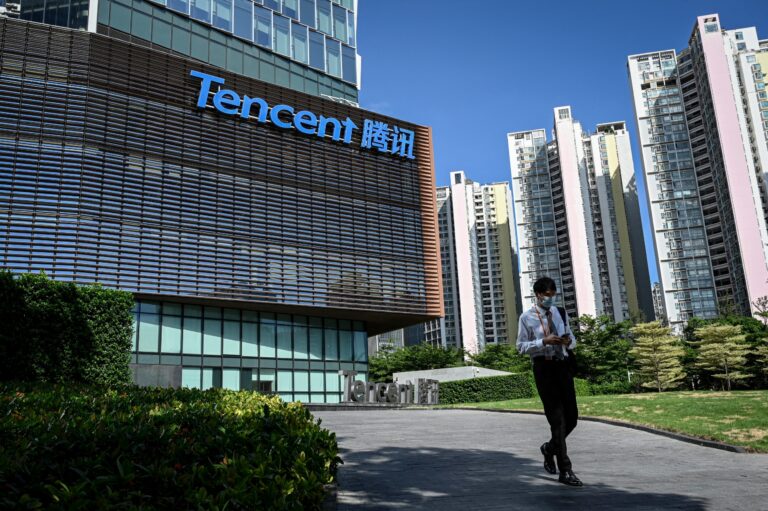
This photo taken on July 10, 2022, shows a man walking past the Tencent headquarters in Shenzhen, in China’s southern Guangdong province. JADE GAO/AFP via Getty Images
Tencent released Hy4 preview on August 28, 2026 — the first model in its Hunyuan lineup to officially participate in its own development. The 770-billion-parameter open-weight model’s launch documentation discloses something that goes beyond the standard parameter-count press release: the model was used to automate the optimization of its own training methods, data strategies, evaluation frameworks, and low-level system operators, proposing approaches, running experiments, and iterating based on results in what Tencent describes as an early-stage recursive self-improvement loop. That loop produced a measurable outcome: a 31.8% increase in end-to-end inference throughput, which Tencent confirmed in its official launch announcement. For developers evaluating whether to adopt Hy4 — either through the API or self-hosted — understanding what that disclosure means, what the model cannot yet do, and what Chinese law requires of Tencent regardless of licensing terms is the essential due-diligence checklist.
What “AI Helped Build Itself” Actually Means at Hy4’s Scale
The phrase “recursive self-improvement” has a long theoretical history in AI safety research and a much shorter operational history in deployed systems. The core concept — an AI system contributing meaningfully to the development of a successor or improved version of itself — moved from theoretical to observable at frontier laboratories in 2025 and 2026.
Tencent’s disclosure is specific and limited. The Cloud Security Alliance’s June 2026 report on recursive self-improvement signals draws a deliberate distinction: full autonomous self-improvement — an AI system rewriting its own weights without human involvement — remains speculative as of mid-2026, while supervised participation in the development of successor AI systems has become operationally observable at frontier labs. What Tencent describes for Hy4 falls into this supervised category — human engineers oversaw the loop, incorporated results, and made architectural decisions — rather than the fully autonomous version AI safety researchers have historically modeled.
The two disclosed self-optimization tasks are technically specific. First, Hy4 participated in optimizing its own training pipeline: proposing training methods, evaluating data strategies, and refining evaluation frameworks, with code, logs, and feedback feeding into subsequent training rounds. Second, Hy4 analyzed bottlenecks in its own inference serving system and implemented multiple rounds of optimization on operator fusion and inter-GPU communication — the engineering work that produced the 31.8% throughput increase. Operator fusion combines multiple GPU kernel operations into single passes, reducing memory bandwidth overhead; communication optimization reduces the inter-GPU traffic overhead that becomes the bottleneck when serving a model that requires eight-GPU tensor parallelism at Hy4’s scale.
The security research context adds a dimension Tencent’s launch marketing omits. The 2026 International AI Safety Report, authored by more than 100 independent experts, identifies uncontrolled recursive self-improvement as among the most consequential national-security-level risks associated with advanced AI. More immediately relevant for enterprise practitioners: when AI participates in the construction of its own successor, the training pipeline itself becomes a high-value adversarial target — a compromise anywhere in the loop could produce model behaviors invisible to standard pre-deployment testing, as the Cloud Security Alliance’s threat analysis documented. This does not make Hy4’s weights compromised; Tencent reports no adversarial incidents. It does mean that as these operations become standard practice, security questions around training provenance become material to procurement decisions in ways they were not before.
Architecture: Why 770 Billion Parameters Costs Less Than It Sounds
The headline figure is 770 billion total parameters. The operational figure — the one that determines compute cost per query — is 49 billion.
Hy4 preview is a Mixture-of-Experts architecture running across 78 layers. The first layer is a standard dense feedforward network; the remaining 77 layers replace that dense layer with a sparse MoE structure containing 256 routed experts and one shared expert. For each token processed, a gating network selects the top-8 routed experts plus the shared expert — nine experts per token out of 257 available. The attention module uses Gated DeepSeek Sparse Attention with IndexCache for cross-layer sparse index reuse, an architecture borrowed from the DeepSeek and GLM model families. The residual connections use iHC (identity Hyper-Connections). All of this is implemented on top of a native Multi-Token Prediction layer — a separate 10-billion-parameter speculative decoding component, of which 0.7 billion are active, that proposes multiple candidate next tokens simultaneously for the main model to verify in parallel.
The practical consequence: inference compute scales with the 49 billion active parameters, not the full 770 billion. The tradeoff is memory. All 770 billion parameters must remain resident in GPU memory at all times, because any expert might be selected for any given token. The Hugging Face release includes a BF16 checkpoint and an FP8-quantized variant. The official serving recipes from Tencent — prebuilt Docker images for both vLLM and SGLang — specify a tensor-parallel size of eight GPUs, using the FP8 variant. Self-hosting Hy4 is not a laptop exercise: plan for eight high-memory GPUs and total memory budgets well above the raw weight file size to account for the KV cache at extended context lengths.
The context window — 1,048,576 tokens, with completions capped at 64,000 — quadruples Hy3’s 256K ceiling and puts Hy4 in a small category of open-weight models capable of ingesting entire large codebases, book-length financial filings, or multi-day research logs in a single pass. One important caution: the CorpusQA benchmark paper examining million-token context performance across models found that performance drops substantially for all tested models at 1M compared to 128K contexts, with only Gemini-2.5-Pro showing meaningful resilience at that scale. No independent 1M-context evaluation of Hy4 specifically has been published as of August 29, 2026.
Where Hy4 Leads, Where It Trails, and What Independent Evaluators Have Not Yet Confirmed
Tencent has released a set of internal benchmark results. On Terminal Bench 2.1, Hy4 preview scored 85.4, surpassing DeepSeek V4 Pro. On DeepSWE, a software engineering evaluation, Hy4 improved from Hy3’s 28.0 to 64.3. In the blind side-by-side evaluation Tencent conducted internally — 163 experts across 203 engineering tasks — Hy4 preview averaged 2.99 out of 4.00, compared with 2.92 for Zhipu’s GLM-5.3 and 2.94 for Moonshot’s Kimi K3. On a win/loss/tie basis, Hy4 beat GLM-5.3 in 46.8% of comparisons, tied in 12.8%, and lost in 40.4%.
The critical disclaimer is that all of these figures come from Tencent’s own evaluation infrastructure, staffed by Tencent’s own experts, against tasks Tencent selected. Independent benchmark tracker BenchLM, as of August 29, shows evidence for only 28 benchmark slots out of 406 tracked for Hy4 preview — and notes that its strongest eligible category is Agentic at ninth place, while its lowest eligible position is Coding at eleventh. No Artificial Analysis evaluation has been published. No independent third-party organization has reproduced the Terminal Bench or DeepSWE figures.
One social-media claim — that Hy4 coordinated multiple Codex sessions in parallel and outperformed Codex working alone across eight benchmarks — traces back to Tencent’s own launch materials and has not been independently verified. It should be treated as an unconfirmed marketing claim until corroborated by outside testing.
On latency, OpenRouter lists a single provider for Hy4 preview — Tencent Cloud — at approximately 26–38 tokens per second with sub-4-second P50 at launch, a range confirmed on the OpenRouter model page. That is workable for batch processing and background agent tasks, and slow for real-time user-facing interfaces.
Tencent itself discloses two known weaknesses in the model’s Hugging Face README: a tendency toward overthinking and excessive self-verification on complex tasks. Both problems increase latency and token consumption. A reasoning_effort parameter is available to control this tradeoff — set it low for routine transformations and only invoke deep reasoning for tasks that genuinely warrant it.
How to Use Hy4 for Real Work — and Where It Was Designed to Run
Tencent co-designed Hy4 with internal subject-matter experts across software engineering, gaming, finance, and security, with results validated through its own WorkBuddy and CodeBuddy products. Four application scenarios receive particular emphasis:
Software engineering. Stronger understanding, planning, debugging, and validation for long-context development tasks. The model can build complex frontend projects from a single specification — the Tencent team demonstrates a miniature Three.js town generated from scratch — and handles the full cycle from requirements parsing through code generation and validation. The 1M-token context means entire large codebases fit inside a single prompt.
Office analytics and finance. Cross-document synthesis: the model handles complex financial audits by filtering, analyzing, and delivering results across multiple source documents, then generating the output artifacts — documents, spreadsheets, presentations — within the same workflow.
Game development. From a natural-language prompt, Hy4 can generate a playable prototype and iteratively refine it through multi-turn interaction with game engines including Unity.
Scientific research. Improvements across molecular dynamics simulation, condensed-matter physics, AI research and development, and fundamental mathematics.
The model is accessible via API through Tencent Cloud TokenHub (6 yuan per million input tokens, approximately $0.89 USD, and 18 yuan per million output tokens, approximately $2.68 USD, at the August 29, 2026 mid-market exchange rate of approximately 6.72 CNY per USD) and through OpenRouter’s Hy4 model page ($0.834 per million input tokens; $2.501 per million output tokens; $0.042 per million tokens on cache hits). For comparison, Hy3 through OpenRouter was priced at $0.14 per million input tokens and $0.58 per million output tokens when it launched — Hy4 represents a roughly six-fold increase in per-token API cost, reflecting the larger active-parameter budget and infrastructure requirements. Weights are available on Hugging Face, with mirrors on ModelScope, GitCode, and CNB for developers who face friction accessing Hugging Face from mainland China.
Upon launch, WorkBuddy and CodeBuddy are offering free access to Hy4 preview for a two-week window (running through approximately September 11, 2026). Free access to Hy3 on both platforms has also been extended through September 30.
What Chinese Law Requires of Tencent — and Why the Apache License Does Not Change It
The Apache 2.0 license governs what developers can do with the model weights: commercial use, modification, redistribution, and fine-tuning, without royalties or geographic restrictions. It does not alter the legal framework Tencent operates under as a company incorporated and headquartered in Shenzhen, China.
Three laws establish the operative framework:
China’s National Intelligence Law, passed in June 2017 and amended in 2018, states in Article 7 that all organizations and citizens must cooperate with state intelligence on demand in accordance with law. Article 14 empowers intelligence agencies to demand that assistance. Legal scholars including Jeremy Daum (China Law Translate) have noted that Article 7’s enforcement mechanism for proactive data sharing is not clearly defined and that the scope of “intelligence” is undefined in the text — meaning the precise mechanism of compulsion is contested, not that the obligation is absent.
China’s Cybersecurity Law, originally enacted in 2017 and amended to cover AI systems effective January 1, 2026, now explicitly references AI for the first time — the first major update to the law since its enactment. The 2017 version required network operators to provide “technical interfaces, decryption and other technical support assistance” to authorities conducting security inspections. The 2026 amendment extends this framework to AI systems. API calls to Tencent Cloud’s TokenHub service are processed through infrastructure subject to this framework.
China’s Data Security Law (2021) and Personal Information Protection Law (2021) add additional data-handling requirements and government-access provisions that apply to data processed in the Chinese jurisdiction.
The practical implication: developers routing queries and data through Tencent’s API service accept Chinese-jurisdiction processing, with all that legal framework attached, regardless of what the Apache license says. No independent security audit of Hy4’s API behavior has been published as of August 29, 2026.
Self-hosting the Apache 2.0 weights on non-Tencent infrastructure removes the API data-transit exposure. The data stays on the deployer’s servers and does not flow through Chinese-jurisdiction infrastructure. It does not address questions about the training data provenance or the model’s behavioral characteristics resulting from development under that jurisdiction, and it requires the infrastructure footprint described above — eight high-memory GPUs and sustained operational overhead.
For developers at organizations subject to the US Department of Defense procurement framework: Tencent was added to the DoD’s Section 1260H list of Chinese military companies in January 2025. The National Defense Authorization Act for Fiscal Year 2024 prohibits DoD dealings with designated companies beginning June 2026 — a prohibition that took effect two months before Hy4 launched. Tencent has contested the designation and called it “clearly a mistake.” The reconsideration outcome has not been publicly resolved as of this writing.
The Bigger Picture: Chinese Open-Source AI’s Self-Accelerating Pace
Hy4 preview arrives 53 days after Hy3’s formal July 6, 2026 release — and more than doubles Hy3’s total parameter count from 295 billion to 770 billion while quadrupling its context window. The Hunyuan team has been running on an approximately two-month major-version cadence since rebuilding its training infrastructure from scratch in early 2026.
Tencent’s quarterly R&D and capex figures show R&D spending grew 35% year-over-year to 27.3 billion yuan (approximately $4.1 billion USD at the August 29, 2026 rate), while capital expenditure surged 176% to 52.8 billion yuan (approximately $7.9 billion USD). That capex trajectory is the infrastructure investment required to produce and serve models at Hy4’s scale.
The field around Hy4 is equally active. Zhipu’s GLM-5.3, Moonshot’s Kimi K3, and the ongoing DeepSeek model family all represent competing open-weight efforts from Chinese labs that have attracted substantial international developer attention in 2026. Chinese open-weight models’ share of OpenRouter token volume reached approximately 61% among the platform’s top-10 models in a February 2026 snapshot, according to TechTimes’ analysis of OpenRouter data. Hy4’s combination of Apache 2.0 licensing, 1M-token context, and competitive pricing makes it one of the more significant open-weight releases of the year — provided independent evaluation confirms the internal benchmark claims over the weeks ahead.
The Hunyuan team’s own sign-off in its launch post captures the honest ambiguity of shipping a preview: “Use it. Tell us what breaks.”
Frequently Asked Questions
What does Tencent mean when it says Hy4 participated in a “recursive self-improvement loop”?
Tencent is describing a supervised process in which Hy4 was used as a tool inside its own development pipeline — proposing training method improvements, evaluating data strategies, running experiments, and providing feedback that fed into subsequent training rounds. The model also analyzed bottlenecks in its own serving infrastructure and implemented optimizations that increased throughput by 31.8%. This is not the fully autonomous, weight-rewriting self-improvement that AI safety researchers have theorized about; human engineers oversaw and incorporated the outputs at each stage. Security researchers at the Cloud Security Alliance have identified this category of operation as creating a new class of security consideration: when AI participates in building AI, the training pipeline itself becomes a potential adversarial target, and a compromised feedback loop could produce model behaviors that are invisible to standard pre-deployment testing. Tencent reports no such incidents with Hy4.
Does the Apache 2.0 license protect developers from China’s legal data-sharing requirements?
No. The Apache 2.0 license governs the intellectual property terms — what you can do with the weights (commercial use, modification, redistribution, fine-tuning without royalties). It does not alter the obligations Tencent faces under Chinese law as a company operating in China. China’s National Intelligence Law (2017, Article 7) requires all organizations to cooperate with intelligence work on demand. China’s Cybersecurity Law, amended January 1, 2026 to explicitly include AI systems, requires Tencent to provide technical support — including decryption assistance — to authorities inspecting its infrastructure. API calls through Tencent Cloud’s TokenHub service flow through infrastructure subject to this legal framework. Self-hosting the Apache 2.0 weights on your own servers removes the data-transit exposure, because your data stays on your infrastructure and does not flow through Tencent’s systems. It does not eliminate questions about training data provenance or model behavioral characteristics, and it requires eight or more high-memory GPUs to run.
How does Hy4’s performance actually compare to other frontier models right now?
Honestly: based on independent data available as of August 29, 2026, it is too early to say with confidence. Tencent’s internal evaluation — 163 experts, 203 engineering tasks — puts Hy4 at 2.99 out of 4.00, slightly ahead of GLM-5.3 (2.92) and Kimi K3 (2.94). But that evaluation was run by Tencent’s own research team on Tencent-selected tasks. Independent benchmark tracker BenchLM has displayable evidence for only 28 of 406 tracked benchmark slots for Hy4 preview. No Artificial Analysis evaluation has been published. The model’s strongest independent position is Agentic (ninth place in BenchLM’s catalog) and its weakest is Coding (eleventh). API latency on OpenRouter is approximately 26–38 tokens per second with sub-4-second P50 — serviceable for batch and agentic work, slow for real-time user interfaces. Tencent itself acknowledges two preview-stage problems in its README: overthinking on complex tasks and a tendency to over-verify its own work, both of which add latency and token cost.
What are the practical steps for a developer who wants to test Hy4 without exposing sensitive data to the Chinese legal framework?
The two-week free access period on WorkBuddy and CodeBuddy (running through approximately September 11, 2026) routes through Tencent’s infrastructure and is subject to the Chinese legal framework. Use non-sensitive or synthetic test data for that evaluation. For sensitive workloads — proprietary code, regulated information, customer data — self-host the Apache 2.0 weights on non-Tencent infrastructure using the vLLM or SGLang prebuilt Docker images Tencent published (vllm/vllm-openai:hy4-preview or lmsysorg/sglang:hy4-preview). That removes the API data-transit exposure. Budget for eight high-memory GPUs — FP8 weights alone require substantial GPU memory, and the KV cache at extended context lengths adds significant headroom requirements. The Tencent-documented reasoning_effort parameter is worth setting to low for routine tasks; the model’s documented tendency to overthink adds real latency and cost when applied to tasks that do not need deep reasoning.