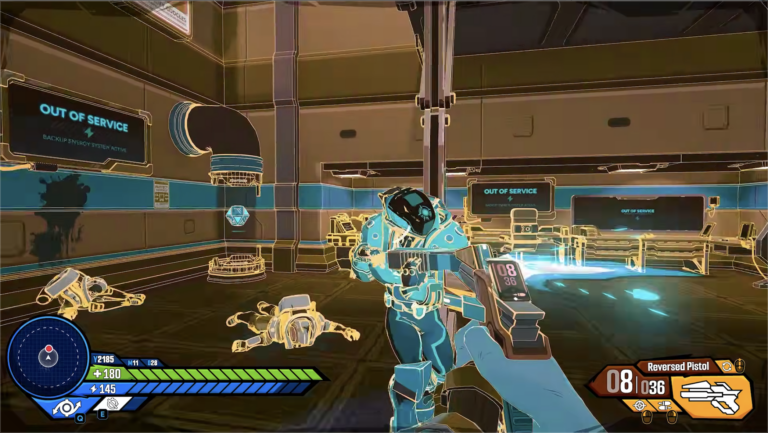
Tempus Vitae Gamescom Reveal: Pistol That Shoots Backward in Time Opens Locked Doors in Debut FPS

August 30, 2026:

Tempus Vitae Gamescom Reveal: Pistol That Shoots Backward in Time Opens Locked Doors in Debut FPS
Tempus. Victae
Whiteboard.games

Argentine indie studio Whiteboard Games showed the world last week, at FGS Live from Gamescom, that its debut commercial title Tempus Vitae treats temporal powers not as story decoration but as the literal ability-gate system — the functional equivalent of the keys, power-ups, and movement upgrades that every metroidvania has used since Super Metroid in 1994. Frozen time creates traversal paths through bullet mazes. A pistol that fires backward in time opens locked doors. Jumping two centuries into the future of the same physical space reveals corridors that did not exist before. Time travel in Tempus Vitae is the lock-and-key design — not a feature layered on top of it.

The game is heading to PlayStation 5, Xbox Series X|S, PC via Steam, and PC via the Epic Games Store in 2027. The Steam page lists Whiteboard Games as both developer and publisher — a departure from I See Red, which used Gameforge as its distribution partner.

A Studio That Started With a Whiteboard — and This Very Game

Whiteboard Games was founded around 2019 when a group of students at Da Vinci School’s Design and Video Game Programming course in Buenos Aires decided to keep working together after graduation. The name comes from the literal object they gathered around to pitch ideas. Luciano Musella, the studio’s founder and CEO, secured Argentine investment funding that let the group grow from a student team into a commercial studio of roughly 30 people.

Notably, Tempus Vitae is not a new idea for the studio — it is the oldest one. In 2019, the founding members built a time-travel prototype called Tempus Vitae and presented it at Bit Bang Fest in Argentina before pivoting to a different project. That pivot became I See Red, a twin-stick shooter roguelite published in partnership with Gameforge in 2022. Now, with their first commercial game behind them, the studio has returned to the concept that started everything — rebuilt from scratch as a full-scale sci-fi FPS for current-generation platforms.

Station Theia: One Space Station, Two Centuries, One Missing Brother

Alex, the game’s protagonist, awakens on the space station Theia with no memory of how she arrived and bodies strewn across the floor around her. The station is at war. Her brother Adrian is missing. And someone, or something, has left her with time-travel technology that lets her jump 200 years into the future of the same physical space — and back.

What Alex finds when she makes that jump is the reason the story works as a premise: the future is worse. In 2185, Theia is a battleground between rebel scientists and the authoritarian Lawkeepers, an Earth-based faction that treats the station as territory to be held. In 2385, the war is long over, the humans are long dead, and what remains of Theia is a rusted post-apocalyptic ruin overrun by creatures of unknown origin. Alex’s search for her brother requires understanding not just what is happening in one era but what connects the two — and what in the past she can change to reshape the future.

The emotional register is atmospheric and oppressive. Tempus Vitae carries an ESRB Mature rating for blood, violence, and strong language. But the horror is environmental and cosmic rather than purely visceral — the sense that Alex is trapped inside a catastrophe she arrived at the end of, trying to reach its beginning.

Time as the Key: How Temporal Powers Replace Traditional Ability Gates

The central mechanical insight behind Tempus Vitae is worth explaining in design-language terms, because it is what separates it from FPS games that add a “time-rewind” power as a novelty and metroidvanias that add gunplay as an upgrade path.

In a traditional metroidvania — from Super Metroid to Hollow Knight to Metroid Dread — the progression mechanic is ability-gating: a wall you cannot pass at the start of the game becomes passable once you acquire a specific tool or movement power. The ability is the key. The inaccessible area is the lock. Exploration is the process of discovering which keys fit which locks, then backtracking to apply them. This structure defines the genre regardless of visual style or setting.

Tempus Vitae preserves that structure entirely but replaces the traditional ability set with temporal mechanics that are native to the first-person perspective. Stopping time freezes enemy bullets in place, creating a momentarily navigable path through what would otherwise be an impenetrable hail of fire — a spatial unlock achieved through time manipulation rather than a movement ability. Fast-forwarding through time builds physical momentum, allowing Alex to reach previously inaccessible ledges or cross gaps she could not before. Temporal displacement moves Alex instantaneously across the station — serving the fast-travel and sequence-unlocking functions that metroidvanias typically assign to portals or teleporters. Temporal anomalies, when nudged correctly, cause historical events to change — opening paths in one era that did not exist before.

The most precise expression of the design thesis is the game’s time-reversal pistol: a weapon that fires backward in time and can, according to Whiteboard Games, open a locked door the way a conventional key would. Causality, running in reverse, becomes a mechanism for unlocking access. That is not a metaphor. That is the literal door-opening system.

The dual-timeline map amplifies this further. Station Theia in 2185 and Station Theia in 2385 are the same physical space but in two distinct states — different structures standing, different corridors cleared, different obstacles in place. A wall that blocks a path in 2185 may not exist in 2385. A corridor accessible in one era may be sealed in the other. Navigating Tempus Vitae requires the player to hold two map versions in working memory simultaneously and to understand which era’s state enables access to which locations — a spatial cognition challenge significantly more demanding than a single-map metroidvania.

Prior FPS games have approached this design space. Metroid Prime (2002) brought the metroidvania exploration structure into a first-person perspective via visor-based HUD mapping and environment-locked upgrades. Prey (2017) used first-person perspective with metroidvania-style level design and repeated-traversal progression. PowerSlave (1996-97, console versions) was an even earlier attempt at the combination. Tempus Vitae distinguishes itself from all of these by making the traversal mechanics themselves — rather than items found in the environment — the ability-gate system. The abilities Alex acquires are not pickups; they are the properties of time itself that the station’s technology lets her access.

What the Gamescom Gameplay Trailer Showed

The official gameplay trailer released at FGS Live from Gamescom on August 26, 2026, demonstrated the time-gate mechanics in motion. Coverage of the trailer confirmed the footage showed time manipulation in combat — freezing time to navigate while enemies are locked in place — and in environmental traversal, including crossing moving platforms. The trailer also confirmed that Alex can fire her weapons while time is frozen, meaning temporal manipulation opens tactical options in combat as well as progression gates on the map.

The game has also received the attention of Steam’s Future Games Show event, where it appeared as a featured title in the curated sale section.

Who Is This For, and What Will It Take to Deliver

Tempus Vitae is aimed squarely at players who found Metroid Prime‘s first-person exploration more compelling than its shooting — and who have been waiting for an indie alternative to the AAA-budget FPS metroidvania since Prey‘s 2017 release. Fans of atmospheric sci-fi, ability-gate exploration, and story-driven single-player games with a puzzle spine are the target audience.

The game’s minimum hardware requirements are modest — an Intel Core i5 2400 or AMD FX-8320 processor, 8 GB of RAM, and a GTX 670 or equivalent GPU running DirectX 11 — making it accessible on systems from the early 2010s. The recommended specs step up to a GTX 970 and 12 GB of RAM. Storage requirement is 10 GB.

At launch, the game will support 11 languages, with full audio in English and subtitles across 10 languages, including French, Italian, German, Spanish (Spain), Japanese, Korean, Portuguese (Brazil), Russian, Simplified Chinese, and Spanish (Latin America). The Spanish (Latin America) and Portuguese (Brazil) subtitle support is notable for a studio from Buenos Aires producing a game that debuted at the Latin American Games Showcase — a deliberate inclusion of its home-region audience.

The promise of Tempus Vitae is significant: an Argentine indie studio has designed a first-person metroidvania where temporal powers replace traditional ability gates, dual-timeline architecture doubles the effective explorable map, and a pistol that fires backward in time opens locked doors. Whether the level design delivers on that structural elegance — whether holding two versions of a space station in memory at once feels enlightening rather than disorienting — is a question only the finished game can answer. The 2027 release window gives Whiteboard Games time to finish what they started, and it gives players time to wishlist.


Frequently Asked Questions

What is Tempus Vitae?

Tempus Vitae is a first-person shooter metroidvania from Argentine indie studio Whiteboard Games, set aboard the space station Theia across two time periods: the war-torn year 2185 and the post-apocalyptic year 2385. Players control Alex, a time-displaced astronaut searching for her missing brother, using an arsenal of temporal powers to navigate and fight. It is scheduled for release in 2027 on PC (Steam and Epic Games Store), PlayStation 5, and Xbox Series X|S.

How does time travel work as a game mechanic in Tempus Vitae?

In Tempus Vitae, temporal powers replace the traditional ability-gating system of the metroidvania genre. Rather than finding a key or a power-up that opens a previously blocked path, players use temporal mechanics — stopping time to create navigable routes through enemy fire, fast-forwarding to build momentum for previously unreachable jumps, using temporal displacement for instant long-range traversal, and nudging temporal anomalies to change historical events and open new areas. The clearest example: a pistol that fires backward in time can open a locked door in the same way a conventional key would. Time travel is not the story’s wrapper — it is the lock-and-key system.

Is Tempus Vitae Whiteboard Games’ first game?

Tempus Vitae is Whiteboard Games’ first commercial debut under this design, but the concept predates the studio’s public profile. The founding team built an early Tempus Vitae prototype in 2019 and presented it at Bit Bang Fest in Argentina before pivoting to I See Red, a twin-stick shooter roguelite published through Gameforge in 2022. The return to Tempus Vitae represents the studio completing the project that originally brought them together.

What platforms will Tempus Vitae support, and what are the PC requirements?

Tempus Vitae is coming to PlayStation 5, Xbox Series X|S, and PC via both Steam and the Epic Games Store in 2027. Minimum PC specs are an Intel Core i5 2400 or AMD FX-8320 processor, 8 GB of RAM, and a GTX 670 2 GB GPU with DirectX 11 — accessible to systems from the early 2010s. Recommended specs are a GTX 970 4 GB and 12 GB of RAM. Storage is 10 GB.

Source link