HomeAuto Telefónica Needs Trump Admin and Caracas Sign-Off to Sell Venezuela’s Last Mobile Giant
Telefónica Needs Trump Admin and Caracas Sign-Off to Sell Venezuela’s Last Mobile Giant
September 26, 2026:
JAVIER SORIANO/AFP via Getty Images
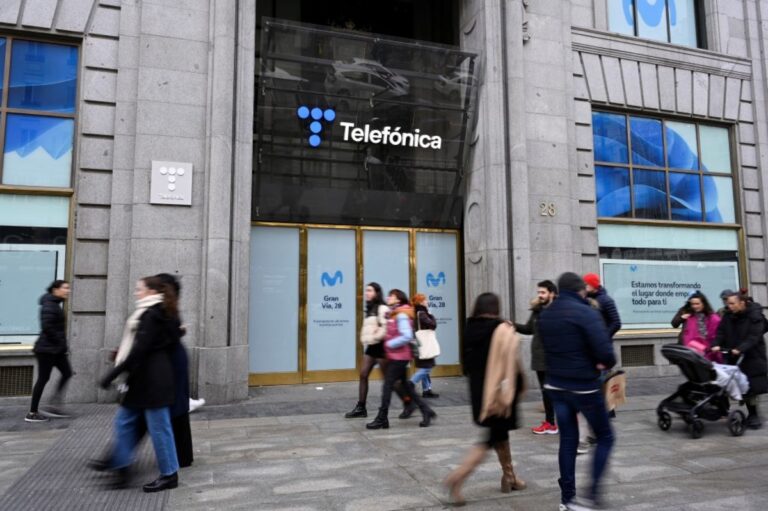
Telefónica SA is weighing a formal sale of its Venezuelan subsidiary — the last piece of its historic Latin American empire — in a deal that would require something no routine telecom M&A transaction demands: the simultaneous blessing of both the Trump administration and the government in Caracas. That dual-government precondition has transformed what would otherwise be a standard portfolio exit into a first-of-its-kind geopolitical test of U.S. influence over Venezuela’s economy following the January 2026 military operation that removed Nicolás Maduro from power.
Bloomberg reported Friday morning, citing people familiar with the matter, that Telefónica aims to exit Venezuela within twelve months but is waiting for conditions to improve before initiating a competitive auction. The company has already received an unsolicited approach — preliminary discussions with LARA Fund (Latin America Real Assets Opportunities), a Miami-based private equity firm co-founded by Mauricio Claver-Carone. Those talks did not advance. Claver-Carone told Bloomberg his firm is not actively pursuing deals in Venezuela and is focused on closing transactions elsewhere. Telefónica declined to comment.
Movistar Venezuela: What Is Being Sold
The asset in question is Movistar Venezuela, which commands approximately 54% mobile market position and serves more than 7 million subscribers. Telefónica entered Venezuela when it acquired BellSouth’s Latin American operations in 2004–2005, bringing with it what was then one of the region’s most valuable wireless networks. Today, Movistar is the dominant player in Venezuela’s three-operator mobile oligopoly, ahead of state-owned CANTV’s Movilnet unit (approximately 40% share) and privately held Digitel (approximately 15%).
That market position conceals the severe structural headwinds that have made Venezuela an unattractive commercial asset for years. Mobile penetration stands at roughly 60% — well below regional averages — while only around 15% of the population accesses fixed-line internet. Revenues from the Venezuelan unit are estimated to fall in the range of $200 to $300 million annually, but the bolívar’s chronic volatility makes precise figures difficult to establish, and a decade of hyperinflation and currency controls has made it functionally impossible for Telefónica to repatriate those earnings back to Madrid. Venezuela’s currency has shed 14 zeros through repeated redenominations since 2008 — a statistic that captures the structural impossibility of operating a foreign business here on normal commercial terms.
Why Washington and Caracas Both Have a Say
The requirement for U.S. government approval traces directly to the January 3, 2026 military operation — code-named “Operación Resolución Absoluta” — in which U.S. forces captured Maduro at his Caracas residence and transferred him to New York to face narcoterrorism charges. Two days later, former Vice President Delcy Rodríguez was sworn in as interim president after Venezuela’s Supreme Court ordered her to assume all presidential powers. Since then, the United States has taken what analysts describe as a domineering role in Venezuela’s economic future — from oil deal structures to debt restructuring arrangements — while refraining from pushing for near-term democratic elections.
On the legal side, the U.S. Office of Foreign Assets Control has issued General License 62, which specifically authorizes negotiations and entry into contingent contracts for new investment in Venezuela’s telecommunications sector — including dealings with CONATEL (Venezuela’s telecoms regulator) and state-owned CANTV. But GL 62 only covers negotiations; contract performance requires separate OFAC authorization before closing. In practice, this means the Trump administration retains a direct veto over when — and to whom — the deal can close, regardless of what Telefónica and a buyer agree to commercially. Telefónica’s “waiting for the right window” is not merely commercial patience; it is also a waiting game with OFAC.
The “Caracas” side of the approval equation means Rodríguez’s government, which has been cooperating closely with Washington on economic restructuring since taking office in January. Venezuela has passed new investment liberalization laws and the two governments have been conducting coordinated trade and energy negotiations. But that cooperation has its own fragility: any acquirer perceived as too close to Washington — or too closely associated with figures involved in reshaping Venezuela’s economy under U.S. oversight — could face political complications in Caracas.
Claver-Carone’s Shadow
Claver-Carone’s LARA Fund is not, on the surface, an obvious lead contender to acquire Venezuela’s dominant mobile network. The fund is small, Miami-based, and Claver-Carone himself told Bloomberg it is not actively pursuing Venezuelan deals. But his preliminary contact with Telefónica carries significance that extends beyond the status of those specific talks.
From January 2026 through July 2026, Claver-Carone served in what multiple sources described to Reuters as a “viceroy”-like informal advisory role within the Trump administration’s Venezuela policy framework — despite holding no formal government position. He was instrumental in structuring U.S. firm Centerview Partners’ contract to restructure Venezuela’s approximately $200 billion in debt, a contract worth more than $150 million that was awarded without competitive bidding. He also weighed in on which companies received access to Venezuelan oil deals. Per Reuters, he was reportedly forced out in July 2026, though he described his departure as voluntary.
Claver-Carone’s background makes the LARA Fund’s approach to Telefónica a data point about the intersection of U.S. Venezuela policy and commercial deal-making, not just a routine PE inquiry. His departure from the informal advisory position does not remove the question of whether politically connected U.S.-linked capital will ultimately shape who owns Venezuela’s dominant carrier — it merely removes one specific actor from the equation.
Spain’s Dominant Carrier Began Pulling Out of Latin America 35 Years After Arrival
The potential Venezuela sale is the culmination of a strategic overhaul that Telefónica’s CEO Marc Murtra unveiled at the company’s Capital Markets Day on November 4, 2025, under the “Transform & Grow” five-year strategy. The plan targets revenue growth of 1.5 to 2.5% compound annual growth rate through 2028, accelerating to 2.5 to 3.5% by 2030, with gross savings of €3 billion (approximately $3.44 billion) by 2030 achieved partly by concentrating exclusively on four core markets: Spain, Germany, Brazil, and the United Kingdom.
“We’re going to exit all of Hispanoamérica,” Murtra declared at the presentation. When asked about Venezuela’s shifting political picture after the U.S. intervention, he held firm: the situation in Venezuela has changed, but Telefónica’s roadmap had not, he said.
What followed was a historically fast-paced divestiture campaign. Telefónica sold or agreed to sell operations in Argentina, Peru, Ecuador, Uruguay, Colombia, Chile, and Mexico — seven markets in roughly eighteen months. These transactions collectively generated approximately $3.9 billion in proceeds. They also triggered Telefónica’s largest reported annual losses in two decades: the company posted a net loss of €4.318 billion for 2025, largely due to €2.269 billion (approximately $2.60 billion) in write-downs on Latin American disposals and a further €2.049 billion (approximately $2.35 billion) earmarked for a workforce reduction affecting more than 5,000 employees in Spain.
Telefónica first entered the region around 1990 via Chile, riding the wave of state privatizations that swept Latin America. Its arrival in Venezuela came in 2004–2005 through the BellSouth acquisition. Now, roughly 35 years after its southward expansion began, Venezuela is the last redoubt.
The Mexico Precedent
The most recent comparable transaction is the Mexico deal, signed April 8, 2026, in which Telefónica sold Movistar Mexico for $450 million — then serving more than 21 million customers as the country’s second-largest carrier — to Melisa Acquisition LLC, a consortium of telecom-as-a-service platform OXIO and asset manager Newfoundland Capital Management (approximately €389 million at then-current exchange rates). The deal was structurally different from Venezuela’s likely trajectory: Mexico presented a straightforward regulatory environment by comparison, though it carried its own complications from a multiyear tax dispute with Mexican authorities worth approximately $250 million.
Venezuela’s structural challenges run deeper. Currency controls, political risk, sanctions compliance obligations, and the absence of any established hard-currency revenue model mean any acquirer is taking on an asset whose future value depends on a political and economic transition that remains uncertain. International telecoms majors like América Móvil’s Claro and Millicom (Tigo) have had no presence in Venezuela — a historical signal of how difficult the market has been to navigate.
That signal may be changing. Millicom, which has been Telefónica’s primary acquirer throughout the Latin American exit — buying the Colombian, Uruguayan, and Ecuadorian units, then partnering on Chile — identified Venezuela as a potential growth market alongside Peru, CEO Marcelo Benítez told Bloomberg in April 2026. With Maduro removed and U.S. investment frameworks easing across multiple Venezuelan sectors, Millicom’s stated interest in Venezuela is worth watching as the sale process eventually opens.
What Venezuela Subscribers Should Know
For Movistar Venezuela’s more than 7 million customers, a sale will raise practical questions about network investment continuity and service quality. Movistar made a $500 million network investment in Venezuelan network infrastructure across 2024–2025, including the acquisition of new 5G spectrum in a January 2025 CONATEL auction and the launch of 5G pilot tests in Caracas. The new CEO Antonio Valente assumed his role this year; the company has been on an infrastructure modernization trajectory.
What a sale does not automatically resolve is the surveillance record that attaches to Movistar’s operational history in Venezuela. Telefónica’s 2021 transparency report — the last before the company stopped publishing Venezuela-specific disclosures — revealed that 20% of its subscribers surveilled — more than 1.58 million Movistar subscribers, roughly 20% of the subscriber base — had their communications intercepted at the direction of Venezuelan government agencies in that year alone. Interception requests came not through judicial orders but from police, military, and intelligence agencies. Metadata from 13% of subscribers was routinely delivered to security agencies, according to a July 2026 congressional memo prepared by the Atlantic Council’s Democracy+Tech Initiative for the Tom Lantos Human Rights Commission. The interception volume was four times higher than that of the next comparable country in Telefónica’s network.
Whoever acquires Movistar Venezuela inherits not just its spectrum licenses and towers, but the infrastructure through which one of Latin America’s most documented surveillance programs ran. Under the Rodríguez government, the political direction of that surveillance infrastructure is one open variable.
Who Might Buy
The field of plausible acquirers is narrow. Telefónica’s preferred structure is a competitive auction with multiple bidders, not a bilateral deal — a preference that implies the company knows interest is limited and is trying to create competitive tension where natural market demand may be thin.
Structural options that have been discussed in Spanish financial media include: a merger with or acquisition by CANTV (the state-owned incumbent), a sale to Digitel (Venezuela’s third operator, controlled by the Cisneros family), or an acquisition by an international player such as Millicom with regional scale. Major U.S. carriers have shown no appetite for Venezuelan investments. The involvement of a U.S.-linked buyer — the LARA Fund scenario — remains theoretically possible but appears commercially unlikely based on current signals, even as it would carry obvious geopolitical logic given Washington’s controlling role in Venezuela’s economic restructuring.
One structural option that would carry the most profound implications for Venezuela’s 7 million-plus mobile subscribers: if no private buyer materializes and CANTV absorbs Movistar Venezuela, the mobile market would shift from a three-operator structure with a dominant private player to one with overwhelming state presence. That outcome would be difficult for service quality and would remove the last independent check on state control of Venezuela’s telecommunications infrastructure.
No final decision has been made, and Telefónica could opt against a sale altogether. But with Mexico now closed and every other Latin American market either sold or in transition, the company’s focus will inevitably shift toward the last chapter of a 35-year continental presence.
Can Washington Really Make or Break This Deal?
How does the U.S. government have authority over a Spanish company’s Venezuelan sale?
Two mechanisms give Washington effective control. First, any transaction involving U.S. persons — including buyers with U.S. investors, U.S.-dollar financing, or U.S. bank clearing — requires authorization under OFAC’s Venezuela Sanctions Regulations, 31 CFR Part 591. OFAC General License 62 permits negotiations for telecom investments but requires a separate license for the actual transaction to close. Second, the Trump administration has positioned itself — through Claver-Carone’s informal advisory role and direct engagement with the Rodríguez government — as the de facto coordinator of major Venezuelan economic restructuring decisions. Any large commercial deal that hasn’t been pre-cleared with Washington faces the risk of political opposition that can block it in Caracas as well.
What is LARA Fund and why does its approach to Telefónica matter?
LARA Fund (Latin America Real Assets Opportunities) is a Miami-based private equity fund co-founded by Mauricio Claver-Carone, the Cuban-American lawyer and diplomat who served as Trump’s Special Envoy for Latin America in early 2025 and subsequently as an informal but influential advisor shaping U.S. Venezuela policy through mid-2026. Claver-Carone was also previously the first American president of the Inter-American Development Bank before being removed from the Inter-American Development Bank by its board of governors in September 2022 following an ethics investigation. His fund’s preliminary contact with Telefónica matters not because the talks advanced — they did not — but because it signals that U.S.-connected interests with direct insight into Washington’s Venezuela strategy have already been assessing the asset.
What happens to Venezuelan subscribers if Telefónica sells?
In the near term, network operations would continue under whatever transition framework the sale agreement specifies. The more consequential question concerns long-term investment: the 5G buildout currently underway, the infrastructure modernization program, and the quality of the 4G network that serves over 50% of Venezuela’s mobile internet traffic all depend on the new owner’s commitment to continued capital expenditure in a country with severe currency and repatriation risks. A state-owned buyer (CANTV) would likely continue operations but at slower improvement pace under budget constraints; a private buyer would need a hard-currency revenue model that currently does not exist at scale for telecoms in Venezuela.
Frequently Asked Questions
Why must Telefónica get approval from both Washington and Venezuela to sell Movistar?
Because the United States now plays an effective veto role in major Venezuelan economic transactions following the January 3, 2026 military operation that removed Maduro and installed Delcy Rodríguez as interim president. On the legal side, U.S. Treasury’s OFAC General License 62 requires authorization for telecom investment transactions in Venezuela — negotiations are permitted, but contract performance requires a separate OFAC license. On the political side, the Trump administration has been coordinating Venezuela’s major economic restructuring decisions and any deal that lacked Washington’s informal blessing would face significant headwinds in Caracas. “Washington and Caracas approval” is thus both a legal requirement and a political reality.
What does Claver-Carone’s past role in Venezuela say about how this sale might unfold?
It says the sale is already being watched by people with deep U.S. policy connections to Venezuela’s economic future. Claver-Carone shaped which U.S. companies got access to Venezuelan oil deals and debt restructuring contracts during his informal advisory period (January–July 2026). His departure from the advisory role in late July 2026 does not close the door to politically shaped deal-making; it removes one specific actor. The LARA Fund’s approach to Telefónica — even if not pursued — is a preview of how the Venezuelan telecom sale may eventually attract buyers whose credentials include Washington relationships as much as balance sheets.
Could Venezuela’s mobile market end up fully state-controlled after Telefónica exits?
It is a real risk. Venezuela’s three-operator mobile market currently has Movistar (54%), state-owned Movilnet/CANTV (approximately 40%), and private Digitel (approximately 15%), as of November 2024 data. If no credible private buyer emerges and CANTV acquires Movistar, the state would control roughly 94% of Venezuela’s mobile market, leaving Digitel as the only independent operator. That outcome would represent a fundamental shift in the competitive and surveillance landscape of Venezuelan telecommunications — at a moment when Movistar’s own history shows it was already serving as a conduit for government surveillance of approximately 20% of Movistar subscribers surveilled at the direction of the Maduro government.