HomeAuto T-Mobile Live Data Shows Satellite at 0.002% of Traffic: Physics Explains Cap
T-Mobile Live Data Shows Satellite at 0.002% of Traffic: Physics Explains Cap
August 25, 2026:
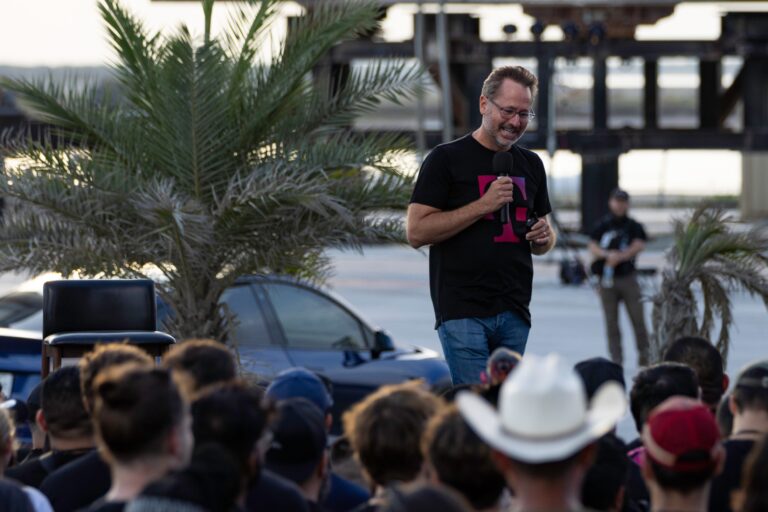
T-Mobile CEO Mike Sievert speaks during a T-Mobile and SpaceX joint event on August 25, 2022 in Boca Chica Beach, Texas. Michael Gonzalez/Getty Images
Peter Osvaldik delivered the most quantitatively specific public case yet for why orbital direct-to-device networks carry a structural ceiling — and why no number of satellites, no capital investment, and no engineering iteration can repeal it. The proof is already in T-Mobile’s own network logs.
Speaking at the Evercore Partners TMT Global Conference on Monday, August 24, T-Mobile Chief Financial Officer Peter Osvaldik disclosed that direct-to-device (D2D) satellite traffic on T-Mobile’s network accounted for 0.002 percent of total network traffic during the preceding week. That single figure — drawn from live network telemetry, not a projection — quantifies the outcome of a physics debate the telecom industry has been conducting in strategic language for three years. Osvaldik then named exactly why it cannot grow to a meaningful fraction of total traffic, regardless of how many satellites SpaceX launches.
The remarks came as SpaceX continues to escalate its public rhetoric about “Starlink Mobile,” its ambition to compete directly with AT&T, T-Mobile, and Verizon. The CFO’s willingness to put specific engineering numbers on the record — not just competitive assertions — gives carriers, investors, and subscribers a framework they can evaluate independently.
Law One: Signal Power from Space Cannot Reach You Indoors
The first physics constraint Osvaldik named is propagation loss.
Every radio signal weakens as it travels. The governing rule is inverse-square propagation: double the distance and signal power drops to one-quarter. At the minimum operationally viable altitude for a low Earth orbit (LEO) satellite — approximately 350 kilometers (217 miles) — the distance penalty versus a terrestrial cell tower roughly 1 kilometer (0.6 miles) away is staggering.
The math is not subtle. A satellite at 350 km (217 miles) is 350 times farther from a user’s phone than a typical nearby cell tower. Under the inverse-square law, that translates to a power ratio of 350 squared — roughly 122,500 to one — before any other losses are counted. In decibel terms, a satellite link at 700 MHz (the frequency T-Mobile uses for T-Satellite) suffers roughly 51 extra decibels of path loss compared to a terrestrial tower at the same frequency from 1 kilometer (0.6 miles) away.
The 350 km (217 miles) floor is not an engineering choice that could be optimized away. As Osvaldik explained at the Evercore conference, satellites below 300 km face drag that requires prohibitively heavy propulsion systems and burns through propellant rapidly, making commercial constellation economics unworkable. The altitude floor is a constraint of orbital mechanics, not antenna design.
That path loss deficit already pushes a satellite link to the edge of what a standard smartphone antenna can close. Then comes the building.
Ericsson’s Mobility Report data — the industry’s benchmark for this figure — establishes that approximately 70 to 80 percent of mobile data traffic is generated indoors. Modern construction materials add their own attenuation on top of the satellite’s already-strained link: common glass causes 5 to 10 additional decibels of loss; concrete walls 20 to 30 decibels; low-emissivity coated glass — now standard in office buildings throughout the United States — 25 to 40 decibels. A satellite signal already 51 decibels weaker than a terrestrial tower, losing another 25 to 40 decibels through a single modern glass wall, has dropped 76 to 91 decibels below terrestrial equivalence — well outside the recoverable range for the radio hardware in a standard smartphone.
“You cannot put enough power on,” Osvaldik said at the Evercore conference. “You can put 100,000 satellites up with all the spectrum of all three MNO operators and you will never be able to project enough power to overcome that open-signal loss of 350 kilometres.”
The same constraint applies in cars. Modern vehicles, particularly those with metallized glass and structural steel bodies, attenuate radio signals comparably to a lightweight building. Indoor environments and vehicles together account for the bulk of where subscribers actually use their phones — the population that satellite D2D structurally cannot serve.
Law Two: Each Orbital Beam Can Serve About Ten Users at Once
Even if signal penetration were a solved problem, a second constraint rules out dense urban service: beam capacity.
A satellite at 350 km (217 miles) altitude uses a phased-array antenna to form focused beams — controlled constructive interference among many antenna elements that concentrates signal energy onto a specific patch of ground. The beam can be steered electronically, but its minimum achievable width is bounded by the laws of diffraction: beam width is proportional to the ratio of wavelength to antenna aperture. A phased-array antenna on a small satellite, no matter how sophisticated, cannot focus a 700 MHz beam onto an arbitrarily small ground footprint from 350 km (217 miles) up.
Independent measurements of Starlink’s direct-to-cell beams — conducted using crowdsourced Speedtest data by network benchmarking firm Ookla — show beam footprints with an effective radius of approximately 19 kilometers (12 miles) when the satellite is directly overhead, and approximately 44 kilometers (27 miles) at lower elevation angles. Manhattan Island covers roughly 59 square kilometers (23 square miles). A beam radius of 19 kilometers (12 miles) at overhead elevation produces a footprint of approximately 1,134 square kilometers (438 square miles) — roughly 19 times the area of Manhattan.
Osvaldik’s estimate at the Evercore conference put the beam at “six to fifteen times” Manhattan’s size, depending on how the borough’s boundaries are defined — consistent with the physics and with the Ookla measurement range. What matters is the capacity that beam can sustain: approximately ten concurrent outdoor broadband users.
“A beam size larger than the size of Manhattan that can reliably provide service to ten concurrent outdoor users,” Osvaldik said at the Evercore conference. “It’s just not an experience that customers demand.”
To illustrate what that means in practice: Manhattan has over one million residents plus millions of daily visitors. A conventional terrestrial cell tower handles hundreds of simultaneous users within a radius of a few kilometers. A single satellite beam covering an area larger than Manhattan handles ten. The math does not improve with more satellites — more satellites increase geographic coverage, not the per-beam user ceiling.
A peer-reviewed crowdsourced measurement study of Starlink’s direct-to-cell network — covering data collected between October 2024 and July 2025 — independently confirmed that current V1 satellites deliver approximately 4 megabits per second (Mbps) per beam in outdoor conditions, and found a strong negative correlation between D2D usage and population density: the service concentrates exactly where terrestrial coverage is absent.
What T-Mobile’s Own Traffic Data Shows
Osvaldik did not rely solely on first principles. He cited the company’s actual network measurements.
D2D satellite traffic on T-Mobile’s network represented just 0.002 percent of total traffic in the preceding week.
The figure is worth contextualizing. In May 2026, T-Mobile CEO Srini Gopalan disclosed at a J.P. Morgan investor conference that T-Satellite accounted for approximately 0.0002 percent of total traffic, based on May data. The August figure from Osvaldik is 0.002 percent — a tenfold increase over roughly three months, as T-Satellite has expanded from text-only to data and voice-capable services, and as the subscriber base on the $10-per-month add-on has grown.
Even accounting for that growth trajectory, the arithmetic underscores Osvaldik’s argument. T-Satellite’s commercial July 2025 launch opened the service, which has since expanded to 22 countries with more than 650 dedicated satellites in orbit, yet generates only one-fiftieth of one percent of T-Mobile’s traffic. The service is doing exactly what both companies designed it to do: providing connectivity in remote areas — national parks, maritime corridors, backcountry wilderness — where no terrestrial tower exists and users have no alternative.
T-Satellite currently supports SMS, picture messaging, location sharing, and select optimized apps including WhatsApp voice and video on approximately 60 compatible phone models. Current V1 generation satellites deliver speeds of 2 to 4 Mbps — functional for messaging and light data tasks, but not competitive with terrestrial LTE or 5G. The service requires outdoor sky visibility and does not penetrate building rooftops or vehicle bodies.
SpaceX Pushes Back: V2 Will Change Everything
Osvaldik’s remarks did not emerge in a vacuum. SpaceX has been systematically escalating its rhetoric about Starlink Mobile’s competitive ambitions since its June 2026 initial public offering.
At Mobile World Congress in Barcelona in March 2026, SpaceX rebranded its direct-to-cell program as “Starlink Mobile” and outlined next-generation V2 satellite specifications. SVP of Starlink Michael Nicolls described the V2 design as featuring a phased-array antenna five times the size of the current generation, 16 times more spatial beams per satellite, and overall throughput per satellite 20 times higher than V1. Peak per-user speed is targeted at 150 Mbps. The V2 satellites will operate on the 5G NR non-terrestrial network (NTN) standard rather than LTE, and will require handsets equipped with modems such as Qualcomm’s Release 19-capable X105 chipset — not available in current phones. SpaceX plans to begin deploying V2 satellites via Starship in mid-2027, with a target constellation of roughly 1,200 satellites for global contiguous coverage.
Following SpaceX’s August 2026 earnings call, the company stated ambitions to compete directly with the Big Three US carriers rather than serve only as a coverage layer. Verizon shares fell 3.6 percent, AT&T fell 2.7 percent, and T-Mobile fell 2.4 percent in after-hours trading.
Independent analysts have been measured about SpaceX’s V2 claims. The fundamental physics constraints Osvaldik described apply to V2 satellites as well. Larger antennas and custom chips improve spectral efficiency and per-satellite throughput, but diffraction limits on beam width mean a 5× larger phased array still cannot concentrate a 700 MHz signal onto a geographic footprint approaching what a terrestrial small cell achieves. A narrower beam helps — it reduces interference and improves per-user capacity in the covered area — but it does not eliminate the atmospheric drag floor that keeps all commercial LEO satellites above 300 km (186 miles), nor does it grant signals the power to reliably penetrate modern insulated buildings at scale.
Where Satellite D2D Genuinely Excels
The physics constraints define satellite D2D’s legitimate value, not just its limits.
“It has a great complementary place in outdoor areas, particularly areas like national parks where the economics just don’t make sense to build a terrestrial network,” Osvaldik said at the Evercore conference. “It can be a great added complementary benefit for customers, and that’s where we see it play out.”
That framing aligns with how T-Mobile has structured T-Satellite commercially. The service is an opt-in add-on for subscribers who want coverage insurance in outdoor remote environments — hikers, boaters, long-haul truckers, emergency responders in areas beyond tower reach. Real-world emergency performance has validated the concept: during the BC wildfire evacuations in August 2026, Rogers Communications in Canada activated its direct-to-device satellite service province-wide across British Columbia, providing connectivity to more than 21,000 evacuees where terrestrial towers had been severed by fire damage.
The broader industry picture supports this positioning. Verizon and AT&T are building their own satellite safety-net offerings through AST SpaceMobile’s Block 2 BlueBird constellation — a company whose Block 2 satellites use an architecturally different approach (massive 2,400-square-foot, or 223-square-meter, phased-array antennas per satellite, targeting broadband-speed data) but face a similar physics reality. All of these programs are structured around gap-filling rather than replacement of terrestrial networks.
Can Physics Be Repealed?
The exchange at the Evercore conference sharpens a debate that will shape a large portion of the $600 billion global mobile market over the next decade.
SpaceX’s stated ambition — positioning Starlink Mobile as an eventual challenger to terrestrial carriers, not merely a complement — implies a fundamentally different future for mobile connectivity. Osvaldik’s counter is not a competitive hedge. It is a statement about geometry: the inverse-square law and the diffraction limit on beam focusing are not design choices that any amount of money or engineering talent can override. A satellite at 350 km (217 miles) altitude is constrained by the same physics as every electromagnetic wave at that distance, from that antenna size, at that wavelength.
What V2 satellites and their successors plausibly will deliver is meaningfully better rural and remote service: higher speeds, lower latency, more reliable connectivity in the areas terrestrial economics cannot reach. The 0.002 percent figure for current D2D traffic could grow substantially as satellite data rates improve — it has already grown tenfold since May 2026. But the structural physics argument suggests that growth will not come at the expense of terrestrial carriers’ core business. It will come from the 500,000 square miles of US territory currently beyond any cell tower’s reach, and from the remote maritime and aviation corridors that terrestrial networks were never designed to serve.
The physics, Osvaldik argued on Monday, August 24, is not a temporary engineering challenge. It is geometry.
Frequently Asked Questions
Why does it matter that satellite D2D handles only 0.002 percent of T-Mobile’s traffic?
The figure comes from T-Mobile’s live network telemetry as of the week ending around August 23, 2026 — not a model or estimate. It represents the realized outcome of a year of commercial T-Satellite service (launched July 2025) with more than 650 dedicated satellites in orbit. The 0.002 percent share, compared to the 0.0002 percent Gopalan cited in May 2026, shows that D2D traffic has grown tenfold in roughly three months as T-Satellite expanded its services from text-only to data and voice. Even with that growth, satellite accounts for one-fiftieth of one percent of total T-Mobile traffic. The figure is the strongest available evidence that satellite serves its design purpose — emergency and remote outdoor coverage — rather than encroaching on terrestrial usage patterns.
Can SpaceX’s next-generation V2 satellites overcome the physics limitations Osvaldik described?
SpaceX’s V2 satellite specs promise 20 times the per-satellite throughput, 150 Mbps peak per user (versus 2–4 Mbps today), and 16 times more spatial beams per satellite, targeting mid-2027 deployment. Those improvements address spectral efficiency and per-satellite capacity. They do not change the inverse-square propagation loss that separates a satellite at 350 km (217 miles) from a phone — which is set by the altitude floor imposed by atmospheric drag, not by satellite hardware. They do not meaningfully shrink beam footprints to the point where urban concurrent-user service becomes comparable to terrestrial, because the minimum beam width is governed by the diffraction limit: the ratio of wavelength to antenna aperture at that altitude. And they do not make satellite signals penetrate modern insulated buildings, where 70 to 80 percent of mobile data is consumed. V2 will serve remote and rural environments better. The structural barriers to urban replacement remain.
How many people can a Starlink direct-to-cell satellite beam serve at once, and why does that limit matter?
According to T-Mobile CFO Peter Osvaldik, citing T-Mobile’s own estimates at the Evercore Partners TMT Global Conference on August 24, 2026, a next-generation V2 satellite beam covering six to fifteen times the area of Manhattan can reliably provide outdoor broadband service to approximately ten concurrent users. Ookla’s crowdsourced V1 beam measurements confirm beam footprints at overhead elevation have a radius of roughly 19 kilometers (12 miles), covering an area approximately 19 times Manhattan’s size. A terrestrial cell tower serving a comparable area would handle hundreds of simultaneous users. The gap means satellite D2D can provide genuine value in low-density rural environments where a handful of concurrent users is realistic. In a city, the beam’s concurrent-user capacity is exhausted by a single city block.
What is T-Satellite actually useful for today?
T-Satellite is T-Mobile’s commercial direct-to-device satellite service, launched in July 2025 in partnership with SpaceX’s Starlink constellation. It provides SMS, picture messaging, location sharing, and select optimized apps — including WhatsApp voice and video — in outdoor areas beyond any terrestrial cell tower’s reach: national parks, remote highways, maritime corridors, and backcountry terrain. Current V1 satellites deliver speeds of 2 to 4 Mbps. The service costs $10 per month as an add-on and is included at no additional cost on T-Mobile’s Experience Beyond 2.0 and Go5G Next plans. About 60 phone models are compatible. T-Satellite needs outdoor sky visibility and does not work reliably inside buildings or vehicles. It does not replace cellular service — it functions as a safety net for the approximately 500,000 square miles of US territory that terrestrial towers do not reach.