November 19, 2026:


System76 put its redesigned Thelio Prime Linux desktop on sale on November 18, with Linuxiac reporting availability at 11:07 a.m. ET. The configurator starts at $1,599. Anyone planning the top graphics option should check one number first: System76’s product page lists a 600W power supply, while NVIDIA’s published figure for the RTX 5070 that System76 offers is 650W.
The product page lists a 600W supply and a maximum recommended graphics card of 132 mm (5.2 in) tall, 45 mm (1.8 in) wide and 258 mm (10.16 in) long. NVIDIA’s RTX 5070 listing shows 650W of required system power and 250W of total graphics power. NVIDIA describes the 650W figure as a minimum based on a system with a Ryzen 9 9950X processor, and it says actual requirements vary by configuration. The Thelio Prime’s fastest listed processor is the Ryzen 9 9900X, so the two systems are not identical.
Earlier Thelio Prime listings carry a different number. System76’s Thelio Prime Elite page lists a 650W supply, and FOSS Force reported 650W for the previous Prime in March. System76 has not explained the move to 600W. Buyers can ask System76 support to confirm the supply in their exact configuration before paying.
The rest of the launch details are more consistent. Linuxiac reports an internal volume of 9.78 liters (2.58 gal) and a 29-minute assembly time, and System76’s own blog post matches both figures.
Buyers pick one graphics option from System76’s discrete graphics options: the RTX 3050, RTX 5060, RTX 5060 Ti, RTX 5070 and Radeon RX 9060 XT, alongside integrated Radeon graphics. The RTX 5070 with 12GB of memory is the top NVIDIA option.
The product page calls the supply 80+ Certified with efficiency of 90% or better but names no higher tier. An 80 Plus rating describes how efficiently a supply converts wall power, not how much it can deliver. Capacity is the wattage figure, and that is where a 600W unit sits 50W below NVIDIA’s 650W reference for the RTX 5070, a number NVIDIA frames as a minimum for its own test system.
System76 has not said how the 600W supply was validated against the RTX 5070 build or whether it applies to every configuration. Separately, the page’s maximum recommended GPU dimensions, including the 258 mm (10.16 in) length, are the only fit figures we found System76 publishing at launch, so buyers should compare any specific card’s length against them. Buyers can also ask support to confirm both items in writing.
Linuxiac and System76’s blog give 9.78 liters (2.58 gal) as the internal volume, which Linuxiac says is 48.5% smaller than the original Thelio Prime. Phoronix, relaying System76’s pre-launch teaser, called it an 11-liter (2.9 gal) machine. Multiplying the listed outside dimensions of 288 by 148.9 by 281.9 mm (11.3 by 5.9 by 11.1 in) gives about 12.09 liters (3.19 gal) for the bounding box. System76 has not said which measurement its 11-liter figure uses, so the three numbers are best read as different ways of measuring one box.
The headline figure matters less than the usable space inside. The product page’s 258 mm (10.16 in) card limit is the number that decides whether a given graphics card fits.
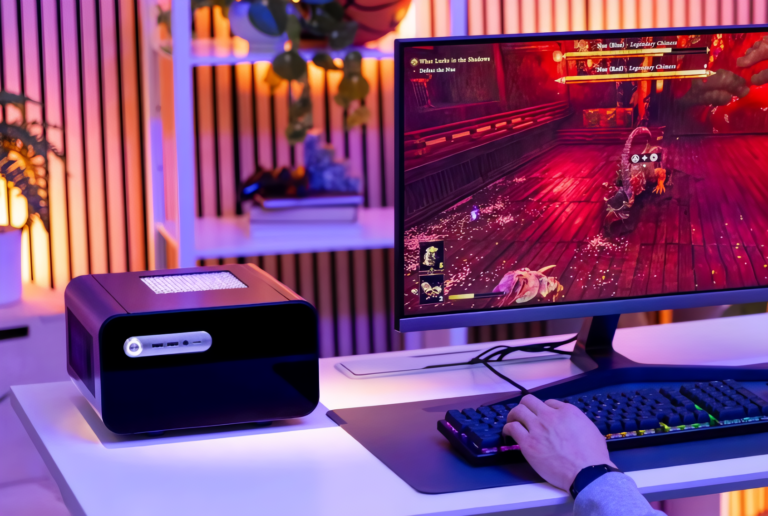
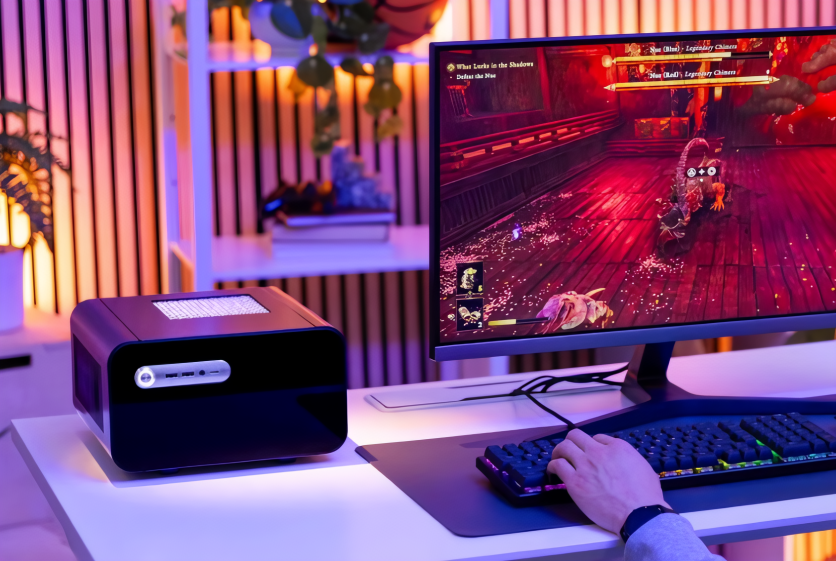
The enclosure pairs milled stainless steel and aluminum in a 1.5 mm aluminum body and stands upright or lies on its side on magnetic feet. The side panels attach magnetically. System76 says it tested them through 16,000 robotic open-and-close cycles, plus 1,500 more in a freezer and 1,500 more after heating, though those figures are the company’s own and have not been independently confirmed.
Cooling follows a split design. System76 says separate thermal chambers give the CPU and GPU their own air, and that a stainless-steel mesh over the CPU intake lets in more airflow than punched aluminum could. The idea is to keep GPU exhaust out of the CPU intake, though System76 has not shown that the layout does so. The page also promises custom fan curves and calls the system “whisper quiet,” but we found no published noise measurement, temperature reading or sustained-load result.
System76 says assembly takes 29 minutes, and Linuxiac reports a 42% cut from the predecessor. The company builds the metal enclosure at its Denver, Colorado factory.
| Component | Options |
|---|---|
|
CPU |
Ryzen 5 9600X (6-core), Ryzen 7 9700X (8-core), Ryzen 7 9800X3D (8-core), Ryzen 7 9850X3D (8-core), Ryzen 9 9900X (12-core) |
|
Graphics |
Integrated Radeon; NVIDIA RTX 3050 (6GB), RTX 5060 (8GB), RTX 5060 Ti (16GB), RTX 5070 (12GB); AMD Radeon RX 9060 XT (16GB) |
|
Memory |
16, 32, 48, 64 or 96GB DDR5-5600 |
|
Storage |
One M.2 PCIe Gen5 and one M.2 PCIe Gen4 slot; OS drive from 500GB to 8TB; additional M.2 drive up to 8TB; up to 16TB total |
|
Networking |
2.5GbE; Wi-Fi 6E and Bluetooth 5.2 built in, removable as an option |
|
Power supply |
600W 80+ Certified |
|
Dimensions |
11.3 × 5.9 × 11.1 in (288 × 148.9 × 281.9 mm), upright with feet |
The table follows System76’s product page. The page does not say which configuration the $1,599 price covers. The two X3D processors, the 9800X3D and 9850X3D, are the gaming-oriented options. The 12-core Ryzen 9 9900X tops the processor range. According to a report relayed by NeoTeo from 9to5Linux, System76 CEO Carl Richell confirmed the Radeon RX 9060 XT option on October 29.
System76’s product page does not state a ship date, although a Phoronix preview said November shipping would begin. FOSS Force reported a $1,499 base price in March for the previous Thelio Prime, so the new $1,599 start sits $100 higher, though neither base configuration is fully specified.
System76’s page lists Pop!_OS 26.04 LTS with its COSMIC desktop as the first operating system choice, with Ubuntu 24.04 LTS and Ubuntu 26.04 LTS beside it, and says other Linux distributions and Windows can be installed.
Linuxiac notes that Pop!_OS 26.04 has not been formally announced, so the preinstall appears ahead of an official release. System76’s blog describes full-disk encryption with owner-controlled keys as part of the setup.
Before launch, a NeoTeo report listed Pop!_OS 24.04 LTS with COSMIC as the option, which is the stable release System76 shipped in December 2025. The product page now lists 26.04, but because that release has not been formally announced, check the configurator before ordering.
A new category of state law sits behind this launch. California’s AB 1043 and Colorado’s SB 26-051 share a core mechanism: operating system providers must offer an account-setup interface for a birth date or age and make an age-bracket signal available to apps. California’s duties take effect January 1, 2027, and Colorado’s law, signed June 3, takes effect July 1, 2028.
This is attestation, not identity verification. The account holder indicates an age; Colorado’s sponsors describe the framework as sending age-bracket data to apps without requiring identification documents. That gives adults a lighter privacy cost than the document-based checks used by some websites. Richell argues in a March blog post that the approach is easy to defeat because whoever sets up the account can enter any age, and Reclaim The Net quoted him describing a child creating a virtual machine and entering an age of 18. The US Supreme Court’s June 2025 ruling in Free Speech Coalition v. Paxton upheld a Texas age-verification law for sexual-content websites under intermediate scrutiny, but it addressed website checks and not operating-system signals, and we found no ruling that does.
Colorado’s law as enacted exempts operating systems distributed under licenses that permit recipients to copy, redistribute and modify the software without platform-imposed limits on installing modified versions, according to FOSS Force’s May analysis. California’s amendment, AB 1856, adds a similar carve-out. Reclaim The Net’s bill tracker and GovBuddy’s bill history list AB 1856 as signed on September 10, 2026, but we could not confirm that date on the legislature’s own site. The exemption wording is narrow, so readers should check Colorado’s bill page and the California text themselves.
System76 says it pushed for the exemption. Richell met Colorado Sen. Matt Ball, a co-author of SB 26-051, in March, and the senator suggested excluding open-source software. A May System76 blog post states that Pop!_OS and COSMIC will not include age verification or age attestation. For Thelio Prime buyers that means the preinstalled Pop!_OS would not prompt for an age under System76’s stated plan. The post does not address Ubuntu, which System76 also offers on the same machine.
The Prime targets buyers who want a Linux-first, US-assembled small desktop with real GPU choices and less bulk than a mid-tower. Magnetic panels and feet suit people who plan to upgrade memory or storage themselves. Anyone configuring an RTX 5070 should get written confirmation of the power supply and card clearance for their exact build, since System76’s product page lists 600W while NVIDIA’s reference figure for the card is 650W.
System76’s product page shows a $1,599 starting price. It does not say which configuration that covers, and higher-end options such as an RTX 5070, 96GB of memory or multi-terabyte storage will cost more.
System76 lists the RTX 5070 as an option beside a 600W power supply, while NVIDIA’s published required system power for the card is 650W, a minimum NVIDIA bases on a Ryzen 9 9950X system. Ask System76 to confirm the supply in your configuration before ordering.
System76’s page says other Linux distributions and Windows can be installed. Preinstalled choices are Pop!_OS 26.04 LTS, Ubuntu 24.04 LTS and Ubuntu 26.04 LTS.
System76 says Pop!_OS and COSMIC will not include age verification or age attestation. California’s operating-system age-signal law takes effect January 1, 2027, and Colorado’s law and California’s AB 1856 amendment exempt openly licensed software, though readers should check the bill text before assuming the exemption applies.