HomeAuto Sunny Dancer Shows Cancer Survivors What Medicine Already Knows They Need
Sunny Dancer Shows Cancer Survivors What Medicine Already Knows They Need
September 10, 2026:
Quiverdistribution.com
George Jaques never read the clinical literature. He was 25 years old, writing from memory — from watching his mother fight breast cancer when he was a teenager and from later working with a cancer charity for young people with the illness. What he built, in Sunny Dancer — which opens in US theaters September 18, 2026 — was a four-week summer camp in the Scottish Highlands for teenagers in cancer remission: no hospital scenes, no inspirational speeches, no tragedy. Just teenagers being teenagers. And peer-reviewed science, as of a January 2026 Cureus scoping review of 44 studies, would like to congratulate him on accidentally designing an evidence-based clinical intervention.
That convergence — between a young British filmmaker’s gut instinct and the frontier of psycho-oncological research — is the most important thing a viewer can understand about Sunny Dancer before buying a ticket. And it is something the film itself never states, because it doesn’t need to: it simply enacts it.
What Happens in Sunny Dancer, and Why It Matters
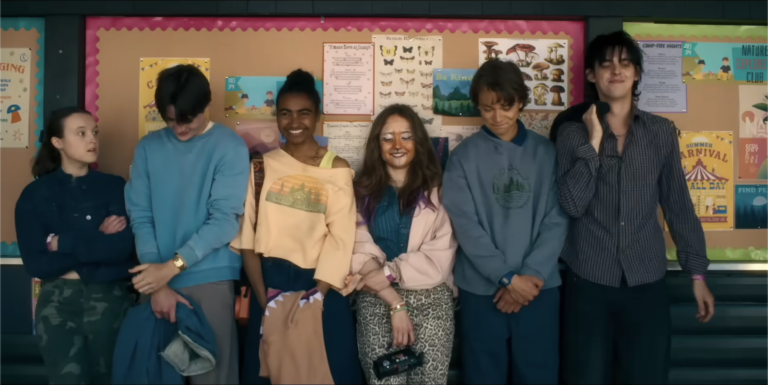
Ivy Pritchard (Bella Ramsey) is 17 years old and 10 months into remission from leukemia. She has beaten cancer. She is not, in any clinical or conventional sense, okay. Her parents (Jessica Gunning and James Norton, playing concerned adults with genuine comedy) have noticed what they cannot name: since remission, their daughter has withdrawn into herself, shed her friendships, and developed a particular contempt for anything that asks her to perform gratitude for surviving. So they enroll her, over her fierce objections, in CRF Camp — Children Run Free, a four-week residential program in the Scottish Highlands for young people affected by cancer. Ivy calls it “chemo camp.” Her assessment is not inaccurate, and it is exactly where she needs to be.
At camp, she meets dormmate Ella (Ruby Stokes), whose primary objective is to lose her virginity before August ends; the flinty, philosophical Ralph (Earl Cave); the dreamy and gentle Jake (Daniel Quinn-Toye), who becomes Ivy’s love interest; and the camp president Patrick (Neil Patrick Harris), whose relentless cheerfulness initially reads as the film’s comic villain and slowly reveals itself as something more complicated. The story is: Ivy learns to be seventeen again. What the science says is: Ivy is undergoing post-traumatic growth, and everything about this camp’s design is producing it.
The film premiered at the 76th Berlin International Film Festival in February 2026, where it received a Special Mention under the AG Kino-Gilde Cinema Vision 14plus prize and won the Wolfgang Petersen Prize. It spent the summer in wide UK and European release — opening in the UK on August 14, 2026 — and arrives in US limited release on September 18.
Why the Hardest Part of Cancer Comes After
The premise of Sunny Dancer — that remission can feel worse than illness — is not sentimentality. It is a clinically documented post-remission phenomenon.
Cancer, particularly during adolescence, creates a rigid scaffolding around a patient’s life: medical identity, structured schedules, a specific social role, the constant presence of caregivers and clinical staff. Treatment ends, and that scaffolding collapses. For adolescents, this is especially destabilizing because it happens during what developmental psychologist Erik Erikson identified as the critical period of identity formation — Stage 5, “Identity vs. Role Confusion,” roughly ages 12 to 18, as described in Erikson’s identity formation framework. This is the developmental window in which teenagers are supposed to construct a stable sense of self through active experimentation with roles, values, and relationships. A cancer diagnosis mid-adolescence freezes that process at the moment of diagnosis, leaving survivors not only physically changed but developmentally stalled: the “psychosocial moratorium” that healthy teenagers take for granted — the years of trying on identities — never happened for them.
Ivy’s emotional withdrawal is not a character flaw. It is an Eriksonian developmental arrest, dressed in jeans and contempt.
Research confirms the post-treatment window is when distress peaks, not during active treatment. A 2025 mixed-methods study confirmed that post-treatment distress peak evidence shows AYACS’ psychological health suffers long into survivorship, with disrupted development from cancer and its treatment as the key mechanism. A 2025 systematic review of psychosocial interventions for teenage and young adult post-treatment cancer survivors found that distress is greatest after the external support structures of treatment are removed — and that evidence-based interventions remain underprovided to address it. Over 40% of young cancer survivors experience clinical levels of distress after treatment ends, not during it.
The film’s opening premise — this kid got through cancer, and now she’s in pieces — is accurate in ways the film’s tone (warmly comedic, irrepressibly funny) never calls attention to.
Post-Traumatic Growth and What It Actually Requires
The concept of post-traumatic growth (PTG) was formalized in the mid-1990s by psychologists Richard Tedeschi and Lawrence Calhoun at the University of North Carolina Charlotte. Their Tedeschi and Calhoun PTG framework describes positive psychological transformation that emerges not from trauma itself but from the cognitive and social processing that follows it — the period after the acute crisis when the individual rebuilds their understanding of themselves, their relationships, and the world. Tedeschi and Calhoun identified five domains in which this growth manifests: new possibilities, relating to others, personal strength, spiritual change, and appreciation of life.
The crucial distinction: PTG does not happen in the hospital. It happens after.
A January 2026 scoping review from the University of Osaka — the most comprehensive mapping of PTG factors in childhood and adolescent cancer survivors to date — reviewed 44 peer-reviewed studies and classified the factors that promote or inhibit growth into six categories: cancer-related, personal, cognitive processing, social and interpersonal, coping, and psychological health outcomes. The qualitative research strand, the University of Osaka scoping review found, consistently identified social and interpersonal factors as the mechanism most strongly associated with PTG. Specifically: cooperation and support from family, peers, and healthcare professionals appeared in seven of the seven qualitative studies reviewed.
An earlier landmark study by Arpawong and colleagues, drawing on 94 adolescent and young adult survivors within six months of completing cancer treatment, found that the majority reported PTG — and that PTG was positively associated with post-traumatic stress symptoms. The Arpawong 2013 survivor PTG study established that the two experiences co-occur: distress and growth are not opposites but parallel processes. Ivy’s anger and her blooming are not narrative contradictions. They are empirically expected to coexist.
The mechanism that produces growth is the same in the research literature and in Sunny Dancer: a community of peers who share the experience, in a setting where the “sick role” is absent, and where ordinary social experimentation — friendship, romance, conflict, transgression — is permitted to resume.
What’s Actually Happening When Teenagers Drink at Chemo Camp
Sunny Dancer does not flinch from the fact that its teenage cancer survivors drink vodka, consider recreational drug use, skinny-dip, and pursue sexual experience. Director Jaques has described wanting a film in which cancer was “the least interesting thing” about his characters: they are “still teenagers,” with “these skills, this whole life.”
The neuroscience supports that framing with precision. The adolescent brain is characterized by a developmental asymmetry: the limbic system — governing emotion, reward, and social motivation — matures years ahead of the prefrontal cortex, which governs impulse control and long-term planning. The NIH adolescent brain development literature establishes that the resulting imbalance during adolescence produces a period of heightened reward-seeking and peer-social sensitivity that is neurobiologically adaptive, not pathological — it evolved to promote social bonding, group formation, and identity experimentation.
For adolescents who have undergone cancer treatment, this normal developmental trajectory has been disrupted. Chemotherapy, extended hospitalization, and social isolation during treatment suppress the ordinary experiential testing of embodiment and peer connection that healthy teenagers take for granted. Research on cancer treatment’s disruption of adolescent development confirms that the characters in Sunny Dancer are not simply rebelling against their parents’ anxiety. They are reclaiming developmental experiences that their illness denied them — reasserting that they are embodied, alive, and neurobiologically primed to be exactly as chaotic as any other teenager.
A 2024 mixed-methods systematic review drawing on 26-study peer support evidence for adolescent and young adult childhood cancer survivors found that the most effective programs fostered specific relational qualities: belonging, normalization, emotional safety, shared meaning-making, and identity reconstruction. Normalization is the operative mechanism. What looks like camp misbehavior in Sunny Dancer is, in clinical terms, the active ingredient.
Patrick, the Camp, and the Evidence for Why This Works
Neil Patrick Harris plays Patrick, the relentlessly cheerful camp president, as a figure initially easy to dismiss — khaki shorts, motivational slogans, the full toolkit of institutional positivity. Lamplight Review’s Brent Hankins, reviewing the film at Berlinale, noted that this apparent caricature evolves into “something unexpectedly touching” when the character’s own history is revealed — that Harris “shifts into a register of quiet devastation” that recontextualizes everything.
What the film dramatizes through Patrick is the mechanism that peer support research identifies as making structured programs work: the presence of facilitators who have lived the experience and can model meaning-making without demanding it. Patrick’s slogans are not the point. His presence — and the camp’s design — are.
The film, notably, does not restrict its science to the protagonist. Ella’s sexuality is portrayed not as recklessness but as agency. Ralph’s dark humor is not a coping failure but a mode of meaning-making — a way of holding mortality at arm’s length while remaining in relation to it, which is precisely what Calhoun and Tedeschi describe as the cognitive mechanism of PTG.
What Sunny Dancer Refuses to Be
There is a specific genre of cancer film that Sunny Dancer refuses to inhabit. Disability rights activist Stella Young coined inspiration porn as a term in 2012 to describe media that objectifies sick or disabled people as emotional fuel for healthy audiences — narratives in which a person’s ordinary experiences are framed as extraordinary achievements precisely because of their illness or disability. The genre has thick roots in cancer cinema: weeping bedside scenes, last-night-on-earth romance, life lessons delivered from hospital gurneys.
Jaques designed Sunny Dancer in direct structural opposition to this framework. There are no hospital scenes. The cancer is the backstory, not the story. The characters are not inspiring; they are funny, angry, horny, awkward, and occasionally stupid in ways that have nothing to do with being sick, and everything to do with being seventeen — as Lamplight Review Berlinale critic Brent Hankins observed. This is not a tonal preference. It is an accurate representation of what PTG researchers describe as the “normalization” mechanism — the condition in which growth becomes possible precisely because illness is no longer the organizing principle of an individual’s social identity.
Sunny Dancer sits within a specifically British realist youth cinema tradition — the lineage of Ken Loach, Andrea Arnold’s Fish Tank (2009), Rocks (2019) — in which working-class and marginalized young people receive complex, un-sentimentalized portraits where joy and suffering coexist without resolution. This tradition refuses the comfort of uplift arcs precisely because real recovery rarely produces one.
What Viewers in the US Should Know Before September
Sunny Dancer opens in limited US release on September 18, 2026. The film earned an IMDb rating of 8.3 as of publication and won the Wolfgang Petersen Prize at Berlinale. Berlinale director Tricia Tuttle called it “a hidden gem.” An estimated digital VOD release follows 6 to 8 weeks after the theatrical run, placing streaming availability around late October to early November 2026.
Bella Ramsey — known to US audiences primarily as Ellie in The Last of Us (HBO, 2023–present) and previously as Lyanna Mormont in Game of Thrones — delivers a performance that multiple critics at Berlinale described as career-best. The Lamplight Review Berlinale critique and FirstShowing.net’s Berlinale assessment both praised the film extensively. They carry the weight of a character who has survived something genuinely terrible and has absolutely no interest in making that survival legible or inspiring to anyone — which turns out to be both the comedy engine of the film and the scientific condition for her recovery.
The score, composed by Este Haim (of the band HAIM) and Zachary Dawes, reinforces the film’s central argument about embodiment and joy — HAIM’s sonic world of feminine physicality and emotional directness is thematically continuous with Ivy’s arc from numbness to reclaimed presence.
What Does the Science Say About Peer Camps? It Says Build More of Them
The film is inspired by real residential programs for young cancer survivors in the UK — the type operated by charities including the Teenage Cancer Trust, Youth Cancer Trust, and Barretstown, all listed in the Cancer Research UK support directory. These programs do exactly what CRF Camp does in the film: they remove young survivors from the medical context, place them among peers with shared experience, and create unstructured social time in which identity can be tested, rebuilt, and claimed.
The 2024 26-study peer support review found that the programs producing the strongest outcomes were those fostering meaningful peer relationships and relational depth — belonging, normalization, emotional safety, shared meaning-making, and identity reconstruction. Telehealth alternatives are expanding — NIH-registered trials for digital peer support interventions were active through 2026 — but the in-person residential model produces qualitatively different outcomes than digital-only programs, a distinction the research literature consistently notes and the film viscerally demonstrates. The specific ingredients that make CRF Camp work in Sunny Dancer — shared physical challenges, unstructured time, the absence of the clinical gaze — are the ingredients the meta-analytic literature identifies as active.
The film’s implicit argument is that these camps deserve sustained public funding. The research says so too.
Frequently Asked Questions
What is Sunny Dancer about, and where can US audiences see it?
Sunny Dancer is a British coming-of-age comedy-drama written and directed by George Jaques, starring Bella Ramsey as Ivy, a 17-year-old who is 10 months into remission from leukemia. Her parents enroll her in Children Run Free (CRF) Camp — a four-week residential program for teenagers affected by cancer — over her adamant objections. What follows is less a cancer story than a story about who Ivy is and who she wants to become, told through friendships, romance, dark humor, and an encounter with camp president Patrick (Neil Patrick Harris), whose cheerfulness turns out to be more complicated than it looks. The film opens in Sunny Dancer US limited release on September 18, 2026. Digital VOD is expected approximately six to eight weeks later.
What is post-traumatic growth, and does the film accurately depict it?
Post-traumatic growth (PTG) is the positive psychological transformation that can emerge from the cognitive and social processing that follows trauma — the work of rebuilding self-understanding, relationships, and life meaning after a major crisis. It was formalized by Tedeschi and Calhoun PTG researchers Richard Tedeschi and Lawrence Calhoun in the mid-1990s and has since been documented in hundreds of peer-reviewed studies. The crucial insight is that PTG does not happen during the trauma — it happens after, in the period of social reconnection and meaning-making. Sunny Dancer‘s structure — set entirely in the post-treatment peer community, with no hospital scenes — is, whether intentionally or not, the clinical prescription: a 2026 Cureus scoping review of 44 studies found social and interpersonal factors (peer belonging, shared meaning-making, normalization) to be the primary mechanism driving PTG in childhood and adolescent cancer survivors.
Why do the teenagers in Sunny Dancer engage in risky behavior, and why does the film frame this positively?
The risk-taking in Sunny Dancer — drinking, sexual exploration, skinny-dipping — is grounded in documented adolescent neurobiology. The adolescent brain’s limbic system (governing reward, emotion, and social motivation) matures before the prefrontal cortex (governing impulse control and long-term planning), creating a developmental period of heightened peer reward-seeking that is neurobiologically adaptive, as described in NIH adolescent risk-taking research. For cancer survivors, whose treatment interrupted the normal social experimentation of adolescence, this is not recklessness — it is developmental reclamation. The characters are not misbehaving; they are doing what teenagers are neurobiologically required to do, after having been denied the opportunity to do it during treatment. The film’s refusal to frame this negatively is one of its most scientifically accurate choices.
What does this film get wrong, and are there critics who disagree?
Sunny Dancer received overwhelmingly positive notices at Berlinale and in its UK release, with critics praising Bella Ramsey’s performance and Jaques’s tonal control. However, Little White Lies offered a dissenting assessment, finding the film “uneven” and noting that it “jackknifes between earnest and flippant” in ways that leave the subject undersold. The film’s final act has also been described — including by favorable critics — as slightly rushed. The film’s IMDb audience score (8.3 as of publication) suggests broader approval than its Moviefone audience score (67) does — a gap worth noting for US viewers calibrating expectations. It is not a tearjerker, and viewers expecting the emotional register of The Fault in Our Stars may find the film’s British black humor and deliberate avoidance of cathartic illness beats unexpected.