Study Finds Heated Asteroids Lost Chlorine; Pristine Meteorites May Overstate Halogen Supply

November 15, 2026:

Study Finds Heated Asteroids Lost Chlorine; Pristine Meteorites May Overstate Halogen Supply
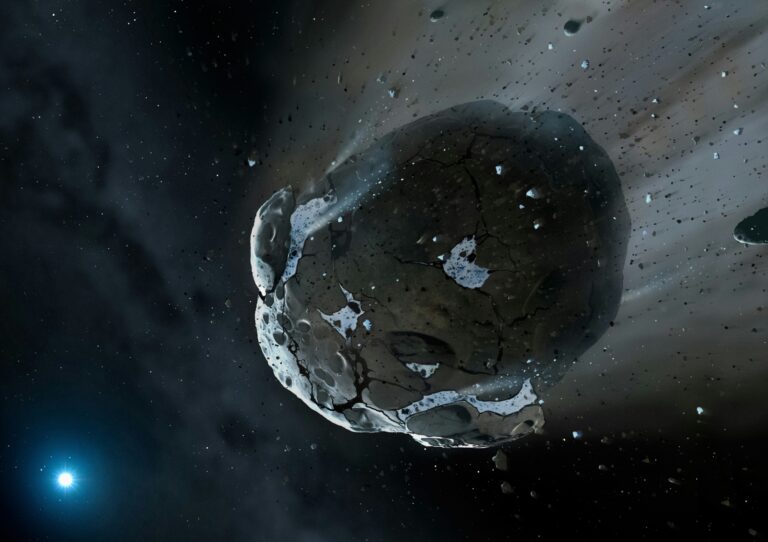
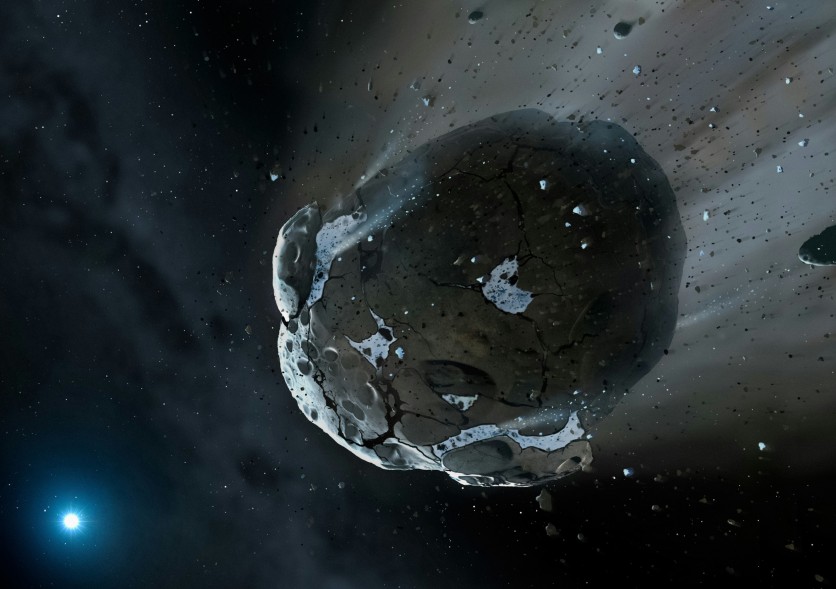
Artist's View Watery Asteroid White Dwarf Star
Artist’s View of Watery Asteroid in White Dwarf Star System GD 61 Caption This is an artist’s impression of a rocky and water-rich asteroid being torn apart by the strong gravity of the white dwarf star GD 61. Similar objects in our solar system likely delivered the bulk of water on Earth and represent the building blocks of the terrestrial planets. Credits Artwork: NASA, ESA, M.A. Garlick (space-art.co.uk), University of Warwick, and University of Cambridge; Science: NASA, ESA, J. Farihi (University of Cambridge), B. Gänsicke (University of Warwick), and D. Koester
NASA Hubble Space Telescope/Unsplash.com

The meteorites that look most pristine may be giving planetary scientists an overly generous count of the fluorine, chlorine, bromine and iodine that fed the rocky planets, according to a journal pre-proof listed as available online Nov. 14, 2026, in Icarus. Anthony Gargano and seven co-authors report that heating inside asteroids drove off and redistributed these halogens, so the bulk halogen budgets of the parent bodies could be much lower than their least-altered meteorites imply.

Earth’s volatile inventory is judged against meteorites, so an inflated meteorite baseline changes how much volatile loss scientists must explain. The authors propose that parent-body processing could help reconcile chondrite-based accretion models with Earth’s lower volatile inventory.

The paper, “Halogen and K-Cl isotope records in non-carbonaceous chondrites: evolution of the volatile element inventory of asteroidal accretionary feedstock,” lists Gargano, Zoltan Vaci, Justin I. Simon, Wayne Buckley, Zachary Sharp, Piers Koefoed, Aaron Bell and Kun Wang as authors. Gargano is a postdoctoral researcher at NASA’s Johnson Space Center, according to his posted CV. A pre-proof is an accepted manuscript that has not yet been assigned to a journal issue, so details can still change before final publication.

Halogen and Potassium Levels Fall as Meteorites Show More Heating

The team analyzed two non-carbonaceous meteorite families: ordinary chondrites (H, L and LL groups, petrologic types 3.1 to 6) and enstatite chondrites (EH and EL groups, types 3 to 6), plus several achondrites. Petrologic type is a shorthand for how much a meteorite’s parent asteroid altered it. Within the heating sequence, type 3 rocks are unequilibrated and the least metamorphosed, while types 4 to 6 record progressively higher temperatures.

For ordinary chondrites, types 4 to 6 correspond to peak temperatures of up to roughly 1,200 to 1,300 kelvin (about 1,700 to 1,880°F), well below the roughly 1,700 kelvin (about 2,600°F) at which silicate rock finishes melting.

According to the abstract, halogen and potassium concentrations fall as metamorphic grade rises, while the heavier isotopes of chlorine and potassium become more abundant. The reported values generally increase from −4.5 to +8.6 per mil for δ³⁷Cl and from −1.41 to −0.33 per mil for δ⁴¹K.

Lighter isotopes tend to escape first when material vaporizes, which leaves the remaining rock enriched in the heavy ones. Chlorine and potassium sit at opposite ends of the volatility scale: published estimates give them 50 percent nebular condensation temperatures of 427 kelvin (309°F) for chlorine and 1,006 kelvin (1,351°F) for potassium. The authors read the combined pattern as open-system loss or transfer of volatiles during sub-solidus metamorphism, meaning heating well below the melting point of the rock.

Ordinary Chondrites Leaked Halogen Vapors While Enstatite Chondrites Held Them

The two meteorite families behave differently. Ordinary chondrites show the strongest depletion and widest isotopic spread, which the authors tie to halogen-bearing vapors escaping through comparatively permeable material. Ordinary chondrites are also the most numerous meteorite group.

Enstatite chondrites, which are highly chemically reduced, show much more muted changes. The authors attribute that to better volatile retention in less permeable systems.

The authors also highlight fluorine, which they say favors enstatite chondrite-like bodies as Earth’s main halogen source. That fits an older observation: enstatite chondrites have oxygen isotope compositions that resemble Earth and Moon rocks.

How Does Asteroidal Distillation Move Halogens Toward Surfaces?

The central idea is what the authors call asteroidal distillation. Vapors released from the hot interior travel outward and condense in cooler, near-surface material, which can overprint the chemistry of the “unequilibrated” samples that have traditionally served as the best proxies for what an asteroid started with.

Heat for that kind of metamorphism is generally attributed to the decay of short-lived aluminum-26, which has a half-life of about 717,000 years. One review of planetesimal thermal evolution calls aluminum-26 the dominating heat source for metamorphism, while judging that the low abundance of iron-60 makes its contribution insignificant.

To test distillation, the team built an onion-shell mass-balance model, which treats the asteroid as concentric layers exchanging volatiles. It suggests bulk parent-body halogen budgets could be considerably lower than the most primitive chondrites would indicate. The model parameters, data tables and achondrite results sit in the full text and are not described in the abstract.

Earth’s Volatile Gap Depends on How Many Halogens Its Building Blocks Held

Earth is depleted in moderately volatile elements relative to CI chondrites, the meteorites that most closely match the Sun’s composition. A 2017 Nature paper led by Patricia Clay used neutron-irradiation noble-gas techniques and found chlorine, bromine and iodine in carbonaceous, enstatite, Rumuruti and primitive ordinary chondrites to be about 6, 9 and 15 to 37 times lower, respectively, than earlier accepted values. That revision held regardless of petrologic type, and it let Earth’s halogen depletion line up with that of other elements of similar volatility.

The new abstract pushes in a related direction through a different physical process: parent-body heating rather than measurement error. The abstract does not say how its grade-dependent trends relate to Clay’s finding that the downward revision applied across petrologic types.

Other work has also placed Earth’s volatile signature on smaller bodies. A 2017 Nature study by C. Ashley Norris and Bernard Wood argued that melting and vaporization on precursor bodies, and possibly the Moon-forming impact, set Earth’s moderately volatile element abundances. Gargano and Sharp’s 2019 work on iron meteorites found δ³⁷Cl values as low as −7.2 per mil, and the authors suggested extensive devolatilization during planet formation, which could explain Earth’s chlorine isotope value through the loss of roughly 60 percent of its initial chlorine.

Potassium Studies Disagree on Whether Heating Leaves Isotopic Signatures

A 2023 Goldschmidt conference abstract by Vaci, Gargano, Koefoed and Wang, four of the new paper’s authors, reported preliminary data suggesting a positive correlation between potassium and chlorine isotope compositions in ordinary and enstatite chondrites. That is consistent with coupled, volatility-controlled, mass-dependent fractionation rather than anomalies inherited from nucleosynthesis.

Not every study has read potassium the same way. Hannah Bloom and colleagues measured potassium isotopes in more than 40 carbonaceous and ordinary chondrites and found no clear correlation with petrologic type, adding that the simple 1-to-6 scheme does not capture potassium mobility well.

A 2023 study of rubidium and potassium by Nicole Nie and colleagues found correlated behavior at low metamorphic grades but great scatter at high grades. Their modeling concluded that volatilization limited by gas transport should have a negligible isotopic effect, with diffusion a possible alternative. How those results fit Gargano’s grade-dependent trends is a question the full paper, and follow-up work, will have to address.

Treat Unequilibrated Meteorites as Least Heated, Not Volatile-Complete

For readers following where Earth’s ingredients came from, the practical takeaway is narrow but sharp: a type 3 label tells you a meteorite was among the least heated, and this abstract argues it does not guarantee the meteorite holds its parent asteroid’s full halogen budget. If the authors’ onion-shell estimate holds up, the question for Earth shifts from how much halogen the planet lost to how much its feedstock ever carried. The evidence so far rests on one abstract, a pre-proof and a model not yet open to outside scrutiny, and the potassium literature remains split.


Frequently Asked Questions

Why is Earth low in volatile elements compared with meteorites?

Earth’s silicate portion is strongly depleted in moderately volatile elements relative to CI chondrites, the meteorites that most closely match the Sun’s composition. Researchers disagree on the cause: Norris and Wood favored melting and vaporization, while Braukmüller and colleagues argued that building blocks resembling carbonaceous chondrites explain the pattern.

What does a meteorite’s petrologic type mean?

It is a numeric scale for how much a chondrite’s parent asteroid altered it. Types 1 and 2 reflect water alteration, type 3 marks the least-metamorphosed, unequilibrated rocks, and types 4 to 6 record increasing thermal metamorphism.

Does asteroidal distillation change how scientists estimate Earth’s building blocks?

It could, if the authors’ mass balance survives scrutiny. Samples labeled unequilibrated are the usual stand-ins for what asteroids accreted, and the abstract warns they may not represent bulk halogen budgets. A lower feedstock baseline would reduce the volatile loss that Earth accretion models have to explain, which is the reconciliation the authors propose.

Has anyone independently confirmed that asteroid heating strips halogens?

Not in the material available so far. The abstract does not describe the model parameters, data tables or achondrite results, and the potassium studies from Bloom and colleagues in 2020 and Nie and colleagues in 2023 reached different conclusions about what metamorphism does.

Source link