August 25, 2026:


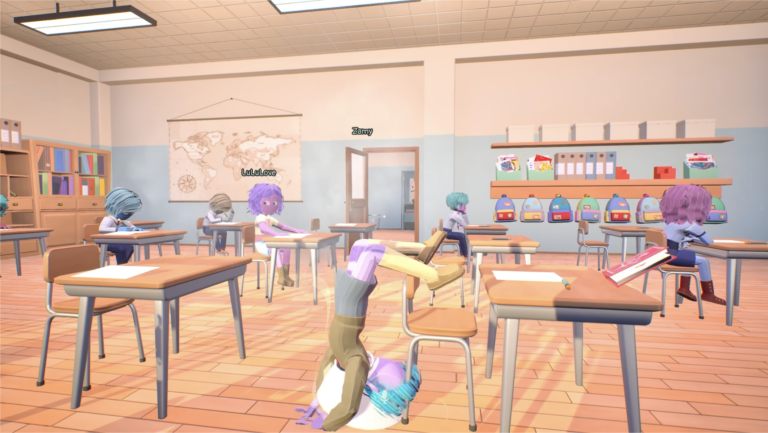
Indie developer Studio Cimosa revealed Finals Week on August 24, 2026 with an official announcement trailer, and the premise lands with the immediate clarity of a great party game concept: you and up to three friends neglected to study for the entire semester, finals are here, and the only path to graduation runs directly through organized cheating. No cramming. No extra credit. Just walkie-talkies, binoculars, passed notes, and a teacher with what the Steam page diplomatically describes as “suspiciously deadly accuracy” when it comes to throwing erasers.
The scenario works because it is nearly universal. According to the International Center for Academic Integrity, more than 60 percent of university students freely admit to cheating in some form — a figure that has held consistent across decades of surveys. Finals Week turns that shared cultural anxiety into a game mechanic, putting players on the side of the accused and making coordination, not virtue, the path to success.
Finals Week is a first-person co-op stealth game for one to four players, set inside a 1990s-era school — a period before ubiquitous smartphones when cheating required creativity and physical improvisation. The core design challenge is information asymmetry: different players in the classroom will have access to different parts of the answer landscape — a textbook here, a glimpse at a neighbor’s paper there, a set of binoculars aimed at the front board — and the group must route that information to whoever needs it, under time pressure, while a patrolling teacher actively hunts for rule-breakers.
The communication toolkit Studio Cimosa has built for this includes walkie-talkies, cellphones, binoculars, physical textbooks that can be passed around, and a freeform drawing system that lets players write answers on sheets of paper, on classroom walls, or directly on their friends’ faces. The last option sounds like a gimmick, but it is the kind of unhinged sandbox detail that generates the best screenshots and the most memorable streaming moments — the gaming equivalent of writing on someone’s forehead while they sleep.
Getting caught carries consequences. The game promises “various restraints” for misbehaving students, including, in what may be its most inspired design touch, a Cone of Shame — the dog accessory, repurposed as a classroom punishment. It is absurd enough to be memorable and specific enough to signal that the developers have thought carefully about what the fantasy of consequence looks like when you bring it into a comedic game space.
The structural heart of Finals Week is its shared-fate co-op design. As Studio Cimosa states plainly on the game’s Steam page: “pass together or fail together.” This means no player can carry the group to victory while others free-ride, and no single caught student tanks the entire run in isolation — everyone is bound to the same outcome.
This approach aligns Finals Week with the strongest recent entries in co-op comedy games. Titles like Overcooked!, It Takes Two, and Lethal Company all use variants of shared-fate mechanics to create what game designers call “comedy of errors” dynamics: funny, frustrating, and memorable precisely because the group’s coordination — or spectacular failure to coordinate — is the entertainment. Where Lethal Company and its successors (including the recently viral R.E.P.O.) combine shared-fate structure with horror atmosphere, Finals Week swaps the horror for nostalgia and academic absurdity, which is a meaningfully different emotional register.
The game also structures time: exams are the high-tension phases, and between them, players decompress in the school hallway, which functions as a social hub where they can shoot hoops, throw baseballs, decorate statues, and plan the next round of cheating. This is a design choice with a real payoff — giving a co-op party game breathing room between pressure phases is often what separates a title players return to from one they exhaust in a single session.
A detail the announcement trailer does not mention: Finals Week is entering this particular concept space alongside a direct competitor. CheatCheat, developed by CheatDev, is another co-op exam-cheating game currently in development for PC, with a Steam page that launched several months earlier and has already accumulated over 100,000 wishlists.
The two games share the same foundational premise — cooperatively cheat through exams while evading faculty — but diverge sharply in execution. CheatCheat supports up to six players (vs. Finals Week‘s four), leans into supernatural and horror elements (a demonic faculty, “emo magic” that lets players possess classmates, procedural generation across levels), and appears more roguelike in structure — players progress grade by grade toward graduation across a labyrinthine school run by actual demons. Finals Week, by contrast, is grounded: 1990s setting, no supernatural elements, a single vigilant-but-human teacher, and a tone that sits closer to slapstick than horror.
Whether the market supports two co-op exam-cheating games launching within the same window is an open question. What is certain is that the micro-genre now has real momentum: CheatCheat‘s wishlist numbers suggest genuine audience interest in the concept, and Finals Week‘s announcement adds a second credible entrant from a different aesthetic direction.
Finals Week targets a broad range of PC hardware. The minimum specifications — a Core i7-3820 or equivalent processor, 8GB of RAM, and an Nvidia GTX 970-class GPU — are modest enough that most gaming PCs purchased in the past several years will handle them without difficulty. The recommended configuration requires an AMD Ryzen 9 3900XT and an Nvidia RTX 3060, which the game’s physics-driven, cartoony world apparently requires for optimal performance — the visuals look simple, but simulation fidelity has a way of hiding behind cheerful art styles.
Both configurations require a broadband internet connection for online co-op. Studio Cimosa strongly recommends a microphone, which given the game’s communication-dependent design — shouting coordinates across walkie-talkies while a teacher bears down — is not really a suggestion but a practical necessity. Family Sharing and Steam Achievements are both supported.
The game currently supports English only, with interface localization listed as the only language feature. No release date or pricing has been announced. Players can add Finals Week to their Steam wishlist now to receive a notification at launch.
No. Despite the similar name, the two are entirely unrelated. The Finals is an established free-to-play first-person shooter from Embark Studios set in a futuristic game-show arena. Finals Week, from Studio Cimosa, is an upcoming co-op stealth comedy about cheating on school exams. The naming overlap is an unfortunate coincidence.
Both games share the same core premise — cooperatively cheat through exams while evading faculty — but they are meaningfully different in execution. CheatCheat supports up to six players, features supernatural elements like a demonic faculty and magical abilities, and uses procedural generation for replayability. Finals Week supports up to four players, is set in a grounded 1990s school with a single human teacher, and focuses on stealth timing and physical communication tools (walkie-talkies, notes, binoculars) rather than supernatural powers. You can find more details on the CheatCheat Steam page.
The game supports both single-player and online co-op, so solo play is an option. That said, the design is clearly built around four-player coordination — the communication tools, the shared-fate mechanic, and the developer’s strong recommendation to use a microphone all point toward group play as the intended and probably optimal experience.
The shared-fate mechanic creates mutual dependency, which in turn produces the two things that make co-op games memorable: genuine teamwork moments when coordination works perfectly, and spectacular comedy when it does not. Games like Overcooked!, It Takes Two, and Lethal Company all use variants of this structure because it ensures every player’s contribution matters and every failure is a shared story worth retelling. Finals Week is applying the same structural logic to a school-cheating scenario, which layers in an additional layer of relatable tension most adults recognize from lived experience.