HomeAuto Stuart Fails to Save the Universe Finale Names HBO Max Its Own Simulator via Real Physics
Stuart Fails to Save the Universe Finale Names HBO Max Its Own Simulator via Real Physics
September 26, 2026:
Wbd.com
The Season 1 finale of Stuart Fails to Save the Universe — which aired September 24, 2026, on HBO Max’s official platform — pulled off something genuinely strange: it landed its hapless comic shop owner inside a working multicamera sitcom taping, complete with archived laugh-track recordings from The Big Bang Theory itself bleeding in through the walls, and it did so using Nick Bostrom’s simulation trilemma, Roger Penrose’s pre-Big Bang cosmology, and Douglas Hofstadter’s strange loops as the actual operating framework. HBO Max confirmed Season 2 before the finale even aired, making the show’s meditation on what it means to exist inside a franchise IP both timely and a little uncomfortably self-aware.
If you watched the finale and felt like it was doing something more than joking about TV tropes, you were right. The physics is real. The philosophy is real. And the show’s creators appear to have designed the entire season as a formal argument that the franchise multiverse is, in every meaningful sense, a simulation — with Warner Bros. Discovery as the named simulator.
The Season 2 renewal was announced in August 2026, just four episodes into the first season’s run, making Stuart Fails to Save the Universe HBO Max’s second-biggest comedy launch ever globally according to the platform.
What Happened in ‘Spoiler: Filmed Before a Live Studio Audience’
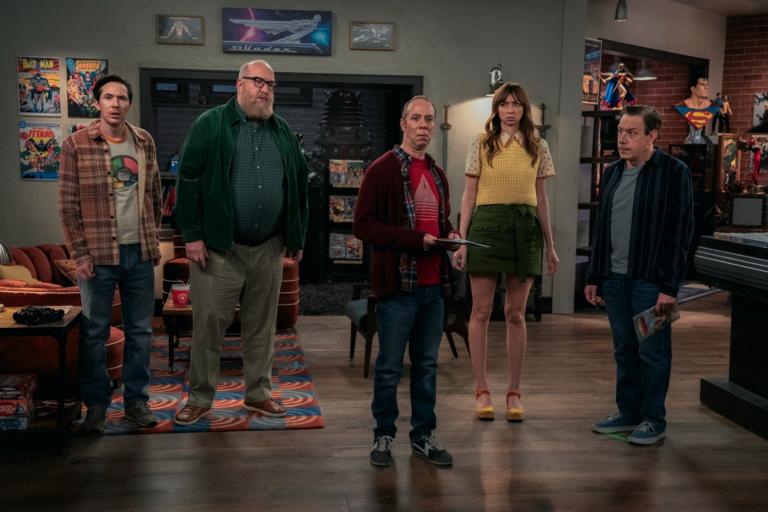
After nine episodes of multiverse-hopping — through warlord dystopias, AI-governed utopias, a universe governed by magic, and one unsettling reality in which the group discovers a comic book documenting their own journey in real time — Stuart Bloom (Kevin Sussman), Denise (Lauren Lapkus), Bert (Brian Posehn), and Barry Kripke (John Ross Bowie) arrive in what feels like a featureless void. A character named Kyle identifies the entity opposing their mission as the Adversary: an ancient, malevolent consciousness that existed in silence before the Big Bang and has resented every multiverse disruption Stuart’s accidents have caused since.
Then the laugh track starts. And what emerges around them is not another alternate universe — it is a working taping of Stuart Fails to Save the Universe, with actors who look exactly like them performing their own lives for a studio audience. The characters walk off the Warner Bros. soundstage into the Burbank night, deviceless and uncertain whether anything they experienced was real.
Lauren Lapkus, who plays Denise, has suggested in post-finale interviews that the sitcom universe they found themselves in might simply be another alternate reality — one where Stuart and friends happen to be TV characters — rather than a definitive reveal that their entire existence was fiction. Kevin Sussman noted the Inception-like possibility that the actors playing the fictional characters might themselves be fictional in someone else’s simulation. Both readings are philosophically defensible, and the show appears to have constructed the finale specifically to preserve both.
That is not narrative ambiguity as a dodge. It is the show correctly encoding the simulation hypothesis.
What Nick Bostrom’s Trilemma Says the Finale Actually Means
In 2003, Oxford philosopher Nick Bostrom published the paper that gave the simulation hypothesis its modern formal structure. His trilemma in the Philosophical Quarterly holds that at least one of three propositions must be true: either virtually no civilizations reach a stage of technological maturity capable of running simulations of conscious beings; or civilizations that reach that stage virtually never choose to run them; or we are almost certainly living in a simulation right now.
The argument does not claim we ARE in a simulation. It claims that statistical indifference — absent other evidence — should make us assign high probability to the simulation hypothesis, since if simulations are run, simulated minds will vastly outnumber biological ones.
What Stuart Fails to Save the Universe does in its finale is name the simulator. In Bostrom’s framework, the simulators are abstract posthuman entities of unknown purpose. In the show, they are identifiable: Chuck Lorre Productions, Warner Bros. Television, HBO Max, and Warner Bros. Discovery. The laugh track drawn from archived Big Bang Theory audience recordings is not just an artistic callback. It is the information channel between the simulator level and the simulated level — the exogenous signal leaking into the in-universe reality that the characters can eventually hear.
When the laugh track begins creeping in before the characters realize what universe they are in, the show is dramatizing the information-theoretic idea that structure external to a system leaks in through the system’s behavior. If a reality has a “script,” its signatures may appear as narrative coherence, as improbable coincidences, or — in the finale’s most precise formal move — as sound arriving from outside the diegesis.
Lapkus’s reading (the sitcom universe is just another branch) maps onto the many-worlds interpretation’s solution to the same problem. Under Hugh Everett III’s framework — formalized in his 1957 Princeton dissertation — the universal wave function never collapses; every quantum measurement branches into all possible outcomes simultaneously. From the inside, every branch feels undetermined even if the global wavefunction is fully deterministic. The characters’ uncertainty about whether they are fictional is the experiential content of inhabiting a branch where the simulation hypothesis is true — and not being able to rule out any of Bostrom’s three options.
What Was the Adversary, Actually?
The Adversary — Kyle’s explanation gives it a physical analogue worth taking seriously. An entity described as existing in silence before the Big Bang, hostile to the expansion of structure and entropy, maps cleanly onto the quantum vacuum’s relationship to inflationary cosmology.
In quantum field theory, the vacuum is not empty. It has non-zero energy density (the cosmological constant) and seethes with virtual particle fluctuations. The Big Bang may be understood as a phase transition from a “false vacuum” — a metastable high-energy state — to our universe’s true vacuum, releasing the energy that drove inflation. The false vacuum was, in that framework, a state of relative silence and stability before the explosive disruption that produced structure, time, and entropy-generating matter.
The Adversary’s resentment of Stuart’s disruptions is the personification of that false vacuum’s “preference” for equilibrium — a cosmologically accurate bit of worldbuilding, even if the show wraps it in mythology.
Roger Penrose’s Conformal Cyclic Cosmology offers a more specific model for how something could exist “before” the Big Bang. Penrose, who shared the 2020 Nobel Prize in Physics, proposes in his Conformal Cyclic Cosmology framework that the universe cycles through infinite “aeons,” with the far future of each aeon — when only massless particles remain, making time effectively meaningless — conformally matched to the Big Bang of the next. In this model, structural information can thread across the boundary between aeons. The Adversary, in CCC terms, is the structural imprint of a prior aeon’s equilibrium: something that remembers the silence before this universe’s birth and wants it back.
Neither CCC nor the false-vacuum interpretation is mainstream consensus cosmology. Both are proposals from serious physicists. The show uses them not as decoration but as the actual metaphysics of its villain — which is precisely the kind of STEM literacy you do not usually find in a franchise comedy spinoff.
How Stuart Prime’s Messages Work: Quantum Entanglement at Branch Scale
A running mystery across Season 1 was the communications Stuart received from “Stuart Prime” — another version of himself who appeared to know where they were going and could leave guidance across universes. The finale confirms Stuart Prime and the Adversary are distinct entities, not two names for the same force.
In standard quantum mechanics, entanglement allows correlated outcomes between particles without enabling causal signaling — you cannot transmit information faster than light using entanglement alone. But the show is working within the many-worlds framework, where all branches share a common causal history up to the branching event: the moment Stuart damaged the device. Stuart Prime and Stuart share an entangled causal origin. In Everettian terms, they are both running along branches that diverged from the same initial state, which gives the show a principled (if speculative) basis for why Prime can plant messages Stuart will find — they share enough causal structure that Prime can predict Stuart’s trajectory even without violating no-signaling constraints.
The device itself, in this reading, is a decoherence-reversal engine: rather than allowing quantum states to collapse irreversibly into classical outcomes, it keeps the group’s wavefunction in a state of controlled superposition across branch transitions, permitting traversal. This is not physically plausible with current technology — decoherence is effectively irreversible at macroscopic scales — but it is internally consistent with the show’s established physics, and it gives the repairs Stuart needs to make in each episode actual narrative stakes.
How the Finale’s Multicam Universe Encodes Information Theory
Bill Prady and Chuck Lorre designed the finale’s sitcom-within-the-show with unusual formal precision, per executive producer interviews. Camera moves on dollies rather than Steadicams. Proscenium framing. Jokes “calibrated to be slightly worse” to signal a different quality register. The laugh track drawn from actual Big Bang Theory audience recordings.
This is not merely parody of the multicam form. It is an application of Kolmogorov complexity in information theory — the measure of the shortest description that fully specifies a given system — to storytelling architecture. A single-camera drama has high descriptive complexity: many camera positions, degrees of freedom in mise en scène, variable rhythmic structure, no fixed joke architecture. A four-camera multicam sitcom has radically reduced complexity: three walls, constrained camera angles, predictable joke rhythm, emotional beats at defined temporal intervals.
The characters’ disorientation upon entering the sitcom universe is the subjective experience of being compressed into a lower-dimensional space — of inhabiting a universe with fewer informational degrees of freedom than the one they came from.
Marshall McLuhan’s formulation — that the medium is the message — finds its most literal science-fiction expression here. The format of multicamera television has become a physical law governing in-universe behavior. The show’s transition from single-camera to multicam is not a shift in production style. It is a shift in the physics of the universe the characters inhabit. Stuart and his friends can eventually hear the laugh track because the medium they are now inside produces that signal as a structural necessity, not as an editorial choice by some external creator.
The Strange Loop That Makes It All Work
In Gödel, Escher, Bach (1979) and I Am a Strange Loop (2007), Douglas Hofstadter proposed that consciousness is a cyclic structure that passes through multiple levels of a hierarchy and returns to where it started, involving self-reference and paradox. A brain’s symbolic self-model, in Hofstadter’s framework, both refers to itself and is constituted by that self-reference. The “I” is not a static entity but a dynamic loop that achieves a new degree of self-awareness precisely because it can see itself seeing.
Stuart Fails to Save the Universe‘s finale places its characters inside a strange loop of exactly this kind. The characters exist in a universe that contains a TV show about them, performed by actors who are those characters, watched by an audience whose laughter is now part of the characters’ world. It is a Gödelian recursive structure: a system that can refer to itself in a way that creates paradox, or — more charitably — achieves a new level of self-awareness.
Sussman’s post-finale observation that the actors playing the fictional characters might themselves be fictional initiates the infinite regress that is structurally identical to the cosmological question the season began with: if there is a universe before the Big Bang, is there a universe before that? The show has translated cosmological recursion into narrative recursion, which is what good science fiction does — it finds the formal isomorphism between a physics problem and a human-experience problem and lets the two illuminate each other.
What Franchise IP Has to Do With All of This
The show’s poster on the fake Warner Bros. lot in the finale’s closing sequence — the jokey “Young Leonard” and “Two and a Half Women” placards — does something the show’s creators were clearly thinking about carefully. It is laughing at the industrial logic that produced Stuart Fails to Save the Universe itself: a show exists because IP can be licensed, not necessarily because a story needed to be told.
This is the unstated implication the simulation hypothesis makes explicit. In Bostrom’s trilemma, once you accept that simulations are being run, you must ask: why? What is the motivation of the simulators? In the franchise multiverse, the motivation is identifiable: renewal economics, global streaming subscriber acquisition, brand loyalty monetized across decades. The Adversary resents Stuart’s disruptions because each new alternate universe is a new production order, a new budget allocation, a new season. The desire to restore the original universe is, structurally, the desire to stop making new content.
The show does not make this argument explicitly — it would be too self-defeating to do so — but the finale’s formal choices encode it completely. Lorre’s memoir Sitcom: A Memoir, which chronicles his decades inside the multicam production machine, is reviewed by Kirkus and due October 2026, three weeks after the finale. The timing is biographical rather than conspiratorial, but the convergence is there: a showrunner whose entire career has been spent inside the franchise simulation publishing a memoir about what that feels like, the same month his latest franchise creation ends its first season by asking whether being inside a franchise simulation is a fate you can escape.
Season 2, whenever it arrives, inherits the question the finale refuses to answer: is the sitcom universe just another branch, or is every branch a variation on the same script? The physics, rigorously followed, suggests you cannot tell from inside.
Frequently Asked Questions
What exactly did the Season 1 finale of Stuart Fails to Save the Universe reveal?
The finale placed Stuart, Denise, Bert, and Kripke inside a working taping of the TV show bearing their own name — performed by actors who looked identical to them for a live studio audience. A villain named the Adversary was revealed as an ancient consciousness predating the Big Bang, hostile to all the multiverse disruptions the group caused. The season ended without resolving whether the characters are genuinely fictional, and HBO Max confirmed Season 2 in August 2026, before the finale had even aired.
What is Nick Bostrom’s simulation trilemma, and why does it apply to this show?
Nick Bostrom’s 2003 paper in the Philosophical Quarterly argues that at least one of three propositions is almost certainly true: civilizations almost always go extinct before they can run simulations of conscious beings; those that can run them almost never choose to; or we are almost certainly living in a simulation. The finale’s core move is to name the simulators — Chuck Lorre Productions, HBO Max, and Warner Bros. Discovery — making explicit what Bostrom left abstract. The laugh track drawn from archived Big Bang Theory recordings functions as the exogenous information signal that leaks from the simulator level into the simulation, audible to the simulated beings before they consciously recognize what it means.
Does the finale’s multicam-sitcom universe have anything to do with real physics?
It does. Kolmogorov complexity and information theory describe the multicam format as a lower-dimensional informational space than single-camera drama — fewer degrees of freedom, more constrained architecture. The characters’ disorientation is consistent with the experience of moving from a high-complexity to a low-complexity environment. Marshall McLuhan’s “the medium is the message” principle is literalized: the show’s format change is a physics change. More speculatively, Roger Penrose’s Conformal Cyclic Cosmology provides a framework for how the Adversary — an entity predating the Big Bang — is physically conceivable: as a structural imprint from a prior aeon, carried across the conformal boundary between cycles.
Is the show actually worth watching, and where can I find it?
Season 1 of Stuart Fails to Save the Universe earned a “Certified Fresh” designation on Rotten Tomatoes and became HBO Max’s second-biggest comedy launch ever globally as of the renewal announcement. Critical reception was divided — some found the humor uneven, others called it one of the year’s best new comedies — but the consensus is that the show is more scientifically ambitious than its franchise-spinoff origins suggest. All 10 episodes of Season 1 are currently available on HBO Max. Season 2 has no announced premiere date.