HomeAuto Starship Flight 14 Confirmed for Sept. 22: Orbital Debut Carries Revenue Payload
Starship Flight 14 Confirmed for Sept. 22: Orbital Debut Carries Revenue Payload
September 17, 2026:
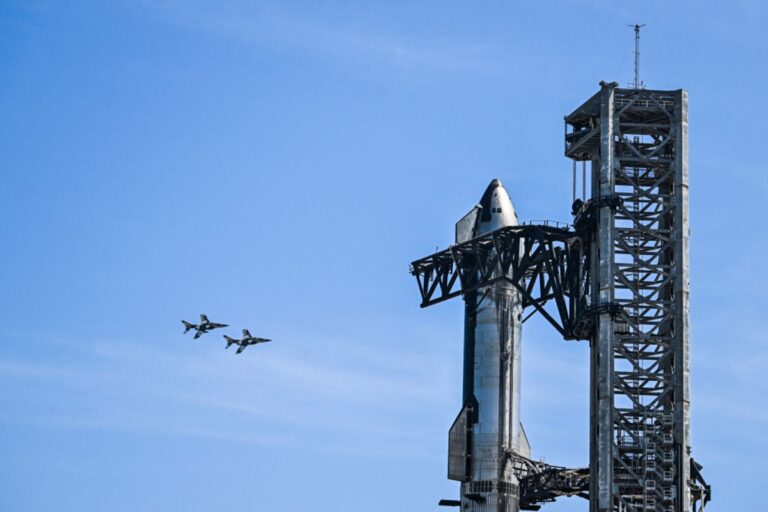
CHANDAN KHANNA/AFP via Getty Images
SpaceX will attempt the first orbital flight of Starship on September 22, with the company officially setting a 75-minute launch window that opens at 8:15 a.m. ET (7:15 a.m. CT) and closes at 10:14 a.m. ET from Starbase, Texas — and, for the first time in the program’s three-year test campaign, the mission is expected to generate revenue. SpaceX CFO Bret Johnsen told investors at Goldman Sachs’ Communacopia and Technology Conference on September 10 that Flight 14 will be “a revenue-generating flight,” specifically because it will carry 26 production Starlink V3 satellites to an operational orbit where they will join the active constellation.
September 23 is set as the backup date, with the same 75-minute window. An FAA launch license from the Office of Commercial Space Transportation remains the mission’s gating item; SpaceX announced the date and full mission profile in an update posted September 15, but did not announce regulatory clearance at that time. Details of SpaceX’s official September 22 announcement confirm 26 Starlink V3 satellites aboard Ship 41, a 275 km target orbit, six revolutions over a nearly 10-hour mission, and a Pacific Ocean splashdown west of Chile.
What Is New in This Mission Compared to What TechTimes Previously Reported
When TechTimes last covered Flight 14 on September 11, the target date was “no earlier than September 15,” with a September 18 backup, and the satellite count was described as “roughly 20.” Three facts have changed. SpaceX’s official September 15 update confirmed 26 satellites aboard Ship 41 — not 20 — with three of those 26 modified with cameras pointed at the ship’s heat shield to image it during and after satellite deployment. The September 22 launch date is the third target this mission has had, having slipped past September 15 and September 18. And the CFO has now put a financial label on the flight that no previous update contained.
The Flight 13 Booster Failure — and the Engineering Fix on Booster 21
The most substantive new engineering content in SpaceX’s September 15 update concerns what went wrong with Booster 20 on Flight 13 and what SpaceX has changed for the upcoming mission.
On July 24, Flight 13’s boostback burn success marked the first time the Block 3 Super Heavy used all 33 of its Raptor 3 engines cleanly on the boostback — a genuine first for the vehicle. The problem came during the terminal phase of the landing burn. SpaceX wrote in its September 15 update that “the three center engines showed signs of ice clogging which triggered an early end to the maneuver.” With the center engine cluster cutting out early, the booster attempted its landing burn on only 8 of the planned 13 engines before hitting the Gulf of Mexico at high speed and breaking apart.
The mechanism behind this failure is worth explaining specifically, because it is different from the prior anomaly on Flight 12. During the Super Heavy landing burn, the inner 13 engines — the only ones equipped with gimbal actuators and capable of reigniting — draw their propellant from a dedicated liquid oxygen (LOX) header tank, a separate smaller reservoir inside the booster that provides pressurized propellant flow during terminal deceleration. At the extreme cold of cryogenic operations — liquid oxygen operates at roughly -183°C (-297°F) — moisture that has infiltrated propellant lines and filters can freeze into ice crystals that partially or fully block propellant flow to individual engines. The three center engines of Booster 20 experienced enough flow restriction to trigger an automated protective shutdown rather than risk an engine-rich fire or uncontrolled deceleration asymmetry.
This is not an entirely novel failure mode: propellant filters added from Booster 10 addressed related contamination concerns identified in earlier test campaigns. For Booster 21, SpaceX has made hardware modifications to improve filtration, specifically targeting the propellant feed path from the LOX header tank to the center 13 engines, alongside software updates to improve relight reliability.
A successful landing burn on Flight 14’s Booster 21 would serve a specific engineering purpose beyond the single mission: it would validate that the filtering fix is sufficient. Booster 19’s startup sequencing failure on Flight 12 also failed its boostback and landing burn from a different cause — an off-nominal attitude triggered by engine startup asymmetry. Booster 20 (Flight 13) failed its landing burn due to ice clogging. Booster 21 is thus the third consecutive Block 3 Super Heavy to reach a landing burn attempt, and the first with this specific modification in place.
The Mission Profile: What Starship Will Attempt on September 22
This will be the first Starship flight to aim for a closed orbital trajectory rather than a suborbital arc. Every prior flight — including Flight 13’s July 24 Indian Ocean splashdown — followed a ballistic path that ascended and descended without completing a revolution around Earth. Flight 14 will require Ship 41 to perform at least two engine burns in space, a sequence no Starship has completed in the orbital profile.
After stage separation from Booster 21, Ship 41 will fire its Raptor Vacuum engines to achieve orbital velocity — approximately 7.8 km/s (about 17,500 mph) — and enter an orbit approximately 275 km (171 miles) above Earth. The vehicle will then coast through roughly six revolutions of the planet over a nearly 10-hour mission. During this coast phase, the 26 Starlink V3 satellites will be sequentially deployed through Ship 41’s internal “PEZ dispenser” mechanism, a track-based deployment system that pushes satellites out through the nosecone’s payload bay door. Three of the 26 satellites have been modified with cameras aimed back at the ship’s heat shield tiles.
SpaceX’s sufficient redundancy on critical hardware gate is explicit in the official mission description: “Starship will only execute a burn to enter orbit after the flight control team has ensured there is sufficient redundancy on hardware critical to doing so.” This phrasing — absent from any prior coverage of Flight 14 — means the flight control team will evaluate Ship 41’s health after launch and stage separation before committing to the orbital insertion burn. If the ship is assessed as not sufficiently healthy, the orbital attempt would be aborted and the vehicle would follow a suborbital trajectory instead.
If orbit is achieved and the satellite deployment completes, Ship 41 will fire a single Raptor engine for a deorbit burn, then execute a controlled reentry and Pacific Ocean splashdown west of Chile. Both the booster splashdown and the ship splashdown are ocean recoveries — no Mechazilla tower catch is planned for either vehicle on this flight. Musk deferred ship catch plans in August, saying a tower catch of the Ship upper stage would likely come “in a few months,” after the Starbase facility’s landing-zone safety profile review is completed with the FAA.
Why 26 V3 Satellites, Not 20
The count of 26 operational Starlink V3 satellites aboard Flight 14 is meaningfully different from the “roughly 20” figures that appeared in prior reporting, including TechTimes’ September 11 article. The difference matters for understanding the mission’s business impact.
Starlink V3 satellites cannot be launched in useful quantities on any rocket in SpaceX’s current fleet other than Starship. Each V3 satellite weighs 2,000 kg (4,409 lbs) and carries a form factor too large for the Falcon 9’s 5.2-meter (17-foot) diameter payload fairing. Starship’s 9-meter (29.5-foot) diameter payload bay can accommodate up to 60 V3 satellites per mission. Each V3 satellite carries 1 Tbps per-satellite downlink capacity, more than 10 times higher than the roughly 96 gigabits per second on the current V2 Mini satellites that make up most of the existing constellation. Each also carries inter-satellite laser links for routing traffic between satellites without requiring a ground station handoff.
The network arithmetic of 26 satellites at 1 Tbps each is roughly 26 terabits per second of new downlink capacity added to the constellation in a single mission. V3 launch capacity versus Falcon 9 is more than 10 times greater per mission — even at 26 rather than the maximum 60, Flight 14 represents a step-change from anything achievable with Falcon 9. The Starlink constellation currently operates 11,112 working satellites, all V1 or V2 variants.
CFO Confirmation: The Financial Threshold
For most of its three-year test program, Starship has been a cost center — SpaceX Space segment Q2 financials show a $542 million operating loss on $962 million of revenue, with R&D spending rising 55% year-over-year as the company poured capital into Block 3 hardware and testing. Johnsen confirmed at the Goldman Sachs conference that a recently signed compute-hosting deal gives the company confidence in reaching a $100 billion annualized revenue target by year-end 2026.
The shift that Flight 14 represents is structural rather than immediate: 26 V3 satellites reaching operational orbit do not transform SpaceX’s quarterly financials overnight. But Starship crosses a threshold that has broader implications. Once an orbital V3 deployment succeeds, every subsequent Starship flight that carries V3 satellites generates revenue directly. The SpaceX June 2026 Nasdaq IPO, filed under the ticker SPCX on June 12, 2026, stated plainly that SpaceX’s growth strategy depends on increasing launch cadence and payload capacity — which is dependent on Starship operating at scale.
Polymarket traders assigned an 82% probability to Flight 14 launching before September 30 as of last week.
The Artemis Connection: What Orbit Enables Next
Flight 14 does not demonstrate orbital propellant transfer, the crewed landing system, or any Artemis-specific capability. But it is the unconditional prerequisite for all of them.
NASA’s Artemis IV mission — currently targeting 2028 and designed to put the first astronauts on the lunar surface since Apollo 17 — requires a variant of Starship to first reach orbit, then receive propellant from multiple tanker Starship flights, then depart for the Moon, then dock with Orion in lunar orbit, and then descend to the surface. Per the NASA estimate 10 to 16 tankers are required in succession, because liquid oxygen and liquid methane boil off over time and the transfer must be completed before fuel loss becomes prohibitive. Every step in that sequence waits on the first step: reliable orbital Starship operations.
A Government Accountability Office report from July 23, 2026 found that SpaceX is more than a year behind its original schedule for key Artemis Human Landing System milestones, with Raptor engine development cited as a primary risk. Flight 14’s outcome — whether it achieves orbit, executes a clean deorbit burn, and gives NASA confirmed data on Starship’s orbital capability — will directly shape how much slack remains in the already tight Artemis timeline.
What the FAA Review Governs
The September 22 launch date remains conditional on FAA approval that had not been issued as of September 15. This is standard for each new Starship mission configuration, though the orbital reentry profile requires a categorically more complex safety analysis than the suborbital missions that preceded it.
For a suborbital vehicle, the FAA analyzes what happens if propulsion fails at various points during a trajectory that stays over water. For an orbital reentry, the FAA must evaluate what happens if Ship 41 achieves orbital velocity but its deorbit burn fails to fire: the vehicle would remain in orbit indefinitely and could eventually reenter over populated land. The safety case for the orbital profile requires SpaceX to demonstrate that this risk is bounded to an acceptable level under FAA Part 450 orbital launch rules, the risk-based commercial space launch regulations that govern Starship’s licensing. That analysis takes longer than a suborbital review — which is why the September 22 date is labeled “NET” (No Earlier Than) rather than confirmed.
The FAA concluded its review of the Flight 12 mishap investigation on July 13, 2026, clearing the path for subsequent flights.
Frequently Asked Questions
What time does Starship Flight 14 launch, and where can I watch?
The launch window opens at 8:15 a.m. ET (7:15 a.m. CT, 12:15 UTC) on September 22 and closes at 10:14 a.m. ET (9:14 a.m. CT, 14:14 UTC). A backup window runs on the same schedule September 23. SpaceX will broadcast live at SpaceX.com and on X, typically beginning about 30 minutes before the window opens. The FAA license must be issued before the launch can proceed; check SpaceX’s official channels for real-time status.
What specifically went wrong with the booster on Flight 13, and has it been fixed?
During the terminal phase of Flight 13’s landing burn on July 24, three of the center cluster engines on Super Heavy Booster 20 detected ice clogging in their propellant lines and shut down automatically, leaving the booster with only 8 of 13 planned engines firing during final deceleration. The booster made a hard Gulf of Mexico splashdown and was destroyed. For Flight 14, SpaceX has added hardware filtration fix for Booster 21, specifically targeting the propellant feed path from the liquid oxygen header tank to the center 13 engines that perform the landing burn, along with software updates to improve relight reliability. Whether the fix is sufficient will be answered when Booster 21 attempts its own Gulf splashdown on September 22.
Why does Flight 14 put 26 satellites in orbit rather than the full 60 Starship can carry?
Starship’s payload bay can accommodate up to 60 Starlink V3 satellites at maximum load, but Flight 14 is still an engineering test flight, not a routine operational mission. SpaceX is deploying 26 V3 satellites — enough to validate the deployment mechanism, confirm the satellites reach operational orbit, and generate revenue, while keeping mass below the full maximum so the mission can prioritize demonstrating the orbital profile cleanly. Three of the 26 are modified with cameras for heat shield imaging rather than standard broadband operation.
Why does this flight matter to Starlink subscribers who already have service?
V3 satellites deliver more than 10 times the per-satellite downlink capacity of the V2 Mini satellites that make up most of today’s constellation, and they carry higher-capacity laser crosslinks between satellites. The V3 generation is designed to relieve congestion in densely served markets and expand capacity to underserved regions without adding proportional launch costs. Starship is the only vehicle that can deploy V3 satellites at the mass and scale required — each V3 unit weighs approximately 2,000 kg (4,409 lbs), making it incompatible with Falcon 9’s payload fairing in useful quantities. Subscribers in congested markets are likely to see improvements in throughput and reliability as V3 satellites scale up, though the first 26 satellites on Flight 14 represent a small fraction of the operational constellation eventually planned.