HomeAuto Star Wars Graphic Novel Turns Jabba’s Bounty Race Into Game-Theory Lesson
Star Wars Graphic Novel Turns Jabba’s Bounty Race Into Game-Theory Lesson
September 16, 2026:
Papercutz.com
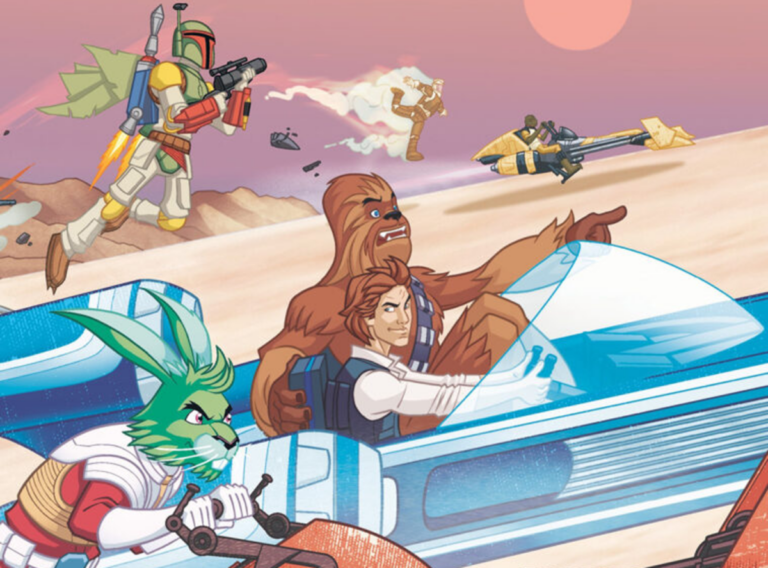
The crime lord at the center of Star Wars: Smugglers and Scoundrels Vol. 1 — Race for Jabba’s Bounty, which arrived in comic shops and online retailers on September 15, 2026, dispatches not one but a field of competing agents to recover a stolen family heirloom. Han Solo and Chewbacca. The Millennium Falcon. Boba Fett. Aurra Sing. Greedo. And, stealing scenes with a wisecrack and a ship called the Rabbit’s Foot, Jaxxon T. Tumperakki, the six-foot green Lepi smuggler who first appeared in Star Wars #8 in 1977 and spent the next four decades as the franchise’s most ridiculous loose end.
That choice — many agents, one prize, all paying costs regardless of outcome — is not just a narrative device. It is the textbook structure of an all-pay contest auction — every participant commits real resources, and only one collects the prize. Written by longtime Star Wars comics writer Cavan Scott with art by Christian Colbert, the 112-page original graphic novel from Papercutz — the children’s imprint of Portland-based Mad Cave Studios, making its Star Wars debut — is, beneath its bouncing green protagonist, a surprisingly rigorous lesson in competition economics.
Why Jabba Uses Freelancers Instead of Soldiers
Before getting to the economics of the race itself, it is worth asking why Jabba runs one at all. He is, by any measure, a wealthy and powerful figure capable of fielding an internal enforcement apparatus. Yet his instinct when the heirloom goes missing is to commission independent contractors — notably unreliable ones — rather than deploy his own organization.
The answer is principal-agent theory, applied to criminal enterprise. Jabba does not know where the heirloom is. His internal enforcers, compensated on fixed terms, have fixed incentive to exert search effort. External contractors paid on contingent terms — bounties, deliverable only on success — have maximal incentive, because their payout scales directly with outcome. Diego Gambetta’s foundational 1993 study of organized crime as a private governance institution argues exactly this: criminal organizations like the Sicilian Mafia succeed not through brute violence but through a sophisticated understanding of how to structure incentive problems that formal institutions cannot resolve. Jabba is not running a crime syndicate. He is running a market.
The parallel to real organizational economics is direct. Pharmaceutical companies use competitive prize grants to incentivize drug discovery because internal R&D teams with fixed budgets exert less effort than contestants racing for a single winner-take-all prize. The DARPA Grand Challenges that produced the first autonomous vehicles operated on the same logic. Jabba’s multi-agent commission, in other words, is a well-studied organizational technology centuries old in human practice, appearing here in a middle-grade Star Wars graphic novel for ages seven and up.
Cooperation, Defection, and Why the Double-Crosses Are Inevitable
The official book synopsis for Race for Jabba’s Bounty explicitly promises “double-crosses and questionable morals.” This is not a character flaw in the story’s agents — it is the mathematically predicted equilibrium behavior of rational players in a finitely repeated multi-agent contest.
Here is the structure: two agents searching for the heirloom can cooperate temporarily, pooling information and effort to locate it faster than any competitor. But at the moment of success — when the item is found — the payoff structure transforms. Only one agent wins the full bounty. Cooperation becomes individually irrational. Each agent anticipates this, which means each has incentive to defect before the other does. This is the prisoner’s dilemma — formalized at RAND in 1950 by Merrill Flood and Melvin Dresher — and the backward induction that unravels cooperation in finitely repeated games applies here with full force.
Han Solo’s “questionable morals” are not a personality quirk. They are the Nash equilibrium outcome of the specific game structure Jabba designed. The crime lord did not engineer an honest competition; he engineered a competition in which betrayal is rational, because betrayal — along with the creative maneuvering it produces — is what generates the outcome certainty he needs. Jabba’s Palace, as an enforcement backstop, functions as the mechanism that keeps agents’ total defection from collapsing the market entirely: everyone knows that delivering nothing to Jabba is worse than competing honestly. The floor of compliance is Jabba’s enforcement power, not the agents’ ethics.
What Jabba’s Heirloom Actually Is (Per Marcel Mauss)
The object at the center of the story is described in the official synopsis as a “precious family heirloom.” In purely material terms, this is not a weapon or a power source. It is an artifact whose value is relational. This distinction matters.
French sociologist Marcel Mauss argued in his 1925 masterwork The Gift that objects circulating in prestige economies are never fully separated from their owners — they carry the social identity of the giver and create binding obligations on the recipient. An object in a gift economy is a “total social fact” — legal, economic, moral, and political simultaneously. The theft of such an object is not merely an economic loss; it is a challenge to its owner’s standing in the social hierarchy, a negation of the network of relationships the object encodes.
For Jabba, the heirloom’s loss is a political crisis. Hutts are organized into kajidics — Hutt clan-syndicate governance units in which the word itself translates as “the means by which we prosper.” Each kajidic is simultaneously a family, a criminal enterprise, and a political faction. Failing to recover an object of dynastic significance signals weakness to the Grand Hutt Council and to rival kajidics, undermining the credibility that Gambetta identifies as the core product that private protection enterprises sell. The heirloom, in Maussian terms, is not an asset. It is Jabba’s social self, made portable.
This is why Jabba does not simply absorb the loss. The political cost of visible weakness exceeds the material cost of the object by orders of magnitude. The race is not about the thing. The race is about Jabba’s ability to project the enforcement capacity that makes his entire operation viable.
The Character Who Holds All of This Together
Jaxxon T. Tumperakki, the green humanoid rabbit at the story’s center, is 49 years old and has never had a 112-page original story before. He debuted in Star Wars #8 in the pages of Marvel Comics — created by writer Roy Thomas and artist Howard Chaykin as a deliberate homage to Bugs Bunny, with the name “Jaxxon” taken from Bugs’s habit of calling strangers “Jackson.” He is a Lepi, a humanoid lagomorph species — think carnivorous space rabbits — from the overcrowded world of Coachelle Prime, forced into interstellar diaspora by their species’ high reproductive rate pushing population past the planet’s ecological carrying capacity.
That last detail is not throwaway worldbuilding. Carrying capacity — the ecological maximum a given environment can sustainably support — is the mechanism behind every major historical diaspora, from the Irish Famine emigration waves to the centuries-long Bantu expansion across sub-Saharan Africa. The Lepi simply operate on an interstellar scale. And Jaxxon, the one Lepi who rejected his species’ expansion imperative entirely, is a demographic outlier — a character whose entire life philosophy is a refusal of the biological logic his society runs on.
He is also, as Cavan Scott described in the official announcement materials, “Star Wars’ great underdog — well, under-rabbit.” The rabbit as trickster archetype runs deep in world mythology — Brer Rabbit, the Rabbit in the Moon, the Bugs Bunny lineage that Thomas and Chaykin were drawing on — and the trickster role in a narrative ecosystem is structural: the absurd figure who defeats gravitas-heavy adversaries through wit and audacity, and in doing so reveals the pomposity of the adversaries. Jaxxon facing down Boba Fett is the same underlying story as the Tortoise facing the Hare, but running backwards.
Cavan Scott brought Jaxxon back to official Lucasfilm canon in April 2018, via the backup story “The Eggs of Livorno” in the Star Wars Adventures Annual 2018, illustrated by Mauricet. The 2026 graphic novel is his largest canonical appearance yet — the first time a single sustained narrative has been built specifically around him.
Why Jabba’s Sociology Has a Historical Parallel
The Hutt political structure deserves more attention than it usually gets. The kajidic system — through which Hutts organize their criminal enterprises as clan-based governance units — emerged, according to established Star Wars canon, following the Hutt Cataclysms, a near-civilizational collapse that prompted the species’ ruling body to restructure power around indirect economic control rather than military conquest. This is not arbitrary science fiction. It maps directly onto a well-documented historical pattern.
Diego Gambetta’s framework for the Sicilian Mafia — crime organizations as private governance institutions that develop expensive-but-credible signaling systems (violence, ritual, codes of silence) because they cannot use courts to enforce contracts — has been applied to criminal organizations in Russia, Hong Kong, Japan, Bulgaria, and mainland China by subsequent scholars. The Hutt kajidic is a fictional variant of the same structure, complete with clan membership (raising the cost of defection), a dispute resolution council (the Grand Hutt Council replacing court arbitration), and a shared commercial ideology (“the means by which we prosper”) that stabilizes complex multi-party transactions. Star Wars did not design this consciously, but it got the institutional logic right.
How the Format Trains the Reader
Race for Jabba’s Bounty is 112 pages. Lucasfilm Publishing Creative Director Michael Siglain made a point of explaining why the format was chosen: “These will be specifically created for a middle-grade audience and will embrace the medium to allow us to do things that are only possible in comics.” That phrase — “only possible in comics” — is a claim about visual-narrative epistemology that deserves unpacking.
Scott McCloud’s 1993 Understanding Comics: The Invisible Art identified “closure” as the defining cognitive mechanism of sequential art: the reader mentally completes the action implied between two static panels, co-creating the narrative rather than passively receiving it. A film shows you continuity; a comic requires you to construct it. This is not a weakness of the format — it is a distinct epistemological demand that develops a specific form of active interpretive engagement that prose and screen cannot replicate.
Siglain’s rationale lands differently when read through McCloud. Lucasfilm is not simply choosing a cheaper or faster production format. It is making a decision about how a generation raised on short-form video — which offers continuity without demanding inferential completion — should learn to construct narrative meaning. The graphic novel format is the specific technology for doing that. That is the unstated argument inside the publishing decision.
Mad Cave Studios’ Papercutz imprint will follow Race for Jabba’s Bounty with a second Star Wars original graphic novel, Tales from the Outer Rim — The Legend of Beggar’s Canyon, written by Greg Pak with art by Brent Schoonover, which will arrive October 13, 2026. Both titles are sized at 6.5 × 9 inches and aimed at ages seven through twelve — the middle-grade reading window that franchise publishers have historically underserved with original comics content.
How to Get the Book
Star Wars: Smugglers and Scoundrels Vol. 1 — Race for Jabba’s Bounty is available in hardcover ($19.99), trade paperback ($14.99), and digital PDF ($9.99). It is stocked at comic shops through the Diamond/Lunar distribution system and available directly from Papercutz.com, which ships to the US, Canada, and Puerto Rico, with free shipping on US orders over $25. The Kindle edition is available through Amazon. Both ISBNs — 9781545836477 (hardcover) and 9781545836484 (paperback) — are live in the major retail systems.
Frequently Asked Questions
Who is Jaxxon, and why does he matter to Star Wars fans?
Jaxxon T. Tumperakki is a six-foot humanoid rabbit — technically a Lepi, a carnivorous lagomorph species — created by writer Roy Thomas and artist Howard Chaykin for Star Wars #8 in 1977, making him one of the first original characters in the franchise’s comics history. The name was a pun on Bugs Bunny’s habit of calling strangers “Jackson.” He was deliberately absurd — a wisecracking, jumpsuit-wearing space rabbit facing down Stormtroopers — and his sheer improbability made him a cult figure for fans who grew up reading the Bronze Age Marvel comics. When Disney acquired Lucasfilm in 2012 and rebranded the Expanded Universe as “Legends” (non-canon) in 2014, Jaxxon lost canonical status along with thousands of other characters. Cavan Scott restored him to canon in the 2018 Star Wars Adventures Annual, and Race for Jabba’s Bounty is his first standalone, full-length original graphic novel — 49 years after his first appearance.
Why does Jabba post the bounty to multiple hunters simultaneously, instead of just hiring one?
This is the organizing economic logic of the entire book. Jabba uses a structure economists call an all-pay auction or contest: by commissioning multiple agents simultaneously, he creates a competition in which every participant pays real costs (time, risk, fuel, navigational effort) regardless of outcome, but only one collects the prize. This maximizes Jabba’s probability of recovery by forcing parallel search across diverse skillsets and information networks — Han Solo knows certain smuggling routes, Boba Fett has tracking technology, Greedo has Tatooine street contacts — at no additional cost to Jabba beyond the single bounty prize. The same structure drives patent races, pharmaceutical R&D competitions, and innovation prize contests in the real world. The double-crosses are not incidental to this structure — they are the predicted equilibrium outcome of rational agents in a multi-agent finitely repeated competition.
Is this book appropriate for kids who haven’t seen the Star Wars films?
Yes, and intentionally so. Lucasfilm Publishing Creative Director Michael Siglain stated explicitly that these titles are “specifically created for a middle-grade audience” and designed to do “things that are only possible in comics” — emphasizing the visual format as the vehicle, not prior film knowledge. The story is set during the Galactic Civil War era (the original trilogy’s timeframe), so recognizable characters like Han Solo and Boba Fett appear, but the narrative is self-contained. The Papercutz format (6.5 × 9 inches, 112 pages, ages 7-12) positions it as a natural entry point to the Star Wars expanded universe for readers who have not yet encountered the films. It is also available in hardcover ($19.99), paperback ($14.99), and digital ($9.99), making it accessible as a gift or library acquisition at multiple price points.
What makes a graphic novel different from just reading the same story as a chapter book?
Comics theorist Scott McCloud, in Understanding Comics: The Invisible Art (1993), identified a cognitive skill he called “closure” as the defining mechanism of sequential art: the reader mentally constructs the action implied between two static panels, rather than having it narrated or shown continuously. A film delivers continuity; a novel delivers it in words; a graphic novel requires the reader to generate it actively in the gutter between panels. This is a distinct inferential skill — documented to have transfer value in spatial reasoning tasks — that prose and screen media do not train in the same way. Lucasfilm’s explicit rationale for commissioning these original graphic novels rather than prose chapter books reflects exactly this distinction: the format does something educationally specific that other formats do not.