HomeAuto STALZONE Reveals Tulpa Season: Free Extraction MMO Refuses to Wipe Your Progress
STALZONE Reveals Tulpa Season: Free Extraction MMO Refuses to Wipe Your Progress
September 4, 2026:
Stalzone.com
STALZONE — the free-to-play extraction shooter that promised to end the genre’s most punishing tradition — appeared at the inaugural FPS Games Show on September 3, 2026, unveiling a new horror-themed season called Tulpa while nearly 18,000 players were already in-game. The free-to-play game, formerly known as STALCRAFT: X, has built its identity on a single rule that separates it from Escape from Tarkov, Gray Zone Warfare, and virtually every other extraction shooter in the genre: your character, your faction standing, your reputation, and your equipped weapons never disappear. Only the loot you find in the field is at risk.
That claim, reaffirmed at a showcase that also featured Rainbow Six Siege, Ready or Not, and Escape from Tarkov itself, is now backed by over 107,000 Steam reviews and an estimated 653,900 owners on Steam as of September 3. Before downloading, there is one thing the marketing language does not foreground: STALZONE’s core development studio is in St. Petersburg, Russia, and the company’s own published privacy policy explicitly states user data is transferred to the Russian Federation — where Russia’s SORM surveillance law gives the Federal Security Bureau direct access to data held by Russian companies.
From STALCRAFT to STALZONE: A Genre Argument Dressed as a Rebrand
EXBO renamed STALCRAFT: X as STALZONE on June 18, 2026, but the change was more than cosmetic. The rebrand arrived alongside a full engine overhaul, new starting missions, reworked early locations, English voiceover improvements, and a PvP rebalance — changes the developer described as years of iteration driven by community feedback.
The game originally launched on Steam in December 2022 as STALCRAFT and has been built continuously since then. According to EXBO, the old name carried legal risks and confused new players who expected the game to be more like Minecraft — the platform the original STALCRAFT was actually built on before EXBO developed a fully independent proprietary engine. That engine now powers a 50-plus-hour story campaign, a persistent open world shared between thousands of simultaneous players, and an in-house anti-cheat system called EXENS.
What “No Wipes” Actually Means Technically
The extraction shooter genre is defined by a brutal tradeoff: everything you carry into a match is at risk, and dying means losing it. Escape from Tarkov, the genre’s defining benchmark, takes this to its logical extreme — even your equipped armor and weapons disappear when you die, and seasonal wipes reset player progression back to zero in competitive modes. STALZONE’s architecture separates two categories of player assets at the server level. Character progression data — your faction reputation, equipped weapons and armor, earned skill progress, and standing within the Zone — is stored persistently and cannot be lost to any in-game event. The loot found during each run is at risk until you extract it safely. This bifurcation means dying in a firefight costs you the run’s findings but not the months of work that made your character capable of having that firefight in the first place.
The world itself also persists. There are no session timers, no map resets between matches, and no progression wipes resetting all players to equal footing. NPCs maintain routines. Two rival factions contest territories continuously, and the balance of power on the map shifts based on what thousands of players are actually doing — including while you are offline. The game uses global matchmaking calibrated to power levels, attempting to limit the gear disparity between a veteran player and someone in their second hour, which is one of the most common failure points of the genre.
Global cataclysms — periodic events like an energy emission that turns the sky red and kills anything exposed in the open — create shared moments of urgency that cut across faction lines and make the Zone feel like a place rather than an arena.
Tulpa: The Horror Season Revealed at FPS Games Show
STALZONE’s appearance at the FPS Games Show on September 3, 2026 — a collaborative, no-paid-placement showcase featuring 16 games — served as the public reveal for the game’s new Tulpa season. The season had already begun rolling out with a September 2 patch, but the FPS Games Show trailer gave it its widest audience yet.
Tulpa introduces a new layer of dread to a game already built around paranoia. Stalkers in the Zone are reporting presences they cannot see or understand — experienced players abandoning their routes, experienced scavengers suddenly turning superstitious. The season’s patch notes describe “primal fear filling the Zone.” It runs through December 2, 2026.
What It Actually Feels Like in the Zone
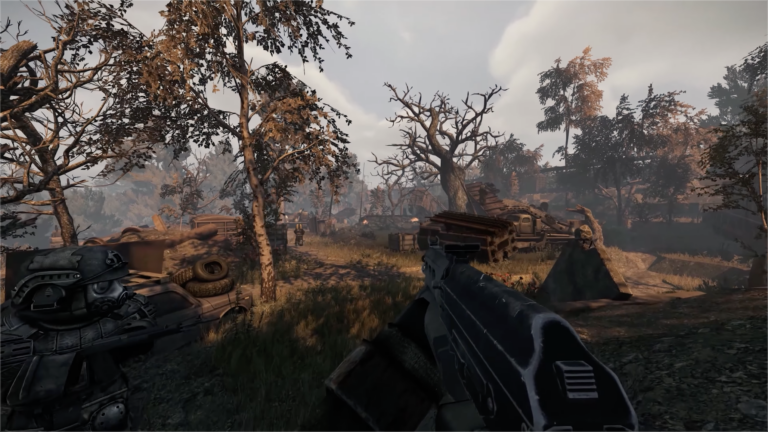
A new player in STALZONE arrives in the Chernobyl Exclusion Zone as a Stalker — an armed scavenger in a wasteland that has been twisted by unexplained anomalies and overrun with mutants, fractured between two rival factions that have been fighting over its resources for longer than anyone in the Zone can clearly remember. The 50-hour story campaign runs across two main arcs, set in the southern and northern regions of the Zone, and it is fully integrated into the live multiplayer world — meaning the story happens alongside thousands of other players doing their own things in the same space.
The central tension is not “survive and escape.” It is “survive and belong.” Players choose a faction early, and that choice shapes every subsequent movement through the Zone — which routes are safe, which territories carry ambush risk, which players might help you rather than shoot you. Proximity voice chat ensures that every dark stairwell and ruined factory corridor becomes a potential negotiation. Hearing someone you cannot yet see, deciding whether to open fire or say something — that specific friction is the Zone’s defining texture.
The emotional register is inherited from the S.T.A.L.K.E.R. franchise: grim, paranoid, procedurally unpredictable, lit by radiation glow and broken neon. Tulpa adds a supernatural pressure on top of it — the sense that something in the Zone has changed, that the ordinary dangers have a new layer underneath them.
Where the Community Has Concerns About the Late Game
STALZONE carries a “Mixed” rating on Steam across nearly 18,000 English-language reviews, with 67 percent positive in the most recent 30-day window. The pattern in the reviews is consistent: the early and mid-game earn strong praise. The endgame does not.
Players who reach the northern territories — the game’s high-level content — report that the map design forces them into a narrower and more punishing corridor of near-constant PvP, conflicting with the measured PvPvE tension the game sells itself on. Grind timelines for top-tier gear can stretch into weeks or months. Reviewers specifically call out endgame monetization concerns including “predatory Battle pass and pay-to-win tactics” and describe the loot economy as tilted toward players who spend money on progression boosts.
EXBO describes its monetization as “honest free-to-play” — cosmetics and optional boosters, not direct power purchases. The developer responds to Steam reviews directly, which signals active engagement. But the line between “optional acceleration” and “pay to win” tends to sharpen exactly at the endgame content the community is most critical of, and the sustained “Mixed” rating across the game’s entire review history reflects that tension.
STALZONE’s Russian Developer and What It Means for Your Data
This is the section the marketing materials do not include.
EXBO operates in two legal entities: EXBO North, its core development studio, is based in St. Petersburg, Russia. Exbo East, based in Astana, Kazakhstan, handles global distribution and is the entity players outside Russia formally contract with when they accept the terms of service. EXBO’s published privacy policy — which any player can read at exbo.net/legal/privacy.pdf — states directly in Section 4.1: “We may transfer and maintain on our servers or databases some of Your personal information between the European Economic Area (EEA), the United States of America and the Russian Federation.” The policy also lists Yandex LLC (Russia) and Unitpay (Russia) as named service partners who receive player data.
Russia’s System for Operative Investigative Activities — commonly known as SORM — is the legal framework that matters here. Under laws originating in 1995 and expanded through SORM-2 (1998) and SORM-3, all telecommunications companies and internet service providers operating in Russia are required by law to install FSB-controlled interception hardware on their networks, provide the FSB direct access to all user traffic and metadata, and sign non-disclosure agreements prohibiting them from informing users they have been surveilled. Court orders are technically required for interception, but they are secret — not shown to the service provider — and Russian courts approved surveillance requests at a rejection rate of 0.00005 percent between 2016 and 2024.
The data EXBO collects that could be subject to this framework includes: device information and unique hardware identifiers, IP address and derived location data, user ID and username, in-game chat content (routed through Unity Technologies’ Vivox platform), friends list and connected social account IDs (if a Steam or VK account is linked), and email address. EXBO’s privacy policy details these data categories and its transfer practices.
EXBO states it does not sell player data for monetary reward, and it claims standard contractual clause protections for international data transfers. No independent third-party security audit of STALZONE’s data handling has been publicly published. The structural condition — a development studio in a country whose law compels data cooperation with its security service, with disclosed data transfers to that country — exists regardless of what the company’s stated policy says, because SORM access is not a sale and is not subject to the company’s privacy commitments.
For a player whose primary concern is the game’s design and its free-to-play status, this may be an acceptable tradeoff. For a player who is cautious about Russian government access to their gaming account data, communication metadata, and IP address, it is information they should have before installing.
Practical steps that can partially mitigate exposure: use a VPN to mask your IP address from the server, limit connected social accounts (particularly avoid linking VK), do not use in-game voice chat for sensitive conversations, and use a dedicated email address rather than a primary one. None of these steps fully removes the structural legal risk from the Russian jurisdiction — they reduce the data profile a compelled request could access.
How STALZONE Compares to Escape from Tarkov and Gray Zone Warfare
Escape from Tarkov remains the genre benchmark: harder, more punishing, and more demanding of real-money investment in time and hardware to play competitively. Its developer, Battlestate Games, is also a Russian company. Gray Zone Warfare, developed by MADFINGER Games (Czech Republic), is a session-based PvPvE shooter with a more measured approach to combat intensity but similar wipe mechanics for seasonal resets.
STALZONE’s differentiator — the persistent world without wipes — is a genuine design philosophy distinction, not a marketing claim. The genre has a documented history of commercial failures, in part because the permanent-loss model drives away a large segment of players who find it more punishing than engaging. STALZONE’s approach is a direct response to that documented failure mode.
What STALZONE does not yet match in its current state: the graphical fidelity and animation quality of Escape from Tarkov’s most recent updates, the map density of Gray Zone Warfare’s mature northern territories, or the competitive reputation of either established game. The Steam review data suggests the game is delivering on its early and mid-game promise convincingly — and that the endgame still has structural problems that EXBO acknowledges but has not yet resolved.
The Tulpa season, running through December 2, represents EXBO’s current answer to keeping the live-game ecosystem engaged while that work continues.
Frequently Asked Questions
What happened to STALCRAFT?
STALCRAFT — and its successor STALCRAFT: X — were both earlier names for the same game now called STALZONE. Developer EXBO renamed it in June 2026, citing legal risks with the old name and the game having evolved well beyond its original Minecraft-based origins. The game has been in continuous development since 2013. All existing progress, characters, and accounts carried over without interruption.
Does STALZONE actually wipe your progress?
No — persistent character progression is the core design premise. When you die in STALZONE, you lose the loot you gathered during that run, but your equipped weapons, armor, faction reputation, character standing, and all other account progression are stored server-side and cannot be taken away by any in-game event. Seasonal content (like the current Tulpa arc) adds new narrative content and limited-time rewards but does not reset player progression. This is the fundamental design difference from Escape from Tarkov.
Is STALZONE safe to install given that its developer is based in Russia?
That depends on what “safe” means to you. STALZONE is not known to contain malware or security vulnerabilities. However, EXBO North — the core development studio — is located in St. Petersburg, Russia, and EXBO’s own privacy policy states that user data is transferred to the Russian Federation. Russia’s SORM law requires companies operating there to give the FSB direct access to user data and communications. The data EXBO collects includes IP address, device identifiers, in-game chat, and connected social account information. Players who are concerned about Russian government access to their gaming data should understand this structural condition before installing. Partial mitigations include using a VPN and a dedicated email address.
Is STALZONE pay to win?
In the early and mid-game, the community consensus on Steam is that it is not. EXBO offers cosmetics, a seasonal battle pass, and progression boosters. The dispute intensifies in the endgame — specifically the northern territories — where players report that gear timelines are long enough that paid acceleration starts to matter competitively. The sustained “Mixed” Steam rating (67% positive) tracks closely with this community friction. EXBO characterizes its monetization as “honest free-to-play” with no direct power purchases.