August 29, 2026:


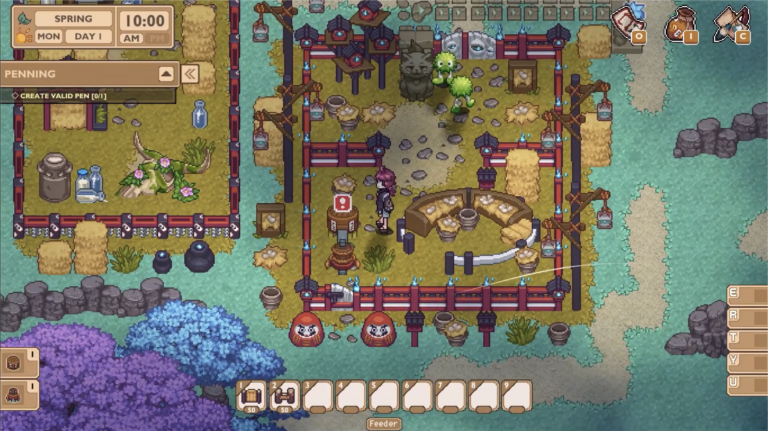
Philippine indie studio Yangyang Mobile is exhibiting Spirit Rancher at Gamescom 2026’s Indie Arena Booth this week, and the game showing on the floor in Cologne solves a design problem that creature-collector and farming sim hybrids have struggled with for years. Most games that combine the two genres end up with two parallel systems: you farm crops separately from managing your creatures. Spirit Rancher collapses both into a single loop. Your creatures are your crops. There is no other farming system to maintain.
The game is in development for a 2027 release on Steam for Windows and macOS, and Yangyang Mobile — the Manila-based studio whose donut-therapy dating sim High Times launched July 23, 2026 to Very Positive reviews — can now devote its full ten-person team to bringing it to completion.
The farming sim genre has produced dozens of games since Stardew Valley popularized it, and that game has itself sold 50 million copies as of February 2026. The challenge for every new entrant is to offer something mechanically distinct rather than just prettier pixel art. Spirit Rancher does something no prior game in either the farming sim or creature-collector genre quite manages: the creatures you catch in the wild are the resources your ranch produces. There are no seeds, no crop rows to plant. If you need wood, you catch a wood spirit. If you need coal, you catch a coal spirit.
The system runs deeper than a simple substitution. Wood spirits consume coal to produce wood. Coal spirits need something else. Every spirit type sits in a dependency web — a living food chain — where the player’s job is to assemble complementary creatures into habitats where they sustain one another while supplying the resources needed to expand the ranch. Put the right spirits together and they feed each other; the ranch becomes a self-running ecosystem rather than a manual task list.
RPGFan editor-in-chief Mike Salbato played an early build at PAX East 2026 in April and described the mechanic as genuinely novel, unlike anything he had encountered in prior farming or creature-collection games. The pixel art and animations were singled out as polished well beyond what might be expected from a game still early in development.
Getting spirits onto your ranch requires combat. Spirit Rancher uses real-time battles in which each spirit type has a distinctive attack — a coal spirit fires projectiles, a wood spirit stomps with an area-of-effect attack, a grass spirit delivers a cutting move effective against nearby foliage. Once captured, spirits can be assigned to a player hotbar, meaning their moves carry over into exploration and further combat. The collection loop feeds the combat capability feeds the collection loop: the more spirits on your ranch, the wider your combat toolset.
The official Spirit Rancher Steam page adds a further layer: players can fuse with spirits directly, channeling their abilities for movement and world interaction beyond combat. This goes beyond a hotbar ability — it allows the player to temporarily take on a spirit’s physical form.
The currency system also keeps faith with the game’s spirit-world logic. Rather than gold or coins, players earn karma as purple flame, which they trade for new recipes and ranch upgrades. There is no human-made money in the world of Spirit Rancher.
Spirit Rancher is currently on the show floor at Gamescom 2026’s Indie Arena Booth in Hall 10.2, through August 30. The Indie Arena Booth features 182 developers from across the globe, selected through a competitive process run by Super Crowd. Spirit Rancher’s inclusion marks the Philippine studio’s most prominent festival showing.
The Gamescom build includes several additions beyond what PAX East attendees saw in April. New spirit types expand the roster of catchable creatures. Spirit Arts — special, enhanced attacks distinct from standard spirit moves — have been added to the combat system. Terraforming has been introduced as a ranch customization tool, allowing players to change the tile appearance of the land they manage. Early visitors to the booth have already been responding publicly, with at least one Gamescom attendee posting on the Spirit Rancher Steam Community page that they were impressed by what they saw and asking about multilanguage support for future release regions.
Spirit Rancher is also participating in the Gamescom 2026 Steam sale event, making it visible to Steam’s recommendation systems during one of the largest gaming event weeks of the year.
Spirit Rancher is not purely a mechanical game. The player character wakes with no memory of their past in a mythical world where every element of nature has a corresponding living spirit. Guided by Zinnia — a Kitsune, the Japanese fox spirit of folklore — the player is tasked with purifying wild spirits, bringing them home to a ranch, and restoring vitality to a dying world. The central dramatic question is whether the player can rebuild this spirit ecosystem — and uncover what happened to their own past — through the act of ranching. The game’s emotional register is cozy and quietly mythological: gentle combat, unhurried resource loops, and a cast of villagers who are themselves based on creatures from mythology, eligible for relationships and romance. The narrative promises branching choices with consequences that affect the fate of the world — a meaningful story ambition for a game with “potato spirit” in its list of catchable creatures.
Yangyang Mobile was founded in 2015 by John and Danni Pineda in Manila, and has built its catalog around emotionally rich narrative games — including The Letter, Love Esquire, and Perfect Gold. The studio devotes itself to diversity: nearly half its team are women and/or LGBTQIA members. High Times, its donut-therapy dating and cooking sim, launched July 23, 2026 on PC, Xbox Series X/S, PlayStation 5, Nintendo Switch, and Nintendo Switch 2, and has earned Very Positive reviews on Steam. With that title shipping, the full ten-person team has moved its attention to Spirit Rancher — which remains the studio’s most ambitious departure from its visual novel roots.
Spirit Rancher does not yet have a confirmed release date. The 2027 window was described as a studio target during PAX East, contingent on development progress. Features including spirit fusion, villager relationship mechanics, and story content were not present in earlier demo builds.
The comparison is useful but imprecise. Stardew Valley on Wikipedia has no creature-catching mechanic whatsoever; its farming is seed-based and its social simulation is its second pillar. Spirit Rancher replaces both the crop system and the ambient nature of farming with a live ecology. Stardew Valley’s 50 million copies sold demonstrate the ceiling for what the genre can reach; Spirit Rancher is proposing a fundamentally different answer to the question of what you’re actually managing on the farm. The comparison that best captures the mechanic is Slime Rancher’s resource-producing creatures combined with a food-chain dependency logic that that game doesn’t quite implement — and wrapped in Stardew Valley’s cozy relationship and world-restoration structure.
Yangyang Mobile has described 2027 as the target release window for Spirit Rancher on Steam, for Windows and eligible macOS versions. No specific release date has been announced. The game is not yet available but can be wishlisted on its Steam page.
In most creature-collecting games, caught creatures are combat assets — they fight for you, and the collection loop is primarily in service of stronger battles. In Spirit Rancher, caught creatures are your ranch’s economic engine: each one produces a resource your ranch needs, and each one also consumes something another spirit produces, creating a food-chain dependency system. The result is a game where catching a new creature type expands your resource network rather than your battle roster — a fundamentally different use for the collection mechanic.
Spirit Rancher is listed on Steam for both Windows and macOS, but current Steam store notes indicate the game is incompatible with macOS 10.15 Catalina or newer. Most current Mac users run Catalina or later. Players on Mac should check their system version and monitor the game’s Steam page for compatibility updates as development continues.
Each spirit type produces one resource and consumes another. A wood spirit produces wood but needs coal to do so; a coal spirit produces coal but needs its own input resource. By placing complementary spirits together in habitats, the player builds a self-sustaining loop: Spirit A produces what Spirit B needs, and Spirit B produces what Spirit A needs — or what the player needs to build out the ranch further. The design is analogous to a simplified food web, where each creature occupies a niche in a larger system. The player’s role shifts from manually harvesting crops to designing and managing these living interdependencies.