HomeAuto Spectrum Misses Again as Isar Goes Silent: Six Days, Three Contracts, No Orbit Yet
Spectrum Misses Again as Isar Goes Silent: Six Days, Three Contracts, No Orbit Yet
September 5, 2026:
Isaraerospace.com
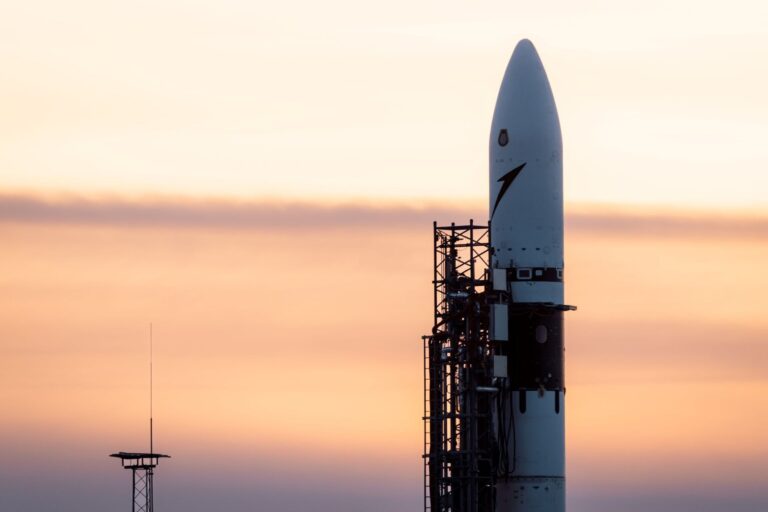
Isar Aerospace’s Spectrum rocket was grounded for the seventh consecutive time on Friday, September 4, when wind speeds of approximately 24 knots forced a scrub at Andøya Spaceport in northern Norway — and this time, the company said nothing about it. Nordland Police activated road and maritime exclusion zones around the launch site at 10:39 AM local time, then quietly lifted them less than four hours later at 2:25 PM, leaving the launch industry to piece together what had stopped the attempt from police bulletins and weather data. The approved window remains open through September 10.
The silence is new. Every one of the six prior scrubs since January had been accompanied by an official Isar statement — sometimes brief, sometimes detailed, always timely. The seventh scrub arrived without one. Whatever the engineering team is working through, they have chosen not to say.
That silence lands at a moment when the stakes attached to a Spectrum orbital insertion have never been higher. Three separate binding commercial obligations now converge on a rocket that has never completed stage separation in flight: a €197.8 million (approximately $230 million USD) European Space Agency commitment structured around a 2027 orbital deadline; a $112.5 million Canadian spaceport deal whose pad handover condition falls on November 1; and a Planet Labs Germany satellite delivery clock that started ticking on July 2 and runs for twelve months. Each day the window remains open without a flight is a day consumed from all three simultaneous binding obligations simultaneously.
Seven Scrubs and What They Reveal
The “Onward and Upward” qualification campaign began January 21, 2026, when a faulty pressurization valve stopped the countdown before it reached its window. On March 25, Spectrum got the closest it has ever come to ignition: T-minus 3 seconds, when an unauthorized fishing vessel drifted into the maritime exclusion zone. By the time Norwegian range safety cleared it, liquid propane in the vehicle’s first stage had warmed above its narrow acceptable operating band — propane’s cryogenic handling requirement means even a brief hold on a warm day can render the propellant out of specification for the day’s window. On April 9, a suspected composite overwrapped pressure vessel leak — the high-pressure gas storage component that drives propellant pressurization and engine valve actuation — sent engineers back to the hangar. Isar said at the time it was assessing.
June brought two more attempts. The June 15 window closed when Isar detected anomalous readings in the vehicle’s fluid systems — the network of propellant lines, pressurization paths, and associated plumbing that feed the nine first-stage Aquila engines. Three days later, a second attempt in the same window produced no launch. On September 4, the weather ended the attempt before any technical issue could.
Taken individually, these scrubs read as the normal friction of a first-time launch operator commissioning new hardware. Taken collectively, they reveal something more specific: the two categories of failures that recur — pressurization system anomalies (the January valve, the April COPV, the March temperature breach caused by a pressurization-adjacent hold) and propulsion fluid-system anomalies (both June scrubs) — are precisely the subsystems that a vertically integrated startup must develop without the accumulated test-history that an established propulsion supply chain provides. Isar builds nearly everything in-house, including its Aquila engines, its COPVs, and its fluid-system components. That strategy gives the company control over its production cost and design cycle. It also means every anomaly is a bespoke problem the team is solving for the first time, rather than a known issue with a known fix inherited from supplier experience.
This is not unique to Isar — SpaceX worked through analogous COPV challenges on Falcon 9 in 2016 — but it means the scrub count is diagnostic, not merely unfortunate. The vehicle will fly when the fluid systems and pressurization architecture are fully characterized. The question the September 5–10 window will begin to answer is whether that characterization is now complete.
What Spectrum Must Do That It Has Never Done
The “Onward and Upward” mission carries five CubeSats and one non-separable experiment — the first time Spectrum has flown with paying customers aboard. The payloads, selected through ESA’s Boost! program and the German Space Agency at DLR’s Microlauncher Competition, span European academic and commercial space actors:
CyBEEsat (TU Berlin, Germany): demonstrates a miniaturized transceiver for the Short Duration Mission band, cybersecurity applications, and radiation-tolerant perovskite solar cells
FramSat-1 (NTNU, Norway): Norwegian-built space technology demonstrator
Platform 6 (EnduroSat, Bulgaria): technology demonstrations and customer payloads
SpaceTeamSat1 (TU Wien Space Team, Austria): student-developed software running in orbit
TriSat-S (University of Maribor, Slovenia): tests battery performance after hibernation and a new optical navigation system
Let It Go (Dcubed, Germany): non-separable experiment remaining attached to the upper stage
All five separable CubeSats were integrated by Berlin-based Exolaunch’s EXOpod Nova deployment system.
For these payloads to reach orbit, Spectrum must execute a sequence of events it has never demonstrated in flight: first-stage engine cutoff; stage separation; second-stage Aquila VAC ignition; payload fairing jettison; a second-stage restart and circularization burn to sun-synchronous orbit; and sequential CubeSat deployment via EXOpod Nova dispensers. None of these milestones — not stage separation, not second-stage ignition, not fairing jettison — has been validated at altitude.
Spectrum is a two-stage launch vehicle standing 28 meters (91.8 feet) tall and 2 meters (6.6 feet) in diameter, with a liftoff mass of 60 metric tons (132,277 pounds). Its full vehicle specifications reflect the compact design enabled by propane’s density advantage. Its first stage is powered by a cluster of nine Aquila sea-level engines, each producing 75 kilonewtons of thrust, for a combined first-stage output of 675 kilonewtons. The single vacuum-optimized Aquila VAC on the second stage produces 94 kilonewtons. Both stages run on liquid oxygen and liquid propane — a combination Isar chose specifically for propane’s density-specific impulse advantage over kerosene-based RP-1 fuel: propane delivers more propulsive energy per unit of tank volume, keeping the overall vehicle compact while still reaching 700 kilograms (1,543 pounds) to sun-synchronous orbit from Andøya, or 1,000 kilograms (2,205 pounds) to low Earth orbit from its planned second launch site in French Guiana.
The Aquila engines run a gas generator cycle: a small fraction of propellant burns in a separate preburner, and the hot exhaust drives the turbopumps — spinning at tens of thousands of revolutions per minute — which pressurize propellant into the main combustion chambers. The gas generator architecture is mechanically well-understood, used by SpaceX’s Merlin and the Saturn V’s F-1 engine, and appropriate for a first-generation commercial design. Isar has conducted more than 124 Aquila hotfire tests, including a single engine fired six consecutive times without refurbishment — but ground testing does not replicate the dynamic load environment of flight, and no Aquila has yet fired under the precise conditions of second-stage ignition after first-stage separation.
The Aquila VAC’s multi-ignition capability is what eliminates the need for a separate kick stage: the second stage can shut down after its initial burn and reignite for a circularization maneuver, placing the payload bus directly into its target orbit. That capability must fire under vacuum conditions for the first time on this mission.
The Contract Clock
The ESA European Launcher Challenge, announced on August 27, formalized €197.8 million (approximately $230 million USD) in program commitments for Isar — the largest single allocation among the three initial ELC awards, ahead of €186.9 million (approximately $217 million USD) for Rocket Factory Augsburg and €158.9 million (approximately $185 million USD) for Spain’s PLD Space. The combined first-round total reached €543.6 million (approximately $632 million USD). Funding is milestone-gated: tranches unlock as the company demonstrates defined technical achievements, with a successful orbital launch before the end of 2027 as the central requirement.
The second obligation is structural. Isar signed a $112.5 million ten-year facilities agreement with Maritime Launch Services in July to secure a dedicated Spectrum launch pad at Spaceport Nova Scotia near Canso, Canada — a site whose 45° north latitude efficiently serves the mid-inclination orbital band (45° to 98°) that neither Andøya nor French Guiana can fully reach. The deal required the two parties to agree on a detailed statement of work by September 1, a deadline that has now passed. The pad handover follows on November 1; full spaceport infrastructure must be complete by December 31, 2027.
The third is the shortest. Planet Labs Germany signed a deal on July 2 with an explicit goal of delivering a German-built Pelican Earth-observation satellite on Spectrum within 12 months — a window that runs through early July 2027. That window depends on Spectrum first reaching orbit, and then flying again reliably enough to constitute a viable launch service.
Each week without a flight narrows all three simultaneously. The November pad handover requirement is now less than two months away; it is increasingly difficult to argue that a Nova Scotia pad handover makes operational sense before a Norwegian orbital success has been demonstrated.
Europe’s Window
The strategic context has been covered at length in prior reporting, but one figure frames it precisely: the United States completed more than 190 orbital launches in 2025, while European launchers managed fewer than 10. The gap became politically acute in 2022 when Russia’s invasion of Ukraine ended European reliance on Soyuz rockets overnight. Ariane 6 addresses the heavy-payload market but does not serve the high-cadence small-satellite market Isar is targeting.
Isar is the only one of the four remaining active European Launcher Challenge participants to have reached a launch pad for an orbital attempt. UK-based Orbex filed for administration in February 2026 and withdrew from the program. Rocket Factory Augsburg and PLD Space have not yet reached a launch pad for orbital attempts.
ESA Director General Josef Aschbacher has said Isar’s second flight is “instrumental in advancing a resilient and autonomous Europe in space.” ESA Director of Space Transportation Géraldine Naja offered the more measured framing: “Regardless of the outcome of this second flight, it will be another step to make the European launch services market more diverse and innovative.”
Isar has grown to more than 400 employees, has raised approximately €870 million (approximately $1.01 billion USD) in total capital through its June 2026 €270 million Series D, and has vehicles 3 through 7 already in production at its Vaterstetten facility outside Munich. A new 40,000-square-meter (approximately 430,556 square feet, or roughly 9.9 acres) manufacturing facility near Munich is designed to support up to 40 Spectrum rockets per year once fully operational. Eight missions are on the manifest beyond “Onward and Upward,” with customers extending through 2028. Whether that manifest holds its shape depends on what the September 5–10 window produces.
What Success Would Change — and What Comes After
A clean orbital insertion on any of the six remaining window days would be the first time any privately developed rocket has reached orbit from European soil. It would validate stage separation, second-stage performance, and the Aquila VAC multi-ignition system in a single flight. It would satisfy the first major milestone of the ELC contract, potentially unlocking initial funding tranches. It would anchor the Nova Scotia conditional milestones on a proven vehicle. And it would start the Planet Labs Germany delivery clock running toward something deliverable.
The September 10 window close does not end Isar’s campaign if it arrives without a launch — but it does require a new airspace closure application, new maritime safety notices, and a new preparation cycle, with the November pad handover deadline still fixed on the calendar.
Isar has yet to confirm publicly that it was even attempting a launch today, or explain what it encountered. The next update may come in the form of a new NOTAM pointing to September 5 or 6 — or a formal statement from the company explaining its next steps. The window, for now, is open.
All currency conversions are approximate based on exchange rates as of September 4, 2026.
Frequently Asked Questions
Why has Spectrum scrubbed so many times, and what does the pattern tell us?
The seven scrubs fall into two recurring categories: pressurization system anomalies (the January pressurization valve failure, the April composite overwrapped pressure vessel leak, the March propellant temperature breach caused by a range hold) and propulsion fluid-system anomalies (both June scrubs and possibly contributing factors in others). Both categories involve the high-pressure plumbing infrastructure that moves propellant from tanks to engines — subsystems that Isar designs and manufactures in-house as part of its vertically integrated production strategy. The pattern reflects the challenge of maturing novel hardware without the accumulated test history that an established component supply chain provides. It does not necessarily indicate a fundamental design flaw, but it does suggest that full characterization of Spectrum’s fluid systems and pressurization architecture is the current rate-limiting factor in reaching orbit.
What does Spectrum have to accomplish technically to qualify the vehicle?
Six flight events must execute in sequence, none of which has been demonstrated in flight: first-stage engine cutoff; stage separation (the first stage must physically release and fall away cleanly); second-stage Aquila VAC ignition; payload fairing jettison; a second-stage restart and circularization burn placing the spacecraft bus at its target sun-synchronous orbit altitude and velocity; and sequential deployment of five CubeSats via Exolaunch’s EXOpod Nova dispensers. Stage separation and second-stage ignition are the two events most watched by the commercial space industry, because they represent the first time any of Spectrum’s upper-stage hardware will operate under real flight conditions. For the latest mission updates from Isar Aerospace, see the official mission updates page.
What happens to the three binding contracts if Spectrum does not reach orbit before the end of the year?
The ESA European Launcher Challenge contract is milestone-gated, meaning Isar cannot access the full €197.8 million (approximately $230 million USD) without satisfying defined technical achievements, with a successful orbital launch before the end of 2027 as the central requirement. Failure to demonstrate orbital capability before that deadline would put the contract structure at risk. The Nova Scotia Maritime Launch Services deal required a statement of work by September 1 (now passed) and a pad handover by November 1 — a condition that is increasingly difficult to fulfill while the rocket remains unproven in orbit. Planet Labs Germany’s 12-month delivery clock started on July 2, 2026; missing that window would require renegotiation. All three conditions compound rather than resolve independently: the rocket that cannot reach orbit from Norway cannot credibly commit to a Canadian launch pad handover on the timelines both parties agreed to. For a full breakdown of the contract structure, see TechTimes’ prior coverage.
When is the next opportunity after today’s scrub?
Norwegian airspace closure notices established a launch window running from September 4 through September 10, 2026. Launch tracking sites reported updated NOTAMs consistent with a September 5 attempt. The window opens at 4:00 PM ET (20:00 UTC) each eligible day and closes one hour later, subject to weather, range safety conditions, and technical readiness. Isar has not publicly confirmed today’s scrub or announced its next attempt date. A livestream is expected on Isar Aerospace’s YouTube channel beginning approximately one hour before any future liftoff.