HomeAuto Sony Q2 2026: AI Memory Shortage Stalls Rivals’ Cameras While Boosting Sony’s Margins
Sony Q2 2026: AI Memory Shortage Stalls Rivals’ Cameras While Boosting Sony’s Margins
November 7, 2026:
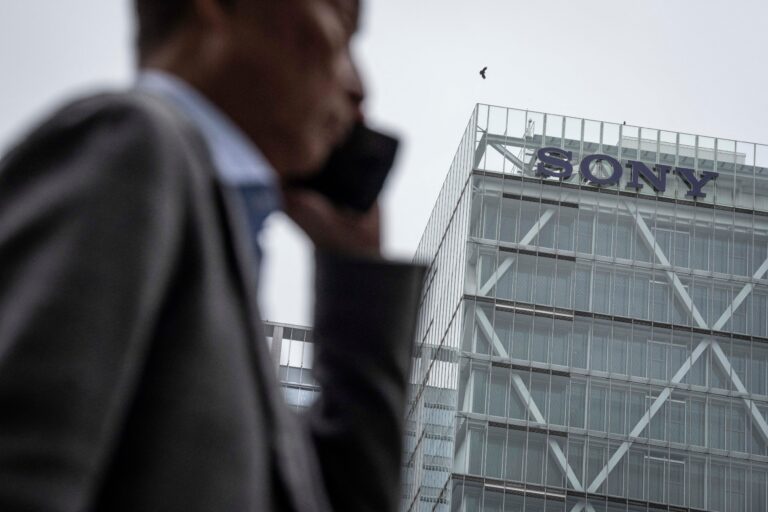
A man walks past the Sony headquarters in Tokyo on November 5, 2026. Yuichi YAMAZAKI/AFP via Getty Images
Sony just posted its strongest quarterly operating performance in years, and the story inside the numbers is more instructive than the headline figures alone. On November 5, Sony Group Corporation filed its Q2 FY2026 SEC Form 6-K, reporting consolidated operating income of ¥622.3 billion on revenue of ¥3,429.4 billion. That is a 45 percent jump in operating income on only a 10 percent revenue increase, with operating margin expanding to 18.1 percent from 13.8 percent a year ago.
The numbers are impressive in isolation. What makes them editorially significant for TechTimes readers is the specific mechanism that drove them — and that mechanism is the same AI memory supply disruption that has been freezing competitors’ camera shipments all year.
The Sensor Moat: Why Sony Wins When Others Wait
TechTimes has covered the camera market’s AI memory crunch from the buyer’s side: which products are on backorder, which segments are insulated, and how long the shortage may last.
What Thursday’s SEC filing adds is the manufacturer-side financial proof of a structural asymmetry those articles could only infer: Sony is not simply surviving the AI memory crunch. Its image sensor division is benefiting from it.
Sony’s I&SS segment — the business unit that manufactures image sensors, including the Exmor RS sensors inside every Alpha mirrorless camera Sony ships — posted operating income of ¥154.6 billion (~$978 million) in Q2, up 12 percent year-on-year, even as segment revenue fell 6 percent to ¥577.6 billion (~$3.7 billion). That divergence between falling revenue and rising operating income is the financial signature of a product-mix shift: Sony’s I&SS division is selling fewer but higher-value sensors, with the premium tier driven by the same AI development demand — automotive LIDAR, high-end smartphone ISPs, industrial machine vision — that is redirecting NAND flash and DRAM capacity away from consumer electronics supply chains.
The technical reason Sony’s cameras are not on that backorder list while competitors’ products are comes down to what kind of memory the AI shortage actually disrupts. The commodity NAND flash and standard LPDDR that AI datacenter buildouts have been absorbing are not the same silicon that powers the DRAM-on-chip layer in Sony’s fully-stacked Exmor RS sensors. Sony Semiconductor Solutions manufactures that layer internally, using its own proprietary stacking process, at Sony’s fab facilities. When SK Hynix and Micron redirect high-bandwidth memory output to GPU server farms, Sony’s stacked sensor production line is not competing for that capacity. Sony is both insulated from the shortage as a camera maker and positioned to capture pricing power as a sensor supplier to the broader industry.
Sony raised its full-year I&SS operating income forecast from ¥420 billion to ¥450 billion (~$2.85 billion), a ¥30 billion upward revision reflecting the improving product mix. The camera segment forecast was unchanged, which is itself telling: steady is an outperformance when rivals are navigating backorder queues.
Cameras: Premium Strategy Paying Off at the Margin
Sony’s ET&S segment — Electronics, Products & Solutions, which houses the Alpha camera business alongside televisions and audio products — posted Q2 sales of ¥567.8 billion (~$3.6 billion), down just ¥7.9 billion (-1 percent) year-on-year. Operating income rose ¥3.2 billion (+5 percent) to ¥64.1 billion (~$406 million).
A one-percent revenue decline with a five-percent operating income improvement is not a rounding error. It is the financial signature of a deliberate value-over-volume strategy: Sony is selling fewer cameras, at higher prices, to customers who specifically want what Sony makes. That customer profile is what two years of launching the Alpha 7 V and Alpha 7R VI has been building.
The Alpha 7 V, which launched in December 2025, was designed around Sony’s partially-stacked 33-megapixel Exmor RS CMOS sensor — a sensor manufactured by I&SS for internal use — paired with the BIONZ XR2 processor, which incorporates a dedicated AI processing unit alongside the main DSP. The result is 759 phase-detection autofocus points driven by real-time subject-recognition, 30-frames-per-second burst shooting at up to 14-bit RAW, and the kind of tracking performance that previously required a flagship sports body. The Camera Journal Press Club awarded it Camera Grand Prix 2026 “Camera of the Year” — a recognition of how thoroughly the A7 V repositioned the entry point of serious full-frame photography.
The Alpha 7R VI, launched in June 2026, goes further: a 66.8-megapixel fully-stacked Exmor RS CMOS sensor with an integrated DRAM layer directly on the die, BIONZ XR2 processing, 30-fps burst capability, and 8K video — in a body covered by the Alpha 7R VI product announcement at $4,499.99. It quickly rose to the top of Amazon’s Hot New Releases chart in the mirrorless category after launch. At that price and specification level, Sony is competing with medium-format digital options while delivering a package that fits existing E-mount glass — a moat that compounds with every new lens a Sony shooter buys.
Both products exist because Sony controls the silicon they run on. That is not a coincidence; it is the strategy made visible.
Sony’s Japan Market Position
In Japan — the world’s most granular camera market by retail-data coverage — Sony’s mirrorless share stood at approximately 29.9 percent for 2026, according to BCN Award 2026 official data, maintaining first place for a third consecutive year and the sixth BCN Award overall. Canon followed at approximately 27.4 percent, Nikon at approximately 15.1 percent. The gap between Sony and its nearest competitor has held even as the backorder environment put pressure on full-frame interchangeable lens camera launches industry-wide.
The BCN Award figure represents actual point-of-sale transactions at Japanese retailers — it tracks what customers are buying, not what manufacturers are shipping. That Sony’s share held at nearly 30 percent in a year when product availability has been constrained across the category reflects both the depth of its installed-base loyalty and the sustained demand for A7 V units, which were available throughout the period of peak backorder disruption for other manufacturers’ full-frame launches.
The RAMageddon Context
TrendForce has estimated a 4–5 percent NAND supply deficit for 2026, with approximately 70 percent of high-end memory output flowing to AI datacenters rather than consumer electronics supply chains, according to the NAND flash market outlook. SK Hynix CEO Kwak Noh-jung, speaking at the Nasdaq listing ceremony on July 10, 2026, said he expected 2027 to be “the worst year yet” for memory supply tightness, with demand projected to exceed production capacity through 2030.
If that forecast proves accurate, the structural advantage of Sony’s internal sensor DRAM only compounds. Each year the shortage persists is another year Sony can ship cameras that rivals cannot, at margins that rivals cannot replicate from outside Sony’s supply chain.
Bloomberg Intelligence has offered a dissenting view — that the shortage may have peaked in Q2 2026, with some capacity relief possible in H1 2027. Sony’s own full-year forecast implies caution: its Q3 and Q4 exchange rate assumption of ¥153 per dollar is more conservative than the ¥159.3 average that applied in Q2, suggesting management is not banking on a smooth second half.
Tamron: Closing the Third Link
Sony’s current vertical integration covers silicon (I&SS sensors) and camera bodies (ET&S manufacturing). The one gap in the supply chain it does not fully control is glass — specifically, third-party lenses made for the E-mount by companies like Tamron, Sigma, and Tokina, whose appeal lies precisely in offering Sony-mount shooters more choice than Sony’s own G Master line provides.
On July 30, 2026, Sony submitted a non-binding acquisition proposal for Tamron Co., Ltd., the Japanese lens and optical equipment manufacturer. The proposed deal was valued at approximately ¥200 billion (~$1.27 billion). Sony currently holds approximately 14.7 percent of Tamron’s shares.
The strategic logic is straightforward: owning Tamron would give Sony lens engineering IP, manufacturing capacity, and the ability to supply both Sony-mount and OEM customers — Tamron’s Photography segment also makes lenses branded for Canon, Nikon, and other camera makers — through a fully integrated optical chain.
The complication is Effissimo Capital Management, a Singapore-based activist fund that has emerged as Tamron’s largest single shareholder at approximately 17.38 percent, surpassing Sony’s stake. Effissimo has a history of engaging Japanese conglomerate targets on shareholder-value grounds; whether it supports, contests, or demands a higher price for Sony’s proposal will likely determine the acquisition’s trajectory. Tamron has formed a special committee to evaluate the proposal; no acceptance or rejection had been announced as of this filing.
Tamron’s Photography segment reported an 8.2 percent revenue decline and a 29.3 percent operating income decline in the first half of FY2026 — financial pressure that strengthens Sony’s negotiating position but also raises questions about whether the acquisition target is worth acquiring at the proposed price in a soft market for the third-party lens category.
Entertainment Windfall: Spider-Man and the Bungie Effect
The quarter’s most dramatic single-segment swing was in Pictures, where operating income rose from ¥13.9 billion to ¥92.6 billion (~$586 million) — a 568 percent increase — driven primarily by Spider-Man: Brand New Day, which broke opening-weekend records for Sony Pictures and generated the kind of theatrical performance that makes the film division the company’s highest-margin business in a given quarter.
Game & Network Services posted operating income of ¥220.1 billion (~$1.4 billion), up 83 percent year-on-year. A significant portion of that swing is a base-effect comparison: Q2 FY2025 included approximately ¥50 billion (~$316 million) in Bungie-related charges — a mix of impairment against previously capitalized development costs and intangible asset write-downs — that depressed the prior-year operating income. Absent those one-time charges, the year-on-year G&NS improvement is more modest, though still healthy.
Music contributed ¥122.8 billion (~$777 million) in operating income, up 6 percent, sustained by streaming royalties and Sony Music Publishing’s expanding catalog position.
Full-Year Outlook
Sony upgraded its full-year FY2026 operating income forecast from ¥1,720 billion to ¥1,870 billion (~$11.8 billion), a ¥150 billion upward revision (+9 percent above July guidance). That figure represents a 29 percent increase over FY2025 actual operating income of ¥1,447.5 billion and would bring Sony’s full-year operating margin to approximately 14.4 percent — compared to 11.6 percent in FY2025. Full-year sales are now projected at ¥13,000 billion (~$82.3 billion), and net income is expected to reach ¥1,330 billion (~$8.4 billion), up ¥120 billion from the prior forecast.
The I&SS upgrade (+¥30B to ¥450B for the full year) is the most strategically significant line in the revision. It is Sony saying, in financial form, that the premium sensor product mix shift is durable — not a one-quarter aberration. For the camera market, the implication is that the structural advantage Sony holds in its own supply chain is likely to widen before it narrows.
All yen figures in this article are converted at approximately ¥158 per dollar, based on the exchange rate as of November 6, 2026, and are approximate.
Frequently Asked Questions
What drove Sony’s record Q2 2026 operating margins?
Three factors: a product-mix shift in the I&SS image sensor division toward higher-value premium sensors (+12% OI despite -6% revenue); the absence of the large Bungie-related charges (~¥50 billion) that depressed G&NS in Q2 FY2025; and the theatrical performance of Spider-Man: Brand New Day in the Pictures segment (+568% OI). The camera business itself (ET&S) contributed a modest but structurally important +5% OI improvement on -1% revenue, confirming that the premium mirrorless strategy is delivering better margins on fewer units.
How does the AI memory shortage help Sony rather than hurt it?
Sony’s I&SS division manufactures the DRAM-on-chip layers for its fully-stacked Exmor RS sensors internally. That silicon is not sourced from commodity NAND or standard LPDDR supply chains that AI datacenter buildouts have been absorbing. Sony is simultaneously insulated from the shortage as a camera maker (its own cameras don’t compete for the disrupted supply) and positioned as a beneficiary as a sensor supplier (the AI-driven demand premium is raising ASPs for Sony’s high-value sensing products).
Is the Sony Alpha 7R VI still worth buying in the current market?
At $4,499.99 it is a significant investment, but it represents one of the few 60+ megapixel full-frame options that is currently available without backorder. Its fully-stacked 66.8MP Exmor RS sensor, 30-fps burst capability, and 8K video place it in a category where availability is itself a differentiator. For photographers already on E-mount glass, the ecosystem lock-in is an argument for the system’s durability, not against it — and Sony’s financial results suggest the glass supply chain will remain well-funded.
What happens to the Tamron acquisition?
Sony’s non-binding proposal is worth approximately ¥200 billion (~$1.27 billion). The main uncertainty is Effissimo Capital, whose ~17.38% stake as Tamron’s largest single shareholder gives it blocking power. Effissimo’s track record is to push for higher valuations in Japanese corporate transactions; if it demands a premium over Sony’s offer, the deal either gets repriced or stalls. Tamron’s weaker half-year results (Photography OI -29.3%) theoretically strengthen Sony’s negotiating position, but activist funds do not always follow target-company financials in their demands.
When will the camera memory shortage end?
SK Hynix’s CEO forecast demand exceeding capacity through 2030; Bloomberg Intelligence dissented, suggesting possible relief in H1 2027. Sony’s own planning appears to assume continued constraint: its Q3–Q4 FX assumption of ¥153/$1 is conservative, and the unchanged ET&S full-year forecast (despite the strong Q2) implies management is not expecting a volume surge in the second half. TrendForce’s 4–5 percent NAND supply deficit estimate for 2026 suggests the structural imbalance between AI datacenter demand and consumer electronics supply will not resolve in a single quarter.